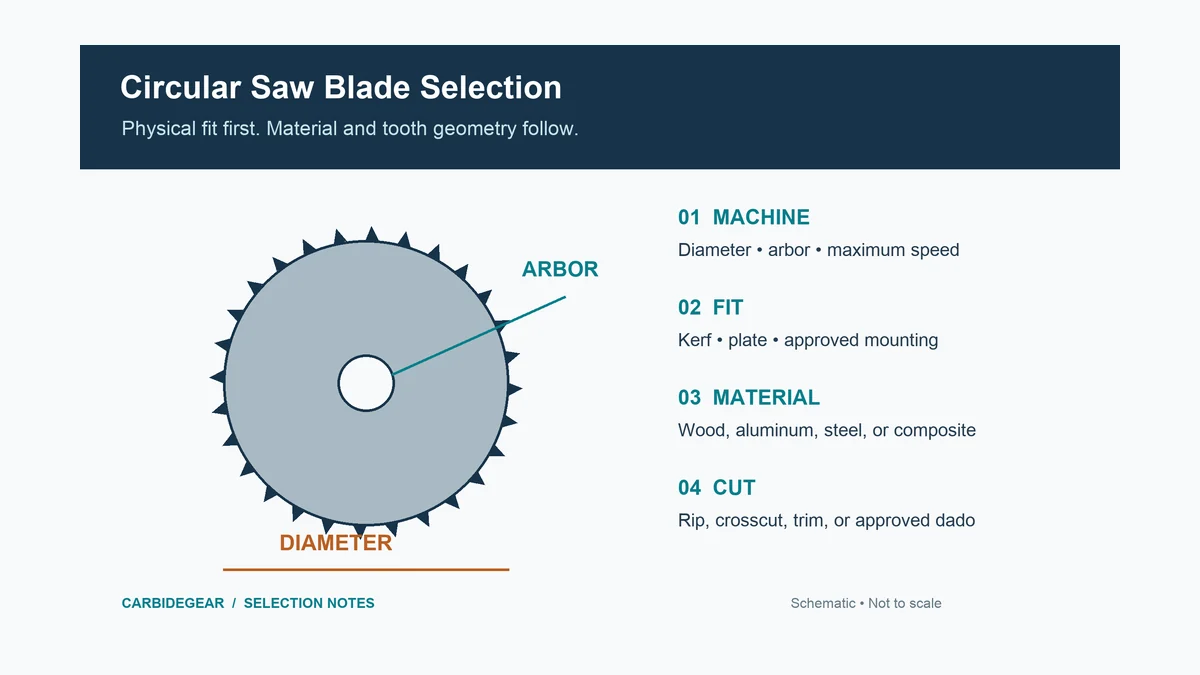
Circular saw blade selection starts with machine compatibility, diameter and arbor, speed rating, and kerf and plate requirements. Material, cutting task, and tooth geometry come next. A blade with a suitable tooth count is still the wrong choice if it cannot be mounted correctly or is not approved for the saw and workpiece.
For handheld wood cutting, compare carbide circular-saw blades for compatible handheld saws after confirming the saw’s blade diameter, arbor, and speed requirements. The branches below separate other machines and materials before narrowing the tooth design.
Circular Saw Blade Selection: Fit Before Teeth
| Check | What to record | Why it comes first |
|---|---|---|
| Machine and cutting system | Exact model and permitted blade applications | Similar diameters do not establish permitted use |
| Diameter | The size specified by the saw | Affects clearance, guarding, and cutting geometry |
| Arbor and mounting | Bore size, shape, flanges, and approved hardware | Determines whether the blade seats correctly |
| Speed | Blade maximum and saw’s specified speed | The blade must be rated for the operating speed |
| Plate and kerf | Body thickness, cut width, and machine requirements | Can affect riving knife, guard, and other compatibility |
| Workpiece | Material, thickness, coating, and support | Determines the required cutting application |
| Operation | Rip, crosscut, panel sizing, trim, or approved grooving | Refines tooth geometry and finish priorities |
Write these fields down before comparing “fine finish” or “general purpose” labels. They establish a candidate blade’s fit; they are not interchangeable specifications.
Diameter and Arbor: Check Both Dimensions
The outside diameter and the center hole describe different parts of the blade. A matching bore does not establish that the diameter is suitable, and the right outside diameter does not establish that the mounting hole fits.
Use the blade sizes and mounting arrangements allowed in the saw instructions. Do not assume that a smaller disc is acceptable because it clears the guard. Likewise, do not use a loose reducer or alter an arbor hole to improvise a fit. Any bushing or special mounting hardware must be permitted by the blade and saw instructions.
Check the actual variant rather than the product family’s headline. Two blades with the same diameter can be offered with different bores. A familiar fractional inch dimension and a nearby metric dimension should not be treated as identical without verification.
Maximum RPM Is a Compatibility Limit
A blade’s maximum speed is a limit, not a recommended cutting setting. Compare it with the saw’s specified operating speed and the manufacturer’s instructions. Do not use a blade rated below the required speed, even if its diameter and arbor match.
For a dimensional example, a blade marked with a 5,000 RPM maximum cannot be selected for a saw specified at 5,800 RPM. Those illustrative numbers show the comparison; they do not prescribe a speed for wood or metal cutting.
A slower-speed dedicated metal saw and a woodworking saw can use different blade systems. The fact that both take round blades does not make their accessories interchangeable.
Kerf, Plate, and Machine Requirements
The plate is the blade body; kerf is the width of the cut produced by the teeth. They are different dimensions. On equipment with a riving knife or splitter, the relevant blade and knife dimensions must meet the saw’s requirements. Check any additional restrictions for a brake system or other machine-specific feature.
A thin-kerf blade can remove less material than a wider design, but that does not make it suitable for every low-powered saw. Body stability, tooth design, and the machine’s dimensional requirements still matter. Compare the actual specifications rather than the phrase “thin kerf.”
Table Saws: Separate General Work, Ripping, and Plywood
If one installed blade needs to handle several woodworking tasks, compare general-purpose carbide table-saw blades within the machine’s permitted dimensions. A general-purpose design is a compromise across tasks, not proof that every cut will match a dedicated blade’s behavior.
Repeated ripping in solid wood places different demands on chip removal from fine crosscutting. Use table-saw blades intended for ripping when that is the main task, while checking wood thickness, available power, kerf compatibility, and the exact blade application.
For veneer-faced sheet goods, the visible edge and surface layers become a priority. The table-saw plywood blade guide provides a separate route for that work. Support, alignment, blade condition, and the cutting arrangement still influence tearout; tooth count cannot compensate for all setup problems.
Handheld Circular Saws: Match the Blade to the Supported Cut
A handheld saw’s blade diameter, arbor, guard, depth adjustment, and permitted applications define the starting point. For plywood work, compare circular-saw blades for plywood using the exact saw format and the surface that needs to remain clean.
Support the sheet so the offcut does not close the kerf or fall unpredictably. A fine-finish blade may improve a suitable setup, but it does not prevent binding caused by unstable support. Blade selection and work support are separate requirements.
Miter and Track Saws Need Their Own Match
A miter saw’s cutting motion and intended blade geometry matter when choosing for trim. Compare miter-saw blades for trim work with the saw maker’s permitted blade type, diameter, arbor, and hook-angle requirements. Do not borrow an aggressive table-saw ripping blade solely because its dimensions look similar.
A track saw adds another set of model-specific checks, including blade size, bore, kerf, and any riving knife or splinter-strip relationship. The track-saw blade guide is the appropriate branch for that system. A nominal diameter that sounds close is not enough to establish fit.
Aluminum, Steel, and Composite Decking Are Different Applications
For aluminum, choose a blade explicitly rated for the nonferrous material and the type of section being cut. Review carbide saw blades for aluminum only after confirming the saw is permitted to make that cut. Material support and the blade’s section-thickness guidance remain part of the setup.
For steel, start with the cutting system and machine approval. Our carbide blades for compatible steel-cutting saws guide distinguishes blade sizes and material applications. A steel-cutting blade is not an automatic conversion kit for a woodworking saw, and a mild-steel rating should not be expanded to stainless steel without the exact product’s specification.
Composite decking can combine different fibers, polymers, and fillers. Use saw blades intended for composite decking with the decking and tool manufacturers’ cutting recommendations. Do not transfer a blade choice from ordinary softwood to every composite merely because both are sold as boards.
Read Tooth Geometry After Establishing Fit
Tooth count influences how the cutting load is divided, but diameter, tooth grind, hook angle, material, and feed also matter. A count that works for a large blade is not a universal target for a smaller one.
Common labels include ATB for alternating top bevel and TCG for triple-chip grind. These identify geometry families, not unrestricted material approvals. Manufacturers offer application-specific variations within them. Read the actual blade’s intended use instead of treating a geometry abbreviation as a complete specification.
The circular saw blade tooth-count explanation covers the balance between tooth count, chip space, and cutting task in more detail. Use it after the physical and material checks, rather than starting with the largest tooth number on a retailer’s filter.
Dado Sets Are a Separate Equipment Decision
A stacked dado set makes a wider groove using a prescribed assembly. It is not a normal single-blade substitution. The saw must expressly allow the setup, including the permitted diameter, total width, arbor engagement, insert, guards, and any relevant brake-system provisions.
Compare dado blade sets for an approved table-saw setup only after those machine requirements are clear. Do not infer compatibility from arbor diameter alone, and do not use extra chippers or unrelated hardware to reach a width outside the system’s permitted configuration.
If the saw does not allow a dado stack, use another appropriate woodworking method rather than changing the machine beyond its instructions. A wider cutting assembly creates requirements that a standard crosscut blade does not have.
When the Task Calls for Another Saw Type
A flexible blade moving back and forth uses a different selection process. The reciprocating saw blade TPI and material guide deals with section thickness, specialty materials, and full-stroke reach; those fields should not be copied into a circular-blade chart.
A continuous bandsaw loop is another system again. For tall wood cuts, use the bandsaw blade TPI guide for resawing to check pitch, loop length, width, and machine capacity. A circular blade’s total tooth count and a band’s teeth per inch are different measures.
Build a Blade Specification Before Buying
Record the saw model and permitted application. Add diameter, arbor, speed requirement, plate and kerf restrictions, then the material and cut. Finally choose the tooth design within the options that remain compatible.
The same circular saw blade selection checks are useful when troubleshooting. If a blade burns or leaves a poor edge, check sharpness, residue, alignment, support, material rating, and operating conditions before adding teeth or changing kerf. The correct replacement is the one that fits the machine and solves the actual cutting task.
