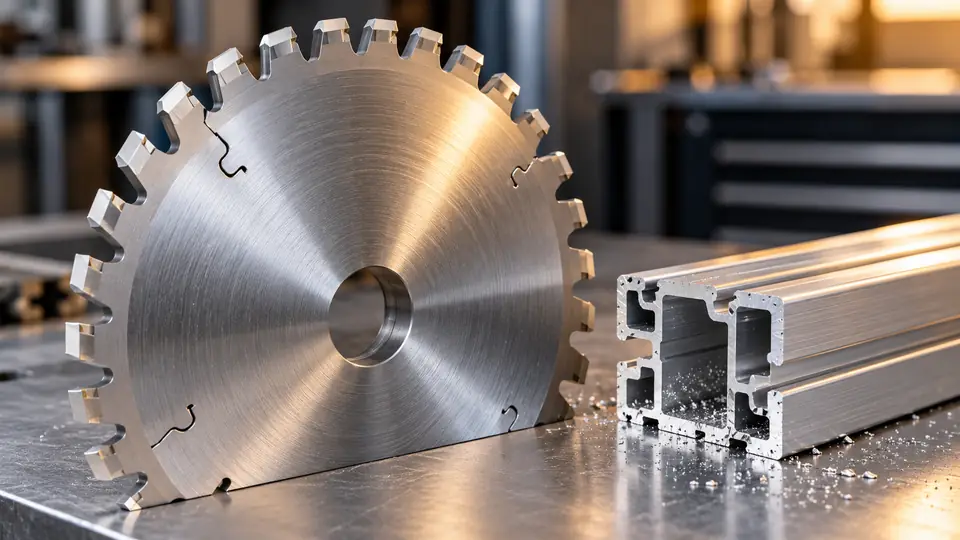
Aluminum is soft enough to grab a poorly matched blade, clog its teeth, and leave a ragged edge in seconds. That is why buyers searching for the best carbide saw blades for aluminum usually need more than a high tooth count. Blade diameter, arbor size, TCG tooth geometry, kerf, and the intended saw all affect whether a blade suits thin sheet, aluminum extrusion, or heavier non-ferrous stock.
The common mistake is choosing a general-purpose wood blade because its dimensions fit the saw. A blade can have carbide teeth and still be a poor match for aluminum if its tooth geometry, hook angle, or application range does not support non-ferrous metal cutting. This roundup focuses on documented aluminum suitability, mounting dimensions, tooth count, and useful differences between blades. The TOMAX 12-inch 100-tooth TCG blade is the strongest overall fit for buyers who have a compatible 1-inch arbor saw and want a purpose-listed aluminum blade.
Different shops need different things. A fabricator cutting aluminum extrusions may prefer a 12-inch blade with a 1-inch arbor, while someone trimming smaller pieces on a 10-inch miter saw may need a 5/8-inch arbor. Fine-finish work can justify 100 or 120 teeth, while a lower tooth count may be a more practical match for general cutting. The recommendations below keep those trade-offs visible rather than treating every carbide-tipped blade as interchangeable.
Quick Answer
- Best Overall: TOMAX 12-Inch 100 Tooth TCG Aluminum Blade for its documented aluminum and non-ferrous metal use, 100-tooth layout, and 1-inch arbor.
- Best 10-Inch Fine-Cut Option: FOXBC 10-Inch 100-Tooth TCG Blade for aluminum work across stated thin, medium, and thick material ranges.
- Best for Fine Finish: TOYAKI 10-Inch 120-Tooth TCG Blade for buyers prioritizing a very high tooth count on a 5/8-inch arbor saw.
- Best Compact Option: GRAFF 4-1/2-Inch Carbide Circular Saw Blade for compatible angle-grinder applications involving aluminum and other listed materials.
Best Carbide Saw Blades for Aluminum Comparison Table
| Product | Best For | Blade Diameter | Arbor | Tooth Count | Intended Material |
|---|---|---|---|---|---|
| TOMAX 12-Inch 100 Tooth TCG Blade | Overall aluminum cutting | 12 inches | 1 inch | 100 | Aluminum, plastic, non-ferrous metals |
| FOXBC 10-Inch 80-Tooth TCG Blade | General 10-inch saw work | 10 inches | 5/8 inch | 80 | Aluminum, copper, brass, plastic, fiberglass |
| TOMAX 10-Inch 80 Tooth TCG Blade | Value-oriented aluminum cutting | 10 inches | 5/8 inch | 80 | Aluminum, plastic, non-ferrous metals |
| FOXBC 10-Inch 100-Tooth TCG Blade | Fine cuts on aluminum | 10 inches | 5/8 inch | 100 | Aluminum and non-ferrous metals |
| MASTEC 10-Inch 100T TCG Blade | Multi-saw aluminum use | 10 inches | 5/8 inch | 100 | Aluminum, plexiglass, plastic, non-ferrous metals |
| GRAFF 4-1/2-Inch Carbide Blade | Compatible angle grinders | 4-1/2 inches | 5/8 to 7/8 inch | 40 | Aluminum, sheet metal, wood, plastic |
| TOYAKI 10-Inch 120-Tooth TCG Blade | Fine-finish work | 10 inches | 5/8 inch | 120 | Aluminum, plastic, non-ferrous metals |
| FOXBC 12-Inch 120-Tooth TCG Blade | Large-saw fine cutting | 12 inches | 1 inch | 120 | Aluminum, copper, brass |
| FOXBC 12-Inch 96-Tooth TCG Blade | Balanced 12-inch cutting | 12 inches | 1 inch | 96 | Aluminum, non-ferrous metals, plastic |
The detailed picks below separate blade size, tooth count, arbor fit, and application range so you can narrow the list without guessing.
1. TOMAX 12-Inch 100 Tooth TCG Aluminum and Non-Ferrous Metal Saw Blade | Best Overall
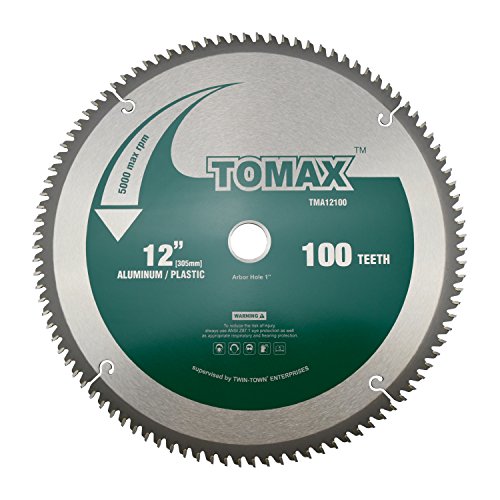
The TOMAX combines the dimensions many larger saw users need with a tooth layout aimed at aluminum and other non-ferrous metals. Its 12-inch diameter and 1-inch arbor make it a candidate for compatible miter, table, or circular saw platforms, while the 100-tooth TCG configuration points toward controlled, clean cutting rather than a coarse wood-cutting setup.
The listing also identifies construction-grade carbide teeth and an electrophoretic coating intended to reduce rusting and corrosion. Those details matter in a shop where the blade may sit between aluminum extrusion projects instead of being used every day. Its stated compatibility with plastic broadens the material range, although the saw itself must still accept a 12-inch blade with a 1-inch arbor.
Pros
- Documented for aluminum, plastic, and non-ferrous metals.
- Uses a 100-tooth triple-chip grind layout.
- Fits a documented 1-inch arbor configuration.
- Uses construction-grade carbide teeth according to the listing.
- Electrophoretic coating is identified as a corrosion-reducing feature.
Cons
- Its 12-inch diameter and 1-inch arbor exclude compatible 10-inch and 5/8-inch-arbor saws.
- The listing does not provide a detailed machine-by-machine compatibility chart.
This is the most sensible starting point for a buyer with a compatible 12-inch saw who wants a dedicated aluminum blade with a relatively fine 100-tooth layout. Choose a different option if your saw uses a 5/8-inch arbor or if a compact grinder blade is the real need.
To buy this product, click here.
2. FOXBC 10-Inch 80-Tooth TCG Aluminum Saw Blade | Best for General 10-Inch Saw Work

For a 10-inch miter or table saw with a 5/8-inch arbor, this FOXBC offers a practical aluminum-focused configuration. The 80-tooth TCG layout is less dense than the 100- and 120-tooth choices in this roundup, which gives it a distinct place for buyers who need a general-purpose non-ferrous blade rather than the finest available tooth spacing.
The 0.094-inch kerf is stated in the product information, as are laser-cut stabilizer vents. FOXBC lists aluminum, copper, brass, plastic, and fiberglass among the intended materials, so this blade may suit a small fabrication bench handling several non-ferrous jobs. Compatibility is listed for several common 10-inch saw brands, but the arbor and machine requirements should still be checked before installation.
Pros
- Documented 10-inch diameter and 5/8-inch arbor.
- Uses an 80-tooth TCG geometry for aluminum and non-ferrous metals.
- Lists a 0.094-inch kerf.
- Laser-cut stabilizer vents are included in the documented design.
- Application range includes aluminum, copper, brass, plastic, and fiberglass.
Cons
- Its 80-tooth count may be less suited to buyers specifically seeking the finest finish listed here.
- It cannot replace a 12-inch blade or a blade with a 1-inch arbor.
This blade fits buyers who want one aluminum-oriented option for a compatible 10-inch saw and who value a broader non-ferrous material range. The 100-tooth FOXBC is a closer match for a buyer placing more emphasis on tooth density and the listed aluminum thickness ranges.
To buy this product, click here.
3. TOMAX 10-Inch 80 Tooth TCG Aluminum and Non-Ferrous Metal Saw Blade | Best Value-Oriented 10-Inch Option

This TOMAX shares the useful 10-inch and 5/8-inch arbor format found on many compatible saws, while keeping the specification set straightforward. It is listed for aluminum, plastic, and non-ferrous metals, and its 80-tooth TCG configuration gives it a clear application identity instead of leaving the buyer to guess whether a wood blade is suitable.
The blade uses construction-grade carbide teeth according to the listing, along with an electrophoretic coating intended to reduce rusting and corrosion. Those features are relevant for a homeowner or small shop that may move between aluminum trim, plastic components, and other occasional cutting jobs. The available information does not provide a stated kerf or detailed brand compatibility list, so the saw manual and arbor dimensions deserve extra attention.
Pros
- Documented for aluminum, plastic, and non-ferrous metals.
- Uses an 80-tooth TCG tooth design.
- Fits a documented 5/8-inch arbor.
- Has a 10-inch blade diameter for compatible saws.
- Includes stated construction-grade carbide teeth and electrophoretic coating.
Cons
- The listing does not specify a kerf measurement.
- Detailed compatibility with individual saw models is not provided in the supplied information.
This is a sensible pick for a 10-inch saw owner who wants the essential aluminum-cutting specifications without moving to a 100- or 120-tooth configuration. Buyers who need documented material thickness ranges or stabilizer vents have clearer information with the FOXBC alternatives.
To buy this product, click here.
4. FOXBC 10-Inch 100-Tooth TCG Aluminum Saw Blade | Best for Thin-to-Medium Aluminum
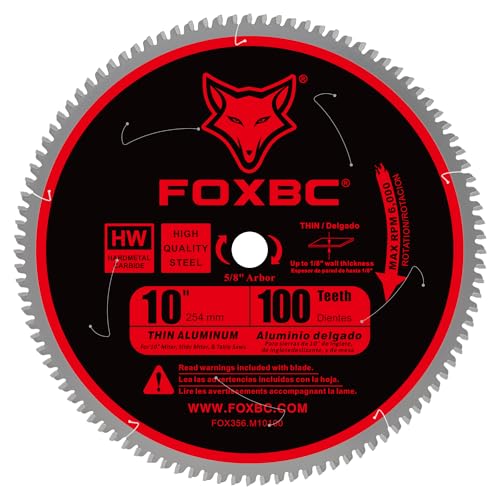
The FOXBC 10-inch 100-tooth blade is one of the more clearly specified choices for aluminum thickness. The listing identifies thin material up to 1/8 inch, medium material from 3/32 to 1/4 inch, and thick material from 3/16 to 7/16 inch. Those ranges give a buyer more context than a bare claim that the blade cuts aluminum.
Its 0.095-inch kerf, 5/8-inch arbor, and 100-tooth TCG design make the configuration easy to compare with the 80-tooth FOXBC model. Laser-cut stabilizer vents are also listed, along with compatibility across several common 10-inch miter, slide miter, and table saw platforms. The product information supports a focused aluminum application, but it does not establish suitability for every saw or every aluminum profile.
Pros
- Documents a 10-inch diameter and 5/8-inch arbor.
- Uses a 100-tooth TCG configuration.
- Lists a 0.095-inch kerf.
- Provides stated thin, medium, and thick aluminum ranges.
- Includes laser-cut stabilizer vents in the documented design.
Cons
- The high tooth count may be unnecessary for buyers who prefer the 80-tooth version for general work.
- The stated material ranges do not guarantee compatibility with every saw setup.
Pick this blade when your 10-inch saw accepts a 5/8-inch arbor and your projects move between aluminum sheet, profiles, and other listed non-ferrous materials. The TOYAKI 120-tooth blade is the more specialized choice for buyers who place finish density ahead of a broader comparison of material thickness.
To buy this product, click here.
5. MASTEC 10-Inch 100T TCG Aluminum Saw Blade | Best for Multi-Saw Use

MASTEC keeps the core setup familiar: a 10-inch blade, 100 carbide teeth, TCG geometry, and a 5/8-inch arbor. The listing identifies aluminum, plexiglass, plastic, and non-ferrous metals as intended materials, giving this blade a useful place in a shop that cuts more than aluminum extrusion alone.
The product is described for miter saws, circular saws, and table saws. That broad machine wording can be helpful, but it also means the buyer must confirm that the specific saw accepts the blade diameter, arbor, and application. The supplied information does not state a kerf, stabilizer vent design, or aluminum thickness range, so this option is easier to understand as a straightforward 100-tooth TCG blade than as a highly documented specialist model.
Pros
- Uses a documented 10-inch diameter.
- Has 100 carbide teeth in a TCG layout.
- Uses a 5/8-inch arbor.
- Lists aluminum, plexiglass, plastic, and non-ferrous metals.
- Is identified for miter, circular, and table saw use.
Cons
- The supplied specifications do not identify a kerf measurement.
- No aluminum thickness range is provided in the listing information.
MASTEC suits a buyer who needs a 10-inch, 5/8-inch-arbor blade for several listed materials and saw types. If you want more detailed information about stabilizer vents, kerf, or material thickness, the FOXBC 100-tooth model provides a fuller specification picture.
To buy this product, click here.
6. GRAFF 4-1/2-Inch Circular Saw Blade | Best Compact Option

The GRAFF is a different tool category from the full-size miter and table saw blades above. Its 4-1/2-inch diameter, 40-tooth layout, and stated 5/8- to 7/8-inch arbor range are aimed at compatible angle grinders. That makes it relevant for compact cutting tasks where a 10- or 12-inch saw blade would be awkward or impossible to mount.
Its application list includes aluminum, sheet metal, non-ferrous metal, wood, plywood, drywall, MDF, and plastic. The listing also identifies carbide teeth, expansion slots, and compatibility with several angle-grinder brands. Because the blade is smaller and has fewer teeth than the other recommendations, it should be judged as a compact tool option rather than a direct substitute for a high-tooth-count aluminum blade on a miter saw.
Pros
- Uses a compact 4-1/2-inch blade diameter.
- Lists a 5/8- to 7/8-inch arbor range.
- Has 40 carbide teeth.
- Is documented for aluminum and non-ferrous metal.
- Lists compatibility with several angle-grinder brands.
Cons
- It is intended for compatible angle grinders rather than standard 10-inch or 12-inch saws.
- Its 40-tooth layout is substantially different from the fine-tooth configurations elsewhere in this roundup.
This blade belongs on the shortlist for compact angle-grinder work involving aluminum or sheet material. Skip it if your project calls for a conventional miter or table saw blade, since the diameter, mounting system, and tooth count serve a different setup.
To buy this product, click here.
7. TOYAKI 10-Inch 120-Tooth TCG Aluminum Saw Blade | Best for Fine Finish Work

TOYAKI takes the highest tooth-count approach among the 10-inch options here, with 120 teeth and a TCG layout. The listing identifies it for aluminum, plastic, and non-ferrous metals, while its stated ultra-fine finish positioning makes it especially relevant to buyers who care about the appearance of a cut edge.
The blade measures 10 inches, uses a 5/8-inch arbor, and has a stated 2.8 mm thickness. Those details help with fit and installation, but they do not remove the need to verify the saw’s own requirements. The product information describes it for miter saws, table saws, and circular saws, creating a broad application range while leaving the exact machine match to the buyer.
Pros
- Uses a 120-tooth TCG configuration.
- Has a 10-inch diameter and 5/8-inch arbor.
- Is documented for aluminum, plastic, and non-ferrous metals.
- Lists a 2.8 mm blade thickness.
- Is positioned for ultra-fine finish work.
Cons
- The 120-tooth configuration may be excessive for buyers seeking a more general 80-tooth blade.
- The supplied information does not include a kerf measurement or aluminum thickness range.
TOYAKI is the focused pick for a compatible 10-inch saw where tooth density and finish work matter most. For broader specification coverage, including a stated kerf and aluminum thickness ranges, the FOXBC 10-inch 100-tooth blade is easier to evaluate.
To buy this product, click here.
8. FOXBC 12-Inch 120-Tooth TCG Aluminum Saw Blade | Best Large-Saw Fine-Cut Option

This FOXBC brings a 120-tooth configuration to a larger 12-inch blade with a 1-inch arbor. The listing identifies a 0.095-inch kerf and a negative 5-degree hook angle, along with TCG teeth for aluminum and other non-ferrous applications. For a shop already equipped with a compatible 12-inch saw, those documented dimensions make the product easy to separate from the 10-inch fine-cut models.
FOXBC lists thin aluminum up to 1/8 inch, medium material from 3/32 to 1/4 inch, and thick material from 3/16 to 7/16 inch. Copper pipe and brass plate are also included in the stated application range. The high tooth count and material coverage give this blade a specialized identity, although buyers should confirm the saw’s arbor, guard clearance, and permitted blade specification before mounting it.
Pros
- Uses a 12-inch diameter and 1-inch arbor.
- Has 120 TCG teeth.
- Lists a 0.095-inch kerf.
- Specifies a negative 5-degree hook angle.
- Provides stated aluminum thickness ranges and other non-ferrous applications.
Cons
- It is unsuitable for saws built around a 10-inch blade or 5/8-inch arbor.
- The 120-tooth layout is a specialized choice rather than the broadest configuration in this group.
This is a strong match for large-saw owners who want a fine-tooth aluminum blade and documented thickness guidance. The FOXBC 12-inch 96-tooth model may be a better fit for buyers who want the same basic size and arbor format with a less dense tooth layout.
To buy this product, click here.
9. FOXBC 12-Inch 96-Tooth TCG Aluminum Saw Blade | Best Balanced 12-Inch Option

The 12-inch 96-tooth FOXBC occupies the middle ground between the brand’s 12-inch 120-tooth blade and the 10-inch choices. It uses a 1-inch arbor, a 0.094-inch kerf, and a negative 5-degree hook angle according to the listing. That combination gives buyers a clearly documented large-blade alternative without moving all the way to the densest tooth count in the roundup.
Its listed material thickness ranges cover thin, medium, and thick aluminum, while the application description also includes plastic, copper pipe, and brass plate. Laser-cut stabilizer vents are part of the stated construction, and compatibility is listed for several 12-inch miter, slide miter, and table saw platforms. The key limitation is simple: this remains a 12-inch, 1-inch-arbor blade, so its useful flexibility depends on having the right machine.
Pros
- Uses a documented 12-inch diameter and 1-inch arbor.
- Has 96 TCG teeth.
- Lists a 0.094-inch kerf and negative 5-degree hook angle.
- Provides stated thin, medium, and thick aluminum ranges.
- Includes laser-cut stabilizer vents and several listed 12-inch saw compatibilities.
Cons
- It cannot fit the 5/8-inch arbor used by the 10-inch recommendations.
- Buyers seeking the finest listed tooth count may prefer the 120-tooth version.
Choose this FOXBC when your 12-inch saw accepts a 1-inch arbor and you want a middle-ground tooth count with detailed aluminum application information. The 120-tooth FOXBC is the more finish-focused alternative, while the TOMAX is the better match for buyers who prefer its documented coating and construction details.
To buy this product, click here.
Buying Guide
Match the Arbor Before Comparing Tooth Counts
Arbor size is the first filter because a blade with the wrong mounting dimension is not a practical option for the saw. The 10-inch models in this roundup use a 5/8-inch arbor, while the 12-inch selections use a 1-inch arbor. A quick glance at the blade diameter is not enough. Check the saw documentation and the blade’s stated mounting details before weighing tooth count or price.
Choose the Blade Diameter for the Saw, Not the Material
Aluminum does not determine whether a 10-inch or 12-inch blade is correct. The machine does. A 12-inch aluminum blade may suit a compatible miter or table saw, while a compact 4-1/2-inch blade belongs to a different angle-grinder setup. Never treat nominally similar circular blades as interchangeable across machines without confirming the mounting and operating requirements.
Understand What Tooth Count Changes
The products here range from 40 teeth on the compact GRAFF blade to 120 teeth on the TOYAKI and FOXBC fine-cut options. Tooth count is one useful comparison point, but it does not establish a universal performance ranking. A buyer cutting occasional aluminum pieces may prefer an 80-tooth blade, while someone focused on a fine edge may favor 100 or 120 teeth. TCG geometry is also significant because each selected blade is identified for non-ferrous material work with that tooth form.
The guide to circular blade selection for aluminum and other materials keeps material approval and machine compatibility separate from the number of teeth.
Look for Documented Aluminum Thickness Ranges
Several FOXBC blades provide specific ranges for thin, medium, and thick aluminum. That information gives the buyer more context than a general material label. The ranges still do not replace machine instructions or establish that every shape and profile is suitable. Use them as a product-selection reference, then verify the particular workpiece and saw setup.
Compare Kerf, Hook Angle, and Blade Thickness Carefully
Kerf describes the stated cut width for products that provide the measurement. The FOXBC 10-inch 80-tooth blade lists a 0.094-inch kerf, while the 10-inch 100-tooth version lists 0.095 inch. The 12-inch FOXBC models list 0.094 and 0.095 inch kerfs, and the 12-inch models also identify a negative 5-degree hook angle. These figures help compare documented configurations, but they should not be treated as promises of a particular finish or cutting speed.
Separate Carbide-Tipped Construction From Solid Carbide Tools
These products are saw blades with carbide teeth or carbide-tipped cutting edges. They are not solid carbide discs. That distinction matters because the blade body, tooth attachment, and machine mounting system are part of the complete tool. The supplied listings identify carbide teeth or high-density carbide, but they do not establish a universal carbide grade or composition for any product.
Check the Full Machine Setup
A blade’s advertised material range is only one part of compatibility. Confirm diameter, arbor, saw type, guard clearance, and any manufacturer restrictions before installation. The GRAFF is listed for angle grinders, the 10-inch FOXBC products are listed for several 10-inch saw types, and the 12-inch FOXBC products are listed for 12-inch miter, slide miter, and table saws. Those distinctions should guide the shortlist before any other feature does.
Best Carbide Saw Blades for Aluminum FAQ
What tooth geometry is used by these aluminum saw blades?
Every selected blade is identified with a triple-chip grind, or TCG, configuration except that the compact GRAFF listing describes its carbide-tooth construction without supplying a TCG designation. TCG is a recurring feature across the 10-inch and 12-inch aluminum-focused blades, so it is a useful comparison point for this roundup.
Can any of these blades cut materials besides aluminum?
Yes. The listings identify several additional materials. TOMAX lists plastic and non-ferrous metals. FOXBC lists combinations that include copper, brass, plastic, and fiberglass. MASTEC lists plexiglass and plastic, while GRAFF lists sheet metal, wood, plywood, drywall, MDF, and plastic. Stay within the product’s documented application range and verify the machine requirements.
What arbor size do most 10-inch blades use here?
The 10-inch TOMAX, FOXBC, MASTEC, and TOYAKI blades listed in this article use a 5/8-inch arbor. That does not mean every 10-inch aluminum blade uses that size, so the saw and blade specifications should be matched directly before purchase.
Are 12-inch blades automatically better than 10-inch blades?
No. A 12-inch blade may be the correct size for a larger saw, but it is not a universal upgrade. The 12-inch products here use a 1-inch arbor, while the 10-inch models use a 5/8-inch arbor. Tooth count, kerf, hook angle, and the intended saw all remain relevant.
Which blade has the highest tooth count?
The TOYAKI 10-inch blade and the FOXBC 12-inch blade both list 120 teeth. The TOYAKI uses a 5/8-inch arbor, while the FOXBC uses a 1-inch arbor, so the mounting system separates these two options even though their tooth counts match.
Is the GRAFF blade suitable for a table saw?
The supplied listing identifies the GRAFF as a 4-1/2-inch circular saw blade compatible with angle grinders and lists several grinder brands. It should not be treated as a table-saw blade based on diameter alone. Buyers seeking a table or miter saw blade should use one of the products whose listing identifies that saw category and whose arbor matches the machine.
What should I verify before installing a carbide aluminum blade?
Verify the blade diameter, arbor size, saw type, guard clearance, and the machine manufacturer’s requirements. Also compare the intended aluminum thickness and material range with the workpiece. A blade should never be installed solely because its advertised material matches the project.
Does a higher tooth count guarantee a cleaner aluminum cut?
No guarantee can be made from tooth count alone. A higher count is a meaningful design difference, but the supplied product information does not provide controlled testing that would establish a universal finish ranking. Use tooth count alongside TCG geometry, kerf, hook angle, saw compatibility, and the type of aluminum work you plan to do.
Final Verdict
The TOMAX 12-Inch 100 Tooth TCG blade is the strongest overall recommendation because its listing directly covers aluminum and non-ferrous metals, documents a 1-inch arbor and 100-tooth configuration, and identifies carbide teeth plus an electrophoretic coating. It suits the buyer who already owns a compatible 12-inch saw and wants a purpose-listed blade rather than a general woodworking model.
For a 10-inch saw, the FOXBC 100-tooth blade offers the clearest aluminum thickness guidance and a documented 0.095-inch kerf, while the TOYAKI 120-tooth model is the more specialized fine-finish alternative. The FOXBC 12-inch 96-tooth blade gives large-saw owners a middle-ground configuration, and the GRAFF is the compact choice for compatible angle grinders. Match the blade to the arbor and machine first, then use tooth count, kerf, hook angle, and material range to make the final call.
