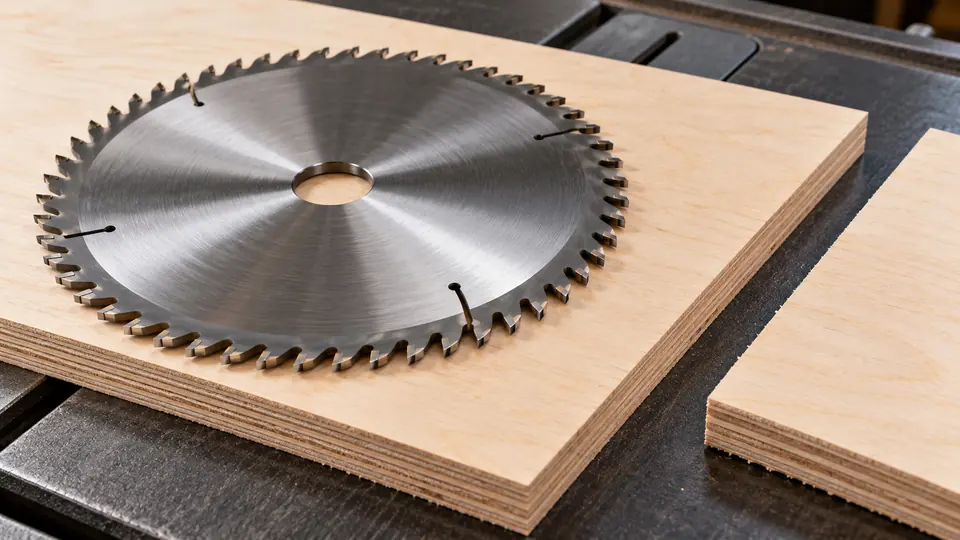
Plywood can look beautifully smooth on one face and explode into a fuzzy, splintered mess on the other after a single table-saw pass. That is why shoppers search for the best table saw blade for plywood rather than grabbing an ordinary general-purpose blade. Veneer layers reward a blade with suitable tooth geometry, enough teeth for a fine cut, and an arbor and diameter that match the saw. A 10-inch blade with an 80-tooth Hi-ATB design, such as the Freud LU80R010, is the strongest overall fit here for buyers who care most about clean plywood and melamine edges.
The common mistake is choosing by tooth count alone. An 80-tooth blade may leave a refined edge, but the blade still has to fit the saw, clear the guard and riving-knife setup, and suit the work being done. Kerf also matters. A thin-kerf blade removes less material, while a thicker .126-inch kerf may feel more substantial on a larger saw. Some shoppers need a dedicated fine-finish blade, others want a multi-blade set for framing and finish work, and a few need compatibility with an 8-1/4-inch jobsite saw instead of a standard 10-inch machine.
The recommendations below weigh plywood suitability, tooth geometry, blade size, arbor fit, kerf, supported materials, and the difference between a dedicated finish blade and a flexible multi-purpose set. The Freud is the premium choice for controlled, splinter-conscious cuts, while options from CMT, WEN, FOXBC, Ryltanks, Luckyway, HARDWIN, and OSTTE cover different budgets and cutting routines.
Quick Answer
- Best Overall: Freud LU80R010 for its documented 80-tooth Hi-ATB geometry, plywood focus, and 5/8-inch arbor.
- Best Multi-Blade Set: Ryltanks 32T, 60T, and 80T Three-Pack for buyers who switch between framing, general cutting, and fine finishing.
- Best Premium Alternative: CMT Orange Tools 221.060.10 for plywood, melamine, laminate, and other sheet materials.
- Best Ultra-Fine Finish: FOXBC 90-Tooth Ultimate Polished Finish Blade for veneered plywood and detail-oriented woodworking.
Best Table Saw Blade for Plywood Comparison Table
| Product | Best For | Blade Diameter | Arbor | Tooth Count | Key Detail |
|---|---|---|---|---|---|
| Freud LU80R010 | Overall plywood and melamine work | 10 inches | 5/8 inch | 80 | Hi-ATB, .126-inch kerf |
| Ryltanks Three-Pack | Mixed cutting tasks | 10 inches | 5/8 inch | 32, 60, 80 | .098-inch kerf |
| HARDWIN 80T | Thin-kerf fine finishing | 10 inches | 5/8 inch | 80 | .098-inch kerf, ATB |
| FOXBC 90T | Polished veneer and detail cuts | 10 inches | 5/8 inch | 90 | .087-inch kerf, ASFG |
| CMT Orange Tools 221.060.10 | Sheet goods and crosscutting | 10 inches | 5/8 inch | 60 | .126-inch kerf, PTFE coating |
| WEN BL1080 | Accessible ultra-fine cutting | 10 inches | 5/8 inch | 80 | 2.4 mm thin kerf |
| Luckyway 32T and 60T Two-Pack | Flexible plywood cutting | 10 inches | 5/8 inch | 32, 60 | ATB, two-blade set |
| FOXBC 60T Fine Finish | Fine crosscuts and plywood | 10 inches | 5/8 inch | 60 | .087-inch kerf, ATB |
| OSTTE 80T | Budget fine-finish cutting | 10 inches | 5/8 inch | 80 | ATB, maximum 5,500 RPM listed |
Use the detailed reviews below to match tooth geometry and kerf with your plywood, saw, and preferred finish.
1. Freud LU80R010: 10-Inch Ultimate Plywood and Melamine Blade — Best Overall

The Freud LU80R010 is the most application-specific blade in this group. Its 80 teeth use a Hi-ATB grind, a geometry associated with scoring and slicing veneer fibers cleanly rather than relying on a coarse tooth to tear through the sheet. The listing identifies it specifically for plywood and melamine, so it speaks directly to the problem of chipped decorative faces and ragged exposed edges. Its 10-inch diameter and 5/8-inch arbor fit the dimensions used by many full-size table saws, but the saw’s own requirements still need checking before installation.
This blade uses a .126-inch kerf and a .087-inch plate, giving buyers a useful distinction from the thinner .087-inch and .098-inch options below. The laser-cut anti-vibration slots and Perma-Shield coating are documented features, while the coating is also identified as helping resist pitch buildup and corrosion. For a cabinet side, shelving panel, or melamine component where the cut edge will be visible, that focused design makes more sense than a 32-tooth framing blade. It is a specialized purchase, though, and shoppers who want one blade for rough ripping and quick construction cuts may prefer a set.
Pros
- Designed specifically for plywood and melamine applications.
- Uses an 80-tooth Hi-ATB grind for fine sheet-material cutting.
- Fits a documented 10-inch, 5/8-inch arbor configuration.
- Includes laser-cut anti-vibration slots.
- Uses a Perma-Shield non-stick coating identified for reducing pitch buildup and drag.
Cons
- The .126-inch kerf is wider than the thin-kerf designs in this roundup.
- Its plywood and melamine focus makes it less suitable as a single rough-cut blade.
This is the blade to choose when the plywood face matters more than having several cutting modes in one package. A buyer working mainly with construction plywood may find the specialized 80-tooth layout excessive, while a cabinetmaker or furniture builder has a clearer reason to choose it over a mixed set. Confirm the arbor, blade diameter, guard clearance, and saw instructions before fitting it.
To buy this product, click here.
2. Ryltanks 32T, 60T, and 80T Three-Pack — Best Multi-Blade Set

A plywood project can change character quickly. One minute you are breaking down a full sheet, then you are trimming a narrow shelf or cleaning up an exposed edge. The Ryltanks set addresses that shift with three 10-inch blades: a 32-tooth blade for framing, a 60-tooth blade for ripping and crosscutting, and an 80-tooth blade for fine finishing. Each uses a 5/8-inch arbor, and the listing identifies a .098-inch kerf across the set.
That spread gives this package a practical advantage over a single fine-finish blade. The 80-tooth option is the relevant member for delicate plywood faces, while the 60-tooth blade can handle less appearance-sensitive work without changing to a coarse framing blade. The listing also names plywood, melamine, OSB, hardwoods, and softwoods among supported materials. Laser-cut stabilizer vents are included in the product description, along with a stated maximum of 6,000 RPM. Those figures still need to be matched to the particular saw and blade position, especially where a table saw’s manual sets a lower limit.
Pros
- Includes separate 32T, 60T, and 80T cutting options.
- All three blades use a documented 10-inch diameter and 5/8-inch arbor.
- The .098-inch kerf is identified for the set.
- Plywood, melamine, OSB, hardwood, and softwood are listed as applications.
- The 80-tooth blade provides a dedicated fine-finish choice within the package.
Cons
- Buyers seeking one dedicated premium plywood blade may not need the two lower-tooth-count blades.
- The package requires storage and blade changes between cutting tasks.
Choose this set for a workshop that moves between rough breakdowns and cleaner plywood work. It is less focused than the Freud and less specialized than the 90-tooth FOXBC, but the three tooth counts create a useful working sequence. Before using any blade, verify the saw’s compatibility and the listed speed requirements rather than treating the set as universally interchangeable.
To buy this product, click here.
3. HARDWIN 10-Inch 80T Fine Finish Table Saw Blade — Best Thin-Kerf 80T Option

The HARDWIN blade takes the familiar 80-tooth fine-finish format and pairs it with a .098-inch thin kerf. That can matter during repeated plywood cuts, where the blade removes a narrower strip of material than the Freud’s .126-inch kerf. Its 10-inch diameter and 5/8-inch arbor are clearly listed, and the product description identifies ATB tooth geometry for wood, veneers, and other sheet materials.
The blade body is listed at .071 inch, with a claimed operating capacity up to 6,000 RPM. The listing also identifies a non-stick coating and tungsten carbide teeth. Those details give the blade a sensible profile for finish-oriented plywood work, particularly where the user wants an 80-tooth option without stepping up to a wider kerf. The product description uses strong finish language, but actual edge quality will still depend on plywood construction, alignment, blade condition, feed control, and the saw setup. That makes the HARDWIN attractive on paper while leaving room for realistic expectations.
Pros
- Uses 80 ATB teeth for fine wood and veneer cutting.
- Lists a .098-inch thin kerf.
- Uses a documented 10-inch diameter and 5/8-inch arbor.
- Includes tungsten carbide teeth and a non-stick coating.
- The listed .071-inch body provides a clearly documented blade-body dimension.
Cons
- The product description does not provide a separate plywood-specific tooth grind such as Hi-ATB.
- Its fine-finish 80T layout is less suited to fast rough breakdowns than the 32T options in this roundup.
The HARDWIN fits a buyer who wants a thin-kerf 80-tooth blade for plywood, veneer, and general finish work. It is a more focused purchase than a multi-pack and a less plywood-specific design than the Freud. Check the saw’s approved blade thickness and guard setup, since thin-kerf blades can interact differently with a riving knife or splitter.
To buy this product, click here.
4. FOXBC 10-Inch 90-Tooth Ultimate Polished Finish Blade — Best for Veneered Plywood

For a plywood panel with a delicate veneer, the FOXBC 90-tooth blade offers the highest tooth count in this selection. Its .087-inch kerf is also among the narrowest listed, and the product uses an axial shear-face grind alongside a double-side-grind geometry. Those are meaningful distinctions for a buyer comparing it with conventional ATB blades. The listing names veneered plywood, melamine, molding, hardwoods, and softwoods as intended materials.
The blade uses a 10-inch diameter and 5/8-inch arbor, with compatibility information naming several 10-inch saw families. That makes it easy to compare dimensionally with the other full-size choices, although the exact saw manual remains the final authority. The high tooth count points toward finish work rather than quick stock removal. If the job involves long rip cuts through ordinary construction plywood, a 60-tooth or 32-tooth blade may be a more practical companion. For exposed veneer edges, trim components, and careful panel work, the FOXBC’s geometry is the reason to select it.
Pros
- Uses 90 teeth for a fine-finish cutting profile.
- Lists an .087-inch kerf.
- Includes axial shear-face grind and double-side-grind geometry.
- Veneered plywood and melamine are identified among supported materials.
- Uses a documented 10-inch diameter and 5/8-inch arbor.
Cons
- The 90-tooth configuration is specialized for fine work rather than rough stock removal.
- The listing does not identify a plywood-specific Hi-ATB grind.
This blade suits a furniture maker or trim builder who wants a very fine cutting profile for visible plywood surfaces. It may be unnecessary for shop furniture hidden behind edging or for demolition-style work. Match it to a compatible 10-inch saw, and keep a lower-tooth-count blade available for cuts where speed and clearance matter more than the final veneer edge.
To buy this product, click here.
5. CMT Orange Tools 221.060.10 Laminated and Chipboard Blade — Best for Sheet-Material Range

The CMT Orange Tools blade is built around a 60-tooth format and a broader sheet-material brief. Its listed applications include plywood, melamine, laminate, chipboard, OSB, hardwoods, and softwoods, which gives it a useful place in a workshop that cuts more than one kind of panel. The product is also identified for stationary table saws, miter saws, radial arm saws, and vertical panel saws. That range is helpful, but buyers still need to confirm the mounting and operating requirements for their exact machine.
This blade uses a 10-inch diameter, 5/8-inch bore, .126-inch kerf, and .087-inch plate according to the model designation and supplied specifications. Its construction details include a laser-cut steel plate, heat-expansion slots, sound-dampening slots, a tensioning ring, tri-metal brazing, and a PTFE non-stick coating. Those features distinguish it from the simpler thin-kerf options. The 60-tooth count sits between rough-cut and ultra-fine designs, making it a practical fit for plywood work where the user wants a clean edge without moving all the way to 80 or 90 teeth.
Pros
- Lists plywood, melamine, laminate, chipboard, OSB, hardwood, and softwood applications.
- Uses a documented 10-inch diameter and 5/8-inch arbor.
- Provides a 60-tooth crosscut-oriented configuration.
- Includes laser-cut heat-expansion and sound-dampening slots.
- Uses a non-stick PTFE coating and tri-metal brazing.
Cons
- The .126-inch kerf is wider than the thin-kerf alternatives here.
- The listing describes crosscut applications, so it is not the clearest choice for fast ripping.
The CMT makes sense for someone cutting plywood alongside laminate, melamine, and chipboard on a stationary machine. Its broader application list is more useful than a narrow plywood-only focus for mixed sheet-goods work. Buyers who want the finest possible veneer edge may prefer the Freud or FOXBC 90T, while those who want less material removal should look at the thin-kerf choices.
To buy this product, click here.
6. WEN BL1080 10-Inch 80-Tooth Carbide-Tipped Blade — Best Accessible Fine-Finish Option
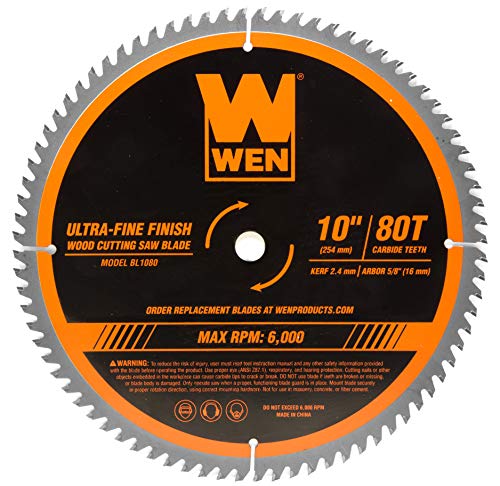
The WEN BL1080 keeps the specification list straightforward: a 10-inch diameter, 5/8-inch arbor, 80 carbide-tipped teeth, and a 1/10-inch, or 2.4 mm, kerf. The product is identified for hard and soft woods and for use with many miter saws, jobsite saws, and table saws. Plywood falls naturally within that woodworking application, but the listing does not give it the same dedicated plywood and melamine identity as the Freud.
Its value lies in the familiar fine-finish format. An 80-tooth blade is a sensible direction for plywood face cuts where a coarse construction blade could leave more visible tearing. The thin kerf also distinguishes it from the .126-inch blades in this roundup. WEN lists a rating up to 6,000 RPM, so that figure should be checked against the saw’s instructions rather than treated as permission for every machine. This is a clean, uncomplicated option for a buyer who wants a fine-finish blade without moving into unusual geometry.
Pros
- Uses 80 carbide-tipped teeth for fine wood cutting.
- Lists a 10-inch diameter and 5/8-inch arbor.
- Provides a documented 2.4 mm thin kerf.
- Is identified for both hard and soft woods.
- Compatibility is listed for many 10-inch miter, jobsite, and table saws.
Cons
- The listing does not specifically identify a Hi-ATB or other plywood-focused tooth grind.
- It is a single fine-finish blade, without the alternate tooth counts included in the Ryltanks or Luckyway sets.
The WEN suits a general woodworker who wants an 80-tooth blade for plywood and other wood panels, especially when thin kerf is a priority. It is less targeted than the Freud and less specialized for polished veneer than the FOXBC 90T. Confirm the saw’s permitted blade diameter, arbor, kerf, and maximum speed before use.
To buy this product, click here.
7. Luckyway 32T and 60T Two-Pack — Best Two-Blade Flexibility
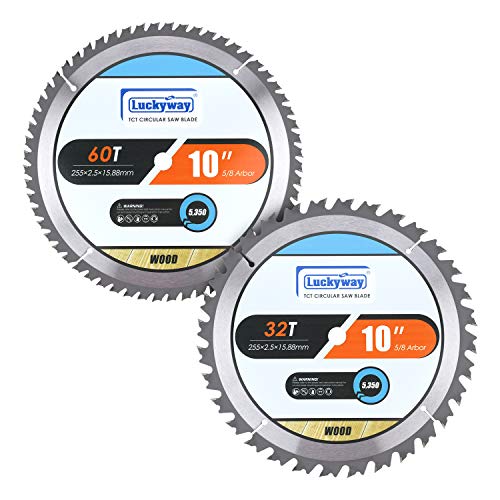
The Luckyway package takes a different route from the fine-finish-only blades. It includes one 32-tooth and one 60-tooth 10-inch blade, both with 5/8-inch arbors. The product listing names plywood, MDF, chipboard, laminate, hardwood, softwood, and panels among the supported materials, and it identifies both crosscutting and ripping. That makes the set useful for a buyer who needs to break down plywood and then make cleaner sizing cuts without buying two unrelated products.
Both blades use ATB tooth geometry, and the bodies are described as fully hardened steel. The 32-tooth blade is the more natural choice for faster, less appearance-sensitive cuts, while the 60-tooth blade is the better match for a cleaner plywood edge. The package does not include an 80-tooth or 90-tooth blade, so it is not aimed at the most delicate veneer work. Still, the two-step approach can feel practical in a garage shop, where one blade handles rougher work and the other stays reserved for finish cuts.
Pros
- Includes separate 32T and 60T blades.
- Both blades use a documented 10-inch diameter and 5/8-inch arbor.
- Plywood, MDF, chipboard, laminate, hardwood, and softwood are listed.
- ATB geometry is identified for both blades.
- The listing supports both ripping and crosscutting applications.
Cons
- The package does not include an 80T or 90T blade for ultra-fine plywood finishes.
- The supplied specifications do not state the kerf width for either blade.
This two-pack is a practical fit for construction plywood, workshop shelving, and projects that alternate between breakdown and sizing cuts. A cabinet builder focused on exposed veneer may want a higher-tooth-count blade, while a buyer tired of swapping between only one rough and one finish blade may find the Ryltanks set more complete. Blade fit and saw instructions remain decisive.
To buy this product, click here.
8. FOXBC 10-Inch 60T Fine Finish Crosscut Blade — Best Thin-Kerf 60T Option

The FOXBC 60-tooth blade sits in a useful middle position. Its ATB geometry and fine-finish crosscut designation point toward cleaner plywood sizing cuts, while its .087-inch kerf is narrower than the .126-inch format used by the Freud and CMT. The blade is listed for plywood, melamine, oak, pine, and molding, so its intended material range extends beyond a single sheet good.
Its 10-inch diameter and 5/8-inch arbor are familiar dimensions, and the product description lists compatibility with several DeWalt, Skil, Metabo, and Makita 10-inch saws. Those examples can help a buyer begin checking fit, but they do not replace the exact saw manual. A 60-tooth blade will not provide the same fine-tooth focus as the 80-tooth Freud or 90-tooth FOXBC, yet it can be a more balanced choice for a shop that cuts plywood regularly and still wants a reasonably broad cutting role.
Pros
- Uses 60 ATB teeth for fine crosscutting.
- Lists a narrow .087-inch kerf.
- Supports plywood, melamine, oak, pine, and molding according to the product information.
- Uses a documented 10-inch diameter and 5/8-inch arbor.
- Compatibility examples include several common 10-inch saw families.
Cons
- The 60-tooth count is less specialized for delicate veneer than the 80T and 90T choices.
- The product is identified primarily for crosscutting, so it is not the clearest pick for repeated fast ripping.
Choose this FOXBC when a thin-kerf, 60-tooth blade better matches the way your shop works. It gives plywood buyers a middle ground between rough-cut flexibility and ultra-fine tooth counts. For melamine or highly visible veneer, the Freud remains more application-specific, while the FOXBC 60T may be easier to justify for mixed everyday woodworking.
To buy this product, click here.
9. OSTTE 10-Inch 80T Table Saw Blade — Best Budget-Oriented 80T Option

The OSTTE blade gives plywood shoppers a simple 80-tooth format with a 10-inch diameter and 5/8-inch arbor. Its application list includes plywood, MDF, laminate, chipboard, hardwood, and softwood, so the product is aimed at broad wood cutting rather than one narrow panel category. The listing also identifies ATB geometry and four-face precision grinding, features that help explain its placement among the fine-finish choices.
The product information lists a maximum speed of 5,500 RPM and says the blade can cut wood with nails. That latter application deserves care. A buyer should follow the saw and blade manufacturer’s instructions rather than assume a table saw setup is appropriate for every nail-embedded board. The OSTTE does not provide the specialized plywood and melamine positioning of the Freud, but it does offer the tooth count many shoppers seek for cleaner plywood cuts. It is best viewed as a straightforward 80T alternative for a compatible 10-inch saw.
Pros
- Uses 80 ATB teeth for fine wood cutting.
- Lists a 10-inch diameter and 5/8-inch arbor.
- Plywood, MDF, laminate, chipboard, hardwood, and softwood are identified as applications.
- Includes four-face precision grinding in the product description.
- Lists a maximum speed of 5,500 RPM.
Cons
- The listing does not state the kerf width or plate thickness.
- It does not identify a dedicated plywood-specific Hi-ATB design.
The OSTTE is suited to a buyer who wants an 80-tooth plywood blade with broad wood-material coverage and does not need the Freud’s specialized construction details. Its missing kerf information matters if your saw has tight splitter or riving-knife requirements. Check every dimension and the speed limit before fitting it, especially on a jobsite or compact table saw.
To buy this product, click here.
Buying Guide
Start With the Saw’s Diameter and Arbor
A blade can have the ideal tooth count and still be the wrong purchase if its physical mounting dimensions do not match the saw. Most options here are 10-inch blades with 5/8-inch arbors, but that shared specification does not guarantee compatibility with every table saw. Check the manufacturer’s manual for approved blade diameter, arbor size, blade-body thickness, kerf range, and guard or riving-knife requirements before opening the package.
The 8-1/4-inch FOXBC blade was left out of this 10-inch comparison because diameter is a real compatibility issue, not a minor variation. A smaller blade may suit a specific jobsite saw, but it should not be treated as an automatic substitute for a 10-inch model.
Match Tooth Count to the Cut
Tooth count helps describe the blade’s role. The 32T blades in the Ryltanks and Luckyway sets are aimed at faster framing or rougher work, while 60T choices such as the CMT and FOXBC occupy a useful middle ground. The 80T and 90T blades are more clearly associated with fine finishing. More teeth can be useful for plywood faces and veneer, but the blade still needs suitable geometry and a compatible saw.
Use the guide to plywood blade selection and table-saw compatibility to check the mounting and cutting system alongside the desired veneer edge.
Look at Tooth Geometry
ATB is common in this group, and its alternating tooth bevel is relevant to clean wood crosscuts. The Freud goes further with a documented Hi-ATB grind and a plywood and melamine focus. The FOXBC 90T uses axial shear-face and double-side-grind geometry. These labels are more informative than tooth count alone because they describe how the cutting edges meet the wood fibers.
Understand Kerf Width
The products include .087-inch, .098-inch, and .126-inch kerf examples, along with listings that do not disclose kerf. A narrow kerf removes less material and may be useful for repeated sheet cutting, while a wider kerf can be part of a different blade construction. Do not assume a thin kerf is automatically right for every saw. The riving knife or splitter must be compatible with the blade’s kerf and plate dimensions.
Choose One Blade or a Set
A dedicated blade makes sense if your work repeats the same task. The Freud and FOXBC 90T are focused choices for finish-oriented plywood, while the Ryltanks and Luckyway sets offer multiple tooth counts for shops that move from rough breakdown to cleaner sizing. A set can reduce separate purchases, but it also means storing and changing blades, and not every included blade may suit the project in front of you.
Check the Workpiece Description
Plywood varies widely. Construction plywood, cabinet-grade plywood, veneered panels, melamine, and laminate can place different demands on the cut edge. The product descriptions identify different supported materials, so use those statements rather than assuming every wood blade has the same application. The CMT is especially broad across sheet materials, while the Freud is more directly focused on plywood and melamine.
Respect the Published Speed and Machine Limits
Several products list maximum or rated speeds, including 5,500 RPM and 6,000 RPM figures. Those numbers must be compared with the saw’s specifications and the blade manufacturer’s instructions. They are not a reason to override a machine limit, modify a guard, or use a blade in an unapproved setup. A clean plywood cut begins with a compatible blade and machine combination.
Best Table Saw Blade for Plywood FAQ
What tooth count is best for plywood?
For many fine plywood cuts, 60 to 90 teeth is the relevant range in this roundup. An 80-tooth blade such as the Freud or WEN is a common fine-finish direction, while the FOXBC 90T is aimed at an even more detail-focused cut. A 32-tooth blade is more appropriate for faster breakdown work where the edge will receive additional treatment or be hidden.
Is a Hi-ATB blade useful for plywood?
A Hi-ATB grind is relevant because the Freud listing identifies it specifically for plywood and melamine. Its tooth shape is intended to address the surface fibers found in sheet goods. That does not guarantee a perfect edge on every panel. Blade alignment, feed control, support, and the quality of the plywood face still affect the result.
Is a thin-kerf blade better for plywood?
A thin-kerf blade removes a narrower strip of material, and this can be useful during repeated cuts from expensive sheet stock. The HARDWIN, FOXBC 60T, and WEN provide documented narrow-kerf examples. Thin kerf is not automatically superior, though. Confirm that the blade’s plate and kerf work with the saw’s splitter or riving knife before installation.
Can one plywood blade also cut melamine?
Several products list both plywood and melamine, including the Freud, Ryltanks, and CMT. A blade’s application description can guide the purchase, but melamine faces are sensitive to chipping, so tooth geometry and setup remain important. A plywood blade without a documented melamine application should not be assumed to provide the same result.
Should I choose a 60-tooth or 80-tooth blade?
A 60-tooth blade is a reasonable middle ground for plywood and mixed woodworking, while an 80-tooth blade leans more toward fine finishing. The CMT and FOXBC 60T suit buyers who want a broader cutting role, whereas the Freud, HARDWIN, WEN, and OSTTE provide 80-tooth choices. Select the count based on whether the project prioritizes finish, cutting speed, or a balance of both.
Can these blades be used on both table saws and miter saws?
Some listings identify compatibility with both 10-inch table saws and miter saws, but product type alone is not enough to establish fit. Check the saw’s required diameter, arbor, blade thickness, kerf, guard arrangement, and manufacturer instructions. The same nominal 10-inch size does not eliminate every machine-specific restriction.
Is carbide-tipped the same as solid carbide?
No. The blades in this roundup are described as using carbide teeth or carbide-tipped construction. That means the cutting teeth use carbide while the blade body is a separate material. They should not be described as solid carbide blades, and the distinction matters when comparing construction across different tool categories.
Final Verdict
The Freud LU80R010 is the strongest overall recommendation for plywood because its documented purpose, 80-tooth count, Hi-ATB grind, 10-inch diameter, and 5/8-inch arbor line up closely with fine sheet-material cutting. Its .126-inch kerf means it is not the narrowest option, and its specialized role may be more than a rough construction project needs. Still, for plywood and melamine where the visible face deserves careful treatment, its specification profile is the clearest match.
Choose the Ryltanks three-pack if your shop needs 32T, 60T, and 80T options in one package. The CMT is a strong alternative for broader sheet-material work, while the FOXBC 90T suits veneered plywood and very fine cuts. The WEN, HARDWIN, OSTTE, FOXBC 60T, and Luckyway options fill practical thin-kerf, middle-to-fine finish, or multi-blade roles. Before buying, match the blade’s diameter, arbor, kerf, plate, tooth geometry, and listed speed with the exact table saw, then choose the tooth count that reflects the plywood work you actually do.
