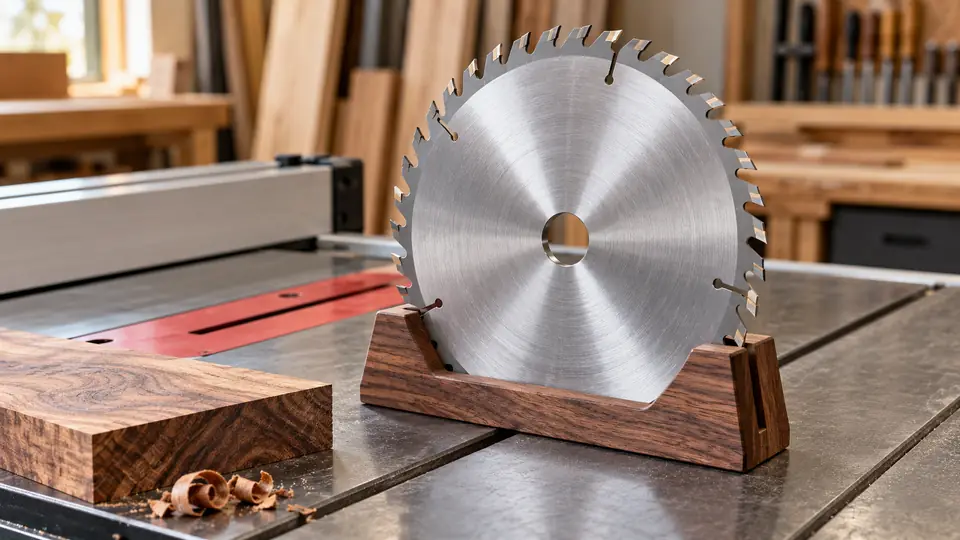
A table saw blade can change the feel of a cut before you ever finish the first board. A 24-tooth blade is aimed at faster general cutting and ripping, while a 60-tooth or 80-tooth blade puts more cutting edges into the wood for finish work. The catch is that tooth count alone does not settle the decision. Blade diameter, arbor size, kerf, saw compatibility, and the material listed by the manufacturer all matter, especially when a blade will move between a table saw and a miter saw.
Common buying mistakes include choosing a fine-finish blade for repeated ripping, overlooking the 5/8-inch arbor requirement found on many 10-inch models, or assuming that every carbide-tipped blade is suitable for every woodworking task. A blade’s stated RPM limit also belongs in the compatibility check. Different buyers have different priorities, so this guide separates general-purpose, ripping, fine-finish, and multi-blade options instead of treating tooth count as a simple quality score.
The DEWALT DWA11040 is the strongest overall fit here because its 40-tooth layout sits between aggressive ripping and dense finishing configurations, while its listing identifies optimized tooth geometry and ultra-sharp carbide. Buyers seeking a dedicated rip blade, a two-pack, or a broader selection of tooth counts will find better matches elsewhere in the list.
Quick Answer
- Best Overall: DEWALT DWA11040 for a balanced 40-tooth woodworking setup.
- Best for Ripping: HARDWIN 24T for its stated ripping focus, 5/8-inch arbor, and thin 2.4 mm kerf.
- Best Two-Blade Set: WEN BL1032-2 for pairing 32-tooth general cutting with a 60-tooth finish blade.
- Best Three-Blade Set: Ryltanks 32T, 60T, and 80T set for buyers who want three documented tooth-count options.
Best Carbide Table Saw Blades Comparison Table
| Product | Best For | Diameter | Arbor | Tooth Count | Documented Materials |
|---|---|---|---|---|---|
| DEWALT DWA11040 | Balanced general woodworking | 10 in. | Not specified | 40 | Not specified |
| DEWALT DWA11024 | General-purpose cutting | 10 in. | Not specified | 24 | Not specified |
| WEN BL1032-2 | Two-blade flexibility | 10 in. | 5/8 in. | 32 and 60 | Hardwoods and softwoods |
| Revvstark 80T | Fine wood and composite cuts | 10 in. | 5/8 in. | 80 | Wood, plastic, composites |
| HARDWIN 24T | Ripping | 10 in. | 5/8 in. | 24 | Hardwood, softwood, plywood, composites |
| WEN BL1060 | Fine-finish woodworking | 10 in. | 5/8 in. | 60 | Hardwoods and softwoods |
| AvantiPro P106060PP | Fine cuts with a spare blade | 10 in. | Not specified | 60 | Wood, plywood, laminates |
| Luckyway 32T and 60T | General cuts and crosscuts | 10 in. | 5/8 in. | 32 and 60 | Wood, panels, MDF, laminates, FRP |
| Ryltanks 32T, 60T, and 80T | Three-stage blade selection | 10 in. | 5/8 in. | 32, 60, and 80 | Wood, plywood, melamine, OSB |
The detailed reviews below separate the blades by tooth count, package format, material coverage, and documented machine dimensions.
1. DEWALT DWA11040 10-Inch 40-Tooth Table Saw Blade: Best Overall

The DWA11040 occupies a useful middle position for woodworkers who do not want to swap blades every few minutes. Its 40 teeth sit between the 24-tooth DEWALT DWA11024 and the denser 60-tooth and 80-tooth options in this guide. That makes the configuration easier to place in a general woodworking setup, although the listing does not specify an arbor size or supported workpiece materials.
DEWALT identifies optimized tooth geometry for increased accuracy and ultra-sharp carbide for clean cutting. Those are product-listing claims rather than independent test results, so they should be read as features of the design rather than a guarantee of a particular finish. The listing also states up to three times the life, but it does not define the comparison conditions. Buyers who want a single 10-inch, 40-tooth blade with a balanced specification should start here, then confirm the arbor and saw requirements before ordering.
Pros
- 10-inch diameter suits the common size identified in the product title.
- 40-tooth layout occupies a middle ground between 24T and finer blades.
- Uses carbide cutting teeth according to the listing.
- Lists optimized tooth geometry for increased accuracy.
- Single-blade format keeps the purchase focused on one general-purpose configuration.
Cons
- The supplied product information does not specify the arbor diameter.
- Supported workpiece materials are not identified in the supplied listing details.
This blade fits buyers who want a balanced tooth count for mixed woodworking and prefer a single DEWALT option over a multi-blade bundle. A dedicated ripper or fine-finish blade will be a clearer match for repetitive, specialized work, while compatibility should be confirmed first because the arbor specification is not documented here.
To buy this product, click here.
2. DEWALT DWA11024 10-Inch 24-Tooth Table Saw Blade: Best General-Purpose Ripper

The DWA11024 is the more aggressive DEWALT choice in this roundup, with 24 teeth rather than the DWA11040’s 40. A lower tooth count generally leaves more space between teeth, which is relevant for stock removal and rip-cut work. The product title identifies it as a general-purpose blade, so it can make sense for a workshop that spends more time breaking down boards than polishing exposed crosscut edges.
Its listing includes the same broad feature language as the 40-tooth model, including ultra-sharp carbide and optimized tooth geometry. The supplied data does not establish an arbor size, kerf, or material list, so the buyer must check the saw manual and product page before installation. That missing dimension matters more here than the brand name, since a 10-inch diameter alone does not confirm mounting compatibility.
Pros
- 10-inch blade diameter is clearly identified.
- 24-tooth configuration suits buyers prioritizing general cutting and ripping.
- Uses carbide teeth according to the listing.
- Lists optimized tooth geometry as a design feature.
- DEWALT identifies the blade as a general-purpose table saw blade.
Cons
- Arbor diameter is not provided in the supplied product information.
- The listing details do not identify supported wood or sheet-material types.
The DWA11024 is a sensible match for rougher cuts, board breakdown, and buyers who prefer a 24-tooth layout. Pick a 40-tooth or 60-tooth blade when the cut edge will be visible and finish quality matters more than an aggressive tooth pattern.
To buy this product, click here.
3. WEN BL1032-2 32-Tooth and 60-Tooth Two-Blade Set: Best Two-Blade Set

The WEN BL1032-2 solves a familiar workshop nuisance: one blade feels too coarse for finish work, while another feels too slow for ordinary cutting. This set includes a 32-tooth blade for general woodcutting and a 60-tooth blade for fine-finish woodworking. Both are 10 inches in diameter with a 5/8-inch arbor, so the documented dimensions are easy to compare with a compatible saw.
The 2.4 mm, or one-tenth-inch, kerf is identified as ultra-thin, and the set is rated up to 6,000 RPM. The listing names hard and softwoods and says the blades fit the majority of 10-inch miter saws, jobsite saws, and table saws. That broad compatibility wording still deserves a check against the specific machine, but the pair gives a practical split for a hobby shop that moves between ordinary cuts and cleaner exposed edges.
Pros
- Includes distinct 32-tooth and 60-tooth blade configurations.
- Both blades measure 10 inches in diameter.
- Both blades use a documented 5/8-inch arbor.
- Lists a 2.4 mm kerf and rating up to 6,000 RPM.
- Identifies compatibility with many 10-inch miter, jobsite, and table saws.
Cons
- The set does not include a lower-tooth-count 24T ripping blade.
- Compatibility is described broadly, so the specific saw still needs checking.
This pair suits a buyer who wants two clearly different woodworking jobs covered without assembling separate purchases. A dedicated 24T blade is a better fit for repeated ripping, while a single 60T blade may be simpler for someone who rarely changes cutting tasks.
To buy this product, click here.
4. Revvstark 10-Inch 80-Tooth Carbide-Tipped Blade: Best for Fine Cuts and Composites
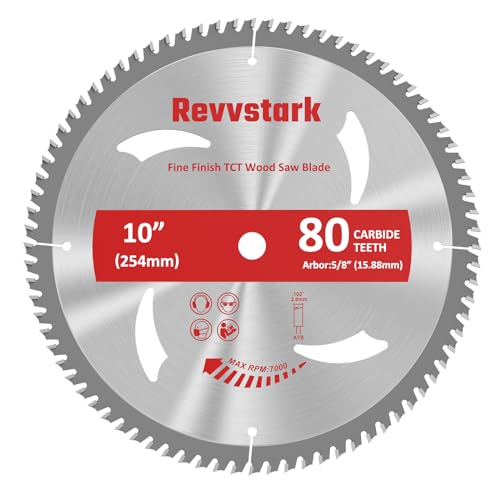
Revvstark takes the fine-cut route with 80 teeth, a 10-inch diameter, and a 5/8-inch arbor. The listing identifies the blade as carbide-tipped and gives it a maximum rating of 7,000 RPM. It also lists wood, plastic, and composite materials, including hardwood, softwood, plywood, MDF, panels, and laminated materials, so this is one of the broader material descriptions in the group.
The blade includes a thin laser-cut kerf, noise-reducing perforations, and thermal expansion grooves according to the product information. Those features explain the intended design direction, but the listing does not supply a kerf measurement or independent noise, heat, or longevity data. The 80-tooth layout is aimed at a dense cut pattern, making it more naturally suited to finish work than fast stock removal.
Pros
- Uses an 80-tooth configuration for fine woodworking cuts.
- 10-inch diameter and 5/8-inch arbor are documented.
- Lists wood, plastic, and composite material applications.
- Includes the stated 7,000 RPM maximum rating.
- Lists noise-reducing perforations and thermal expansion grooves.
Cons
- The listing does not provide a measured kerf width.
- An 80-tooth layout is less suited to buyers seeking a dedicated fast-ripping blade.
Choose this blade for finish-oriented work across the listed wood, plastic, and composite categories, provided the saw accepts its dimensions and RPM rating. Buyers cutting mostly thick stock along the grain may find the 24T or 32T options more appropriate.
To buy this product, click here.
5. HARDWIN 10-Inch 24-Tooth Carbide Blade: Best for Ripping

The HARDWIN blade is the clearest application-specific pick for ripping. Its 24 teeth are paired with a 5/8-inch arbor, and the listing names hardwood, softwood, plywood, and composites as supported materials. It also identifies compatibility with major brands including Makita, Milwaukee, and Skil, although the individual saw’s manual remains the final check.
A stated 2.4 mm kerf and 1.8 mm plate give this blade a more concrete dimensional profile than several competing listings. HARDWIN also lists a maximum rating of 6,800 RPM and carbide teeth joined with brazing technology. The product is still described as suitable for some finishing work, but its title and tooth count point more strongly toward board ripping and general stock preparation.
Pros
- 24-tooth configuration is explicitly positioned for ripping.
- 10-inch diameter and 5/8-inch arbor are documented.
- Lists hardwood, softwood, plywood, and composites.
- Provides a 2.4 mm kerf and 1.8 mm plate measurement.
- States a maximum rating of 6,800 RPM.
Cons
- The 24-tooth layout is less targeted to very fine exposed-edge work.
- Although several brands are named, the exact saw model still requires compatibility verification.
This is the practical pick for someone standing at a table saw with a stack of boards to rip and a preference for documented dimensions. For cabinet parts, trim, or other visible crosscuts, move toward a 60T or 80T blade instead.
To buy this product, click here.
6. WEN BL1060 10-Inch 60-Tooth Fine-Finish Blade: Best Single Fine-Finish Blade
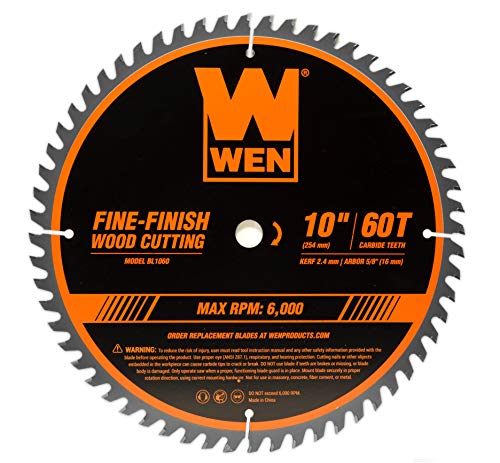
The WEN BL1060 keeps the choice straightforward. It is a single 10-inch, 60-tooth carbide-tipped blade with a 5/8-inch arbor, a configuration aimed at fine-finish wood cutting. The listing names both hardwoods and softwoods and places the blade on miter saws, jobsite saws, and table saws that accept the stated dimensions.
Its 2.4 mm kerf and 6,000 RPM rating make the technical details easy to check before installation. A 60-tooth arrangement is a natural match for buyers who want a cleaner woodworking cut than a 24T rip blade is intended to provide, though the listing does not establish measured finish results. This single-blade format is also useful for a shop that already owns a separate general-purpose blade.
Pros
- 60 carbide-tipped teeth are identified for fine-finish wood cutting.
- 10-inch diameter is documented.
- Uses a documented 5/8-inch arbor.
- Lists a 2.4 mm kerf.
- Rated up to 6,000 RPM and listed for several 10-inch saw categories.
Cons
- It is a single fine-finish blade rather than a multi-purpose set.
- The listing does not specify applications for plastic or composite materials.
The BL1060 is a clean fit for trim, panels, and woodworking where the cut edge matters and a separate rip blade is already available. Buyers who want one blade for several cutting styles should choose the WEN two-pack or a 40-tooth general-purpose model.
To buy this product, click here.
7. AvantiPro P106060PP 60-Tooth Two-Pack: Best Two-Pack for Fine Finishing

AvantiPro packages two 10-inch, 60-tooth carbide-tipped blades for buyers who want a spare ready on the shelf. The listing identifies wood, plywood, and laminates, which gives this pair a more focused material profile than a general-purpose mixed-tooth set. Both blades use the same tooth count, so the purchase is about replacement convenience rather than switching between ripping and finishing.
Laser-cut stabilizer vents are listed as a way to minimize blade movement and reduce noise and heat buildup. Those are stated design features, not independently measured outcomes. The product listing also identifies a 7,000 RPM maximum rating and compatibility with table saws and miter saws, but it does not provide the arbor size in the supplied information.
Pros
- Includes two 10-inch blades.
- Both blades use 60 carbide-tipped teeth.
- Lists wood, plywood, and laminate applications.
- Identifies laser-cut stabilizer vents.
- Provides a stated maximum rating of 7,000 RPM.
Cons
- The supplied product details do not specify the arbor diameter.
- Both blades share a 60T layout, so the pack does not cover aggressive ripping.
This pack makes sense for a woodworker who uses a fine-finish configuration frequently or wants a replacement close at hand. A mixed 32T and 60T set provides greater tooth-count range, while a 24T blade is the better match for repeated ripping.
To buy this product, click here.
8. Luckyway 32-Tooth and 60-Tooth Two-Pack: Best for Mixed Woodworking Materials
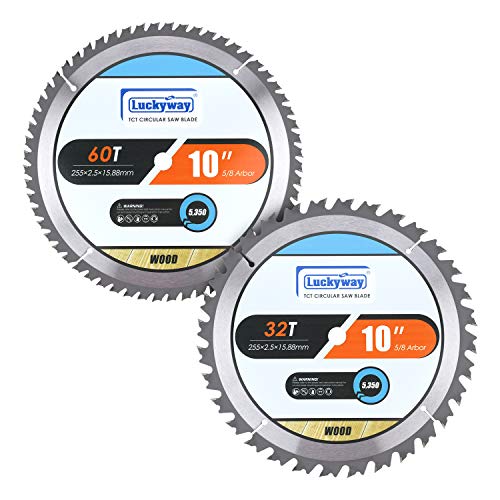
Luckyway’s two-pack pairs a 32-tooth blade with a 60-tooth blade, giving the buyer a general-cutting option and a finer option in one package. Both are 10 inches with a 5/8-inch arbor. The listing covers softwood, hardwood, plywood, chipboard, panels, MDF, laminates, and FRP, making this one of the widest documented material lists in the roundup.
The blades use an ATB tooth design, which the listing describes as scoring wood fibers before the following teeth remove the chip. That explanation is relevant to buyers concerned about surface splintering, although it should not be treated as a measured finish guarantee. The product can also rip along the grain according to the listing, but the 32T blade is the more natural choice for that work within this pair.
Pros
- Includes separate 32T and 60T blades.
- Both blades use a 10-inch diameter and 5/8-inch arbor.
- Lists ATB tooth design.
- Supports a broad documented range of wood, panel, laminate, and FRP materials.
- The listing identifies both crosscutting and ripping use.
Cons
- The set does not include a 24T blade for more aggressive ripping.
- The supplied details do not state a maximum RPM rating for this specific pair.
Pick Luckyway when material range and two distinct tooth counts matter more than owning a dedicated fine-finish spare. Buyers focused on finish work alone may prefer the WEN BL1060 or AvantiPro pair, while heavy board ripping points toward HARDWIN.
To buy this product, click here.
9. Ryltanks 32-Tooth, 60-Tooth, and 80-Tooth Three-Pack: Best Three-Stage Set

Ryltanks gives the widest documented tooth-count range in the roundup: 32 teeth for framing and general work, 60 teeth for ripping and crosscutting, and 80 teeth for fine finishing. Each blade is 10 inches with a 5/8-inch arbor, so the set is aimed at buyers who want to change the blade to match the cut rather than force one configuration to do everything.
The listing specifies a 2.5 mm kerf, a 6,000 RPM maximum, and compatibility with many 5/8-inch arbor table and miter saws. It also names hardwoods, softwoods, plywood, melamine, OSB, oak, pine, and nail-embedded wood. The three blades are carbide-tipped and include laser-cut stabilizer vents according to the listing. Buyers should still verify their exact saw and follow its blade requirements before using any configuration.
Pros
- Includes three distinct tooth counts: 32T, 60T, and 80T.
- All blades are identified as 10-inch models with 5/8-inch arbors.
- Provides a documented 2.5 mm kerf.
- Lists a maximum rating of 6,000 RPM.
- Names a broad range of wood and sheet-material applications.
Cons
- The 2.5 mm kerf is slightly different from the 2.4 mm kerf listed for some competing blades.
- Buyers who need a dedicated 24T ripping blade will need a different configuration.
This set suits a workshop that handles framing, general cutting, crosscutting, and fine finishing and has room to store multiple blades. It is less compelling for a buyer who wants one dedicated rip blade or one single finish blade with no unused configurations.
To buy this product, click here.
Buying Guide
Match Tooth Count to the Cut
Tooth count is the quickest way to separate these blades. The 24T DEWALT and HARDWIN models are the most obvious choices for ripping-oriented work. A 32T blade, such as the WEN or Luckyway option, moves toward general woodworking. The 60T and 80T blades are aimed at finer cutting configurations. That does not make a high tooth count automatically better, since a buyer cutting long boards along the grain may value a different balance than someone trimming visible plywood edges.
The circular-blade guide explains table-saw blade fit and task selection, keeping diameter, arbor, and kerf checks ahead of the tooth pattern.
Check Diameter and Arbor Before Ordering
A 10-inch diameter appears across all nine selected options, but the arbor information is not equally complete. WEN, Revvstark, HARDWIN, Luckyway, and Ryltanks document a 5/8-inch arbor. The DEWALT and AvantiPro listings supplied here do not provide that measurement. Confirm both the blade diameter and arbor against the saw manual. A matching diameter without a matching mounting specification is not enough.
Compare Kerf and Plate Information
Kerf describes the width of the cut made by the blade. WEN, HARDWIN, and Luckyway list a 2.4 mm kerf, while Ryltanks lists 2.5 mm. HARDWIN also provides a 1.8 mm plate measurement. Those figures help shoppers compare the documented physical design, but they do not establish a universal cutting-speed or finish advantage. The saw, material, tooth pattern, and intended operation still shape the result.
Use the Material List as a Selection Filter
Some listings stay broad, while others name specific materials. Revvstark lists wood, plastic, and composite materials. Luckyway includes panels, MDF, laminates, and FRP. Ryltanks names melamine, OSB, oak, pine, and nail-embedded wood. The DEWALT product details supplied here do not provide a comparable material list. Choose a product with documented coverage that resembles the stock you actually cut, then check any restrictions that apply to the specific saw.
Review RPM and Saw Compatibility
Several products provide a maximum RPM rating, including WEN at 6,000 RPM, Revvstark at 7,000 RPM, HARDWIN at 6,800 RPM, AvantiPro at 7,000 RPM, and Ryltanks at 6,000 RPM. These figures belong to the individual blade listing and should be compared with the saw’s requirements. A product that mentions table saw and miter saw compatibility still needs to match the exact machine, arbor, guard arrangement, and operating instructions.
Choose a Single Blade or Set
A single 40T or 60T blade keeps the decision simple and suits a buyer who already owns other configurations. Two-blade sets add a useful change between general cutting and finishing. The Ryltanks three-pack goes further with 32T, 60T, and 80T choices. Sets are useful only when the buyer will actually change blades for different work, so a dedicated 24T rip blade may be the smarter purchase for a shop that repeatedly performs one operation.
Best Carbide Table Saw Blades FAQ
What tooth count is best for table saw ripping?
A 24-tooth blade is the clearest ripping-oriented configuration among these products. HARDWIN identifies its 24T blade for ripping, and the DEWALT DWA11024 is labeled general purpose with the same tooth count. A 32T blade can provide a middle-ground option for general cutting, while 60T and 80T blades are more closely associated with fine-finish work in the supplied listings.
Is a 60-tooth blade suitable for a table saw?
Yes, several products in this roundup list 60-tooth blades for table saws. WEN BL1060, the WEN two-pack, AvantiPro, Luckyway, and Ryltanks all include a 60T configuration. Confirm the blade diameter, arbor, maximum rating, and the specific saw’s requirements before installation.
What arbor size do these 10-inch blades use?
Many of the listed models specify a 5/8-inch arbor, including WEN, Revvstark, HARDWIN, Luckyway, and Ryltanks. The supplied details for the DEWALT and AvantiPro models do not identify an arbor size. Since the arbor is a mounting dimension, check the exact product listing and saw manual rather than assuming that every 10-inch blade fits.
Are carbide-tipped blades the same as solid carbide blades?
No. The products in this roundup are carbide-tipped or described as using carbide teeth. That means the cutting teeth are carbide-tipped, while the blade body is a separate material. They should not be described as solid carbide saw blades.
Can one blade cut hardwood, plywood, and softwood?
Several listings identify multiple wood categories. WEN names hard and softwoods, HARDWIN lists hardwood, softwood, and plywood, and Luckyway and Ryltanks provide broader material lists. The appropriate tooth count can still differ by task. A blade listed for several materials may be convenient, but it does not eliminate the need to select a suitable ripping or finishing configuration.
Does a higher tooth count always produce a better cut?
No. A higher tooth count places more teeth into the cutting pattern and is commonly associated with fine-finish configurations in these listings. A lower tooth count, such as 24T, is more closely associated with ripping and general stock preparation. The better choice depends on the operation, material, desired edge, saw compatibility, and documented blade purpose.
Should I choose a two-pack or three-pack?
Choose a set when your projects genuinely alternate between cutting tasks. The WEN and Luckyway two-packs provide 32T and 60T choices, while Ryltanks adds an 80T blade to that range. A two-pack is simpler for general and finish work. A three-pack gives more flexibility, but a single dedicated blade can be more practical for a workshop with one repeated operation.
Final Verdict
The DEWALT DWA11040 is the strongest overall recommendation because its 10-inch, 40-tooth configuration sits between the aggressive 24T blades and the finish-focused 60T and 80T models. Its listing identifies carbide teeth and optimized tooth geometry, giving it a sensible general-purpose position. The missing arbor and material details mean compatibility must be confirmed before purchase, but the tooth count makes it a practical starting point for mixed woodworking.
Choose HARDWIN or the DEWALT DWA11024 for a more ripping-oriented setup. Choose WEN BL1060, AvantiPro, or Revvstark for a dedicated fine-finish direction. The WEN and Luckyway two-packs suit buyers who switch between general and finish cuts, while Ryltanks offers the broadest documented selection with 32T, 60T, and 80T blades. Match the final choice to the cut, stock, arbor, diameter, and saw rating rather than relying on tooth count alone.
