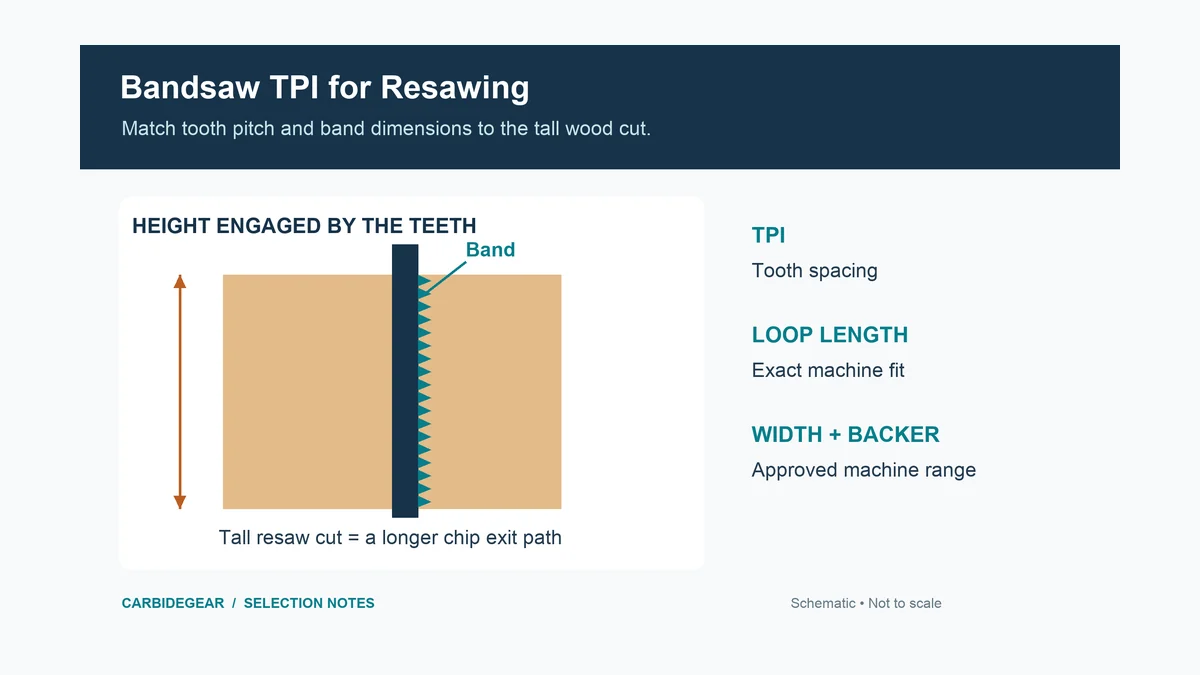
Bandsaw blade TPI for resawing should match the height of wood in the cut, the tooth design, and the machine. For thick wood, coarse-pitch resaw blades provide more gullet space to carry sawdust out of a deep cut. The suitable pitch still depends on feed and the saw’s ability to tension and drive the blade. The band must also have the exact loop length and an approved width and backer thickness.
Once the machine’s blade requirements are known, compare carbide-tipped bandsaw blades for wood resawing by those dimensions and their intended cutting application. Carbide teeth do not make an incorrectly sized band compatible with the saw.
Understanding Bandsaw Blade TPI for Resawing
TPI means teeth per inch along the cutting edge. A coarse band has fewer teeth over that distance and generally larger spaces between them. Those spaces—the gullets—carry the chips produced while the teeth are inside the workpiece.
During resawing, the teeth can travel through a tall section of wood before exiting. A fine pitch that works on a shallow section may struggle to transport the larger volume of sawdust from that deep engagement. Packed gullets can contribute to heat, high feed resistance, and a poor cut.
That does not make the lowest available TPI the best choice for every board. Too little support at the teeth, an unsuitable tooth form, excessive feed, or a blade the machine cannot tension can also cause trouble. Match the whole band to the operation.
Stock Thickness Means Height of the Cut
In resawing, the relevant engagement is the depth of wood the teeth pass through. A board standing on edge may be only an inch thick across the kerf but several inches tall in the cut. It is that tall section that keeps the teeth buried in wood.
As a simple geometric illustration, a uniform 3 TPI band has approximately 18 tooth positions within a straight 6-inch cutting engagement: 3 × 6 = 18. That calculation describes spacing only. It is not a target tooth count, a universal minimum, or a substitute for the manufacturer’s application guidance.
Variable-pitch bands alternate tooth spacing. Their markings cannot be reduced to one exact tooth count for every position in the cut. Use the specified pitch range and the blade maker’s intended stock range instead of assuming that an average gives a complete cutting recommendation.
Use TPI as a Conditional Starting Point
| Work situation | What to prioritize | What to check before changing the band |
|---|---|---|
| Deep resawing in solid wood | Chip capacity and a resaw-specific design | Stock height, gullets, power, and feed |
| Shallower straight cuts | Tooth support and required finish | Whether the current coarse band is appropriate for the section |
| Veneer slices from a tall board | Consistent tracking and a stable cut | Fence setup, stock support, sharpness, and allowance for cleanup |
| Tight curved work | Permitted turning radius | Blade width and task suitability, not resaw pitch alone |
| A large carbide band on a smaller saw | Machine compatibility | Length, width, backer, wheel size, and tension capability |
Some woodworking resaw ranges use coarse pitches around 2–3 TPI, including variable-pitch designs. Treat that as a description of available resaw tooling, not a command to put the same pitch on every saw or thickness of stock. The maker’s recommendation for the exact band takes priority.
Loop Length Is the First Fit Check
Order the blade length specified for the machine and its adjustment range. Similar-looking bandsaws can use different loop lengths. A band that is close to the advertised size can still sit outside the tracking or tension adjustment the saw was designed to provide.
Record the saw model rather than buying from wheel diameter alone. “Fourteen-inch bandsaw” describes a machine class; it is not a complete blade-length specification. Optional riser arrangements and model changes can alter the required length.
Width and Backer Thickness Have Separate Jobs
A wider band can provide useful support for a straight resaw cut, but only within the saw’s supported blade range. Wheel size, guides, frame, spring, and tension system all influence the practical choice. The widest blade that physically passes through the guides is not necessarily the one the machine can operate correctly.
Backer thickness is a different dimension from blade width or cutting kerf. The band repeatedly bends around the wheels; the appropriate backer depends on the blade and machine. A carbide-tipped band offered for a large industrial saw should not be assumed suitable for a smaller woodworking saw just because its loop length can be ordered.
Use the blade maker’s tension requirements together with the saw manual. Do not apply one tension value to every width, backer, and construction, and do not treat a machine’s scale as a reason to exceed its stated limits.
Carbide Teeth Do Not Eliminate Setup Work
Carbide-tipped resaw bands can retain a cutting edge in demanding wood applications, but the tooth material does not correct poor tracking, damaged guides, an unstable fence, or inconsistent feed. A premium band can still leave a tapered slice when the setup is wrong.
Install and adjust the band using the machine’s sequence for tracking, tension, and guides. Prepare a stable reference face and edge on the stock, then support the board through the entire cut. A resaw fence needs to suit the workpiece’s height and the particular saw setup.
Leave a realistic allowance for the surface to be cleaned up afterward. Kerf, surface texture, and movement released during resawing all affect the final usable thickness. A target veneer thickness is not automatically the same as the fence setting.
Read the Symptoms in Order
If a cut slows and the band heats, first inspect the teeth and gullets, confirm the material application, and check whether feed and chip evacuation suit the stock. Changing to a finer pitch can make a chip-capacity problem worse.
If the band wanders or the slice tapers, check sharpness, tooth damage, tension within the approved range, guides, fence alignment, and stock preparation. Do not increase tension or feed until the symptoms disappear without checking the machine’s limits.
Vibration can involve tooth engagement, tracking, wheel condition, or the band itself. Stop to identify the cause rather than assuming that a different TPI is the only answer.
Why Circular-Saw Tooth Counts Do Not Transfer
A circular blade’s printed tooth count describes all the teeth around the disc. Bandsaw TPI describes spacing along a band. Different engagement paths and chip-clearance conditions make a direct numerical comparison unhelpful. The saw-blade tooth-count guide explains the circular-blade terminology when moving between these systems.
What to Record Before Ordering
Choose bandsaw blade TPI for resawing only after checking the machine model, loop length, permitted width and backer, stock height, material, and the blade maker’s pitch and tension guidance. Those fields narrow the selection to bands that fit the saw and the work.
