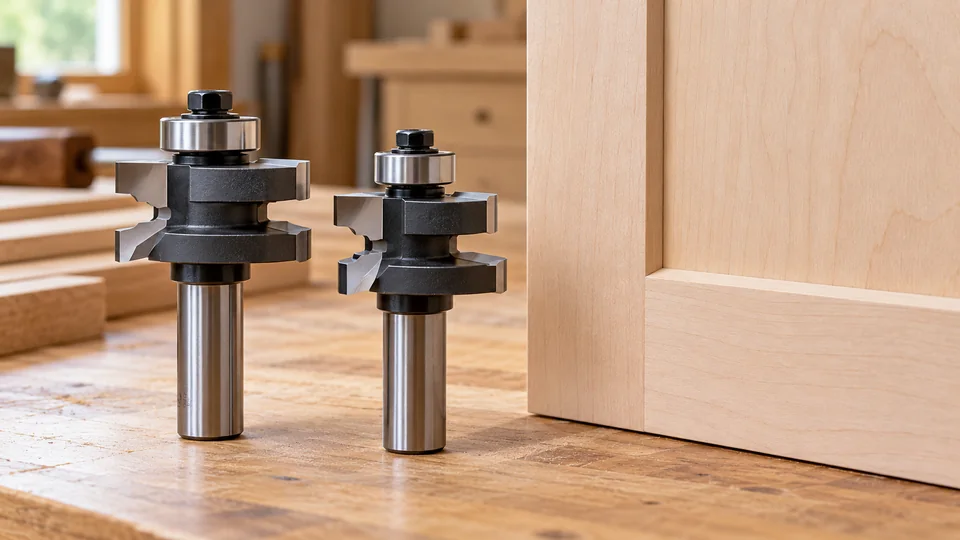
A Shaker door looks simple because its lines are simple. The joinery underneath is less forgiving. A rail and stile set must match the panel thickness, shank size, router-table setup, and the style you want at the door edge. Choose the wrong groove dimension and the panel may sit loosely, bind during assembly, or leave a visible mismatch where the rails meet the stiles.
The biggest buying mistake is treating every Shaker router bit set as interchangeable. Some are made for traditional straight profiles and undersized plywood, while others cut a 15-degree detail, accept actual 1/4-inch panels, or offer adjustable grooves for several door thicknesses. A 1/2-inch shank also requires a compatible collet and table-mounted router setup. Based on the documented specifications, the Freud Premier Adjustable Rail and Stile Bit is the strongest overall option for buyers who need broad adjustment across door thicknesses and panel materials.
Different shops have different priorities. A cabinetmaker may value groove adjustment and long tenons, while a hobbyist making one kitchen might prefer a lower-cost set with a straightforward 1/2-inch shank. Panel thickness, profile, storage, and router compatibility matter more here than a flashy product description, so the recommendations below separate traditional, modern, budget, and adjustable designs.
Quick Answer
- Best Overall: Freud Premier Adjustable Rail and Stile Bit for its adjustable 7/32-inch to 3/8-inch groove range and support for doors from 5/8 to 1-1/4 inches thick.
- Best for Traditional Shaker Doors: Whiteside 5990 Shaker Stile and Rail Router Bit for its 7/32-inch tongue specification and undersized plywood focus.
- Best for Modern 15-Degree Profiles: Whiteside 6009 15 Degree Shaker Stile and Rail Router Bit for actual 1/4-inch panels and a 1-inch cutting length.
- Best Budget 1/2-Inch Option: Newdeli 1/2-Inch Shank Shaker Rail and Stile Router Bits for a basic tongue-and-groove cabinet-door setup at a lower cost.
Best Router Bits for Shaker Doors Comparison Table
| Product | Best For | Bit Type | Shank Size | Panel or Door Range |
|---|---|---|---|---|
| Freud Premier Adjustable Rail and Stile Bit | Adjustable door construction | Adjustable rail and stile | 1/2 inch | Doors 5/8 to 1-1/4 inches thick |
| YONICO 12249 Rail and Stile Set | Standard Shaker frames | Two-bit rail and stile set | 1/2 inch | Stock up to 7/8 inch |
| Rockler Shaker Rail and Stile Set | Chamfered Shaker details | Two-piece rail and stile set | 1/2 inch | Table-mounted routing |
| Newdeli 1/2-Inch Shank Set | Budget cabinet projects | Tongue and groove set | 1/2 inch | Shaker doors and furniture |
| Whiteside 6009 | 15-degree modern profiles | 15-degree stile and rail | 1/2 inch | Actual 1/4-inch panels |
| Newdeli 1/4-Inch Shank Set | Smaller router collets | Tongue and groove set | 1/4 inch | Shaker doors and furniture |
| Sommerfeld Tools Three-Piece Set | Height-matched setups | Three-piece cabinet-door set | Not stated | Material from 3/4 to 7/8 inch |
| Whiteside 5990 | Traditional undersized plywood | Stile and rail set | 1/2 inch | 7/32-inch panels |
| CMT 800.624.11 | Adjustable plywood joints | Three-piece adjustable set | 1/2 inch | Boards 5/8 to 1-3/8 inches |
The detailed reviews focus on panel fit, profile style, shank compatibility, and the setup restrictions that separate these nine options.
1. Freud Premier Adjustable Rail and Stile Bit – Best Overall

A Shaker door project can shift quickly from a standard cabinet build to a custom furniture job. The Freud Premier Adjustable set is built for that kind of variation. Its documented range covers doors from 5/8 to 1-1/4 inches thick, while precision shims adjust the groove from 7/32 to 3/8 inch. That gives the buyer room to match different panel materials instead of being locked into one groove dimension.
The 1-11/16-inch diameter and 1/2-inch shank place this bit in the table-mounted router category. It is identified for doors, windows, veneered plywood, hardwoods, and softwoods, so the application range is broader than a basic fixed Shaker set. The listing also describes an extended-tenon system and Perma-SHIELD coating, but those features should be treated as design details rather than a guarantee of a particular joint life or finish.
Pros
- Adjustable groove range from 7/32 to 3/8 inch.
- Documented for door thicknesses from 5/8 to 1-1/4 inches.
- Uses a 1/2-inch shank for compatible router-table collets.
- Listed for hardwoods, softwoods, veneered plywood, doors, and windows.
- Includes a documented extended-tenon joint design.
Cons
- Requires a table-mounted router rather than a general handheld setup.
- The larger 1-11/16-inch diameter and adjustable setup demand careful calibration.
This is the most useful pick for a cabinetmaker who builds doors with varying thicknesses or panels. A buyer making one fixed-size set may prefer a simpler bit, while someone using undersized plywood should compare the groove specification before ordering.
To buy this product, click here.
2. YONICO 12249 Cabinet Door Rail and Stile Router Bits – Best Standard Set

The YONICO set keeps the job focused: cut the rail and stile portions of a Shaker cabinet door with two matching bits. The documented cutting depth is 3/8 inch in stock up to 7/8 inch, which gives a clear boundary for material planning. That detail matters if your door stock is close to the upper limit, since a trial cut in scrap wood can reveal whether the profile and panel fit match your layout.
A 1/2-inch shank and table-mount requirement make this a conventional choice for a router table. The bits use C3 micro-grain tungsten carbide blades and arrive in a wooden box, so storage is more orderly than tossing loose cutters into a drawer. The set is less flexible than the Freud adjustable design, but that simplicity can feel welcome during a batch of standard cabinet doors.
Pros
- Includes two bits for creating rail and stile cabinet-door frames.
- Specified for stock up to 7/8 inch thick.
- Uses a documented 3/8-inch cutting depth.
- Has a 1/2-inch shank for compatible table-mounted routers.
- Includes C3 micro-grain tungsten carbide blades and a wooden storage box.
Cons
- Its documented stock range stops at 7/8 inch, limiting thicker-door projects.
- The listing does not identify an adjustable groove range.
Choose this set for a straightforward run of standard Shaker frames, especially if the stock fits the published dimensions. The fixed format is less appealing for mixed panel thicknesses, where the Freud or CMT adjustable sets provide more room for setup changes.
To buy this product, click here.
3. Rockler Shaker Rail and Stile Router Bit Set – Best Chamfered Profile

The Rockler set is aimed at woodworkers who want a Shaker frame with a distinctive chamfered edge. That profile gives the door front a small visual break instead of leaving the frame completely flat, a detail that can look crisp under paint or clear finish. The two-bit design cuts cope and stick joints, and the bits are bearing-guided according to the listing.
This set has a clear setup discipline. Rockler specifies table-mounted use and recommends starting with cope cuts while the long edges remain flat and square. A backer board is also recommended to help limit tear-out at the end of the cut. Those instructions are useful for a first-time cabinet-door builder standing over a fresh board with the router humming, since sequence and support affect the quality of the cut.
Pros
- Creates a documented chamfered Shaker edge.
- Includes two bits for cope and stick rail-and-stile joints.
- Uses bearing guidance for the stated profile.
- Has sturdy 1/2-inch shanks.
- Includes setup guidance for cope cuts and backer-board use.
Cons
- Specified for a table-mounted router only.
- The chamfered profile may not suit buyers seeking a completely straight traditional Shaker face.
This is a strong match for cabinet doors where the edge detail is part of the design rather than an afterthought. A plain-profile project should lean toward the Whiteside 5990 or YONICO set, while anyone using this kit should follow the table-router restriction and test the joint on scrap.
To buy this product, click here.
4. Newdeli 1/2-Inch Shank Shaker Rail and Stile Router Bits – Best Budget 1/2-Inch Set

For a homeowner turning flat boards into a small run of cabinet doors, the Newdeli 1/2-inch set offers the basic format without the adjustment hardware found in more elaborate kits. It is described as a rail-and-stile tongue-and-groove set for cabinets and furniture, with controlled depth adjustment and smooth-running bearings identified in the product information.
The C3 micro-grain tungsten carbide tips are listed for clean cutting, while the plastic storage box keeps the two cutters separated. The published details do not establish a specific panel thickness range or a precise groove dimension, so the buyer needs to treat this as a general Shaker set rather than a precision solution for a specialized panel system.
Pros
- Uses a 1/2-inch shank.
- Includes rail-and-stile tongue-and-groove cutters.
- Lists C3 micro-grain tungsten carbide tips.
- Includes bearings and controlled depth adjustment in the product description.
- Comes in a protective plastic storage case.
Cons
- The supplied specifications do not state a precise panel-thickness range.
- The listing does not identify an adjustable groove range or specific profile angle.
This set suits a budget-conscious buyer with a compatible 1/2-inch router table and a conventional Shaker project. It is less suitable for a door program that depends on a precisely documented groove, where the Freud, Whiteside, or CMT options give clearer dimensional guidance.
To buy this product, click here.
5. Whiteside 6009 15 Degree Shaker Stile and Rail Router Bit – Best for Actual 1/4-Inch Panels

The Whiteside 6009 targets a particular look and a particular panel. Its 15-degree Shaker geometry creates a more contemporary detail than a straight traditional profile, while the 1/4-inch tongue specification is intended for actual 1/4-inch panels. That distinction is easy to miss in a product list, yet it can decide whether the panel sits correctly in the groove.
The bit has a 1-inch cutting length, a 1-5/8-inch large diameter, and a 1/2-inch shank. It is identified for natural and composite woods, with a 3/8-inch tongue depth. A cabinetmaker planning painted doors with modern bevel lines may find the profile especially relevant, while someone using 7/32-inch plywood should look at the Whiteside 5990 or 6008-style specification instead.
Pros
- Creates a documented 15-degree Shaker profile.
- Designed for actual 1/4-inch panels.
- Provides a 1-inch cutting length.
- Uses a 1/2-inch shank.
- Lists a 1-5/8-inch large diameter and 3/8-inch tongue depth.
Cons
- The 1/4-inch panel specification limits its fit for undersized 7/32-inch plywood.
- The 15-degree profile is unsuitable for buyers seeking a straight traditional Shaker edge.
Pick this bit when the panel is genuinely 1/4 inch and the angled profile is part of the finished design. It is a specialized purchase, so measuring the panel before ordering matters more than choosing by brand or appearance.
To buy this product, click here.
6. Newdeli 1/4-Inch Shank Shaker Rail and Stile Router Bits – Best for 1/4-Inch Collets

Shank size is the defining reason to look at this Newdeli set. Its 1/4-inch shank configuration is aimed at a different router setup from the 1/2-inch products above, which can matter for compact equipment and smaller collets. The set keeps the familiar two-bit rail-and-stile format for cabinet doors and furniture.
The product description identifies C3 micro-grain tungsten carbide tips, bearings, controlled depth adjustment, and a plastic case. It does not provide a precise panel range or groove measurement, so this option should be approached as a general-purpose Shaker set whose first compatibility check is the router collet. A wrong shank choice turns a promising bargain into a box that stays on the shelf.
Pros
- Uses a documented 1/4-inch shank.
- Includes two rail-and-stile tongue-and-groove bits.
- Lists C3 micro-grain tungsten carbide tips.
- Includes bearings and controlled depth adjustment.
- Comes with a protective plastic case.
Cons
- It is unsuitable for a router collet that accepts only 1/2-inch shanks.
- The supplied information does not state a panel-thickness range or groove dimension.
This is the practical pick for a buyer who has verified a 1/4-inch collet and wants a low-cost Shaker set. If the project depends on a known panel thickness or adjustable joint, a more fully documented set is the safer purchase.
To buy this product, click here.
7. Sommerfeld Tools Three-Piece Shaker Cabinet Door Router Bit Set – Best Height-Matched Set
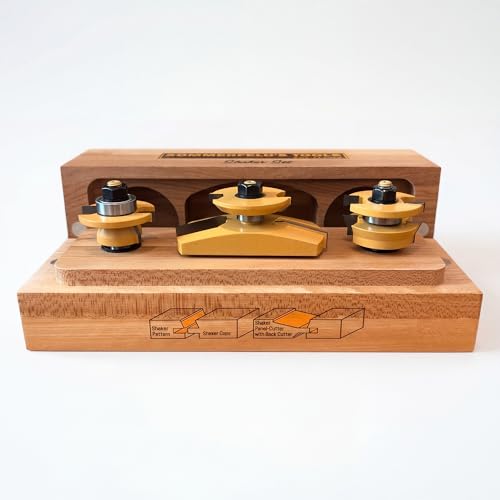
The Sommerfeld set takes a different approach from the two-bit kits. It contains three pieces and identifies the bits as height matched, which is meant to reduce the trial-and-error involved in switching between operations. That can be useful during a cabinet run, when repeated setup changes become tedious and a small height mismatch can show up as a stubborn joint.
The groove is set at 7/32 inch for many undersized plywood panels, and the set is specified for material from 3/4 to 7/8 inch thick. A panel cutter is also preset to make a 7/32-inch groove in the rails and stiles. The hardwood case is a practical storage detail, though the supplied product information does not state the shank diameter, so router compatibility must be verified before purchase.
Pros
- Includes three pieces for a broader cabinet-door setup.
- Bits are documented as height matched.
- Uses a preset 7/32-inch groove.
- Specified for material from 3/4 to 7/8 inch thick.
- Includes a custom-designed hardwood storage case.
Cons
- The supplied specifications do not state the shank diameter.
- The preset 7/32-inch groove is not intended for every panel thickness.
This set fits a woodworker who values repeatable setup and commonly works with 3/4- to 7/8-inch material. Buyers using actual 1/4-inch panels or needing an adjustable groove should choose a different configuration, and every buyer should confirm the shank size before ordering.
To buy this product, click here.
8. Whiteside 5990 Shaker Stile and Rail Router Bit – Best for Traditional Undersized Plywood

The Whiteside 5990 is built around the traditional straight Shaker look and a 7/32-inch panel. Its 7/32-inch tongue thickness is intended for undersized plywood, also listed as 5.5mm, so the selection decision is refreshingly clear: measure the panel, then match the bit. That is a better approach than assuming every sheet sold as a quarter-inch measures exactly the same.
The bit has a 13/16-inch cutting length, a 1-5/8-inch large diameter, and a 1/2-inch shank. The listing identifies a 3/8-inch tongue depth and carbide-tipped construction with a steel shank. Compared with the Whiteside 6009, this is the traditional straight-profile choice rather than the 15-degree modern version.
Pros
- Creates a traditional straight Shaker profile.
- Designed for 7/32-inch or 5.5mm undersized plywood panels.
- Uses a documented 7/32-inch tongue thickness.
- Provides a 13/16-inch cutting length.
- Has a 1-5/8-inch large diameter and 1/2-inch shank.
Cons
- It is intended for undersized panels rather than actual 1/4-inch panels.
- The fixed traditional profile does not provide the adjustment range of the Freud or CMT sets.
This is the cleanest match for a classic Shaker door made with 7/32-inch plywood. A modern angled design or variable panel thickness calls for another bit, but for the right sheet dimension, the straightforward specification is a major advantage.
To buy this product, click here.
9. CMT 800.624.11 Three-Piece Adjustable Shaker Router Bit Set – Best for Wider Board Thicknesses
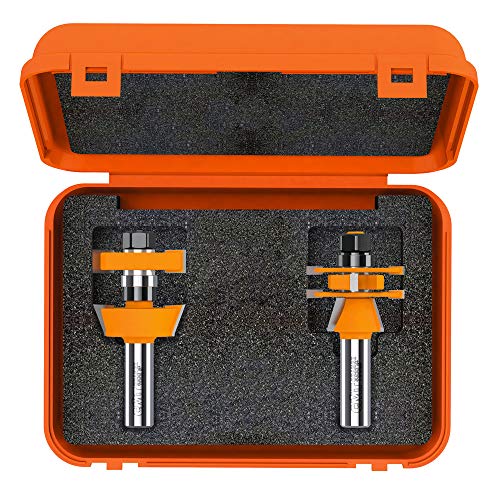
The CMT set is aimed at buyers who need a wider board-thickness window than a basic Shaker pair provides. Its documented range covers boards from 5/8 to 1-3/8 inches, and the design creates adjustable tongue-and-groove joints with a bevel. That combination gives it a useful place beside the Freud, especially for projects involving thicker stock.
The set uses a 1-5/8-inch diameter, a 1/2-inch cut depth, an 18-degree angle, and a 1/2-inch shank. CMT specifies mounting on a router table for plywood veneered panels and identifies an anti-kickback design that controls cutting depth. Those machine and material limits matter, so this is a focused cabinet-door tool rather than a general handheld-router accessory.
Pros
- Supports boards from 5/8 to 1-3/8 inches thick.
- Includes three pieces in an adjustable Shaker set.
- Creates adjustable tongue-and-groove joints with a bevel.
- Uses a 1-5/8-inch diameter and 1/2-inch cut depth.
- Is specified for router-table use with plywood veneered panels.
Cons
- Its documented application is limited to router-table work on plywood veneered panels.
- The 18-degree bevel gives it a different profile from traditional straight Shaker bits.
Choose the CMT when the board range and beveled profile fit the project, especially if 1-3/8-inch stock is part of the plan. For standard straight Shaker doors made from undersized plywood, the Whiteside 5990 or Sommerfeld set is more closely matched.
To buy this product, click here.
Buying Guide
Match the Groove to the Panel
Panel thickness is the first measurement to settle. The Whiteside 5990 and Sommerfeld set identify a 7/32-inch groove or panel relationship, while the Whiteside 6009 is intended for an actual 1/4-inch panel. Those two dimensions are close on a ruler but are not interchangeable in a finished door. Measure the panel itself, especially if it is plywood, before selecting the cutter.
Choose a Straight or Angled Profile
Traditional Shaker doors generally call for a straight, restrained frame detail. The Whiteside 5990 fits that direction. The Whiteside 6009 introduces a 15-degree profile, and the CMT set specifies an 18-degree angle. A sample cut in the same wood is the quickest way to judge whether the bevel suits the cabinet style before committing to a full door run.
Decide Whether Adjustment Matters
Fixed sets are easier to understand because the groove and profile are established by the cutter. Adjustable sets take more setup attention but can accommodate a broader range of door and panel dimensions. Freud documents a 7/32-inch to 3/8-inch groove range, while CMT covers boards from 5/8 to 1-3/8 inches. Pick adjustment only when the project will use that flexibility.
Check the Shank and Router Setup
A 1/2-inch shank cannot be placed in a 1/4-inch collet, and the reverse choice does not solve every compatibility issue. The YONICO, Freud, Rockler, Whiteside, and CMT products listed here use 1/2-inch shanks. The two Newdeli options separate into 1/2-inch and 1/4-inch versions. Sommerfeld’s supplied information does not state the shank diameter, so that detail should be confirmed before purchase.
Plan for a Router Table
Several products specify table-mounted use, including the Freud, Rockler, and CMT sets. A rail-and-stile bit has a broad cutting profile, so the machine configuration and the manufacturer’s instructions should guide the setup. Do not assume a bit listed for a router table is appropriate for a handheld router simply because the shank fits.
Look at the Complete Set
Some products are two-bit sets, while others include three pieces or adjustable components. A two-bit kit may be all that is needed for a single traditional door design. A three-piece set can make sense for repeated cabinet work, especially where height matching or a panel cutter reduces setup changes. Count the useful operations, not merely the number of pieces in the box.
For the wider geometry check, see cabinet-door profiles and frame-to-panel fit before treating the frame groove and panel edge as a matched system.
Best Router Bits for Shaker Doors FAQ
What Router Bit Size Is Best for Shaker Doors?
There is no single size for every Shaker door. The appropriate choice depends on the panel thickness, frame stock, profile, and shank accepted by the router. The Freud set covers doors from 5/8 to 1-1/4 inches, while the YONICO set is specified for stock up to 7/8 inch.
Can These Shaker Router Bits Be Used in a Handheld Router?
Several listings specify table-mounted router use, and the Rockler and CMT products expressly include that restriction. Do not transfer a router-table bit to handheld use without confirming the manufacturer’s instructions and the machine’s compatibility.
Should I Choose 1/4-Inch or 1/2-Inch Shanks?
Choose the shank that matches the compatible router collet and the product’s stated setup. The Newdeli products are available in separate 1/4-inch and 1/2-inch versions, while many of the other reviewed sets use 1/2-inch shanks. A matching diameter is required before the profile or panel dimensions matter.
Are 7/32-Inch and 1/4-Inch Panels the Same for Router-Bit Selection?
No. The Whiteside 5990 and Sommerfeld set are associated with 7/32-inch panels or grooves, while the Whiteside 6009 is designed for actual 1/4-inch panels. Measure the material and match the tongue and groove specification rather than relying on the nominal label used at the store.
What Is the Difference Between a Fixed and Adjustable Shaker Set?
A fixed set uses a defined profile and groove dimension. An adjustable set uses shims or a multi-piece arrangement to accommodate more than one joint configuration. Freud documents shims for a 7/32-inch to 3/8-inch groove range, while the CMT set creates adjustable tongue-and-groove joints.
Can I Use These Bits on Hardwood and Softwood?
Product support varies. Freud lists hardwoods and softwoods among its intended materials, while the Newdeli listings describe woodworking and cabinet-door use without providing the same detailed material range. Match the material information to the selected product and make a test cut before machining finished parts.
How Should I Compare a 15-Degree Bit with a Traditional Shaker Bit?
Compare the finished profile first. The Whiteside 6009 creates a documented 15-degree Shaker pattern, while the Whiteside 5990 is identified for a traditional straight Shaker design. A scrap test makes the visual difference clear and helps confirm that the panel sits correctly.
Final Verdict
The Freud Premier Adjustable Rail and Stile Bit is the strongest overall recommendation because its documented groove adjustment and broad door-thickness range address the two problems that cause the most setup frustration. Its 1/2-inch shank and table-mounted requirement narrow the compatible equipment, but the ability to work across 7/32-inch to 3/8-inch grooves gives it more practical range than a fixed two-bit set.
For a lower-cost standard project, the YONICO set offers a clear 3/8-inch cutting depth, stock up to 7/8 inch, and a 1/2-inch shank. The Whiteside 5990 is the better match for traditional doors using 7/32-inch panels, while the Whiteside 6009 suits actual 1/4-inch panels with a 15-degree profile. Before ordering, measure the panel, confirm the collet, and verify that the chosen bit’s profile matches the door design.
