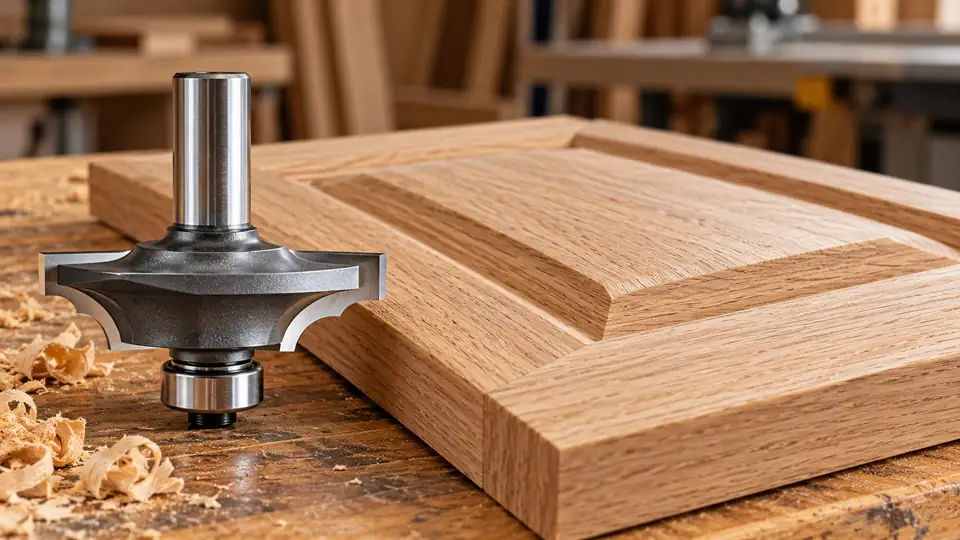
A raised panel bit can turn a plain cabinet panel into the part that catches the light first, but the profile is only half the decision. The router table, shank size, panel thickness, and matching rail-and-stile setup all matter before a single shaving of wood reaches the floor. A 3-1/2-inch panel raiser intended for 3/4-inch stock is a very different purchase from a compact 1-3/4-inch bit for lighter cabinet work.
The most common mistake is choosing by diameter or price alone. Buyers also need to check whether the bit is intended for a table-mounted router, whether the shank matches the collet, and whether the cutting height suits the panel stock. A set may provide useful rail, stile, tongue, and groove functions, while a single profile bit may be the better fit for a specific door design. The Freud 99-518 takes the top overall position here because its documented stock-height guidance, broad wood-material compatibility, and 1/2-inch shank make it a clear fit for traditional cabinet-panel work.
Different woodworkers will favor different profiles. A cove bit gives a softer transition, an ogee creates more ornament, a bevel suits cleaner contemporary lines, and a backcutter can simplify the rear of a traditional panel. The recommendations below weigh those distinctions alongside table-router requirements, dimensions, included functions, and the gaps in each product listing, so the right choice starts with your door design rather than a flashy product photo.
Quick Answer
- Best Overall: Freud 99-518 3-1/2-Inch Raised Panel Bit for documented use with 5/8-inch and 3/4-inch stock and a 1/2-inch shank.
- Best for Traditional Doors: Freud 99-566 Raised Panel Bit With Backcutters for its integrated backcutting function, shims, and traditional reveal design.
- Best Cabinet-Making Set: Freud 97-156 Three-Piece Premier Adjustable Cabinet Bit Set for buyers who need rail-and-stile tooling alongside panel work.
- Best Value-Oriented Profile: YONICO 12151 Bevel Raised Panel Bit for a documented 3-1/2-inch profile, 5/8-inch cutting height, and table-router use.
Best Raised Panel Router Bits Comparison Table
| Product | Best For | Bit Type | Shank | Cutting Diameter | Documented Application |
|---|---|---|---|---|---|
| Freud 99-518 | Overall cabinet-panel work | Raised panel | 1/2 inch | 3-1/2 inches | Doors, drawer fronts, paneling |
| Freud 99-516 | Four-cutter panel routing | Raised panel | 1/2 inch | 3-1/2 inches | Hardwood, softwood, composites |
| Newdeli Three-Piece Set | Mixed cabinet-door tasks | Raised panel, rail and stile | 1/4 inch | Tenon cutter 1-5/8 inches | Wood, MDF, plywood, composites |
| YONICO 12151 | Beveled cabinet panels | Bevel panel raiser | 1/2 inch | 3-1/2 inches | Standard rail-and-stile doors |
| YONICO 12133 | Cove-style cabinet doors | Cove panel raiser | 1/2 inch | 3-1/8 inches | Raised panels with matching rail-and-stile bits |
| YONICO 12130Q | Smaller ogee profiles | Ogee panel raiser | 1/4 inch | 1-3/4 inches | Standard cabinet-door center panels |
| Cabinet Door Three-Piece Set | Basic multi-function setup | Raised panel, tongue and groove | 1/2 inch listed | 2-1/2 inches | Wood, MDF, plywood, composites |
| Freud 97-156 | Complete cabinet-door tooling | Adjustable rail and stile set | 1/2 inch | Not specified | Hardwood, softwood, composites |
| Freud 99-566 | Traditional panels with backcut | Raised panel with backcutters | 1/2 inch | 3-1/2 inches | 3/4-inch panels and traditional doors |
The detailed reviews below show where each profile, shank, and cabinet-door function makes the most sense.
1. Freud 99-518 3-1/2-Inch Raised Panel Bit | Best Overall

The Freud 99-518 is the easiest recommendation for a woodworker who already has a table-mounted router and wants a dedicated raised-panel profile. Its 3-1/2-inch diameter is intended for cabinet doors, drawer fronts, paneling, and decorative work, while the 1/2-inch shank suits a router table equipped for that collet size. The listing gives useful guidance that many cheaper-looking alternatives leave vague: use the 1/2-inch height for 5/8-inch stock and the 5/8-inch height for 3/4-inch stock.
That stock guidance matters at the bench. A panel cut from 3/4-inch hardwood needs a different cutting-height choice from a thinner 5/8-inch panel, and the finished profile should meet the surrounding rails and stiles cleanly. The bit is identified for composition materials, plywoods, hardwoods, and softwoods, so it covers the common cabinet-door material range without asking the buyer to guess from a photograph. It remains a table-router tool, though, and the product information does not support treating it as a handheld-router accessory.
Pros
- Documented 3-1/2-inch raised-panel profile.
- Uses a 1/2-inch shank.
- Provides guidance for both 5/8-inch and 3/4-inch stock.
- Listed for composition materials, plywoods, hardwoods, and softwoods.
- Intended for doors, drawer fronts, paneling, and decorative tasks.
Cons
- Requires a table-mounted router according to the listing.
- The supplied information does not identify a bearing or included rail-and-stile bit.
This is the best fit for cabinet builders who want one clearly specified panel raiser for common stock thicknesses and already have compatible table-router equipment. A buyer seeking a complete door-making setup will need matching rail-and-stile tooling separately, while someone making a traditional flush-backed panel may prefer the Freud 99-566 below.
To buy this product, click here.
2. Freud 99-516 3-1/2-Inch Raised Panel Bit | Best Four-Cutter Option

The Freud 99-516 shares the broad 3-1/2-inch panel profile category with the top pick, but its documented specifications are more detailed. The listing identifies four cutters, a 1/2-inch carbide height, a 1-1/4-inch small diameter, a 2-1/2-inch overall length, and a 1/2-inch shank. Those dimensions give a buyer more information for checking the bit against a router-table setup and the intended panel stock.
Its 1/2-inch carbide height is specified for 5/8-inch stock, while the listing directs users toward a 5/8-inch height for 3/4-inch stock. The product is also identified for hardwood, softwood, and composite panels, with Freud Quadra-Cut technology and Perma-SHIELD coating named in the supplied details. The important practical boundary is clear: this bit is for a table-mounted router with a fence, not a freehand routing job in a cabinet door.
Pros
- Documented four-cutter configuration.
- Uses a 3-1/2-inch overall diameter.
- Provides a listed 1/2-inch carbide height for 5/8-inch stock.
- Uses a 1/2-inch shank and is specified for table-mounted routing.
- Lists Quadra-Cut technology and Perma-SHIELD coating.
Cons
- Requires a table-mounted router with a fence.
- The supplied information does not identify an included backcutter or matching rail-and-stile set.
This bit suits buyers who want a Freud panel raiser with a four-cutter specification and clearly stated dimensions. It may be less useful for someone who needs the rear of a 3/4-inch panel rabbeted during the same operation, where the 99-566 has a more specialized design.
To buy this product, click here.
3. Newdeli Three-Piece Raised Panel Router Bit Set | Best Compact Cabinet Set

The Newdeli set takes a different route from the single-profile Freud and YONICO bits. It includes three cabinet-door tools covering a raised panel, ogee rail and stile work, and tongue-and-groove functions. That arrangement can appeal to a woodworker building a small door project who wants several related operations in one purchase rather than collecting each bit separately.
The listing identifies a 1/4-inch shank, a 1-5/8-inch tenon-cutter diameter, C3 micro-grain tungsten carbide blades, and a hardened steel body. It also names wood, MDF, particle board, plywood, acrylic, and other wood composites as suitable materials, while clearly excluding hard metal sheets and non-wood materials. The supplied instructions mention clamping to the marked line and a maximum RPM of 18,000, so buyers should follow the product instructions and verify their router’s compatibility before use.
Pros
- Includes three cabinet-door router bits.
- Uses a documented 1/4-inch shank.
- Includes raised-panel, rail-and-stile, and tongue-and-groove functions.
- Lists wood, MDF, particle board, plywood, acrylic, and wood composites.
- Identifies C3 micro-grain tungsten carbide blades.
Cons
- The 1/4-inch shank limits use to routers with a compatible 1/4-inch collet.
- The supplied information identifies a maximum RPM but does not provide individual bit dimensions for every tool.
This set makes sense for a compact cabinet-making setup where several door-building operations matter more than owning a large standalone panel raiser. Buyers focused on a broad 3-1/2-inch traditional profile may prefer a Freud bit, while those wanting a small collection of related functions will find the Newdeli format more practical.
To buy this product, click here.
4. YONICO 12151 3-1/2-Inch Bevel Raised Panel Bit | Best Bevel Profile

The YONICO 12151 is aimed at a specific visual result: a beveled raised panel for a standard rail-and-stile cabinet door. Its 3-1/2-inch diameter and 5/8-inch total cutting height provide a useful reference for planning the panel design, while the 1-1/2-inch cutting depth and 5/16-inch fillet further define the profile described in the listing.
The 1/2-inch shank places it in the same table-router class as the larger Freud panel bits. YONICO identifies C3 micro-grain tungsten carbide blades and silver induction brazing in the product information, but the practical buying question remains profile compatibility. A bevel will give a different edge transition from the cove and ogee options elsewhere in this roundup, so the matching rail-and-stile cutter and the desired cabinet style deserve attention before purchase.
Pros
- Documented 3-1/2-inch diameter.
- Provides a listed 5/8-inch total cutting height.
- Identifies a 1-1/2-inch cutting depth and 5/16-inch fillet.
- Uses a 1/2-inch shank.
- Lists C3 micro-grain tungsten carbide blades and silver induction brazing.
Cons
- Specified for a table-mounted router only.
- The product is a single bevel panel bit, so matching rail-and-stile tooling is separate.
Choose this model for a cleaner beveled panel treatment and a full-size 1/2-inch-shank setup. A cove or ogee profile will be a better visual match for more decorative door designs, while a complete cabinet-door set will save time for buyers starting from an empty router-bit drawer.
To buy this product, click here.
5. YONICO 12133 3-1/8-Inch Cove Raised Panel Bit | Best Cove Profile

The YONICO 12133 is the profile-driven pick for cabinet doors with a cove-shaped raised panel. Its 3-1/8-inch diameter is slightly smaller than the 3-1/2-inch options above, and its listing specifically describes use with matching YONICO rail-and-stile router bits. That makes the bit a focused choice for a coordinated door-making system rather than a general-purpose decorative cutter.
There is useful construction information here, including C3 micro-grain tungsten carbide blades and silver induction brazing. The product is intended for a table-mounted router and uses a 1/2-inch shank, so the equipment requirement is straightforward for a compatible table setup. The supplied data does not state the cutting height or overall length, however, so buyers should verify those dimensions before committing to a particular panel thickness or storage arrangement.
Pros
- Uses a documented 3-1/8-inch diameter.
- Provides a cove-style raised-panel profile.
- Uses a 1/2-inch shank.
- Identifies C3 micro-grain tungsten carbide blades.
- Is specified for use with matching rail-and-stile router bits.
Cons
- Requires a table-mounted router.
- The supplied information does not specify cutting height or overall length.
This model belongs in a cabinet shop where the cove profile is part of the design language and matching rail-and-stile bits are already available or planned. If panel thickness is still undecided, the more detailed height guidance on the Freud options makes them easier to evaluate first.
To buy this product, click here.
6. YONICO 12130Q 1-3/4-Inch Ogee Raised Panel Bit | Best Compact Ogee

The YONICO 12130Q is the compact profile in this group. Its 1-3/4-inch diameter and 1/4-inch shank create a different buying proposition from full-size 1/2-inch-shank panel raisers. The listing identifies a 5/8-inch cutting depth, 1/2-inch total cutting height, and 3/16-inch fillet, giving the buyer a useful outline of the ogee shape for standard cabinet-door center panels.
A smaller cutter can make sense for a modest router-table setup or a door design that calls for a less dominant panel profile, but the product remains a table-router tool. YONICO lists C3 micro-grain tungsten carbide blades and silver induction brazing, while the supplied information does not establish a specific panel-stock range. That missing detail means careful test fitting and profile matching matter before cutting a finished hardwood panel.
Pros
- Uses a compact 1-3/4-inch diameter.
- Provides an ogee panel-raiser profile.
- Uses a documented 1/4-inch shank.
- Lists a 5/8-inch cutting depth and 1/2-inch total cutting height.
- Identifies a 3/16-inch fillet and C3 micro-grain tungsten carbide blades.
Cons
- Requires a table-mounted router with a compatible 1/4-inch collet.
- The listing does not specify a recommended panel-stock thickness range.
This is a useful fit for smaller cabinet doors, lighter decorative work, or a buyer who specifically wants an ogee without moving to a 3-1/2-inch cutter. A larger 1/2-inch-shank bit is more appropriate for a full-size traditional panel project where the stock dimensions are already established.
To buy this product, click here.
7. Cabinet Door Three-Piece Raised Panel Router Bit Set | Best Multi-Function Budget Set

This three-piece set is aimed at buyers who want several cabinet-door operations in one package. The listing describes a raised-panel bit, a tongue-and-groove cutter, and a slot cutter, with the panel bit identified as 2-1/2 inches in diameter. It also lists wood, cedar, hardwood, softwood, plywood, particleboard, composite materials, and MDF among the intended materials.
The set has a useful adjustment detail for the tongue-and-groove function. The listing says the blade spacing can be fine-tuned with washers, and it advises clamping the 1/2-inch tongue-and-groove bit at least 0.6 inches from the blade. At the same time, the product information contains mixed shank references, with a 1/2-inch shank in the title and a 1/4-inch slot-cutter reference in the feature text. That conflict deserves verification before purchase, particularly if the router table has only one collet size.
Pros
- Includes three cabinet-door router bits.
- Lists a 2-1/2-inch raised-panel bit.
- Combines panel, tongue-and-groove, and slot-cutting functions.
- Identifies wood, MDF, plywood, particleboard, and composite applications.
- Provides a washer-based adjustment method for blade spacing.
Cons
- The supplied listing contains conflicting shank references that should be checked before purchase.
- The product is unsuitable for metal, slate, stone, and other listed non-wood materials.
This set is best for a buyer who values several cabinet-door functions over a single highly specified profile. It can be a practical starting point for basic furniture work, but a woodworker who needs predictable shank compatibility and exact panel-height guidance should choose one of the more fully documented standalone bits.
To buy this product, click here.
8. Freud 97-156 Three-Piece Premier Adjustable Cabinet Bit Set | Best Complete Cabinet Set
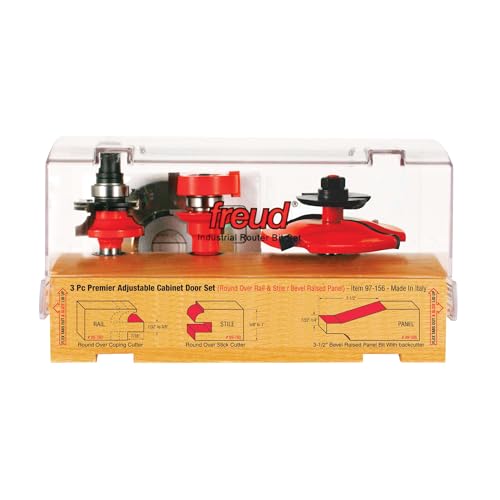
The Freud 97-156 is the broadest cabinet-door package in this selection. Rather than presenting a single raised-panel profile, it combines three pieces with Freud’s Quadra-Cut and Premier Adjustable Rail & Stile technology. That format makes sense for a buyer who is building doors from raw stock and needs the joining operations as well as the center-panel work.
The set uses 1/2-inch shanks, cuts composition materials, plywoods, hardwoods, and softwoods, and includes a wooden storage box. Those details help answer practical questions about collet compatibility, material range, and workshop storage. The supplied information does not list the individual bit diameters, profile dimensions, or exact adjustment range, so it should be purchased as a coordinated cabinet-making set rather than selected for a single known panel geometry.
Pros
- Includes three cabinet-making router bits.
- Uses documented 1/2-inch shanks.
- Includes Quadra-Cut and Premier Adjustable Rail & Stile technology.
- Lists composition materials, plywoods, hardwoods, and softwoods.
- Includes a wooden storage box.
Cons
- The supplied information does not provide individual bit diameters or cutting heights.
- It may provide more tooling than a buyer who needs only one replacement panel bit.
Buy this set when the project involves complete cabinet-door construction and the 1/2-inch router-table setup is already in place. For a single bevel, cove, or ogee profile, a dedicated YONICO bit gives a more direct match to the intended appearance and documented dimensions.
To buy this product, click here.
9. Freud 99-566 Raised Panel Bit With Backcutters | Best for Traditional Flush-Back Panels

The Freud 99-566 addresses a detail that ordinary raised-panel bits leave for another operation: the rear of the panel. Its integrated backcutters are specified to rabbet 3/4-inch panels so they sit flush with a 3/4-inch frame. The bit also carries a 3-1/2-inch diameter, 1/2-inch shank, four cutters, 1-inch carbide height, and 3-inch overall length, making its purpose unusually clear for traditional cabinet-door construction.
The listing describes a full 1-1/2-inch reveal, shims for adjusting tongue thickness from 7/32 inch to 1/4 inch, and an included 54-562 radius backcutter. It also says that the radius backcutter can be replaced with an optional 54-560 square backcutter for a different rear appearance. This is a specialized bit, and the table-mounted router with fence requirement matters because the larger profile and backcutting function demand a suitable setup.
Pros
- Includes backcutters for a 3/4-inch panel and frame relationship.
- Uses a documented 3-1/2-inch diameter and 1/2-inch shank.
- Identifies four cutters and a 1-inch carbide height.
- Provides shims for 7/32-inch to 1/4-inch tongue adjustment.
- Includes a radius backcutter and supports an optional square backcutter.
Cons
- Requires a table-mounted router with a fence.
- Its backcutting design is specialized and may be unnecessary for simpler panel projects.
This is the strongest choice for a traditional raised-panel door where the rear rabbet and frame relationship are central to the build. A standard Freud 99-518 is easier to justify for general panel routing, while a compact YONICO bit is better suited to smaller profiles and 1/4-inch-shank equipment.
To buy this product, click here.
Buying Guide
Match the Profile to the Door Design
A bevel, cove, and ogee do not produce the same visual transition. The YONICO 12151 is described as a bevel panel raiser, the 12133 as a cove design, and the 12130Q as an ogee profile. Look at the rail-and-stile design first, then choose the panel bit that continues its lines instead of treating every raised panel as interchangeable.
Check Panel Thickness and Cutting Height
Panel thickness affects how the profile meets the surrounding frame. The Freud 99-518 provides guidance for 5/8-inch and 3/4-inch stock, while the 99-566 is specifically documented around 3/4-inch panels and backcutting. Several other listings provide cutting-height figures, but do not assume those figures establish a recommended stock thickness unless the product information says so.
Verify the Router Table and Shank
Most of the selected products are identified for table-mounted routers, and that restriction should shape the purchase. A 1/2-inch shank needs a compatible 1/2-inch collet, while the YONICO 12130Q and Newdeli set use 1/4-inch shanks. The cabinet-door set with ASIN B0D7T9YDKZ contains conflicting shank references, so its exact configuration should be confirmed before use.
Decide Between a Single Bit and a Set
A dedicated bit makes sense when the profile is already chosen and matching rail-and-stile tooling is available. A set is more useful for a new cabinet-door project. The Newdeli package combines three related functions in a compact format, while the Freud 97-156 focuses on a complete cabinet-making system with adjustable rail-and-stile technology.
Look at Rear-Panel Requirements
A standard raised-panel bit shapes the front profile, but a traditional door may also need a rear rabbet or backcut. The Freud 99-566 includes backcutters and shims for that purpose. If the rear of the panel simply rests in a groove or another operation will handle the rabbet, that extra function may add complexity without helping the particular build.
Keep Material Limits in View
The supplied listings identify several products for hardwood, softwood, plywood, MDF, particleboard, composites, or acrylic. They also state exclusions for metal and other non-wood materials on some sets. Raised-panel router bits are woodworking tools in this roundup, so a material mentioned for one product should not be transferred to another product automatically.
The profile guide places raised-panel profiles and router setup requirements alongside the frame and panel dimensions that have to work together.
Best Raised Panel Router Bits FAQ
Can Raised Panel Router Bits Be Used in a Handheld Router?
The supplied product information identifies the reviewed panel bits for table-mounted routers, and several specifically require a fence. Do not assume a large raised-panel bit is suitable for handheld use. Check the exact product instructions and the router manufacturer’s requirements before fitting a bit.
What Shank Size Should I Choose?
Choose a shank that matches the router collet. The Freud 99-518, Freud 99-516, YONICO 12151, YONICO 12133, Freud 97-156, and Freud 99-566 use 1/2-inch shanks according to their listings. The YONICO 12130Q and Newdeli set use 1/4-inch shanks. The three-piece cabinet-door listing contains mixed shank information, so verify that detail before ordering.
Which Bit Is Best for 3/4-Inch Cabinet Panels?
The Freud 99-518 provides explicit guidance for 3/4-inch stock by identifying a 5/8-inch height choice. The Freud 99-566 is also closely associated with 3/4-inch panels because its backcutters rabbet the panel rear for a flush relationship with a 3/4-inch frame. Always compare the exact panel dimensions with the product instructions before routing finished material.
Do I Need Rail-and-Stile Bits Alongside a Raised Panel Bit?
Usually, a cabinet door requires more than the center-panel profile. The Newdeli set includes rail-and-stile and tongue-and-groove functions, and the Freud 97-156 is a three-piece cabinet bit set with adjustable rail-and-stile technology. A standalone panel bit such as the Freud 99-518 or YONICO 12151 does not replace those separate frame-making operations unless the rest of the tooling is already available.
What Is the Difference Between a Cove and an Ogee Panel?
A cove profile and an ogee profile create different transitions across the face of the panel. The YONICO 12133 is identified as a cove panel raiser, while the YONICO 12130Q is identified as an ogee panel raiser. The correct choice depends on the door style and the profile of the matching rail-and-stile cutters.
Are These Router Bits Suitable for Metal?
No product in this selection should be treated as a general metal-cutting tool. Several listings specifically identify wood, MDF, plywood, composites, or acrylic and exclude metal or other non-wood materials. Follow the exact material restrictions for the product you select rather than relying on the word “carbide” alone.
Should I Choose a Backcutter?
Choose a backcutter when the door design calls for a rabbeted panel rear or a particular relationship between the panel and frame. The Freud 99-566 includes backcutters, shims, and a radius backcutter for that specialized task. If the panel will be fitted by another method, a standard raised-panel bit may be simpler.
Final Verdict
The Freud 99-518 is the strongest overall recommendation because its 3-1/2-inch raised-panel format, 1/2-inch shank, broad listed wood-material range, and guidance for 5/8-inch and 3/4-inch stock address the central questions most cabinet-door builders face. It remains a table-mounted router bit, but that requirement is clearly documented rather than hidden behind vague product language.
Choose the Freud 99-566 for traditional 3/4-inch doors that need integrated backcutting, the Freud 97-156 for a broader cabinet-door tooling setup, or the YONICO 12151, 12133, and 12130Q when the bevel, cove, or ogee profile is the deciding feature. Before ordering, match the shank to the collet, confirm the table-router requirement, and compare the bit’s documented dimensions with the panel stock and rail-and-stile system already in the shop.
