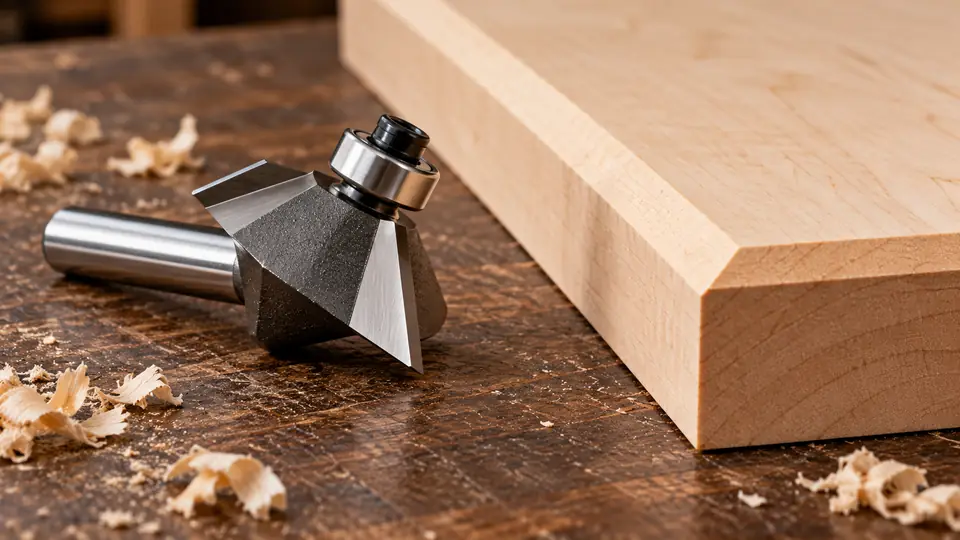
A chamfer bit turns a harsh, square corner into a clean bevel with one controlled pass, but the angle and shank size decide whether that pass belongs on a picture frame, cabinet edge, or a large workpiece. Buyers searching for the best chamfer router bits often make the same early mistake: they focus on the number of pieces and overlook whether the set actually fits their router collet. A 1/2-inch shank cannot go into a 1/4-inch collet, and a compact trim router may not provide the clearance needed for a large-diameter bit.
The useful differences here are easy to feel in a workshop. Multi-angle sets such as the WSOOX and FivePears give you more bevel choices for decorative edges and miter work, while dedicated 45-degree bits keep the setup simpler. Bearing-guided models can help with edge following, and larger bits with longer cutting heights suit broader workpieces when the router and collet support them. Material guidance matters too. Several options are identified for hardwood, plywood, MDF, laminate, or composite panels, while the FivePears listing specifically excludes metal and other non-wood materials.
For most woodworkers who want a flexible starting point, the WSOOX five-piece set is the strongest overall fit because it combines a 1/4-inch shank with five clearly different chamfer angles. Buyers with a 1/2-inch router, a small trim router, or a narrow preference for 45-degree work may find another option more suitable, so the rankings below separate those use cases rather than treating every chamfer bit as interchangeable.
Quick Answer
- Best Overall: WSOOX 5PCS Chamfer Router Bits for five useful bevel angles in a 1/4-inch-shank set.
- Best for Bearing-Guided 45-Degree Work: Whiteside Router Bits 2292 for its documented bearing guide and compact 1-inch diameter.
- Best for Large Workpieces: Whiteside Router Bits 2306 for its 1/2-inch shank, 2-inch diameter, and 1-1/16-inch cutting length.
- Best for 1/2-Inch Router Flexibility: FivePears 6 PCS Chamfer Router Bit Set for six angles, including a 60-degree bit.
Best Chamfer Router Bits Comparison Table
| Product | Best For | Bit Type | Shank Size | Angle or Size | Notable Feature |
|---|---|---|---|---|---|
| WSOOX 5PCS Chamfer Router Bits | Multi-angle woodworking | Five-piece chamfer set | 1/4 inch | 11.25°, 15°, 22.5°, 30°, 45° | C3 micro-grain tungsten carbide blades |
| MNA 4 Pcs 45 Degree Chamfer Router Bits | Basic 45-degree edging | Four-piece 45° set | 1/4 inch | 45° | For MDF, hardwood, and particle board |
| Whiteside Router Bits 2292 | Compact bearing-guided work | 45° chamfer bit | 1/4 inch | 1-inch diameter | 7/16-inch cutting length and bearing guide |
| YONICO 13106q | Handheld or table routing | 45° edge-forming bit | 1/4 inch | 1/2-inch cutting depth | C3 micro-grain tungsten carbide blades |
| Freud 40-104 | Adjustable 45-degree edging | 45° chamfer bit | 1/4 inch | 1-11/32-inch diameter | 1/2-inch bearing and two cutters |
| Whiteside Router Bits 2306 | Large workpieces | 45° chamfer bit | 1/2 inch | 2-inch diameter | 1-1/16-inch cutting length and bearing guide |
| FivePears 6 PCS Chamfer Router Bit Set | 1/2-inch multi-angle routing | Six-piece chamfer set | 1/2 inch | 11.25° to 60° | Wooden storage box and bearing-guided bits |
| KOWOOD Plus 45 Degree Chamfer Router Bit Set | Several 45-degree sizes | Four-piece 45° set | 1/4 inch | 1/4 to 1/2-inch cutting diameters | For dense wood, laminate, plywood, and particleboard |
| Freud 40-114 | Large 45-degree edge treatment | 45° chamfer bit | 1/2 inch | 1-5/8-inch diameter | 5/8-inch height and two cutters |
The detailed picks below show where each shank size, angle range, bearing arrangement, and cutting dimension makes the most sense.
1. WSOOX 5PCS Chamfer Router Bits — Best Overall

A single 45-degree bit handles a lot of everyday edging, but a five-angle set gives a project more room to breathe. The WSOOX set includes 11.25°, 15°, 22.5°, 30°, and 45° bits, so a cabinet edge can receive a restrained bevel while a box or picture frame gets a more pronounced profile. That range is the main reason this set rises to the top. It answers several common chamfer jobs without requiring a separate purchase for every angle.
Every bit uses a documented 1/4-inch shank, making the set relevant to routers and desktop router workbenches that accept that collet size. The listing identifies C3 micro-grain tungsten carbide blades and a heat-treated process, though it does not provide individual cutting dimensions for each bit. That missing detail matters if you need a precisely sized bevel, yet the angle variety remains useful for general woodworking, miter joints, and decorative edge work.
Pros
- Includes five distinct chamfer angles from 11.25° through 45°.
- Uses a documented 1/4-inch shank for compatible routers and workbenches.
- Identifies C3 micro-grain tungsten carbide blades.
- Supports beveled edges and accurate miter-joint work.
- Heat-treated construction is identified in the product listing.
Cons
- Individual cutting lengths and diameters are not listed in the supplied specifications.
- The 1/4-inch shank excludes routers that accept only 1/2-inch bits.
This set suits a woodworker who moves between furniture edges, small boxes, trim, and angled joinery. Pick a dedicated 45-degree bit instead if every project uses the same profile and you need detailed dimensional information before cutting. For a general 1/4-inch router setup, though, the five-angle spread is unusually practical.
To buy this product, click here.
2. MNA 4 Pcs 45 Degree Chamfer Router Bits Set — Best Value-Oriented 45-Degree Set

The MNA set keeps the job wonderfully straightforward. All four bits use the same 45-degree profile, so there is no angle selection to second-guess while edging a tabletop, easing a cabinet corner, or preparing a repeated batch of parts. The listing identifies MNA carbide and describes the bits as balanced for smoother cuts, while the supported materials include MDF, hardwood, and particle board.
A universal 1/4-inch shank gives this set broad relevance for compatible handheld and table-mounted routers. That size is convenient for smaller woodworking setups, but buyers should still verify the collet before ordering. The product information does not identify the individual cutting diameters or lengths, so it is better suited to buyers who want a simple collection of 45-degree options than to someone matching a bit to a precise edge dimension.
Pros
- Provides four bits with the same 45-degree chamfer profile.
- Uses a documented 1/4-inch shank.
- Identifies carbide construction in the product details.
- Lists MDF, hardwood, and particle board as supported materials.
- The listing describes the bits as balanced for smoother cutting.
Cons
- All included bits share the 45-degree angle, so there is no profile variety.
- Individual cutting dimensions are not supplied in the available details.
This is a sensible route for a first 45-degree set or a workshop that repeatedly makes the same bevel. A multi-angle set gives more creative range, while a bearing-guided single bit provides clearer guidance for edge following. MNA makes more sense for uncomplicated, repeatable 45-degree work on compatible wood-based materials.
To buy this product, click here.
3. Whiteside Router Bits 2292 — Best for Compact Bearing-Guided Work

The Whiteside 2292 has a focused job description: it is a 45-degree chamfer bit with a 1/4-inch shank, a 1-inch large diameter, and a bearing guide at the end. That compact diameter is useful around a small trim router base plate, where a bulky bit can feel cramped or fail to clear the opening. The 7/16-inch cutting length and 5/16-inch cutting height also give the buyer more dimensional information than many general-purpose sets.
This is a carbide-tipped bit rather than a multi-angle collection, so its appeal comes from controlled, repeatable 45-degree edging. The bearing guide can help follow an existing edge, while the documented dimensions make it easier to judge whether the bit matches a particular workpiece. It remains a 1/4-inch-collet tool, and the listing does not establish suitability for materials outside ordinary woodworking applications.
Pros
- Uses a 45-degree chamfer profile for consistent bevel work.
- Includes a documented bearing guide.
- Has a 1-inch large diameter suited to small trim routers according to the listing.
- Provides 7/16-inch cutting length and 5/16-inch cutting height specifications.
- Uses a 1/4-inch shank and carbide-tipped construction.
Cons
- Offers only one angle rather than a range of chamfer profiles.
- The 1/4-inch shank limits use to compatible collets.
Choose the 2292 for compact edge work, template-style routing, or a workshop that values a documented bearing and defined dimensions. A set such as WSOOX is more flexible for varied angles, while a larger 1/2-inch bit is better suited to broad, deep bevels. This Whiteside is the tidy, focused option for 45-degree jobs.
To buy this product, click here.
4. YONICO 13106q — Best for Handheld and Table-Mounted Routing

YONICO takes the classic 45-degree chamfer and gives it a documented 1/2-inch cutting depth. That measurement is useful for buyers shaping a visible bevel across a reasonably broad edge, although the final profile still depends on bit height and the workpiece. The 1/4-inch shank keeps it relevant to compact routers, and the listing specifically identifies use on both table-mounted and handheld routers.
The bit uses premium C3 micro-grain tungsten carbide blades, with silver induction brazing identified in the product details. Those construction details help distinguish it from an unspecified bargain bit, but they do not replace a check of your router, collet, and intended material. Its purpose is clear: form beveled edges or help create accurate miter joints in woodworking applications.
Pros
- Provides a documented 45-degree cutting angle.
- Lists a 1/2-inch cutting depth.
- Uses a universal 1/4-inch shank.
- Identifies C3 micro-grain tungsten carbide blades.
- Is listed for handheld and table-mounted routers.
Cons
- Offers only a 45-degree profile.
- The available information does not provide an overall diameter or bearing specification.
YONICO fits a woodworker who wants one defined 45-degree bit and moves between handheld edge treatment and table routing. Buyers needing edge-following guidance may prefer the Whiteside 2292, while those with a 1/2-inch router should look at the larger Whiteside or Freud options. Its central advantage is a clear cutting-depth specification in a compact shank format.
To buy this product, click here.
5. Freud 40-104 — Best for Adjustable 45-Degree Edging

The Freud 40-104 gives a 1/4-inch-router setup a more fully specified 45-degree chamfer option. It has a 1-11/32-inch overall diameter, a 1/2-inch bearing, a 1/2-inch carbide height, and two cutters. The chamfer size can be adjusted by changing the bit height or moving the fence, which gives table-router users a practical way to tune the edge treatment for different parts.
Freud identifies use across composition materials, plywood, hardwood, and softwood, and the bit is listed for handheld and table-mounted routers. Perma-SHIELD coating, ground carbide with titanium, anti-kickback design, and computer balancing are also identified in the supplied specifications. The listing gives a speed figure, but any operating limit should be checked against the current product instructions and router setup rather than treated as a universal setting.
Pros
- Uses a 45-degree profile with two cutters.
- Includes a documented 1/2-inch bearing.
- Provides a 1-11/32-inch overall diameter and 1/2-inch carbide height.
- Allows chamfer-size adjustment through bit height or fence position.
- Is listed for composition materials, plywood, hardwood, and softwood.
Cons
- Its 1/4-inch shank excludes routers set up for 1/2-inch bits only.
- The larger diameter requires more clearance than a compact 1-inch bit.
This bit is a good match for buyers who want a defined 45-degree profile with bearing guidance and adjustment through setup. It is more informative dimensionally than several low-cost sets, though it lacks the angle variety of WSOOX. Choose it for repeatable edge treatment where the 1/4-inch shank and 1-11/32-inch diameter fit the router.
To buy this product, click here.
6. Whiteside Router Bits 2306 — Best for Large Workpieces

The Whiteside 2306 is a very different tool from the compact 1/4-inch options above. Its 1/2-inch shank, 2-inch large diameter, 1-1/16-inch cutting length, and 3/4-inch cutting height point toward broader 45-degree edge work. That larger format can make sense for substantial boards, wide visual bevels, or modern furniture details, provided the router, collet, base clearance, and workholding setup all support it.
A bearing guide sits at the end, giving the bit a documented edge-following feature. Whiteside identifies it as carbide-tipped and lists it for removing sharp wedges or adding visual detail to wood. The larger dimensions bring useful reach, but they also make compatibility more demanding than a small trim-router bit. The product information does not establish use on metal or non-wood materials, so keep the application within the stated woodworking scope.
Pros
- Uses a 1/2-inch shank for compatible larger-router setups.
- Provides a documented 2-inch large diameter.
- Offers a 1-1/16-inch cutting length and 3/4-inch cutting height.
- Includes a bearing guide.
- Is identified for broad wood edge treatment and visual detail.
Cons
- Cannot be used with a 1/4-inch collet.
- The 2-inch diameter calls for more router clearance than compact alternatives.
Pick the 2306 when the workpiece and router justify a larger 45-degree bit. It is excessive for small boxes or a compact trim-router base, where the Whiteside 2292 is easier to place. The defining trade-off is straightforward: more documented cutting reach in exchange for a 1/2-inch machine setup and greater physical clearance requirements.
To buy this product, click here.
7. FivePears 6 PCS Chamfer Router Bit Set — Best for 1/2-Inch Multi-Angle Routing

FivePears is the multi-angle alternative for a 1/2-inch router. The set includes 11.25°, 15°, 22.5°, 30°, 45°, and 60° bits, covering subtle edge easing through a steep bevel. Cutting lengths vary by angle, with the listing identifying 1-inch lengths for several profiles, 3/4 inch for the 45-degree bit, and 9/16 inch for the 60-degree bit. Those variations are useful because the angles are not presented as identical tools in different packaging.
The set uses carbide-tipped bits with YG6X carbide inserts, bearings, and an anti-kickback design identified in the listing. A wooden storage box keeps the six pieces together, which is handy when a 15-degree bit disappears beneath a pile of clamps and offcuts. FivePears lists use on wood, MDF, particleboard, plywood, and compact panels, while specifically excluding steel, iron, sand, and other non-wood materials.
Pros
- Includes six documented angles from 11.25° to 60°.
- Uses a 1/2-inch shank.
- Provides angle-specific cutting-length information.
- Includes bearings and an identified anti-kickback design.
- Comes with a wooden storage box.
Cons
- The 1/2-inch shank is incompatible with 1/4-inch router collets.
- The listing restricts the set to wood and identified wood-based panels rather than metal or abrasive materials.
This set suits a full-size router user who wants the widest angle range among the reviewed picks. A 1/4-inch-router owner should choose WSOOX instead, while a buyer who uses 45 degrees almost exclusively may prefer a dedicated bit with more focused dimensions. FivePears earns its ranking through angle coverage, storage, and a clearly stated material boundary.
To buy this product, click here.
8. KOWOOD Plus 45 Degree Chamfer Router Bit Set — Best for Several 45-Degree Sizes

KOWOOD takes a different approach from the multi-angle sets. All four pieces use a 45-degree profile, but the listed cutting diameters vary from 1/4 to 1/2 inch. That arrangement is useful when the angle should stay consistent while the visible bevel changes with the workpiece. A narrow edge on a small project and a broader decorative bevel on a panel can use the same basic geometry without reaching for four unrelated bits.
The set uses 1/4-inch shanks and is identified for dense wood, laminate, particleboard, and plywood. KOWOOD also describes the series as using C3 carbide and a heat-treated process. The listing names handheld routers, table routers, and CNC equipment among compatible machine types, but the collet and machine instructions still need to be checked for the specific setup. No individual cutting lengths are provided in the supplied details.
Pros
- Includes four 45-degree bits with listed cutting diameters from 1/4 to 1/2 inch.
- Uses a documented 1/4-inch shank.
- Lists dense wood, laminate, particleboard, and plywood as suitable materials.
- Identifies C3 carbide construction.
- Lists handheld routers, table routers, and CNC equipment as machine types.
Cons
- Every bit uses the same 45-degree angle.
- Individual cutting lengths and bearing details are not provided.
KOWOOD fits someone who wants to stay with one angle but change the scale of the edge. It is less useful for miter work requiring several bevel angles, where WSOOX or FivePears offers more range. The important buying check is the 1/4-inch shank and the intended machine, especially for CNC users comparing collet and operating requirements.
To buy this product, click here.
9. Freud 40-114 — Best for Large 45-Degree Edge Treatment

The Freud 40-114 is a single, substantial 45-degree bit for a 1/2-inch router. Its 1-5/8-inch diameter and 5/8-inch height give it a larger profile than the 1/4-inch Freud 40-104, while the two-cutter design keeps the product aimed at straightforward edge treatment and joinery. The chamfer size can be adjusted through bit height or fence position, a useful feature when a project needs something more deliberate than a fixed shallow bevel.
Freud identifies TiCo high-density carbide, a 1/2-inch shank, and use across hardwoods, softwoods, plywood, and composites. The listing also gives a maximum RPM figure, but the correct operating limit must be confirmed against the current instructions, router, and setup. Unlike the bearing-guided Whiteside bits, the supplied information for this model emphasizes adjustable setup rather than a documented bearing, so it is best suited to controlled table or handheld routing where the edge can be referenced reliably.
Pros
- Uses a 45-degree profile with two cutters.
- Provides a documented 1-5/8-inch diameter and 5/8-inch height.
- Uses a 1/2-inch shank.
- Allows chamfer-size adjustment through bit height or fence position.
- Lists hardwood, softwood, plywood, and composites as supported materials.
Cons
- Requires a compatible 1/2-inch collet.
- The supplied specifications do not identify a bearing guide.
This Freud is the right kind of pick for a buyer who wants one larger 45-degree tool and expects to tune the chamfer through setup. The Whiteside 2306 provides a larger diameter and longer cutting dimensions, while the Freud 40-104 serves smaller 1/4-inch routers. Choose the 40-114 when the 1/2-inch shank, 1-5/8-inch diameter, and adjustable edge treatment match the machine and workpiece.
To buy this product, click here.
Buying Guide
Start With the Router Collet
Shank size is the first filter, before angle, brand, or storage box. The reviewed 1/4-inch options suit routers with 1/4-inch collets, while the Whiteside 2306, FivePears, and Freud 40-114 use 1/2-inch shanks. A 1/2-inch bit cannot be made compatible with a 1/4-inch collet through an improvised adapter, so check the router manual and collet marking before buying.
Choose One Angle or Several
A dedicated 45-degree bit is convenient for repeated cabinet edges, tabletop bevels, and standard joinery. Multi-angle sets make more sense for picture frames, boxes, trim, and decorative work where a slight 11.25-degree bevel may look better than a bold 45-degree cut. WSOOX serves that role in a 1/4-inch format, while FivePears extends the range to six angles on a 1/2-inch shank.
Pay Attention to Cutting Dimensions
Angle alone does not tell you how large the finished bevel can be. Cutting length, cutting height, and overall diameter help establish whether the bit matches the edge of the workpiece. The Whiteside 2292 lists a 7/16-inch cutting length and 5/16-inch cutting height, while the Whiteside 2306 lists a 1-1/16-inch cutting length and 3/4-inch cutting height. Sets with incomplete individual dimensions require a more cautious fit check.
Decide Whether a Bearing Helps
A bearing guide can follow an existing edge and is especially useful when the bit is being guided along a workpiece rather than a fence. The Whiteside 2292, Whiteside 2306, and FivePears listings identify bearings. Freud 40-104 and the other reviewed options emphasize different guidance or adjustment details, so do not assume that every chamfer bit includes a bearing simply because it has a similar profile.
Match the Bit to the Workpiece
Most of these products are presented for wood and wood-based materials. MNA lists MDF, hardwood, and particle board. KOWOOD adds dense wood, laminate, and plywood, while FivePears identifies wood, MDF, particleboard, plywood, and compact panels and specifically excludes metal and abrasive materials. These descriptions should guide material selection. Carbide wording alone does not make a woodworking chamfer bit suitable for metal, stone, glass, or tile.
Check Router Clearance and Setup
A compact 1-inch bit such as the Whiteside 2292 may fit through the base plate of a small trim router according to its listing. Larger products such as the 2-inch Whiteside 2306 need more clearance and a compatible 1/2-inch router. Before routing, confirm that the bit is fully seated as directed, the workpiece is secured, and the router manufacturer’s instructions cover the bit’s size and application.
The profile reference explains chamfer angle and finished-edge geometry, so an angle label is not mistaken for the available bevel width.
Best Chamfer Router Bits FAQ
What Is a Chamfer Router Bit Used For?
A chamfer router bit cuts an angled bevel along an edge. Woodworkers use chamfers to soften sharp corners, add a decorative line to furniture, form angled trim, and prepare certain miter-joint details. The final appearance depends on the bit angle, cutting dimensions, setup height, and workpiece.
Is a 45-Degree Chamfer Bit the Most Useful Option?
For many general edge treatments, 45 degrees is a practical starting point because it creates a clear, visible bevel. It is not automatically the best angle for every project. Subtle furniture details may suit 11.25, 15, or 22.5 degrees, while a 60-degree profile can create a steeper visual treatment. A multi-angle set is useful when the project style changes often.
Can a 1/2-Inch Chamfer Bit Be Used in a 1/4-Inch Router?
No. A 1/2-inch shank requires a compatible 1/2-inch collet and router setup. The FivePears set, Whiteside 2306, and Freud 40-114 therefore suit a different machine configuration from the WSOOX, Whiteside 2292, YONICO, and other 1/4-inch-shank picks. Confirm the collet size rather than relying on the bit’s cutting diameter.
Are These Chamfer Bits Suitable for Metal?
The supplied product information presents these selections as woodworking tools for materials such as hardwood, softwood, plywood, MDF, laminate, particleboard, and composites. FivePears specifically excludes metal and other non-wood materials. Do not treat a carbide blade or carbide-tipped construction as proof that a particular router bit is suitable for metalworking.
What Is the Benefit of a Bearing on a Chamfer Bit?
A bearing can help guide the bit along an existing edge, which may simplify edge-following work. It does not remove the need to set the router correctly or secure the workpiece. The Whiteside 2292, Whiteside 2306, and FivePears listings identify bearing features. Check the exact product details because bearing dimensions and arrangements vary.
Should I Buy a Set or a Single Chamfer Bit?
Buy a set if you expect to use several angles or several 45-degree sizes. WSOOX and FivePears cover multiple angles, while KOWOOD provides several 45-degree cutting diameters. A single bit is more sensible when your projects consistently call for one profile and you prefer clearer dimensions, such as the Whiteside 2292 or Freud 40-104.
Can a Chamfer Bit Be Used in a Handheld Router?
Several listings identify handheld-router use, including YONICO, Freud 40-104, Whiteside 2306, and FivePears. Compatibility still depends on shank size, router capacity, base clearance, and the manufacturer’s instructions. A large 2-inch bit should not be treated like a compact trim-router bit simply because both are called chamfer bits.
How Do I Choose Between the WSOOX and FivePears Sets?
Choose WSOOX for a 1/4-inch router and five angles from 11.25 to 45 degrees. Choose FivePears for a 1/2-inch router and six angles extending to 60 degrees, along with identified bearings and a storage box. The deciding factor is the router collet first, followed by the angle range and stated material limitations.
Final Verdict
The WSOOX five-piece set is the strongest overall recommendation for buyers who want a broad selection of chamfer angles without moving beyond a 1/4-inch router setup. Its 11.25°, 15°, 22.5°, 30°, and 45° profiles cover more design situations than a single 45-degree bit, and the listing identifies C3 micro-grain tungsten carbide blades, a heat-treated process, and support for beveled edges and miter work. Its main limitation is the lack of individual cutting dimensions, so buyers needing a precisely specified profile should look closely at the Whiteside 2292 or Freud 40-104.
The best alternative depends on the machine and the edge in front of you. FivePears is the multi-angle pick for a compatible 1/2-inch router, while Whiteside 2306 and Freud 40-114 serve larger 45-degree work with documented dimensions and larger shanks. For a compact router, bearing-guided 45-degree routing, the Whiteside 2292 is easier to place. Check the collet, cutting clearance, workpiece material, and required bevel angle before ordering. That short checklist will prevent the most expensive mistake in this category, buying a bit whose shank or physical size does not match the router.
