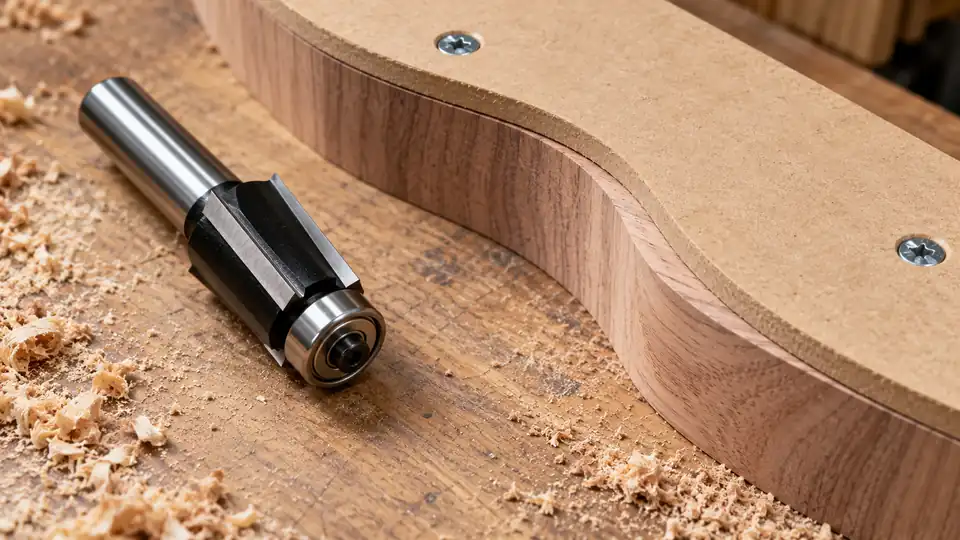
A flush-trim bit looks simple until a template edge, laminate overhang, or plywood panel exposes the difference between bearing position, cutter length, shank size, and cutting direction. A bit that is too short may leave an untrimmed lip. One that is too long can introduce unnecessary leverage, while the wrong bearing arrangement can make a straightforward pattern-routing job awkward. That is why buyers searching for the best router bit for flush trim need more than a cutter diameter and a familiar brand name.
The most useful specifications here are the bearing location, cutting diameter, cutting height, shank diameter, and intended material. A top-bearing bit suits one template arrangement, while a bit with top and bottom bearings offers more flexibility around an edge. Solid carbide, carbide-tipped, and coated carbide products also represent different constructions, so marketing language deserves a careful read. A compact 1/4-inch bit may be ideal for laminate work, while a longer cutter or multi-size set makes more sense for stacked templates and thicker panels.
The Freud 42-100 takes the top spot because its documented 3/8-inch bearing and cutter, 1/4-inch shank, two-cutter design, and stated suitability for composition materials, plywood, hardwoods, and softwoods create a straightforward all-purpose package. Buyers who need a longer reach, multiple cutting heights, a downcut spiral, or laminate-specific trimming will find better fits elsewhere in this list.
Quick Answer
- Best Overall: Freud 42-100: 3/8-inch Bearing Flush Trim Bit for a compact two-cutter design with a 1/4-inch shank and broad documented wood-material coverage.
- Best for Longer Templates: Freud 42-114: 1/2-inch Bearing Flush Trim Bit with a 1/2-inch shank and 1-1/2-inch carbide height.
- Best for Multiple Cutting Heights: Wolfride 4PCS Flush Trim Router Bit Set with four stated cutting diameters.
- Best for Plastic Laminate: Freud 64-100 Solid Carbide Flush Trim Bit, a self-piloting 1/4-inch bit intended for plastic laminate trimming.
Best Router Bit For Flush Trim Comparison Table
| Product | Best For | Bit Type | Shank | Cutting Diameter | Documented Application |
|---|---|---|---|---|---|
| Freud 42-100 | General flush trimming | Bearing flush trim | 1/4 inch | 3/8 inch | Composition materials, plywood, hardwood, softwood |
| Freud 42-114 | Longer, heavier-duty reach | Bearing flush trim | 1/2 inch | 1/2 inch | Composition materials, plywood, hardwood, softwood |
| Wolfride 4PCS Set | Several cutter sizes | Top-bearing set | 1/4 inch | 1/4 to 1/2 inch | Solid wood, MDF, chipboard, plywood |
| Freud 50-102 | Top-bearing template work | Top-bearing flush trim | 1/4 inch | 1/2 inch | Composition materials, plywood, hardwood, softwood |
| Newdeli Pattern Set | Light woodworking and storage | Pattern flush trim set | 1/4 inch | 1/2 inch | Wood, MDF, particle board, plywood |
| CSOOM 8-Piece Set | Mixed trimming tasks | Flush and pattern set | 1/4 inch | Varies by bit | Wood, MDF, particle board, plywood |
| Top and Bottom Bearing Set | Flexible bearing placement | Top and bottom bearing set | 1/4 inch | 1/2 inch | Wood, MDF, chipboard, plywood, acrylic |
| EANOSIC Downcut Spiral | Downcut routing and CNC use | Downcut spiral, top bearing | 1/4 inch | Not stated | Plywood, oak, MDF, hardwood |
| Freud 64-100 | Plastic laminate | Self-piloting solid carbide | 1/4 inch | 1/4 inch | Plastic laminate |
The detailed picks below separate compact bits, longer cutters, multi-piece sets, bearing configurations, and application-specific designs.
1. Freud 42-100: 3/8-inch Bearing Flush Trim Bit: Best Overall
The Freud 42-100 is a particularly easy bit to understand at the router table or in a handheld router. Its 3/8-inch bearing matches the stated 3/8-inch overall diameter, and the 1-inch carbide height gives it a compact footprint for common template and edge-trimming jobs. The two-cutter layout keeps the design conventional, while the 1/4-inch shank fits routers equipped for that shank size.
Its documented material range covers composition materials, plywood, hardwoods, and softwoods, so this is a practical choice for a mixed woodworking drawer. A cabinetmaker trimming a plywood template and a hobbyist cleaning up a hardwood edge can both understand where it fits without sorting through a pile of specialized geometries. The Perma-SHIELD coating is also identified in the product information, although the listing does not establish a measured performance advantage over the other bits here.
Pros
- 3/8-inch bearing and 3/8-inch cutter diameter are clearly specified.
- Uses a 1/4-inch shank for routers equipped with that collet size.
- Two-cutter design is documented.
- 1-inch carbide height suits compact flush-trimming work.
- Listed for composition materials, plywood, hardwoods, and softwoods.
Cons
- The 1-inch carbide height is shorter than the 1-1/2-inch height of the Freud 42-114.
- The 1/4-inch shank is unsuitable for a router that requires a 1/2-inch shank.
This is the strongest starting point for buyers who want one compact bearing-guided bit for ordinary woodworking materials. Choose a different model if your template is taller than the stated carbide height, if you need a 1/2-inch shank, or if plastic laminate is the primary job.
To buy this product, click here.
2. Freud 42-114: 1/2-inch Bearing Flush Trim Bit: Best for Longer Templates
When a short flush-trim bit leaves part of a template unsupported, the Freud 42-114 brings a noticeably different set of dimensions to the job. It has a 1/2-inch bearing and cutter diameter, a 1-1/2-inch carbide height, and a 3-5/8-inch overall length. That extra reach matters for thicker stock and taller template arrangements, although it also calls for careful attention to router clearance and shank compatibility.
This model uses a 1/2-inch shank, separating it from the many 1/4-inch options in this roundup. A user with a compatible router can take advantage of that larger shank format, while someone with only a 1/4-inch collet should look elsewhere. The listing identifies two cutters, Perma-SHIELD coating, and use with hand-held or table-mounted routers, along with coverage for composition materials, plywood, hardwoods, and softwoods.
Pros
- Provides a documented 1-1/2-inch carbide height.
- Uses a 1/2-inch bearing and 1/2-inch cutting diameter.
- Has a 1/2-inch shank for compatible routers.
- Two-cutter design is specified.
- Listed for hand-held and table-mounted router use.
Cons
- Requires a router and collet that accept a 1/2-inch shank.
- Its 3-5/8-inch overall length is greater than the compact bits in this guide.
The 42-114 makes sense for thicker templates and buyers who specifically need the larger shank and longer carbide height. It is a poor match for a compact 1/4-inch router setup, where the Freud 42-100 or 50-102 will be easier to pair with the machine.
To buy this product, click here.
3. Wolfride 4PCS Flush Trim Router Bit Set: Best Multi-Size Set
The Wolfride set is aimed at the woodworker who keeps encountering different edge heights and cutter requirements. Its four stated cutting diameters, 1/4, 5/16, 3/8, and 1/2 inch, give the set a broader size range than a single-bit purchase. Each bit uses a 1/4-inch shank and a top-bearing flush-trim arrangement, making the set relevant to routers configured for that shank size and templates positioned for top-bearing guidance.
The product information identifies industrial-grade carbide cutters and precision grinding, with use across solid wood, MDF, chipboard, and plywood. Those details explain the appeal for a general woodworking drawer, but the listing does not provide individual cutting heights for each bit. The instruction to insert and tighten at least three-quarters of the shank is a meaningful setup detail, especially for a buyer moving quickly between bits.
Pros
- Includes four stated cutting diameters.
- All bits use a documented 1/4-inch shank.
- Top-bearing configuration is identified.
- Listed for solid wood, MDF, chipboard, and plywood.
- Precision-ground cutters are specified in the product information.
Cons
- Individual cutting heights are not provided in the supplied specifications.
- Top-bearing guidance may not match a template arrangement that requires bottom-bearing support.
This set suits a hobbyist who wants several cutter diameters without buying four separate packages. Buyers working with a known template height or needing bottom-bearing flexibility should look at the Freud single bits or the top-and-bottom-bearing set instead.
To buy this product, click here.
4. Freud 50-102: 1/2-inch Top Bearing Flush Trim Bit: Best 1/4-inch Shank Top-Bearing Option
The Freud 50-102 occupies a useful middle ground. It has a 1/2-inch bearing and cutter diameter like the larger 42-114, but its shank is 1/4 inch and its overall length is 2-5/8 inches. For someone using a compact router with a 1/4-inch collet, that combination can be easier to integrate than a 1/2-inch-shank cutter.
The stated 1-inch carbide height keeps it in the compact category, while the top-bearing layout points toward templates and guides arranged above the workpiece. Two cutters and Perma-SHIELD coating are documented, and the bit is listed for hand-held and table-mounted routers. Its material coverage includes composition materials, plywood, hardwoods, and softwoods, giving it a broad woodworking role without claiming suitability for materials outside that list.
Pros
- Combines a 1/2-inch cutter with a 1/4-inch shank.
- Top-bearing configuration is clearly identified.
- Two-cutter design is specified.
- 1-inch carbide height and 2-5/8-inch overall length provide a compact format.
- Listed for hand-held and table-mounted routers.
Cons
- The 1-inch carbide height may not cover taller template assemblies.
- Its top-bearing arrangement is less suitable for jobs requiring a bottom bearing.
Pick this Freud when the router has a 1/4-inch collet and the project calls for a 1/2-inch top-bearing flush trim bit. The 42-100 is smaller in diameter, while the 42-114 offers more carbide height but requires a different shank size.
To buy this product, click here.
5. Newdeli Pattern Flush Trim Router Bit Set: Best for Light Woodworking
The Newdeli set centers on a 1/2-inch cutting diameter and four cutting lengths: 3/8, 3/4, 1, and 1-1/2 inches. That spread is handy for a project where a small trim pass is followed by a deeper template cut, and the included plastic box keeps the individual bits together rather than rattling loose in a drawer. Each bit uses a 1/4-inch shank.
The listing describes sealed bearings, a two-flute design, heat-treated tungsten carbide blades, and a Teflon coating on the steel body. It also identifies use with solid wood, particle board, plywood, MDF, and other wood composites. The product is positioned for trimming, grooving, and light work, so buyers planning routine woodworking should read that scope carefully rather than treat the set as a universal cutter collection.
Pros
- Includes four stated cutting lengths.
- Uses a 1/2-inch cutting diameter across the set.
- All bits have a 1/4-inch shank.
- Sealed bearings and a two-flute design are documented.
- Includes a storage box for the bits.
Cons
- The listing positions the set for light work, which limits how broadly it should be interpreted.
- The supplied information does not clearly identify the bearing position for every bit.
This is a practical set for a woodworker who values several lengths and organized storage. If bearing position is central to the project, the Freud top-bearing bit or the explicitly top-and-bottom-bearing set provides clearer configuration information.
To buy this product, click here.
6. CSOOM 8-Piece Flush and Pattern Router Bit Set: Best Accessory-Rich Set
The CSOOM set takes a broader kit approach, combining four flush-trim bits, four pattern flush-trim bits, six bearings, two wrenches, and two impact magnetic bits. For a workshop building a basic routing drawer, that collection can be more useful than a single fixed bearing arrangement. The supplied information identifies 1/4-inch shanks for the flush-trim bits and K10 micro-grain tungsten carbide blades.
Its stated applications include trimming, edging, and drawer work in wood, MDF, particle board, and plywood. The product information specifically excludes hard metal sheets and other non-wood materials such as steel and iron, which is a valuable boundary for buyers who see the word “carbide” and assume broader material coverage. The green glitter finish may fade over time, according to the listing, without being identified as a functional specification.
Pros
- Includes eight router bits across flush and pattern configurations.
- Provides six bearings for configuration flexibility.
- Includes two wrenches and two impact magnetic bits.
- Uses documented 1/4-inch shanks for the flush-trim bits.
- Listed for wood, MDF, particle board, and plywood.
Cons
- The set is specifically unsuitable for steel, iron, and other hard metal sheets.
- The supplied specifications do not give each included cutter’s individual diameter and cutting height.
Choose the CSOOM set when a mixed box of bits, bearings, and accessories matters more than a precisely documented single cutter. A buyer who needs one known diameter and height should select a Freud bit or another product with clearer individual measurements.
To buy this product, click here.
7. 4-Piece Top and Bottom Bearing Flush Trim Router Bit Set: Best Bearing Flexibility
Bearing placement is the headline feature of this four-piece set. The listing identifies top and bottom bearing flush-trim bits with 1/4-inch shanks, a 1/2-inch cutting diameter, and cutting heights of 3/4, 1, 1-1/4, and 1-1/2 inches. That range gives a buyer more ways to match the cutter to veneer, laminate, shelf edges, and stacked material.
The product is listed for hardwood, softwood, MDF, chipboard, plywood, acrylic, and other wood composites. It also identifies YG6 tungsten carbide blades, a hardened steel body, and an anti-kickback design. Those are supplied construction details, not proof of a measured performance advantage. The listing names CNC, portable, and table-mounted routers among the compatible equipment, but the router still needs to accept the 1/4-inch shank and the operator must follow the machine’s own requirements.
Pros
- Includes top and bottom bearing configurations.
- Offers four stated cutting heights from 3/4 to 1-1/2 inches.
- Uses a 1/2-inch cutting diameter.
- All bits use a documented 1/4-inch shank.
- Listed for wood, MDF, chipboard, plywood, acrylic, and composites.
Cons
- The 1/4-inch shank limits the set to compatible collets.
- The product information warns against steel, iron, and other non-wood materials.
This set is a strong fit for buyers who change template orientation or need several cutting heights. It is less appropriate for someone seeking a compact single bit, a 1/2-inch shank, or a product specifically limited to plastic laminate.
To buy this product, click here.
8. EANOSIC Downcut Spiral Flush Trim Router Bit: Best Downcut Option
The EANOSIC bit brings a different cutting geometry to this group. It is identified as a downcut spiral flush-trim bit with a top bearing, a 1/4-inch shank, and a 1-inch cut length. The listing also states that it uses solid virgin carbide and a blue nano coating. For a buyer specifically seeking a downcut design for plywood, oak, MDF, or hardwood, those distinctions matter more than simply comparing the cutter diameter with a straight bit.
The product information says the bit suits CNC routers and plunge routers with a 1/4-inch collet. It also mentions two independent ball bearings with forced-on steel collars at the tip. The supplied record does not state the cutting diameter, so this is not the right pick for someone whose template requires a precisely confirmed diameter. The listing claims up to 2.5 times the life of an uncoated bit, but that remains a manufacturer claim rather than an independently established result.
Pros
- Uses a documented downcut spiral configuration.
- Includes a top bearing.
- Has a 1/4-inch shank and stated 1-inch cut length.
- Identified as solid carbide with a blue nano coating.
- Listed for plywood, oak, MDF, and hardwood work.
Cons
- The cutting diameter is not stated in the supplied product information.
- Compatibility is tied to a 1/4-inch collet, so it will not suit every router setup.
This bit belongs on the shortlist for a buyer who specifically wants downcut spiral geometry and already knows the router accepts a 1/4-inch shank. For a standard, dimension-first purchase, the Freud 42-100 or 50-102 provides clearer diameter information.
To buy this product, click here.
9. Freud 64-100 Solid Carbide Flush Trim Bit: Best for Plastic Laminate
The Freud 64-100 is the specialist pick in this roundup. Rather than using a bearing, it is described as self-piloting, which makes its operating concept different from the bearing-guided bits above. Its 1/4-inch shank and 1/4-inch diameter suit compact trimming work, while the product is specifically identified for fast plastic laminate trimming in cabinetry, countertops, and related woodworking applications.
The bit is made from solid micrograin carbide and includes Black I.C.E. coating with TiCo Hi-Density Carbide, according to the product information. The listing also states a 24,000 RPM maximum, so buyers should verify that their router and operating procedure are appropriate before use. Since this is a narrow laminate-focused design, it should not replace a bearing-guided bit for every template-routing task.
Pros
- Designed for plastic laminate trimming.
- Uses a self-piloting tip rather than a bearing.
- Has a documented 1/4-inch shank and 1/4-inch diameter.
- Made from solid micrograin carbide according to the listing.
- Black I.C.E. coating and TiCo Hi-Density Carbide are identified.
Cons
- Its 1/4-inch diameter and laminate focus make it more specialized than general flush-trim bits.
- It does not provide the bearing-guided setup used by the other main picks in this guide.
Cabinet and countertop workers trimming plastic laminate should look closely at this Freud because its self-piloting format addresses that specific job. Buyers trimming hardwood templates or plywood patterns will likely want a bearing-guided bit with a documented bearing diameter instead.
To buy this product, click here.
Buying Guide
Match the Bearing Position to the Template
A bearing guides the cutter along a template, edge, or previously shaped surface, but its position changes how the setup works. A top-bearing bit such as the Freud 50-102 is aimed at one arrangement, while the top-and-bottom-bearing set gives more placement flexibility. Check where the guide surface sits before choosing a bit. A perfect cutter diameter cannot rescue a bearing that cannot contact the intended guide.
The guide to bearing position and router bit profiles explains how the cutter and template must line up for a guided trim.
Check Cutting Height Before Looking at Diameter
Cutting diameter affects the width of the cutter, while cutting height determines how much vertical material the bit can trim in one setup. The Freud 42-100 lists a 1-inch carbide height. The Freud 42-114 lists 1-1/2 inches, and the multi-piece sets offer several stated heights. Measure the template and workpiece stack first, then choose a cutter that covers the required edge without assuming a longer bit is automatically better.
Confirm the Shank and Collet
A 1/4-inch shank and a 1/2-inch shank are different mounting requirements. The Freud 42-114 uses a 1/2-inch shank, while the 42-100, 50-102, and the listed sets use 1/4-inch shanks. Check the router’s collet before buying. A bit that cannot be securely and correctly held is the wrong bit, regardless of its bearing or carbide construction.
Choose Straight or Spiral Geometry Deliberately
Most products here use conventional flush-trim or pattern-routing formats. The EANOSIC option is specifically downcut spiral, which gives it a distinct place for buyers seeking that geometry. Do not select a spiral bit simply because the name sounds more advanced. Confirm that the stated cutting direction and application match the workpiece, machine, and desired setup.
Separate General Woodworking From Laminate Trimming
The Freud 42-100 and several sets are documented for wood products such as plywood, hardwood, MDF, and softwood. The Freud 64-100 is specifically positioned for plastic laminate and uses a self-piloting tip instead of a bearing. Those are different jobs. Match the material and trimming method rather than treating every carbide flush-trim bit as interchangeable.
Read the Limits Alongside the Features
Several listings specify materials that should be avoided. The CSOOM and top-and-bottom-bearing products, for example, identify wood-based materials and exclude steel or iron. The EANOSIC record does not provide a cutting diameter, and the Newdeli record does not clearly establish every bearing position. Missing information matters when it affects fit, so verify the specification before committing to a particular setup.
Best Router Bit For Flush Trim FAQ
What Is the Best Router Bit for Flush Trim?
The Freud 42-100 is the strongest general recommendation in this selection because it combines a documented 3/8-inch bearing and cutter, two cutters, a 1/4-inch shank, and stated suitability for composition materials, plywood, hardwoods, and softwoods. A different bit may be better for taller templates, plastic laminate, or multiple cutting heights.
Should I Choose a Top-Bearing or Bottom-Bearing Flush-Trim Bit?
Choose according to where the template or guiding edge sits in relation to the workpiece. Top-bearing and bottom-bearing configurations guide from different positions. The top-and-bottom-bearing set is useful for buyers who work with more than one arrangement, while the Freud 50-102 is a clearly identified top-bearing option.
Is a 1/4-Inch Shank Suitable for Every Router?
No. The router must have a collet designed to hold a 1/4-inch shank. Some routers use a 1/2-inch collet or may require a compatible collet configuration. The Freud 42-114 uses a 1/2-inch shank, while most other products in this roundup use 1/4-inch shanks.
What Cutting Height Do I Need?
Measure the vertical height of the template and material that must be trimmed. A 1-inch carbide height may suit a compact panel or edge, while a 1-1/2-inch height can cover a taller arrangement. Multi-piece sets can help when project dimensions change, but each cutter still needs to be matched to the actual workpiece.
Can a Flush-Trim Router Bit Cut Plastic Laminate?
Some can, but product documentation matters. The Freud 64-100 is specifically identified for plastic laminate and uses a self-piloting tip. Other bits in this guide are listed for wood, plywood, MDF, or composition materials, so do not assume that every model has the same laminate application.
Are Flush-Trim Router Bits Suitable for Metal?
The products in this roundup are documented for woodworking materials, acrylic, plastic laminate, or related applications. The CSOOM and top-and-bottom-bearing listings specifically warn against steel, iron, and other non-wood materials. Carbide construction alone does not establish suitability for metal.
Are Multi-Piece Flush-Trim Sets Better Than a Single Bit?
A set is useful when cutting heights, diameters, or bearing arrangements change from project to project. The Wolfride set supplies four diameters, while the Newdeli and top-and-bottom-bearing sets provide several cutting heights or bearing configurations. A single bit is usually easier to evaluate when one known dimension and application matter most.
What Should I Check Before Routing?
Confirm the shank and collet match, make sure the bearing and cutter are properly secured, and follow the router and bit manufacturer’s operating instructions. The product information for several selections emphasizes secure installation and checking the bearing. Do not exceed documented machine or bit limits, and stop if the setup vibrates abnormally.
Final Verdict
The Freud 42-100 is the best overall router bit for flush trim in this group because its documented dimensions are practical and easy to match to common woodworking tasks. The 3/8-inch bearing and cutter, 1/4-inch shank, two-cutter construction, 1-inch carbide height, and broad listed material coverage make it a balanced choice for someone buying one general-purpose bit.
Different jobs point toward different alternatives. Choose the Freud 42-114 for a 1/2-inch shank and 1-1/2-inch carbide height, the top-and-bottom-bearing set for several bearing arrangements and cutting heights, or the Wolfride set for multiple cutter diameters. For plastic laminate, the self-piloting Freud 64-100 is the more focused option. Before ordering, match the bearing position, cutting height, shank, and documented material application to the router and workpiece in front of you.
