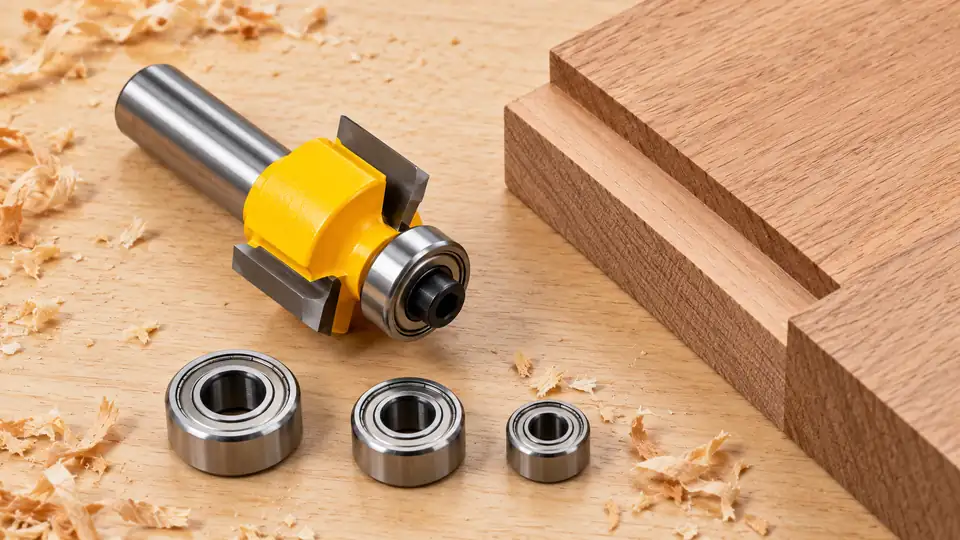
A rabbet router bit has one job that demands careful sizing: cut a clean recess along an edge so another part can sit flush, form a ledge, or meet a panel with a tidy shoulder. The bearing controls the cut path, while the bit height and bearing diameter determine the rabbet depth. That relationship makes these bits useful for cabinet backs, drawers, frames, shelves, and furniture joinery, but it also creates an easy buying trap. A set may list several bearings while offering only a narrow range of practical cutting heights, and a 1/2-inch shank bit will not fit a 1/4-inch collet.
The most useful specifications here are shank size, cutter height, bearing range, overall diameter, and the materials named by the manufacturer. A 1/4-inch-shank set can suit a compact handheld router, while a 1/2-inch-shank option may be the better match for a larger router or table setup. Some products offer several separate cutters, others use one body with interchangeable bearings, and a few are better suited to broad, deeper rabbets than delicate trim work. The Freud 32-526 takes the top spot because its documented 1/2-inch shank, two-cutter design, six bearing positions, and flush-trimming capability give it a particularly useful spread for cabinet and furniture work.
Different buyers will value different things. A beginner may want a complete 1/4-inch set with several cutters, while an experienced woodworker may prefer a single 1/2-inch-shank bit with clearly stated dimensions and a flush-cutting option. Material restrictions matter too. The products below are identified for wood, plywood, MDF, particle board, or related composites, not metal. Check the router collet, bearing position, and required rabbet depth before ordering, then use the table for a quick first pass.
Quick Answer
- Best Overall: Freud 32-526 for its 1/2-inch shank, six bearing positions, and flush-cutting capability.
- Best 1/4-Inch Set: Newdeli Rabbet Router Bit Set for its four cutters and six interchangeable bearings.
- Best for Wide Rabbets: AKYLIN Rabbet Router Bits Set for its documented 3/8-inch to 3/4-inch depth range.
- Best Single-Bit Kit: XDENGP Rabbet Router Bit Set for its one-bit, six-bearing format and 3/4-inch tooth width.
Best Rabbeting Router Bits Comparison Table
| Product | Best For | Shank Size | Cutting Range | Configuration | Materials Listed |
|---|---|---|---|---|---|
| Freud 32-526 | Overall versatility | 1/2 inch | Flush to 1/2 inch | One bit, six bearings | Hardwood, softwood, plywood, composites |
| Newdeli Rabbet Router Bit Set | 1/4-inch-shank users | 1/4 inch | Six bearing sizes | Four bits, six bearings | Wood, MDF, plywood, particle board |
| MEIGGTOOL Rabbet Router Bit Set | Fine shallow rabbets | 1/4 inch | 1/16 to 7/16 inch | Four bits, six bearings | Wood and wood composites |
| Freud 32-522 | Mid-depth furniture rabbets | 1/2 inch | 5/16 to 1/2 inch | One bit, four bearings | Hardwood, softwood, plywood, composites |
| AKYLIN Rabbet Router Bits Set | Wide, deeper rabbets | 1/2 inch | 3/8 to 3/4 inch | One bit, six bearings | Hardwood, softwood, plywood, composites |
| XDENGP Rabbet Router Bit Set | Single-bit convenience | 1/2 inch | 1/8 to 1/2 inch | One bit, six bearings | Wood, MDF, plywood, acrylic |
| WSOOX 1/2-Inch-Shank Set | Multi-bit 1/2-inch setup | 1/2 inch | 1/16 to 1/2 inch | Three bits, six bearings | Wood, MDF, plywood, composites |
| FivePears Rabbet Router Bit | Beginner furniture work | 1/2 inch | 1/8 to 1/2 inch | One bit, six bearings | Wood, MDF, plywood, particle board |
| BOSCH 85615MC | Simple single-depth work | Not stated | 1/2-inch bit | Single bit | Not stated |
The detailed picks below separate compact 1/4-inch sets from 1/2-inch-shank designs and show where each bearing arrangement fits best.
1. Freud 32-526 — Best Overall

The Freud 32-526 is the most broadly documented option in this group. Its 1/2-inch shank suits routers equipped with that collet size, and its 1-3/8-inch overall diameter gives the bit a substantial cutting profile for furniture, cabinet, and carpentry work. The listing identifies two cutters, a 3/4-inch carbide height, and six interchangeable bearing positions covering flush cutting through a 1/2-inch rabbet. That makes it useful when one project calls for a shallow panel recess and the next needs a deeper ledge.
A flush setting adds practical flexibility. For example, a cabinetmaker trimming an edge can use the same bit family for a flush operation, then change the bearing for a rabbet without switching to a completely different profile. The included wrench is another small but useful detail during bearing changes. Its documented material range includes composition materials, plywood, hardwoods, and softwoods, although the larger 1/2-inch shank means a compact router with only a 1/4-inch collet is out of the picture.
Pros
- Uses a documented 1/2-inch shank.
- Offers flush, 1/8, 1/4, 5/16, 3/8, 7/16, and 1/2-inch cutting positions.
- Includes six interchangeable bearings.
- Has two cutters and a stated 1-3/8-inch overall diameter.
- Can also serve as a flush-cutting trim bit according to the listing.
Cons
- Requires a router with a 1/2-inch collet.
- Its documented 1-3/8-inch diameter may be more tool than needed for very small trim work.
This is the strongest fit for a woodworker who wants one well-specified 1/2-inch-shank bit to cover common furniture and cabinet rabbets. A compact-router owner should skip it in favor of a 1/4-inch set, while buyers needing rabbets deeper than 1/2 inch should look at the AKYLIN option instead.
To buy this product, click here.
2. Newdeli Rabbet Router Bit Set — Best 1/4-Inch Set

Newdeli takes a kit-based approach with four rabbeting bits and a 1/4-inch shank format. The cutters are listed at 1/8, 1/4, 3/8, and 1/2-inch heights, while six bearings provide additional depth combinations. That mix is handy for someone working on a small cabinet, picture frame, or drawer project where the router has a 1/4-inch collet and the required rabbet changes from one board to the next.
The listing identifies wood, MDF, particle board, plywood, acrylic, and other wood composites as suitable materials. It also states compatibility with handheld, table-mounted, and CNC routers. The practical catch is clamping. The product information warns that short clamping may cause bending and specifies clamping at least two-thirds of the shank, along with a maximum RPM listing of 16,000. Those details deserve attention before the first cut, especially with a handheld router where a loose setup can spoil a clean edge quickly.
Pros
- Uses a documented 1/4-inch shank.
- Includes four cutter heights from 1/8 to 1/2 inch.
- Includes six interchangeable bearings from 1/2 to 1-1/8 inches.
- Lists wood, MDF, particle board, plywood, acrylic, and wood composites.
- Provides a stated clamping and RPM limitation for setup planning.
Cons
- The listing warns that short shank clamping may cause bending.
- It is unsuitable for metal and other non-wood materials identified in the product information.
Newdeli suits owners of compact routers who want several cutters in one kit and can follow the stated clamping requirements carefully. A 1/2-inch-collet router user will get better mechanical compatibility from the Freud or AKYLIN selections, while a buyer seeking shallow 1/16-inch rabbets may prefer MEIGGTOOL.
To buy this product, click here.
3. MEIGGTOOL 4-Piece Rabbet Router Bit Set — Best for Fine Shallow Rabbets

MEIGGTOOL is the pick for projects where the rabbet needs to start especially shallow. Its six bearing positions are listed for 1/16, 3/16, 1/4, 5/16, 3/8, and 7/16-inch cutting depths. That 1/16-inch setting can be useful for light panel work or a small lip where a deeper recess would weaken the edge or leave an unwanted step.
The kit includes four cutters with 1/8, 1/4, 3/8, and 1/2-inch cutting heights, all on a 1/4-inch shank. The product information identifies a carbide construction with Teflon coating and lists a feed range of 8 to 12 meters per minute plus a spindle-speed range of 18,000 to 24,000 RPM. Those published figures are product-specific guidance, so the router, material, and setup still need to be checked against the manufacturer’s instructions rather than treated as universal settings.
Pros
- Uses a documented 1/4-inch shank.
- Offers a listed 1/16-inch shallow rabbet setting.
- Includes six bearing sizes through 7/16-inch depth.
- Provides four cutter heights from 1/8 to 1/2 inch.
- Lists carbide construction and a Teflon coating.
Cons
- The documented maximum cutting depth is 7/16 inch, below the 1/2-inch range offered by several alternatives.
- Its published feed and spindle figures require careful matching to the router and workpiece.
This kit makes sense for a 1/4-inch-collet owner who frequently cuts narrow rebates in furniture parts, panels, or trim. Choose another product if a full 1/2-inch rabbet is central to the project, or if the router is set up for a 1/2-inch shank.
To buy this product, click here.
4. Freud 32-522 — Best for Mid-Depth Furniture Rabbets

The Freud 32-522 narrows the range to four useful mid-depth settings: 5/16, 3/8, 7/16, and 1/2 inch. That more focused spread can be a virtue for a cabinet builder who already knows the kind of rabbets being cut and does not need flush or very shallow positions. The bit has a 1/2-inch shank, a 1-3/8-inch overall diameter, two cutters, and a stated 1/2-inch carbide height.
Like the 32-526, this model is listed for composition materials, plywood, hardwoods, and softwoods, and it can be used in handheld or table-mounted portable routers. The product information also identifies flush-cutting use for the related 32-504, 32-524, and 32-526 models, but the supplied details do not make that same claim for the 32-522. That distinction matters for shoppers comparing the two Freud bits, since the 32-526 clearly covers more documented operations.
Pros
- Uses a documented 1/2-inch shank.
- Offers four mid-depth settings from 5/16 to 1/2 inch.
- Has two cutters and a stated 1-3/8-inch overall diameter.
- Lists a 1/2-inch carbide height.
- Is identified for composition materials, plywood, hardwoods, and softwoods.
Cons
- Does not list flush or shallow 1/8-inch settings in the supplied specifications.
- Requires a 1/2-inch router collet.
This is a sensible focused purchase for a 1/2-inch-shank router used mainly on furniture and cabinet rabbets in the 5/16-to-1/2-inch range. The 32-526 is a better match for mixed-depth work because it documents more bearing positions and flush trimming.
To buy this product, click here.
5. AKYLIN Rabbet Router Bits Set — Best for Wide, Deeper Rabbets

AKYLIN is unusual in this roundup because its listed cutting depths begin at 3/8 inch and extend to 3/4 inch. The bit uses a 1/2-inch shank, a 1-inch cutting height, and six bearings sized from 3/8 to 1-1/8 inches. For a wide cabinet edge, a heavy frame component, or a lap-joint-style operation, that deeper range is more relevant than a kit built around 1/8-inch trim rabbets.
The product information identifies a carbide-tipped cutter, silver induction brazing, a heat-resistant coating, and a solid-steel 1/2-inch shank. It is listed for handheld and table-mounted routers and for hardwood, softwood, plywood, and composites. The listing also gives a maximum RPM of 18,000. That makes the setup details especially important: the bit’s deeper cutting range should be matched to a suitable router, secure workholding, and the manufacturer’s operating instructions.
Pros
- Uses a documented 1/2-inch shank.
- Offers six listed rabbet depths from 3/8 to 3/4 inch.
- Includes bearings from 3/8 to 1-1/8 inches.
- Lists a 1-inch cutting height.
- Identifies hardwood, softwood, plywood, and composites as supported materials.
Cons
- Does not provide the shallow 1/8, 1/4, or 5/16-inch settings found on several other picks.
- The listed maximum RPM and deeper cutting range require careful machine and setup matching.
Choose AKYLIN when the job calls for a deeper rabbet or lap-joint-style cut and the router accepts a 1/2-inch shank. It is a poor fit for delicate picture-frame work or shallow panel rebates, where MEIGGTOOL or the Freud 32-526 provides a more suitable range.
To buy this product, click here.
6. XDENGP Rabbet Router Bit Set — Best Single-Bit Kit

XDENGP keeps the hardware compact: one rabbeting bit, six interchangeable bearings, and a 1/2-inch shank. The listed bearing diameters run from 3/8 to 1-1/8 inches, with stated cutting depths from 1/8 to 1/2 inch. Its 3/4-inch tooth width is also documented, giving buyers a useful dimension to compare against the edge thickness and shoulder layout of a cabinet or frame part.
The listing names wood, MDF, particle board, plywood, compact panels, hardwood floor, oak, and acrylic among the compatible materials, while excluding metal and other non-wood materials. It also identifies an anti-kickback design, YG6X carbide inserts, and a maximum RPM of 18,000. Those details may appeal to someone who prefers fewer loose cutters in a drawer, although the single-body format does mean every job depends on changing the bearing rather than swapping to a dedicated bit.
Pros
- Uses a documented 1/2-inch shank.
- Includes six interchangeable bearings.
- Lists cutting depths from 1/8 to 1/2 inch.
- Provides a stated 3/4-inch tooth width.
- Identifies an anti-kickback design and YG6X carbide inserts.
Cons
- Includes one cutter rather than multiple separate bit bodies.
- Is restricted to listed wood and composite materials and should not be used on metal.
XDENGP fits a 1/2-inch-router owner who wants a tidy, single-bit setup for ordinary woodworking rabbets. A multi-bit kit is more convenient for someone who changes profiles frequently, while the AKYLIN option is better for cuts that exceed the documented 1/2-inch depth.
To buy this product, click here.
7. WSOOX 1/2-Inch-Shank Rabbet Router Bit Set — Best Multi-Bit 1/2-Inch Setup

WSOOX gives 1/2-inch-collet users three separate rabbeting bits and six interchangeable bearings. The cutters are listed with 1/4, 3/8, and 1/2-inch heights, while the bearing range covers 1/16 through 1/2 inch. That arrangement is attractive for a workshop where switching between dedicated cutter bodies feels quicker than rebuilding one bit for every operation.
The product uses YG8 carbide steel according to the listing and has a heat-resistant Teflon coating. Its stated material range includes wood, MDF, particle board, plywood, acrylic, and wood composites. The supplied information warns about short clamping and possible bending, so buyers should verify that enough of the 1/2-inch shank enters the collet. This set also includes more hardware than a single-bit kit, which can be convenient but requires organized storage for the cutters and bearings.
Pros
- Uses a documented 1/2-inch shank.
- Includes three separate rabbeting bit bodies.
- Provides six bearings covering 1/16 to 1/2-inch depths.
- Lists three cutter heights from 1/4 to 1/2 inch.
- Identifies wood, MDF, particle board, plywood, acrylic, and composites as suitable materials.
Cons
- The listing warns that short clamping may cause bending.
- It requires more storage and bearing changes than a single fixed-depth bit.
This set suits a 1/2-inch router owner who values multiple cutter bodies and a broad shallow-to-medium depth range. The Freud 32-526 has more clearly documented flush-cutting capability, while XDENGP takes less storage space for buyers who prefer one bit body.
To buy this product, click here.
8. FivePears 1/2-Inch-Shank Rabbet Router Bit — Best for Beginners

FivePears is a straightforward single-bit format with six bearings for 1/8, 1/4, 5/16, 3/8, 7/16, and 1/2-inch depths. That sequence covers many familiar woodworking dimensions without asking the buyer to choose among several cutter bodies. For someone building a first cabinet or learning how bearing-guided rabbeting works, the simple layout is easier to understand: select the bearing that corresponds to the desired recess, then secure the bit correctly.
The listing identifies precision-machined tungsten carbide inserts, a solid hardened-steel body, and an anti-kickback design. It names wood, MDF, particle board, plywood, and compact panel as suitable materials and states that three-quarters of the shank should be inserted and tightened securely. The product information does not specify a cutter diameter or overall length, so buyers who need those dimensions for a tight router-table setup should verify them before ordering.
Pros
- Uses a documented 1/2-inch shank.
- Includes six bearing positions from 1/8 to 1/2 inch.
- Lists precision-machined tungsten carbide inserts.
- Identifies a solid hardened-steel body.
- Provides a specific three-quarter-shank insertion instruction.
Cons
- The supplied product information does not specify the cutter diameter or overall length.
- It includes one bit body rather than separate cutters for different heights.
FivePears is a reasonable starting point for a 1/2-inch-collet owner who wants common rabbet depths and clear basic setup guidance. Buyers planning a router-table installation around exact bit dimensions should favor a product with more complete dimensional data, such as the Freud models.
To buy this product, click here.
9. BOSCH 85615MC — Best Simple Single-Bit Option
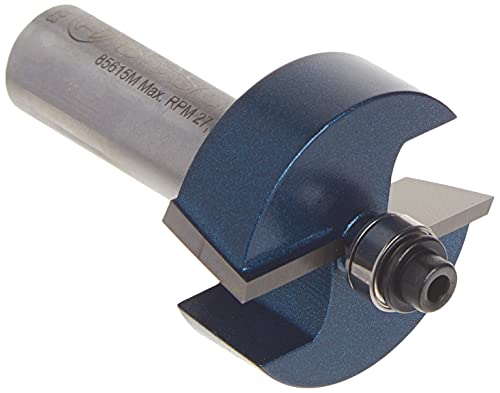
The BOSCH 85615MC takes a less complicated route than the bearing sets above. The supplied information identifies it as a 1/2-inch rabbeting router bit intended to make rabbeting cuts without a router guide. It also lists a micrograin control-cut design and carbide-tipped construction. That format may appeal to a woodworker who wants a single-purpose bit and does not need several adjustable depth positions in one purchase.
Its short specification list is both the appeal and the limitation. The product data does not state a shank diameter, cutter diameter, bearing configuration, cutting-depth range, or supported workpiece materials. A buyer can see the 1/2-inch product designation and the carbide-tipped description, but should verify the exact mounting and dimensional details before placing it in a router. This is especially relevant for a table setup where bit diameter and height affect fence clearance.
Pros
- Is identified as a 1/2-inch rabbeting router bit.
- Is intended for rabbeting without a router guide.
- Lists a micrograin control-cut design.
- Uses a carbide-tipped cutting construction.
- Offers a simpler single-bit format than adjustable bearing sets.
Cons
- The supplied information does not specify a shank diameter or bearing configuration.
- The listing does not state a cutting-depth range or supported workpiece materials.
BOSCH 85615MC is best for buyers who already know the exact single-bit operation they need and can confirm compatibility from the full listing. It is less suitable for someone comparing multiple rabbet depths, since the supplied specifications do not establish the adjustable range provided by the other picks.
To buy this product, click here.
Buying Guide
Match the Shank to the Router Collet
Shank size is the first filter, before bearing count or coating. The Newdeli and MEIGGTOOL sets use 1/4-inch shanks, while the Freud, AKYLIN, XDENGP, WSOOX, and FivePears products identify 1/2-inch shanks. A 1/4-inch collet cannot accept a 1/2-inch shank, so measure or confirm the router’s collet before comparing cutting ranges. The BOSCH listing supplied here does not state its shank diameter, which makes verification especially important.
Choose the Depth Range Around the Joint
Think about the actual shoulder you need to cut. A 1/16-inch rabbet can suit light trim or a delicate panel lip, while a 1/2-inch recess is more relevant to many cabinet and furniture applications. MEIGGTOOL emphasizes shallow settings, AKYLIN reaches a documented 3/4 inch, and the Freud 32-526 covers flush through 1/2 inch. A wide bearing range is useful only when the router, workpiece thickness, and cutter height can accommodate it.
Decide Between One Bit and Several Cutters
A single-bit kit keeps the hardware compact. XDENGP, FivePears, AKYLIN, and the Freud models use one main bit body with interchangeable bearings, although their depth ranges differ. Newdeli, MEIGGTOOL, and WSOOX provide multiple cutter bodies. Multiple bits can reduce repeated cutter-height adjustments, but they also mean more pieces to store and more shank insertion details to check.
Look at the Bearing Sizes, Not Only the Count
Six bearings do not mean the same thing in every kit. Newdeli lists bearings from 1/2 to 1-1/8 inches, MEIGGTOOL lists sizes tied to depths from 1/16 to 7/16 inch, and AKYLIN uses bearings from 3/8 to 1-1/8 inches for deeper cuts. Compare the actual bearing and depth figures with the rabbet shown on your drawing. The number six is less informative than the range.
Check the Workpiece Materials
Most of the selected products identify wood, plywood, MDF, particle board, hardwood, softwood, or related composites. Newdeli and XDENGP also list acrylic, while several products expressly exclude metal or other non-wood materials. Do not treat a carbide-tipped or carbide-inserted router bit as a general-purpose cutter for every material. The material list is part of the product’s intended use.
Review Setup Restrictions Before Cutting
Several listings include specific setup information. Newdeli warns about short clamping and gives a maximum RPM listing of 16,000. XDENGP lists an 18,000 RPM maximum, and MEIGGTOOL provides published feed and spindle figures. These values belong to the respective product listings, not to every rabbeting bit. Secure the shank to the stated insertion requirement, check the router instructions, and avoid relying on a neighboring product’s specifications.
The joinery guide explains rabbet width, depth, and bearing offset and provides a dimensional example for checking the intended recess.
Best Rabbeting Router Bits FAQ
What Does a Rabbeting Router Bit Do?
A rabbeting bit cuts a recessed shoulder along an edge. The recess can receive a cabinet back, frame panel, shelf, or another joining part. Bearing-guided designs follow the workpiece edge while the cutter removes material to the selected depth.
Are 1/4-Inch and 1/2-Inch Router Bits Interchangeable?
No. The shank must match the router collet. The Newdeli and MEIGGTOOL sets identify 1/4-inch shanks, while many of the other selections identify 1/2-inch shanks. Confirm the collet size before ordering because a bearing range cannot compensate for an incompatible shank.
Why Do Rabbeting Bit Sets Include Several Bearings?
Changing the bearing changes how far the cutter travels into the edge, which changes the rabbet depth. The exact range depends on the cutter height and bearing dimensions. Six bearings on one product may cover a different depth span from six bearings on another, so compare the listed measurements rather than the bearing count alone.
Which Rabbeting Bit Is Best for a Shallow Rabbet?
MEIGGTOOL lists a 1/16-inch cutting-depth position, making it the clearest match among these products for especially shallow work. The Freud 32-526, Newdeli, WSOOX, and FivePears listings also include shallow positions, but their documented ranges and shank formats differ.
Which Bit Covers Deeper Rabbets?
AKYLIN has the deepest documented range in this selection, from 3/8 to 3/4 inch. That makes it a specialized choice for wider or deeper rabbets. It does not cover the shallow 1/8-inch setting offered by several other products, so it is not a universal substitute.
Can These Router Bits Cut Metal?
The supplied product information identifies these tools primarily for wood and wood-based materials. Newdeli and XDENGP expressly exclude metal or other non-wood materials. The BOSCH listing provided here does not state supported workpiece materials, so its application should be verified rather than assumed.
Should I Choose One Bit or a Set With Several Bit Bodies?
One-bit kits use less storage and adjust depth by changing bearings. Multi-bit sets provide several cutter bodies and may suit a workshop that frequently changes operations. Newdeli and MEIGGTOOL use four cutters, WSOOX uses three, and XDENGP, AKYLIN, FivePears, and the Freud options use a single main bit body.
What Should I Check Before Using a Bearing-Guided Rabbet Bit?
Check the shank size, bearing installation, cutter height, collet insertion, and the material restriction listed for the product. Also review any product-specific RPM or clamping guidance. The supplied listings do not establish one universal operating setting for every router bit, router, or workpiece.
Final Verdict
The Freud 32-526 is the strongest overall pick because its documented specifications cover the buying questions that matter most: a 1/2-inch shank, two cutters, six bearing positions, a 1-3/8-inch overall diameter, and cutting positions from flush through 1/2 inch. Its listed use across hardwoods, softwoods, plywood, and composition materials gives it a broad woodworking role, while the flush-cutting capability adds another practical operation. Buyers with a 1/4-inch router should choose Newdeli instead, and those needing a 3/4-inch rabbet should move straight to AKYLIN.
For shallow edge work, MEIGGTOOL offers the most clearly documented 1/16-inch setting. WSOOX is the better fit for a 1/2-inch-shank user who wants three cutter bodies, while XDENGP keeps the setup compact with one bit and six bearings. Before ordering, match the shank to the collet, compare the actual depth range with the joint design, and follow the individual listing’s material and setup limits. That quick check matters more than choosing the kit with the most bearings.
