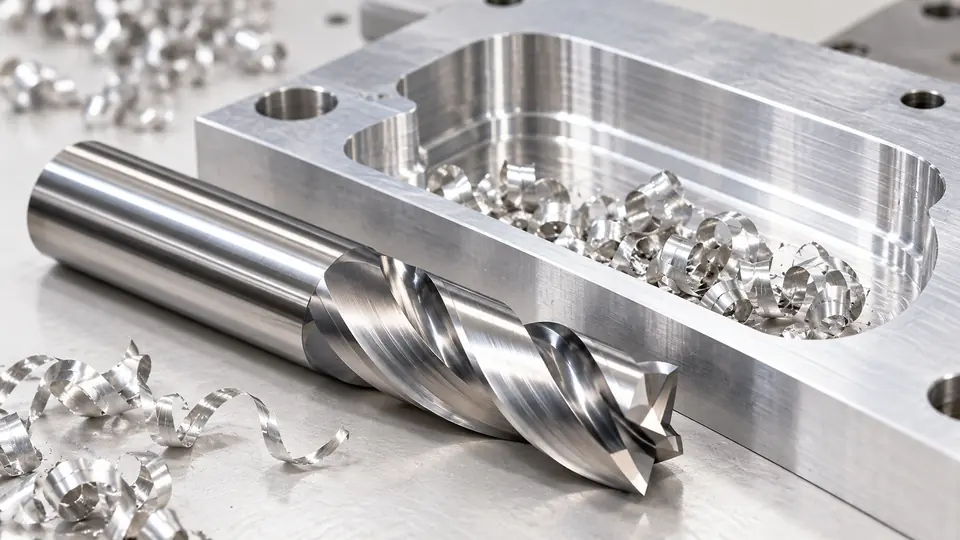
Aluminum can punish a poorly matched end mill with gummy chips, smeared edges, and a cutter that seems to complain before the job is halfway done. The buying decision is more specific than choosing any tool labeled carbide. Flute count, cutting diameter, shank size, coating, and the listing’s stated material range all affect whether a cutter suits a CNC router, desktop CNC machine, or another milling setup.
A common mistake is treating four-flute steel cutters and aluminum-focused three-flute tools as interchangeable. They are different tools for different cutting conditions. A longer cutter may reach deeper features, but its dimensions and machine compatibility need closer attention. A 1/8-inch option can suit small details, while a 1/2-inch cutter is aimed at much larger cuts. The strongest choices here are the WEXWE DLC Series and HQMaster Nano Blue 1/4-inch tools, both of which document three-flute geometry, carbide construction, coatings, and aluminum applications.
Different buyers will prioritize different details. A hobbyist with a 1/8-inch collet may need a small multi-piece set, while a more rigid setup may call for a 1/2-inch shank and longer reach. This roundup weighs those distinctions without treating marketing language as test data. The WEXWE set takes the overall lead for its documented aluminum focus, 1/4-inch shank, three-flute format, and DLC coating, while the other picks cover larger work, compact cutting, and broader material use.
Quick Answer
- Best Overall: WEXWE Tools DLC Series Carbide Square End Mill for a documented three-flute, 1/4-inch-shank aluminum tool with DLC coating.
- Best Long-Reach Option: SpeTool 3 Flute Carbide End Mill for its 1/2-inch cutting diameter, 2-inch cutting length, and 4-inch overall length.
- Best Compact Set: SpeTool 1/8 End Mills for Aluminum for five aluminum-focused cutters with 1/8-inch shanks.
- Best Small-Diameter Pack: 1/8-inch DLC Carbide Square End Mill 10-Pack for its documented 35-degree helix and 10-piece format.
Best End Mills for Aluminum Comparison Table
| Product | Best For | Diameter | Flutes | Coating | Material Compatibility |
|---|---|---|---|---|---|
| WEXWE Tools DLC Series | Overall aluminum work | 1/4 inch | 3 | DLC | Aluminum, copper, magnesium, composites |
| SpeTool 3 Flute Long | Large cuts and extended reach | 1/2 inch | 3 | Not stated | 6061, 7075, non-ferrous materials |
| SpeTool 1/4-inch End Mill | General CNC router work | 1/4 inch | 3 | Not stated | 6061, 7075, non-ferrous materials |
| 1/2-inch DLC Rainbow End Mill | Desktop and industrial CNC machines | 1/2 inch | 3 | DLC Rainbow | Aluminum, copper, magnesium, composites |
| 1/8-inch DLC Square End Mill 10-Pack | Small features and slotting | 1/8 inch | 3 | DLC | Aluminum, copper, magnesium, zinc |
| SpeTool 1/8 End Mill Set | Small CNC router projects | 1/8 inch | 3 | Not stated | 6061, 7075, non-ferrous materials |
| HQMaster Nano Blue End Mill | 1/4-inch aluminum and composite work | 1/4 inch | 3 | Nano Blue | Aluminum, copper, magnesium, composites |
| SPEED TIGER EISE End Mill | Mixed aluminum and steel applications | 1/4 inch | 4 | AlTiN | Aluminum, copper, steels, cast iron |
| 3/8-inch Carbide Square End Mill | Medium-size general milling | 3/8 inch | 4 | AlTiN | Listing emphasizes steels and cast iron |
The detailed picks below show where each cutter’s dimensions, geometry, coating, and documented material range fit best.
1. WEXWE Tools DLC Series Carbide Square End Mill – Best Overall

The WEXWE cutter is the most balanced aluminum-focused option in this group. Its documented 1/4-inch shank and three-flute square-end format fit the common middle ground between tiny detail work and large roughing cuts. The listing identifies HRC62 ultrafine-grain tungsten carbide and a DLC surface coating, while its stated applications include aluminum, copper, magnesium alloys, high-silicon aluminum, and composite materials.
That combination gives the buyer useful information before the tool ever reaches the collet. A three-flute layout offers a different balance of cutting edges and chip space than the four-flute steel-oriented products below. The U-groove design is also identified in the product information, alongside a 2-piece package. The listing reports precision grinding and individual inspection, but those statements should be treated as manufacturer information rather than independent test results.
Pros
- Documented 1/4-inch shank suits equipment using that collet size.
- Three-flute square-end geometry is clearly identified.
- DLC coating is specified for the cutter surface.
- Listed for aluminum, copper, magnesium alloys, high-silicon aluminum, and composites.
- Two-piece package provides a second matching cutter.
Cons
- The listing does not provide cutting length or overall length.
- Specific spindle, feed, and depth-of-cut guidance is not supplied.
This is the sensible starting point for buyers who want a documented aluminum end mill in a familiar 1/4-inch format. Choose another product if the job requires a 1/2-inch cutter, a 1/8-inch shank, or a clearly stated extended cutting length.
To buy this product, click here.
2. SpeTool 3 Flute Carbide End Mill for Aluminum, Extra Long – Best Long-Reach Option

This SpeTool model is the heavyweight choice, with a documented 1/2-inch cutting diameter, 1/2-inch shank, 2-inch cutting length, and 4-inch total length. Those dimensions make it a very different proposition from the compact 1/8-inch tools. Buyers working across deeper stock or larger profiles will immediately see the appeal, though the machine and holder must be matched to the stated 1/2-inch shank.
The three-flute flat-top design is listed for aluminum 6061 and 7075, along with other non-ferrous materials. The product information also names side milling, end milling, and finish machining. It is described for CNC routers and plunge routers, yet the 1/2-inch shank specification should take priority over any general equipment wording. Check the actual collet and machine requirements before ordering, especially if a listing refers to a 1/4-inch collet elsewhere.
Pros
- Documented 1/2-inch cutting diameter suits larger milling work.
- 2-inch cutting length is clearly stated.
- 4-inch overall length provides the listed extended format.
- Three-flute flat-top geometry is specified.
- Aluminum 6061 and 7075 are named among the supported materials.
Cons
- Its 1/2-inch shank limits use to equipment with the matching collet or holder.
- The longer format may be unnecessary for shallow, compact work.
Use this cutter where its large diameter and extended dimensions solve a real reach or material-removal problem. A 1/4-inch or 1/8-inch tool is a better match for small machines, fine details, or lighter work.
To buy this product, click here.
3. SpeTool 1/4-inch Carbide End Mill for Aluminum – Best 1/4-inch CNC Router Option

This SpeTool cutter sits in a useful middle size. The listing identifies a 1/4-inch shank, 1/4-inch cutting diameter, 1-1/2-inch cutting length, and 3-1/2-inch overall length. That gives shoppers a clearer dimensional picture than several competing listings, particularly those that omit cutting length.
Its three-flute flat-top design is documented for aluminum 6061 and 7075, plus non-ferrous metals and several non-metal materials. The stated applications include side milling, end milling, and finish machining. Makita, Bosch, and other plunge routers with a 1/4-inch collet are named in the listing, but the machine’s own requirements still need checking before use.
Pros
- 1/4-inch shank and cutting diameter are both specified.
- Documented 1-1/2-inch cutting length supports clearer tool selection.
- Three-flute flat-top format is identified.
- Aluminum 6061 and 7075 are listed as supported materials.
- 3-1/2-inch overall length is supplied in the specifications.
Cons
- It lacks the DLC coating documented on several other aluminum-focused picks.
- The 1/4-inch diameter is less suited to very small details than an 1/8-inch cutter.
This is a practical fit for buyers who want a clearly dimensioned 1/4-inch aluminum cutter without moving up to the large 1/2-inch format. Select the smaller SpeTool set for tight details or the WEXWE for a documented DLC-coated alternative.
To buy this product, click here.
4. 1/2-inch Carbide Square End Mill Bits for Aluminum – Best Coated Large-Diameter Option

This cutter combines a 1/2-inch shank with a 1/2-inch cutting diameter and a documented three-flute DLC Rainbow coating. The supplied information identifies solid tungsten carbide construction and applications involving aluminum, copper, magnesium alloys, high-silicon aluminum, and composite materials. For a buyer comparing large aluminum cutters, those are meaningful details rather than vague promises.
The listing gives an overall length of 3 inches and describes compatibility with desktop CNC machines and industrial CNC machines, provided the correct collet is selected. That caveat matters. A large cutter is only useful if the machine, holder, and workholding arrangement support its dimensions. The listing also mentions watching stick-out and travel speeds, but it does not publish specific operating values.
Pros
- 1/2-inch shank and 1/2-inch cutting diameter are documented.
- Three-flute square-end design is identified.
- DLC Rainbow coating is specified.
- Solid tungsten carbide construction is stated.
- Aluminum and high-silicon aluminum are included in the listed applications.
Cons
- The large shank requires a matching collet or toolholder.
- Specific cutting length is not provided, although 3-inch overall length is listed.
This pick belongs on a shortlist for larger aluminum work where a 1/2-inch tool and coated solid-carbide construction fit the setup. For a smaller desktop machine or detailed profile, the 1/4-inch and 1/8-inch choices are easier to match.
To buy this product, click here.
5. 1/8-inch DLC Carbide Square End Mill 10-Pack – Best Small-Diameter Pack

Small cutters bring a different kind of precision to the buying decision. This 10-pack uses a 1/8-inch cutting diameter and 1/8-inch shank, with a documented 17 mm flute length and 38 mm full length. The compact dimensions suit buyers working around small pockets, narrow slots, and detailed profiles, provided the machine accepts the stated shank.
The product information identifies three-flute solid carbide construction, DLC coating, a U-type design, and a 35-degree helix angle. Aluminum, copper, magnesium, and zinc alloys are among the listed materials. The 10-piece package is useful for buyers who want matching replacements on hand, although the listing does not provide specific operating parameters or independent tool-life evidence.
Pros
- 1/8-inch cutting diameter and shank are clearly stated.
- Three-flute geometry is documented.
- DLC coating is identified.
- 35-degree helix angle is supplied in the product information.
- Ten cutters are included in the package.
Cons
- The 1/8-inch format is unsuitable for buyers needing larger cutting diameters.
- Specific spindle, feed, and depth guidance is not provided.
This set makes sense for detailed aluminum work and buyers who prefer several matching small cutters available for a project. A larger SpeTool or WEXWE option is more appropriate for broad surfaces and larger profiles.
To buy this product, click here.
6. SpeTool 1/8 End Mills for Aluminum, 5-Piece Set – Best Compact Aluminum Set

This SpeTool set takes the compact route with five 1/8-inch end mills. Each tool is listed with a 1/8-inch shank, 1/8-inch cutting diameter, 7/16-inch cutting length, and 1-1/2-inch overall length. Those measurements create a useful contrast with the longer 1/8-inch DLC pack, whose documented flute and overall lengths differ.
The cutters use three-flute flat-top geometry and are identified for aluminum 6061, 7075, and other non-ferrous materials. The listing also names CNC routers and plunge routers with 1/8-inch collets. That makes collet verification a central part of the purchase, especially for machines that can accept 1/4-inch tools but require a separate setup for smaller shanks.
Pros
- Five cutters are included in the set.
- 1/8-inch shank and cutting diameter are documented.
- 7/16-inch cutting length is clearly listed.
- Three-flute flat-top geometry is specified.
- Aluminum 6061 and 7075 are named among the supported materials.
Cons
- The short 7/16-inch cutting length limits reach compared with longer models.
- The listing does not identify a coating.
This is a tidy match for small CNC router jobs where the machine already accepts an 1/8-inch collet and a five-piece supply is useful. The DLC 10-pack offers a documented coating and longer stated flute length for buyers whose application calls for those details.
To buy this product, click here.
7. HQMaster Carbide Square End Mill with Nano Blue Coating – Best Coated 1/4-inch Set

The HQMaster option is aimed at buyers who want a coated 1/4-inch set with aluminum listed alongside copper, magnesium alloys, composites, and other materials. Its documented three-flute design, U-groove geometry, 1/4-inch shank, and two-piece package place it close to the WEXWE in format, but the named Nano Blue coating gives it a distinct product identity.
The listing identifies HRC60 ultrafine-grain tungsten carbide and a claimed HV7000 coating hardness, along with a low stated friction coefficient. Those are manufacturer specifications, not independent measurements, so they should help describe the tool rather than serve as proof of superiority. The listing also says each cutter is produced on a five-axis grinding machine and inspected, but no external test results are supplied.
Pros
- 1/4-inch shank is documented.
- Three-flute square-end geometry is specified.
- Nano Blue coating is identified.
- Aluminum, copper, magnesium alloys, and composites are listed.
- Two-piece package provides a matching spare.
Cons
- Cutting diameter, flute length, and overall length are not clearly supplied in the listing.
- Its coating and material claims are manufacturer-reported rather than independently tested.
Pick the HQMaster set if the stated Nano Blue coating and broader listed material range matter more than complete dimensional detail. Buyers who want clearer cutting-length specifications may prefer the SpeTool 1/4-inch model.
To buy this product, click here.
8. SPEED TIGER EISE 1/4-inch Carbide Square End Mill – Best Mixed-Material Option

The SPEED TIGER EISE differs from the aluminum-specialized picks through its four-flute configuration and broader stated material range. The listing identifies a 1/4-inch carbide square end mill with AlTiN coating, supplied as a two-piece set. Aluminum and copper appear among the supported materials, alongside cast iron, carbon steel, alloy steel, stainless steel, and hardened steel below HRC50.
That broader application list may appeal to a buyer who switches between aluminum and other metals rather than keeping a dedicated aluminum cutter for every task. Still, four flutes create a different geometry from the three-flute aluminum-focused options, and the listing does not provide cutting length, overall length, or detailed aluminum-specific operating guidance. Treat the HRC statement as the published application boundary, not a universal machining rule.
Pros
- 1/4-inch square end mill format is documented.
- Four-flute geometry is specified.
- AlTiN coating is identified.
- Aluminum and copper are included in the stated applications.
- Two cutters are included in the package.
Cons
- The listing does not provide cutting diameter or cutting length beyond the 1/4-inch product designation.
- The four-flute design may be less specifically targeted to aluminum than the three-flute aluminum-focused options.
This model fits a mixed-material setup where aluminum is one of several workpiece materials. For primarily aluminum work, a documented three-flute option with clearer aluminum-focused geometry is easier to evaluate.
To buy this product, click here.
9. 3/8-inch Carbide Square End Mill – Best Medium-Diameter General Option

This five-piece set fills the medium-diameter space between the 1/4-inch and 1/2-inch cutters. The listing identifies micrograin carbide, 3/8-inch square end mills, four flutes, and AlTiN coating. It also describes use for shallow slots, profile milling, and finish machining, giving the buyer a clearer sense of the tool’s intended operations.
There is a limitation that should stay front and center: the supplied material information emphasizes carbon steel, alloy steel, pre-hardened steel, hardened steel to HRC45, and cast iron. Aluminum is not clearly established in those specifications. That makes this a cautious inclusion for buyers who need a 3/8-inch carbide format, but it should not outrank the cutters whose listings explicitly identify aluminum.
Pros
- 3/8-inch cutting size is identified.
- Five cutters are included.
- Four-flute geometry is specified.
- AlTiN coating is documented.
- Shallow slot, profile milling, and finish machining are listed applications.
Cons
- The supplied listing does not clearly establish aluminum suitability.
- Specific shank diameter, cutting length, and overall length are not provided.
This set belongs with buyers who need a medium-size carbide square end mill and can verify aluminum compatibility with the seller or manufacturer before purchase. For a confirmed aluminum application, choose one of the explicitly aluminum-listed tools above instead.
To buy this product, click here.
Buying Guide
Match the Shank to the Collet
Shank diameter is the first gate. A 1/8-inch cutter needs a matching 1/8-inch collet or holder, while the large SpeTool and DLC Rainbow models specify 1/2-inch shanks. A machine that accepts a 1/4-inch collet cannot automatically hold a 1/2-inch tool, so check the actual setup rather than relying on a broad compatibility statement.
Choose the Cutting Diameter for the Feature
A 1/8-inch end mill can reach narrow details and small slots, while a 1/2-inch cutter covers a much wider path. The trade-off is physical scale. Small tools suit fine features, whereas large tools require a setup that can accept their shank and cutting dimensions. The 1/4-inch choices sit between those extremes.
Understand Three-Flute and Four-Flute Designs
Flute count changes the balance between cutting edges and space around the cutter. Most aluminum-focused picks here use three flutes, while the SPEED TIGER and 3/8-inch general-purpose options use four. That distinction does not prove one format is universally better. It identifies a meaningful geometry difference that should be matched to the tool’s documented application and the machine setup.
Our explanation of flute count and chip evacuation helps put these aluminum-cutting geometries in context.
Read Coating Claims Carefully
DLC appears on the WEXWE, 1/2-inch Rainbow, and small 10-pack tools. HQMaster identifies a Nano Blue coating, while the SPEED TIGER and 3/8-inch set specify AlTiN. The uncoated status of the SpeTool listings is not clearly supplied. Coating type is useful for comparing products, but it is not independent proof of tool life or cutting performance.
Check Cutting and Overall Length
Longer is not automatically better. The long SpeTool model lists a 2-inch cutting length and 4-inch overall length, while the compact SpeTool set lists a 7/16-inch cutting length and 1-1/2-inch overall length. A long cutter may reach a deeper feature, but it also creates a different machine and workholding requirement. Use the published dimensions to confirm that the tool reaches the work without creating an avoidable compatibility problem.
Verify the Aluminum Application
Product titles and descriptions do not carry equal weight. WEXWE, both SpeTool aluminum models, the 1/2-inch Rainbow cutter, the 1/8-inch DLC pack, HQMaster, and SPEED TIGER explicitly identify aluminum or aluminum alloys. The 3/8-inch carbide set emphasizes steels and cast iron, so aluminum suitability should be confirmed before purchase.
Do Not Guess Operating Parameters
None of these listings supplies a complete set of spindle speed, feed, and depth-of-cut instructions in the provided information. Machine rigidity, workholding, tool stick-out, and material condition all matter. Follow the cutter and machine manufacturer’s instructions rather than copying a number from an unrelated tool.
Best End Mills for Aluminum FAQ
What flute count is common among these aluminum end mills?
Most of the aluminum-focused products in this roundup use three flutes. The SPEED TIGER and 3/8-inch general-purpose set use four. Flute count is one part of the cutter geometry, so compare it alongside diameter, coating, shank size, and the stated workpiece application.
Are all of these end mills solid carbide?
The listings identify solid carbide or tungsten carbide construction for several picks, including WEXWE, the 1/2-inch Rainbow model, the small DLC pack, and HQMaster. The supplied information for the SpeTool models describes carbide end mills but does not provide the same construction wording in every listing. The 3/8-inch set identifies micrograin carbide. Product descriptions should be checked for the exact variant before purchase.
Can a 1/2-inch end mill fit a 1/4-inch collet?
No. A 1/2-inch shank requires a matching collet or toolholder. The SpeTool long cutter and 1/2-inch Rainbow cutter both specify 1/2-inch shanks, while the WEXWE, HQMaster, and smaller SpeTool models use 1/4-inch or 1/8-inch formats. Confirm the collet size before ordering.
Which option is best for small aluminum details?
The 1/8-inch products are the natural candidates for small details. The DLC 10-pack lists a 17 mm flute length and 38 mm full length, while the SpeTool five-piece set lists a 7/16-inch cutting length and 1-1/2-inch overall length. Select between them by comparing those dimensions with the feature and machine requirements.
Are the four-flute tools suitable for aluminum?
The SPEED TIGER listing explicitly includes aluminum among its applications, so it is the clearer four-flute choice for this keyword. The 3/8-inch set’s supplied information emphasizes steel and cast iron rather than aluminum. That model should be treated cautiously until aluminum suitability is confirmed.
What does DLC mean on an end mill?
DLC means diamond-like carbon. In the supplied listings, it identifies a coating on several cutters. The product descriptions also associate DLC with hardness and friction characteristics, but those are manufacturer claims. The coating label alone does not establish a particular tool-life or finish result.
Should I choose the longest end mill available?
Choose length based on the feature and machine setup. The long SpeTool model lists a 2-inch cutting length and 4-inch overall length, while compact models are much shorter. Extra length can be useful for reach, but an unnecessarily long tool may create a compatibility or rigidity concern. Use the documented dimensions that match the job.
Do these listings provide recommended feeds and speeds?
The supplied product information does not provide a complete feed, spindle, and depth-of-cut chart for these models. Those values depend on the specific machine, holder, workpiece, tool stick-out, and operation. Use the manufacturer’s current instructions and the machine documentation for operating parameters.
Final Verdict
The WEXWE Tools DLC Series is the strongest overall fit because its listing directly connects a 1/4-inch, three-flute carbide square end mill with aluminum and related non-ferrous materials. Its DLC coating, U-groove design, and two-piece format add useful selection details, while the 1/4-inch shank keeps it more broadly approachable than the 1/2-inch cutters. Buyers should still verify the missing cutting-length and operating information before ordering.
For larger work, the SpeTool long model and 1/2-inch DLC Rainbow cutter provide documented 1/2-inch formats, with the Rainbow option adding a stated DLC coating. Small-detail work points toward the 1/8-inch DLC pack or five-piece SpeTool set. HQMaster offers another coated 1/4-inch alternative, while SPEED TIGER suits buyers who need a four-flute tool listed for several metals. Match the final choice to the collet, cutter diameter, documented aluminum compatibility, and the dimensions your machine can actually handle.
