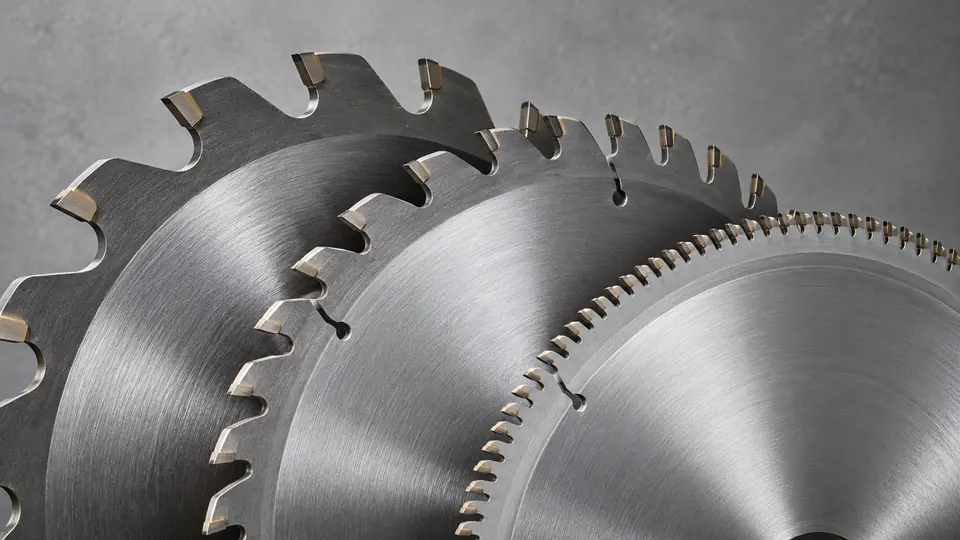
Saw blade tooth count affects cutting speed, chip clearance, cutting force, and the appearance of the cut edge. Fewer teeth generally create larger gullets that clear chips efficiently, which often suits fast rip cuts in solid wood. More teeth divide the cut among more cutting edges and commonly produce a smoother crosscut, but they can restrict chip space and increase heat if used in the wrong application.
A number by itself does not identify the correct blade. A 24-tooth blade for a 7 1/4-inch circular saw is physically different from a 24-tooth blade for a 10-inch table saw. Blade diameter, tooth geometry, workpiece material, feed direction, kerf, hook angle, and saw design all affect performance.
If your main job is cutting solid wood along the grain, compare ripping blades for a table saw by diameter, arbor, and tooth geometry.
How Saw Blade Tooth Count Changes a Cut
Tooth count is the total number of cutting teeth around a circular blade. Reciprocating blades, band saw blades, and some other linear blades are normally described by teeth per inch (TPI) instead. These specifications cannot be compared directly.
On a circular blade, each tooth removes part of the material and carries the resulting chip into a gullet. Tooth count changes the spacing between teeth and the available gullet volume.
- Lower tooth counts: Wider tooth spacing and larger gullets usually support faster chip removal. The cut may show more tooth marks or edge tear-out.
- Higher tooth counts: Closer tooth spacing can produce a finer edge in suitable materials. Smaller gullets may struggle to clear large wood chips during deep rip cuts.
- Excessive tooth engagement: Too many teeth cutting at once can increase friction, heat, and feed resistance.
- Insufficient tooth engagement: Too few teeth in thin or brittle material can cause grabbing, vibration, chipped edges, or tooth damage.
A higher count therefore does not automatically mean a better blade. The useful count depends on the kind of cut and the blade system.
Blade Diameter Changes the Meaning of Tooth Count
Two circular blades with the same number of teeth can have very different tooth spacing. A larger diameter creates a greater circumference, so its teeth are farther apart unless the count rises proportionally.
The approximate circular pitch can be expressed as:
Circular pitch = π × blade diameter ÷ tooth count
This calculation describes nominal spacing around the circumference. It does not account for tooth shape, gullet design, or alternating tooth patterns, so it should not be used as a complete blade-selection formula.
Diameter also affects cutting depth and peripheral speed. Those factors help explain why tooth-count guidance for a 7 1/4-inch handheld circular saw should not be transferred directly to a 10-inch table saw or a 12-inch miter saw.
Typical Tooth-Count Patterns for Woodworking Blades
The following ranges describe common blade categories rather than universal specifications. Blade manufacturers may use different counts and geometries for the same stated application.
| Blade and Operation | Common Tooth-Count Pattern | Primary Reason |
|---|---|---|
| 7 1/4-inch construction or framing blade | Often about 24 teeth | Fast cutting and substantial chip clearance |
| 7 1/4-inch finish-cut blade | Often 40 to 60 teeth | Reduced edge roughness in crosscuts and sheet goods |
| 10-inch table saw ripping blade | Often about 24 teeth | Large gullets for ripping along the wood grain |
| 10-inch general-purpose or combination blade | Often about 40 to 50 teeth | Compromise between ripping speed and crosscut quality |
| 10-inch fine crosscut blade | Often 60 to 80 teeth | Closer tooth spacing for cuts across the grain |
| 12-inch miter saw finish blade | Often 80 to 100 teeth | Fine crosscuts on a larger-diameter blade |
These examples are useful for interpreting blade labels, but they do not override the blade maker’s stated material and saw compatibility. A specialized blade can fall outside these ranges while remaining appropriate for its intended operation.
Rip Cuts, Crosscuts, and Combination Work
Rip Cutting
Ripping follows the grain in solid wood and creates relatively large chips. Dedicated ripping blades commonly use fewer teeth, deep gullets, and tooth geometry that clears those chips efficiently. Forcing a high-tooth-count crosscut blade through a deep rip can produce slow feeding, scorching, and resin buildup.
Fewer teeth alone do not make every blade suitable for ripping. Hook angle, tooth shape, blade body, and the manufacturer’s intended saw type still matter.
Crosscutting
A crosscut severs wood fibers across the grain. More closely spaced teeth can reduce the amount of material removed by each tooth, often leaving a smoother edge. Miter saw blades frequently have higher counts because these saws are used primarily for crosscuts, molding, and joinery cuts.
Feed rate still affects the result. Pushing too rapidly can increase tear-out, while feeding too slowly can create rubbing and heat.
Combination and General-Purpose Cutting
Combination blades balance chip clearance with finish quality. Some use grouped tooth patterns with larger gullets between groups, while others rely on a moderate tooth count and alternating tooth geometry. They are practical for mixed shop work, although a dedicated rip or crosscut blade may perform more efficiently at its specific task.
Tooth Geometry Can Matter as Much as Count
Two blades with identical diameter and tooth count can cut differently because their tooth profiles and hook angles differ.
| Geometry | General Characteristics | Typical Uses |
|---|---|---|
| Flat-top grind (FTG) | Flat cutting edges remove material efficiently and leave a flat-bottomed path | Common on dedicated wood-ripping blades and some joinery blades |
| Alternate-top bevel (ATB) | Teeth alternate bevel direction to shear wood fibers | Crosscuts, plywood, and general woodworking, depending on the exact design |
| Triple-chip grind (TCG) | A chamfered tooth alternates with a flatter finishing tooth | Often used for certain laminates, nonferrous metals, and other application-specific materials |
Hook angle describes the tooth face relative to the blade’s centerline. A more positive hook angle tends to pull aggressively into the work, while a low or negative hook angle can provide more controlled engagement on certain saws and materials. Miter saw blades often use less aggressive hook geometry than table saw ripping blades. Always use a blade approved for the particular saw.
Carbide-tipped circular blades have small cemented-carbide cutting tips attached to a steel blade body. They are not solid carbide blades. Carbide grade, tip size, brazing quality, and sharpening geometry can affect edge life and cutting behavior, so tooth count is only one part of blade construction.
Material Has a Direct Effect on Tooth Selection
Solid Wood
Grain direction is especially influential in solid wood. Lower-count blades commonly suit ripping, while higher-count blades commonly suit crosscutting. Dense species, wet lumber, resinous wood, and thick stock can change chip-clearance and heat behavior.
Plywood, Veneered Panels, and Laminates
Sheet goods often benefit from closely spaced, sharp teeth and a geometry intended to limit surface chipping. Tooth count cannot compensate for an unsuitable tooth grind, dull cutting edges, poor support, or incorrect blade projection.
Some materials also produce abrasive dust that accelerates wear. The blade should be explicitly approved for the panel type being cut.
For a table-saw setup, compare plywood-cutting table saw blades by tooth grind, kerf, and panel application.
MDF and Particleboard
These materials create fine dust rather than long wood chips and can be abrasive. A clean edge often calls for a suitable higher-count carbide-tipped blade, but the manufacturer’s material rating remains more informative than count alone. Dust collection and respiratory protection should match the material and equipment instructions.
Nonferrous Metal
Blades for aluminum and other nonferrous metals often combine a relatively high tooth count with controlled hook geometry and a material-specific tooth grind. A general woodworking blade should not be assumed suitable merely because it has a similar count.
Workpieces such as extrusions and thin sections need secure support and a tooth pattern suited to the section thickness. Follow the saw and blade manufacturers’ instructions for lubrication, clamping, and permitted materials.
Steel
Woodworking and nonferrous-metal blades are generally inappropriate for cutting steel. Steel-cutting circular saws use purpose-specific blades and machines with operating characteristics suited to the material. Matching the tooth count does not make an incompatible blade safe or effective.
Tooth Count Across Different Saw Types
Table Saws
Table saw blade selection is strongly tied to rip, crosscut, or combination use. Blade diameter, arbor, kerf, riving-knife compatibility, and maximum permitted speed must match the saw. A thin-kerf blade can reduce cutting resistance, but its plate and kerf must still work correctly with the machine’s riving knife and guarding system.
For a table-saw setup, compare carbide table-saw blades by cutting task once the required diameter and arbor are clear.
Miter Saws
Miter saws are primarily crosscut machines, so their blades often carry more teeth than comparable ripping blades. Tooth geometry and hook angle should be suitable for the saw’s cutting action. A blade labeled for a table saw is not automatically suitable for a miter saw.
For trim crosscuts, compare miter-saw blades for clean trim cuts after matching the saw diameter and arbor.
Handheld Circular Saws
Construction blades favor speed, while finish blades use more teeth for cleaner cuts. Since handheld saws are guided through the work, blade sharpness, base-plate alignment, workpiece support, and steady feed can influence cut quality as much as the printed tooth count.
On a handheld saw, choose carbide circular-saw blades only after matching the machine’s blade diameter, mounting size, and speed.
Track Saws
Track saw blades are usually selected for clean sheet-goods cutting and compatibility with the saw’s plunge action, riving system, and splinter-control features. Diameter, arbor, kerf, plate thickness, and blade-body clearances require verification. A similar-looking circular saw blade may still be incompatible.
Reciprocating Saws
Reciprocating blades use teeth per inch, not total tooth count. Coarser TPI patterns are commonly associated with rapid wood and demolition cutting. Finer patterns are used for thinner metal and smoother cuts. Variable-pitch blades combine multiple tooth spacings to broaden their useful material range or reduce vibration.
The workpiece should remain engaged by enough teeth to avoid snagging, but the proper TPI depends on material thickness, tooth design, and blade manufacturer guidance. Total-tooth recommendations for circular blades have no direct application here.
How to Select a Tooth Count
- Identify the saw and permitted blade specifications. Confirm diameter, arbor, maximum RPM, kerf restrictions, and approved blade type in the machine manual.
- Identify the workpiece material. Separate solid wood, engineered panels, laminates, plastics, nonferrous metals, and steel. Similar tooth counts do not establish cross-material compatibility.
- Define the cutting direction and objective. Decide whether the task is ripping, crosscutting, breaking down sheet goods, making finish cuts, or cutting a manufactured profile.
- Check the blade’s stated application. Use the manufacturer’s material and saw-type labeling before comparing tooth counts.
- Compare geometry and count together. Review tooth grind, hook angle, gullet form, kerf, and blade construction.
- Account for workpiece thickness. A blade that performs well in thin sheet may behave differently in thick stock because more teeth and a greater portion of the blade are engaged.
- Choose the required balance. Favor chip clearance for demanding rip cuts and finer tooth spacing for finish crosscuts, provided the blade is suitable for the machine and material.
Signs That the Blade or Tooth Count Is Unsuitable
Cutting problems do not prove that tooth count is the sole cause. A dull or dirty blade, incorrect alignment, unstable stock, excessive feed pressure, and unsuitable tooth geometry can create similar symptoms.
- Scorching during a rip cut: Possible causes include restricted chip clearance, a dull or resin-coated blade, misalignment, binding, or an unsuitable feed rate.
- Heavy tear-out: The blade may have too few teeth for the required finish, unsuitable tooth geometry, dull edges, inadequate workpiece support, or incorrect cutting orientation.
- Slow cutting and excessive heat: Too many teeth may remain engaged, but dullness, contamination, blade deflection, and machine setup also deserve inspection.
- Grabbing or chipping in thin material: The tooth spacing or geometry may be too coarse, or the workpiece may lack proper support.
- Vibration and rough tooth marks: Check blade condition, mounting surfaces, arbor fit, workpiece security, and machine alignment before attributing the problem to count.
Disconnect power according to the saw manufacturer’s procedure before inspecting, cleaning, or replacing a blade. Never use a blade with cracked carbide tips, missing teeth, a distorted plate, or damage around the arbor hole. Guards, riving knives, splitters, and anti-kickback equipment should remain installed and adjusted as directed by the machine manufacturer.
What the Printed Tooth Count Cannot Tell You
Saw blade tooth count provides a useful first classification, but it does not reveal the complete cutting behavior. A sound selection also requires:
- Correct blade and arbor diameter
- Maximum blade RPM at least compatible with the saw’s operating speed
- Suitable tooth material and grind
- Appropriate hook angle
- Compatible kerf and plate thickness
- Approval for the workpiece material
- Compatibility with the saw type and safety components
- A blade condition suitable for continued use
For circular woodworking blades, fewer teeth generally favor chip clearance and faster ripping, while more teeth generally favor smoother crosscuts. That guideline becomes reliable only after blade diameter, tooth geometry, material, cutting direction, and machine compatibility have been established.
