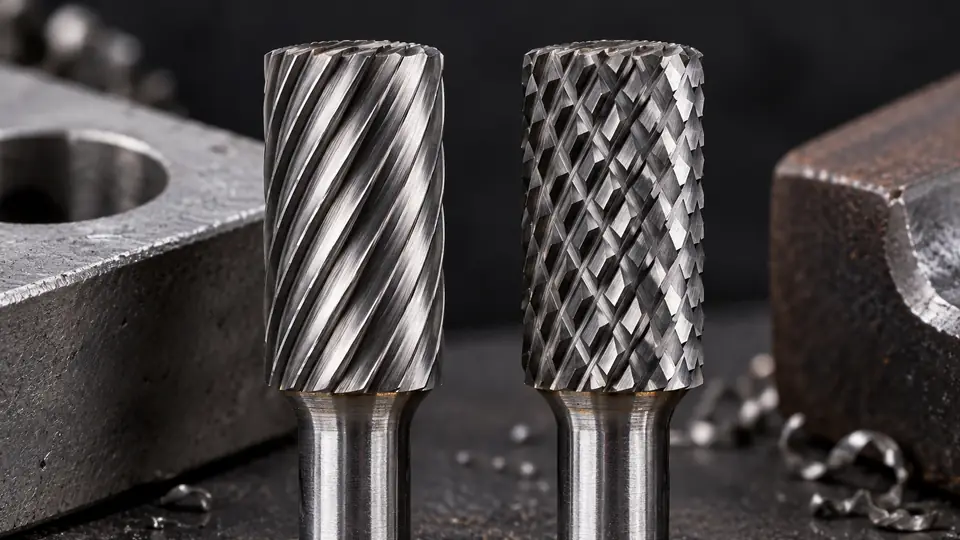
Single-cut carbide burrs have one set of cutting flutes, while double-cut burrs add a second intersecting set. The single-cut pattern generally takes larger bites and favors rapid, direct stock removal. The double-cut pattern breaks material into smaller chips, usually giving the operator greater control and a finer surface.
Neither pattern is universally better. The useful choice depends on the workpiece, removal rate, desired finish, burr shape, tool diameter, grinder, and the amount of control required. Soft, chip-prone metals may call for a separate aluminum-cut or nonferrous-cut geometry rather than either conventional pattern.
If you need several profiles for general deburring, compare multi-shape carbide burr sets after checking the shank size and supported materials.
How the Two Cutting Patterns Differ
Single-Cut Geometry
A single-cut burr has rows of teeth running in one direction across its head. These uninterrupted cutting rows tend to form relatively large chips and remove material assertively. The exact chip shape still depends on the workpiece. Ductile metal may produce longer chips, while cast iron and other brittle materials tend to fracture into shorter particles.
This geometry is commonly used for tasks such as:
- Heavy deburring
- Removing weld material
- Opening or enlarging an existing feature
- Rapid stock removal
- Cleaning castings
- Preparing a surface for later finishing
The aggressive cutting action can require careful tool control, particularly around edges, corners, and irregular surfaces. Excessive pressure may make the burr grab, chatter, or leave deep cutting marks.
Double-Cut Geometry
A double-cut burr has two sets of intersecting flutes. The crossing pattern divides the cutting edges into smaller teeth and generally produces smaller chips than a comparable single-cut pattern.
Double-cut burrs are often selected for:
- Controlled material removal
- General deburring
- Blending welds and transitions
- Shaping contours
- Cleaning edges
- Producing a surface that needs less subsequent finishing
The additional cutting edges spread the cutting action across the burr head. This typically makes the tool easier to guide and less prone to pulling strongly in one direction. It does not eliminate chatter or grabbing, which can still result from poor contact, excessive projection, an unsuitable speed, or an unstable workpiece.
Single Cut vs Double Cut Carbide Burrs at a Glance
| Characteristic | Single Cut | Double Cut |
|---|---|---|
| Cutting pattern | One set of directional flutes | Two intersecting sets of flutes |
| Typical cutting action | Aggressive, direct stock removal | More controlled cutting with smaller bites |
| Chip formation | Usually larger chips | Usually smaller, more fragmented chips |
| Surface result | May leave deeper or more directional marks | Usually produces a finer, more uniform surface |
| Operator control | Can require firmer, more deliberate guidance | Generally easier to control during blending and contouring |
| Typical role | Heavy removal and rough shaping | General-purpose deburring, shaping, and intermediate finishing |
| Potential limitation | Greater risk of aggressive grabbing or coarse marks | May remove heavy stock less directly than a comparable single-cut burr |
These are general tendencies rather than guaranteed results. Tooth spacing, burr diameter, head shape, workpiece properties, tool condition, rotational speed, and technique can change how a particular burr behaves.
Material Compatibility
The cut pattern alone does not establish material compatibility. Burr manufacturers may offer different tooth pitches, carbide grades, head constructions, and application-specific geometries under the same broad single-cut or double-cut label.
Steel and Stainless Steel
Both patterns can be used on suitable steel applications. Single cut can be useful for substantial stock removal, while double cut is often preferred for deburring, contouring, and controlled weld blending. Stainless steel can work-harden and generate significant heat, so the burr must remain sharp and the operating conditions must follow its manufacturer’s guidance.
A double-cut label does not automatically make a burr suitable for every alloy, hardness, or operating condition. The specific tool documentation remains the controlling reference.
Cast Iron
Cast iron is commonly worked with carbide burrs, but its brittle structure changes chip behavior. It tends to create short fragments and dust rather than the long chips associated with ductile metals. Single cut may support rapid cleanup, while double cut can provide greater control around casting features and edges.
Dust control matters with cast materials. The composition of the casting may also require workplace-specific exposure precautions.
Brass, Bronze, and Copper Alloys
Single-cut burrs are often used on some nonferrous alloys, but the alloy and its tendency to smear or load the teeth must be considered. Free-machining brass behaves differently from soft copper, for example. Double-cut patterns can work in suitable cases, though closely spaced teeth may load if the material is soft and gummy.
Aluminum and Other Soft Metals
Standard single-cut and double-cut burrs can clog when used on soft aluminum. Packed material reduces cutting effectiveness, increases friction, and may cause the tool to rub rather than cut.
An aluminum-cut burr is a separate geometry with wider, more open flute spacing. The extra chip space helps evacuate soft material and resist loading. A single-cut burr should not be assumed to be an aluminum-cut burr merely because both have one primary flute direction.
For aluminum, choose from aluminum-cut carbide burrs with the appropriate flute spacing.
Plastics and Wood
Carbide burrs can shape some plastics, composites, and wood, but heat, melting, dust, fiber behavior, and surface tearing may become limiting factors. Specialty burr patterns are often better suited to these materials. Confirm that the burr manufacturer permits the intended application and use suitable dust control.
For wood shaping, use carbide burrs intended for wood carving with a head profile suited to the contour.
Removal Rate, Finish, and Control
For Heavy Material Removal
A single-cut burr is a reasonable starting point when the main objective is removing a substantial amount of metal. Its uninterrupted cutting rows can engage the workpiece assertively. This can be useful for rough shaping, weld removal, and casting cleanup where the surface will receive additional finishing.
Greater aggressiveness does not guarantee faster completion. A burr that repeatedly catches, bounces, or loads may be slower and harder to manage than a more controlled double-cut tool.
For General Deburring
Double cut is commonly favored for removing sharp edges, cleaning machined features, and blending transitions. Smaller chips and a less directional cutting action help the operator approach the desired contour gradually.
Burr shape also matters. A cylindrical burr suits broad walls and flat areas, while ball, oval, tree, flame, and tapered shapes reach different contours. Changing the cut pattern cannot compensate for a head shape that does not fit the feature.
For a Finer Surface
Double cut generally leaves a finer surface than a similarly sized single-cut burr under comparable conditions. The intersecting teeth take smaller bites and reduce the prominence of directional tool marks.
A carbide burr is still a cutting tool rather than an abrasive finishing accessory. A surface that requires a polished or tightly controlled finish may need subsequent abrasive steps. Burr tooth pitch, pressure, runout, and movement also affect the result.
How to Select the Cut Pattern
- Identify the material. Check the burr maker’s stated workpiece compatibility. For soft aluminum and similarly gummy metals, examine aluminum-cut or nonferrous-cut options.
- Define the operation. Rough stock removal points toward single cut. Deburring, contouring, and blending often favor double cut.
- Set the finish requirement. Double cut typically reduces deep tool marks, but further finishing may still be needed.
- Assess access and head shape. Select a burr profile that contacts the intended surface without forcing the shank or an unsuitable part of the head against the workpiece.
- Match the burr to the grinder. Shank diameter, collet size, permitted rotational direction, and speed rating must agree with the equipment.
- Account for operator control. Double cut is often easier to guide on detailed features. Single cut may suit open areas where rapid removal is the priority.
If one burr must cover varied steel deburring and shaping work, double cut is often the more versatile pattern. That is a practical generalization, not a material-specific operating recommendation.
Equipment and Operating Requirements
Carbide burrs are commonly used in die grinders and other suitable rotary tools. A shank that physically enters a chuck or collet does not prove that the machine provides the correct speed, support, concentricity, or control.
- Use the exact collet size specified for the burr shank.
- Confirm that the machine’s speed range does not exceed the burr manufacturer’s limit.
- Keep tool projection as short as the task allows while maintaining safe access.
- Inspect the head, braze joint, and shank before use.
- Reject a burr with visible cracks, a bent shank, damaged teeth, or an uncertain connection between the head and shank.
- Use the specified rotational direction. Reverse operation can produce poor cutting behavior and may conflict with the tool’s design.
- Secure the workpiece and maintain a stable grip on the machine.
Many carbide burrs use a cemented carbide cutting head joined to a steel shank, while other constructions are also available. “Carbide burr” therefore does not establish that the entire tool is a single piece of solid carbide.
Technique That Affects Both Patterns
Cut pattern cannot correct poor operating technique. Several practices influence cutting action and finish:
- Use moderate pressure. Forcing the burr can increase heat, chatter, tooth damage, and grabbing.
- Keep the head moving. Dwelling in one spot can create grooves, local heating, or an uneven contour.
- Avoid excessive leverage. Long projection and heavy side force place additional stress on the shank and joint.
- Maintain supported contact. Sudden engagement at an edge can make an aggressive burr catch.
- Clear chips safely. Stop and isolate the machine before inspecting or cleaning the burr. Never use bare fingers to remove sharp packed chips.
- Replace worn or loaded tools appropriately. A dull burr generates extra heat and pressure. Cleaning methods must be compatible with the tool and workpiece material.
Operating speed should come from the burr manufacturer and should account for head diameter, construction, application, and grinder limitations. A universal RPM value would be misleading.
Safety Considerations
Rotary burrs can throw sharp chips at high velocity. Carbide is wear resistant, but it is comparatively brittle and can fracture under impact, excessive leverage, poor clamping, or improper use.
- Wear suitable eye protection and use a face shield where the risk assessment calls for one.
- Use hearing protection appropriate to the grinder and work environment.
- Control metal chips, dust, and fumes according to the workpiece material.
- Keep guards and safety features in place.
- Do not use a burr above its marked or documented maximum speed.
- Keep hands, loose clothing, hair, and cords clear of the rotating tool.
- Allow hot chips and workpieces to cool before handling.
- Follow the grinder and burr manufacturers’ instructions, including any restrictions on contact angle or application.
Frequently Asked Questions
Does Double Cut Mean the Burr Has Twice the Removal Rate?
No. Double cut describes two intersecting flute directions, not a guaranteed performance ratio. It usually creates smaller chips and more controlled cutting. Actual removal rate depends on the complete tool geometry, workpiece, contact, grinder, and operating conditions.
Can a Double-Cut Burr Handle Heavy Stock Removal?
Yes, a suitable double-cut burr can remove substantial material. Single cut often provides a more aggressive cutting action, while double cut may help the operator maintain the intended shape and avoid taking an excessively deep bite.
Is Single Cut Always the Correct Pattern for Aluminum?
No. Aluminum-cut burrs use wider, more open flutes to reduce chip packing in soft metal. Conventional single-cut geometry and aluminum-cut geometry should be treated as separate categories unless the manufacturer identifies the tool for aluminum.
Is Double Cut the Same as Diamond Cut?
“Diamond cut” is sometimes used for an intersecting or cross-cut pattern, but naming varies among manufacturers. Check a cutting-pattern diagram or technical description rather than relying on the name alone.
Which Pattern Is Better for Beginners?
Double cut often feels easier to control because it takes smaller bites and tends to pull less strongly in one direction. Safe use still requires a compatible grinder, secure workholding, the correct collet, manufacturer-approved speed, and appropriate protective equipment.
A Practical Selection Rule
Select single cut for aggressive rough removal where larger chips and a coarser intermediate surface are acceptable. Select double cut for controlled deburring, contouring, weld blending, and a generally finer result. For soft aluminum or another loading-prone material, examine an application-specific open-flute pattern instead of assuming either conventional cut will work well.
