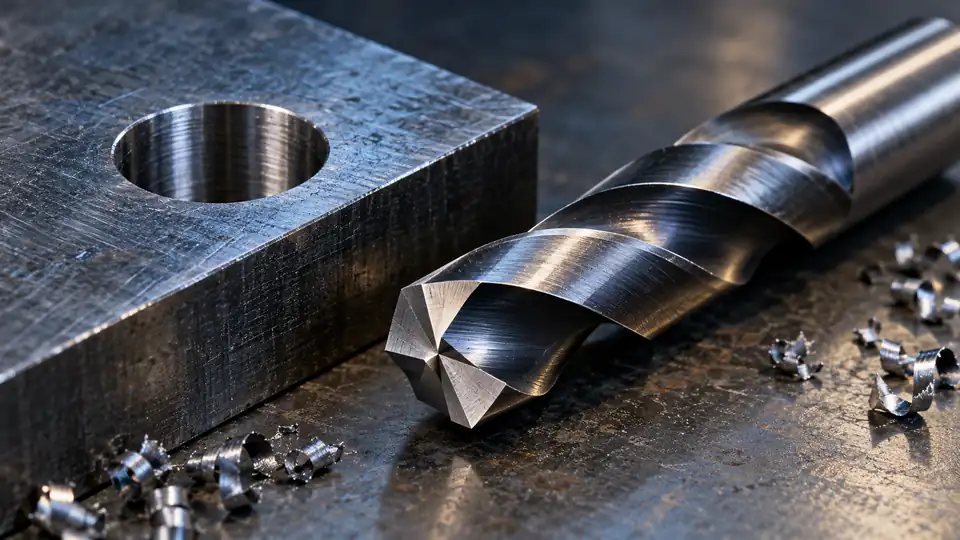
Drilling hardened steel is where an ordinary metal bit can suddenly squeal, skate across the surface, and leave a shallow scar instead of a clean hole. The phrase carbide drill bits for hardened steel covers several very different tools, including solid carbide drills intended for stable drill presses and CNC machines, plus cobalt HSS alternatives that may suit broader workshop use. Choosing between them requires more than counting pieces in the case.
The biggest mistake is treating every bit labeled “carbide” as interchangeable. Solid carbide offers a rigid cutting structure, but the supplied listings repeatedly restrict these tools to stable drill presses or CNC equipment because vibration and poor alignment can cause breakage. Diameter, point angle, coating, flute length, shank style, material rating, and cooling requirements matter just as much. A machinist drilling a few precise holes may prefer a small solid carbide set, while a maintenance buyer who needs many fractional sizes may favor a cobalt set with a storage index.
For the strongest overall match, the TiAlSi-coated set with a 135-degree point includes four useful diameters and clearly states its drill-press and CNC limitation. It is a focused choice for hardened and stainless materials below the documented HRC40 range, while the other picks cover larger size ranges, repeated 1/8-inch work, broader cobalt alternatives, and more specialized hole-making needs.
Quick Answer
- Best Overall: Carbide Drill Bit Set, 1/16 to 1/4 Inch for its documented solid carbide construction, 135-degree point, TiAlSi coating, and hardened-steel focus.
- Best Precision Single Size: 5/32 Carbide Drill Bit 2-Piece Set for buyers who repeatedly need a 5/32-inch hole on stable equipment.
- Best Size Range: HOYUSK Six-Piece Solid Carbide Set for its spread from 1/16 inch to 1/2 inch and stated material coverage.
- Best Cobalt Alternative: Crosstar M35 Cobalt 21-Piece Set for shoppers who want many sizes and a three-flute design, while accepting that it is cobalt HSS rather than solid carbide.
Best Carbide Drill Bits for Hardened Steel Comparison Table
| Product | Best For | Diameter | Construction | Machine Requirement | Notable Feature |
|---|---|---|---|---|---|
| Carbide Drill Bit Set, 1/16 to 1/4 Inch | Overall hardened-steel use | 1/16, 1/8, 3/16, 1/4 inch | Solid carbide | Drill press or CNC | 135° point, TiAlSi coating |
| 5/32 Carbide Drill Bit 2-Piece Set | Repeated 5/32-inch holes | 5/32 inch | Solid carbide, K20 | Drill press or CNC | TiAlSi coating, 0.3-micron grain |
| HOYUSK Six-Piece Solid Carbide Set | Broad size coverage | 1/16 to 1/2 inch | Solid carbide | Stable clamping setup | Six sizes, spiral flutes |
| Bosch CO14B Cobalt Set | Established cobalt assortment | 1/16 to 1/2 inch | M42 cobalt HSS | Metalworking drill setup | 14 sizes, thick web helix |
| Sinyeenglon M35 Cobalt Set | Many replacement bits | 1/16 to 3/8 inch | M35 cobalt HSS | Stable, vertical drilling | 99 pieces, indexed case |
| YFTOOL Three-Piece Carbide Set | Compact precision selection | 1/8, 3/16, 1/4 inch | Solid carbide, K20 | Drill press or CNC | Diamond-like coating |
| YFTOOL 1/8-Inch Five-Piece Set | Repeated 1/8-inch drilling | 1/8 inch | Solid carbide, K30 | Drill press or CNC | 135° point, 30° helix |
| Crosstar M35 Cobalt Set | Many metalworking sizes | 1/16 to 1/2 inch | M35 cobalt HSS | Drill chuck setup | Three-flute design, TiAlN coating |
| HOYUSK Four-Piece Carbide Set | Compact mixed-size kit | 1/16, 1/8, 3/16, 1/4 inch | Solid carbide | High-precision setup | Spiral flutes, round shank |
The detailed picks below separate solid carbide drills from cobalt HSS alternatives and show where each size range or machine restriction matters.
1. Carbide Drill Bit Set, 1/16 to 1/4 Inch — Best Overall

This four-piece set has the clearest match for buyers searching specifically for carbide drills for hardened steel. It uses solid carbide construction and includes 1/16-inch, 1/8-inch, 3/16-inch, and 1/4-inch sizes. The 135-degree split point is identified for stainless steel, hot-working steel below HRC40, and other hard metals, giving the set a more specific application profile than a generic metal drill assortment.
The machine restriction deserves equal attention. The listing identifies this set for drill presses and CNC machines only, not handheld drills. That is a meaningful boundary, since solid carbide is rigid and hard but less forgiving of vibration or movement than many cobalt HSS drills. TiAlSi coating and the documented tolerance claim of ±0.003 mm add appeal for controlled, repeatable drilling, while the compact diameter range keeps the kit focused rather than bloated.
Pros
- Uses solid carbide construction for the four listed drill sizes.
- Includes a 135-degree split point intended for hard metals and stainless steel.
- Uses a documented TiAlSi coating for stainless and hard-steel applications.
- Offers 1/16-inch, 1/8-inch, 3/16-inch, and 1/4-inch sizes.
- The listing clearly identifies drill press and CNC use rather than handheld drilling.
Cons
- The documented material range specifies hot-working steel below HRC40, so the set should not be treated as a universal hardened-steel solution.
- The four-piece size range does not cover larger or metric holes.
This is the strongest fit for a machinist or fabrication buyer with stable equipment who needs several small fractional holes in hard steel or stainless. A handheld-drill user should skip it, and a buyer needing many common sizes may find the Bosch or Crosstar sets more practical despite their cobalt HSS construction.
To buy this product, click here.
2. 5/32 Carbide Drill Bit 2-Piece Set — Best for Repeated 5/32-Inch Holes

A two-piece set built around one diameter makes sense for a very specific job. If a fixture, bracket, or production task repeatedly calls for 5/32-inch holes, having a spare on hand is more useful than paying for a case full of sizes that stay untouched. The listing identifies these as solid tungsten carbide drills with a K20 carbide foundation, 0.3-micron grain structure, and TiAlSi coating.
The documented application range extends to hard steel below HRC55, aluminum, copper, mild steel, tool steel, and carbon steel. That gives this set a broader stated hardness range than the overall pick, although the listing still limits use to stable CNC machines or drill presses and calls for effective cooling. The narrow diameter selection is the trade-off. It is a focused tool purchase, not a general-purpose kit for a mixed repair drawer.
Pros
- Provides two solid carbide drills in the same 5/32-inch diameter.
- Lists suitability for hard steel below HRC55.
- Uses a documented K20 carbide grade and 0.3-micron grain structure.
- Includes a TiAlSi coating for the stated application range.
- Is identified for high-precision work on CNC machines or drill presses.
Cons
- Offers only one drill diameter, limiting its usefulness for mixed-size work.
- Is not recommended for hand tools and requires stable equipment with cooling.
Buy this pair when 5/32 inch is the hole size that keeps appearing on the drawing or work order. It is a sharper fit than a broad set for repetitive precision work, while the Carbide Drill Bit Set, 1/16 to 1/4 Inch is more useful if several small diameters matter.
To buy this product, click here.
3. HOYUSK Six-Piece Solid Carbide Set — Best Size Range

For a buyer who needs both fine pilot holes and a larger opening, this six-piece set covers an unusually broad fractional spread: 1/16 inch, 1/8 inch, 3/16 inch, 1/4 inch, 3/8 inch, and 1/2 inch. That range reaches beyond the compact sets and gives a machine shop or maintenance department more room to handle different brackets, plates, and fixture work without immediately buying individual drills.
The supplied information identifies 0.6-micron micro-particle cemented carbide, sharp spiral flutes, and a round-shank clamping design. The listing also names aluminum alloy, copper, cast iron, stainless steel, mold steel, and hardened steel among the supported materials. Those broad claims make the kit versatile on paper, but the buyer still needs a stable, accurately clamped setup. The larger 1/2-inch drill also makes the equipment requirement more consequential than it would be with a tiny 1/16-inch bit.
Pros
- Includes six diameters from 1/16 inch through 1/2 inch.
- Uses solid cemented carbide with a documented 0.6-micron particle structure.
- Lists hardened steel, stainless steel, cast iron, copper, and aluminum alloy applications.
- Uses sharp spiral flutes for chip movement according to the product information.
- Provides a round-shank clamping design for stable chucking.
Cons
- The listing does not provide a specific hardness limit for the hardened-steel claim.
- The broad size range requires careful matching of the larger drills to suitable stable equipment.
This set suits a workshop that values diameter coverage more than a specialized coating or point geometry. It is a better all-around size kit than the smaller three-piece options, while buyers working repeatedly in one diameter may prefer the 5/32-inch or 1/8-inch multipacks.
To buy this product, click here.
4. Bosch CO14B Cobalt Drill Bit Set — Best Cobalt Assortment

The Bosch CO14B is a cobalt HSS set, not a solid carbide set, and that distinction should be clear before purchase. Its value is the broad 14-size assortment, running from 1/16 inch to 1/2 inch, with familiar fractional steps such as 5/32, 7/32, 5/16, and 3/8 inch. For a general metalworking drawer, that spread can be more useful than a tiny solid carbide kit with only three or four diameters.
The supplied specifications identify an M42 alloy with 8 percent cobalt, a surface-hardened tip, high-heat resistance, and a thick web-helix design. The listed applications include stainless steel, cast iron, titanium, light-gauge metal, aluminum, and hardened steel. Since the construction is cobalt HSS, it belongs here as an alternative for shoppers who need size variety and a different tool behavior, rather than as a substitute for solid carbide in a precision CNC application.
Pros
- Includes 14 fractional sizes from 1/16 inch to 1/2 inch.
- Uses documented M42 alloy with 8 percent cobalt.
- Lists hardened steel, stainless steel, cast iron, titanium, and aluminum applications.
- Uses a surface-hardened tip according to the product information.
- Includes a thick web-helix design identified for added stability in tough work.
Cons
- It is cobalt HSS rather than solid carbide, so it does not match the construction of the carbide picks.
- The listing does not provide a specific hardened-steel hardness limit.
This is the sensible choice for a buyer who needs a wide fractional assortment and wants cobalt HSS instead of brittle solid carbide. Choose one of the solid carbide sets for tightly controlled CNC or drill-press work where the documented carbide construction is central to the job.
To buy this product, click here.
5. Sinyeenglon M35 Cobalt Drill Bit Set — Best for Replacement Coverage

Some buyers reach for hardened-steel bits because they need a deep assortment of small sizes, and this 99-piece M35 cobalt HSS set is built around that need. It includes multiple copies of common diameters from 1/16 inch to 3/8 inch, rather than one lonely bit of each size. That format is handy for a busy maintenance drawer where small drills can disappear, dull, or break during repeated work.
The set includes a plastic index case with labeled compartments, and the supplied instructions call for vertical drilling, low speed from 200 to 1,000 RPM, and cutting fluid. Those instructions are product-specific and should be checked against the workpiece and equipment rather than treated as universal settings. Because these are M35 cobalt HSS bits, they are a practical alternative to solid carbide, especially for general metalwork, but they should not be described as solid carbide drills.
Pros
- Provides 99 M35 cobalt HSS pieces across 14 listed sizes.
- Includes multiple copies of several small diameters.
- Lists stainless steel, cast iron, titanium, hardened metal, aluminum, and mild steel applications.
- Comes in a compartmentalized plastic index case with size markings.
- The product information gives a vertical-drilling and cutting-fluid usage direction.
Cons
- It is M35 cobalt HSS, not solid carbide.
- The largest listed size is 3/8 inch, so it does not cover 1/2-inch holes.
Choose this set for breadth and replacement stock rather than maximum solid-carbide rigidity. It fits a workshop that handles many small holes and values an organized case, while a CNC operator seeking a documented point geometry and carbide coating should move up to the first or eighth pick.
To buy this product, click here.
6. YFTOOL Three-Piece Carbide Set — Best Compact Precision Set

This set keeps the selection tight with 1/8-inch, 3/16-inch, and 1/4-inch solid carbide drills. Those sizes cover several common small-to-medium holes without adding a 1/16-inch bit or jumping straight to the larger 3/8-inch and 1/2-inch diameters. The listing identifies K20 carbide with an ultra-fine 0.3-micron grain structure, plus a diamond-like coating.
The documented material range includes hardened steel below HRC55, aluminum, copper, mild steel, tool steel, and carbon steel. As with the other solid carbide YFTOOL products, the listing calls for stable CNC or drill-press machining, good cooling, and no hand tools. Its stated tolerance claim of ±0.003 mm may appeal to precision-oriented buyers, but the narrow size range remains the defining trade-off.
Pros
- Uses solid carbide in three practical sizes: 1/8, 3/16, and 1/4 inch.
- Lists materials with hardness below HRC55, including hardened steel.
- Identifies K20 carbide and a 0.3-micron grain structure.
- Includes a documented diamond-like coating.
- Is positioned for stable CNC or drill-press machining rather than handheld use.
Cons
- Provides only three diameters, with no 1/16-inch, 3/8-inch, or 1/2-inch option.
- The listing does not establish suitability for hardened steel at or above HRC55.
This compact kit fits a buyer who knows the needed hole sizes and wants carbide construction without paying for a larger assortment. If stainless steel and hot-working steel are the main targets, the TiAlSi-coated 135-degree options provide more directly documented geometry for that application.
To buy this product, click here.
7. YFTOOL 1/8-Inch Five-Piece Carbide Set — Best for Repeated 1/8-Inch Drilling

Five identical 1/8-inch solid carbide drills are a very specific proposition, but it can be useful for repeated work where one diameter sees all the action. This set adds a 135-degree point, TiAlSi coating, K30 carbide, and a stated 0.4-micron grain structure. The 30-degree helix is also documented, giving buyers more geometry information than many generic listings provide.
The product information identifies stainless steel, hot-working steel below HRC40, and other high-hardness steels as target materials. It also describes chip-control features tied to the point and helix design. Those are manufacturer-supplied design claims, not independent test results, so the practical buying decision still comes down to whether the user has a stable drill press or CNC setup, suitable cooling, and a genuine need for five copies of the same diameter.
Pros
- Includes five solid carbide drills in the same 1/8-inch diameter.
- Uses a documented 135-degree point for stainless and hard-steel applications.
- Combines TiAlSi coating with K30 carbide and a stated 0.4-micron grain structure.
- Lists a 30-degree helix angle for the drill geometry.
- Targets stainless steel and hot-working steel below HRC40.
Cons
- All five pieces are 1/8 inch, making the set unsuitable for varied hole sizes.
- The listing restricts the drills to stable machining equipment and does not support handheld use.
This is a practical stock-up set for a repeat 1/8-inch operation, especially where the point and coating match the material. For a mixed repair drawer, the four-piece overall set or six-piece HOYUSK set offers more useful diameter variety.
To buy this product, click here.
8. Crosstar M35 Cobalt 21-Piece Set — Best Cobalt Multi-Size Alternative

The Crosstar set takes a different path from the solid carbide picks. It uses M35 cobalt HSS and covers 21 sizes from 1/16 inch to 1/2 inch, giving a broad selection for hardened metal, stainless steel, high-carbon steel, and titanium alloys. For someone standing at a drill press with a mixed stack of metal parts, that size coverage can be far more convenient than keeping several narrowly focused carbide sets nearby.
Its larger sizes use a documented three-flute design, while the smallest listed sizes use a two-flute arrangement. The product information also identifies TiAlN coating and a three-flat shank. These details create a clear identity, but the material distinction remains central: M35 cobalt steel is not solid carbide. Buyers should select it for its assortment and stated cobalt-steel application rather than expecting it to behave like a rigid solid carbide CNC drill.
Pros
- Includes 21 sizes from 1/16 inch through 1/2 inch.
- Uses M35 cobalt HSS with a stated 5 percent cobalt content.
- Lists hardened metal, stainless steel, high-carbon steel, and titanium alloy applications.
- Uses TiAlN coating according to the product information.
- Provides three-flat shanks and a three-flute design on the larger sizes.
Cons
- It is cobalt HSS rather than solid carbide.
- The flute arrangement changes by size, so the set is not geometrically uniform across all 21 pieces.
Choose Crosstar when a wide size range and cobalt construction matter more than a solid carbide tool body. It is a useful alternative for general metal drilling, while the first and seventh picks are more targeted for documented carbide geometry in controlled equipment.
To buy this product, click here.
9. HOYUSK Four-Piece Solid Carbide Set — Best Compact Mixed-Size Kit

This four-piece HOYUSK set covers 1/16 inch, 1/8 inch, 3/16 inch, and 1/4 inch, making it a close match for buyers who want a compact fractional kit without the larger diameters in the six-piece version. The listing identifies 0.6-micron micro-particle cemented carbide, sharp spiral flutes, and a stable round-shank design. That combination gives the set a straightforward, small-hole focus.
The stated materials include aluminum alloy, copper, steel, hardened steel, cast iron, stainless steel, and mold steel. The listing also warns against handheld drills and poorly calibrated bench drills because misalignment or vibration may cause breakage. That warning is particularly useful here. The set may look like a small general-purpose kit, but its solid carbide construction makes accurate clamping and suitable equipment part of the purchase decision.
Pros
- Provides four useful fractional sizes from 1/16 inch to 1/4 inch.
- Uses solid cemented carbide with a stated 0.6-micron particle structure.
- Lists hardened steel, stainless steel, cast iron, copper, and aluminum alloy applications.
- Includes sharp spiral flutes for the documented metalworking design.
- Uses a round-shank design intended to reduce slipping during clamping.
Cons
- The set does not include 3/8-inch or 1/2-inch drills for larger holes.
- The product warning rules out handheld drills and poorly calibrated bench drills.
This kit fits the buyer who wants the familiar small fractional spread in a solid carbide format and understands the equipment requirement. It overlaps with the overall pick in size range, so the TiAlSi coating and 135-degree point of the first product may be more persuasive for stainless-focused work.
To buy this product, click here.
Buying Guide
Solid Carbide Versus Cobalt HSS
Start by identifying the material rather than trusting the word “carbide” in a title. Products 1, 2, 3, 6, 7, and 9 are described as solid carbide or cemented carbide. Bosch, Sinyeenglon, and Crosstar are cobalt HSS alternatives. Solid carbide may suit rigid, accurately aligned CNC or drill-press work, while cobalt HSS sets provide broad size coverage and a different balance of flexibility and heat resistance. The distinction changes both application and machine expectations.
The comparison of carbide versus cobalt for metal drilling explains the toughness and rigidity trade-off behind this choice.
Match the Hardness Claim to the Workpiece
Several listings give a specific boundary. The overall set identifies hot-working steel below HRC40, while the 5/32-inch and three-piece YFTOOL sets list materials below HRC55. Crosstar lists drilling hardness up to 60 HRC in its product information. Those figures should be read as product-specific claims, not a promise that every hard steel falls within the same range. If the workpiece hardness is unknown, verify it before choosing a drill.
Choose the Diameter Pattern Before the Coating
A coating cannot rescue the wrong hole size. The six-piece HOYUSK set reaches 1/2 inch, Bosch and Crosstar also cover 1/2 inch, and the Sinyeenglon set stops at 3/8 inch. The 1/8-inch and 5/32-inch multipacks make sense for repeated work, while the four-piece sets cover a small cluster of common fractional holes. Sketch the required holes first, then decide whether a focused pack or broad assortment is appropriate.
Pay Attention to Point and Flute Geometry
A 135-degree point appears on the overall set and the five-piece 1/8-inch set. The latter also lists a 30-degree helix, while the Crosstar set uses three flutes on larger sizes and two flutes on smaller sizes. These specifications describe meaningful differences in the tool geometry, but they do not establish a universal performance winner. Use them to match the product to the documented application and the hole-making process.
Check the Machine Requirement
Many solid carbide listings explicitly exclude handheld drills. That restriction is central, not fine print. A drill press or CNC machine can provide the stable alignment these products require, while vibration from a handheld tool may increase the chance of breakage. The HOYUSK four-piece listing also warns against poorly calibrated bench drills. Confirm the drill chuck, shank arrangement, alignment, and workholding before ordering.
Plan for Cooling and Chip Removal
The product listings repeatedly connect cooling with carbide drill use. The overall set, 5/32-inch set, and three-piece set mention good cooling or effective coolant, while the Sinyeenglon instructions identify cutting fluid. The 1/8-inch YFTOOL set documents a 30-degree helix and chip-control design. Follow the selected product’s instructions and the machine or tooling guidance for the material rather than improvising operating settings.
Best Carbide Drill Bits for Hardened Steel FAQ
Are all the products in this roundup solid carbide?
No. The solid carbide options include the overall four-piece set, the 5/32-inch set, both HOYUSK sets, and the YFTOOL sets. Bosch, Sinyeenglon, and Crosstar use cobalt HSS construction. They are included as clearly labeled alternatives for buyers who need broad sizing or replacement coverage, but they should not be confused with solid carbide drills.
Can these carbide drill bits be used in a handheld drill?
The product listings for the solid carbide sets generally say no. Several specifically identify CNC machines or stable drill presses, and one warns that low-precision tools or handheld drills may cause breakage through vibration or misalignment. Confirm the exact listing and equipment requirements before use. The presence of a round shank does not automatically make a solid carbide drill suitable for a handheld tool.
Which set covers the most hole sizes?
The HOYUSK six-piece set includes 1/16, 1/8, 3/16, 1/4, 3/8, and 1/2 inch. Bosch and Crosstar also reach 1/2 inch, with broader assortments, but both are cobalt HSS rather than solid carbide. The Sinyeenglon set covers many repeated sizes from 1/16 inch to 3/8 inch.
Which carbide drill is best for stainless steel?
The overall set and the five-piece 1/8-inch YFTOOL set have the clearest stainless-steel focus in their supplied information. Both identify a 135-degree point and TiAlSi coating, with the first set covering four diameters and the second supplying five 1/8-inch drills. Neither should be treated as suitable for every stainless grade or machine without checking the documented limits and equipment requirements.
What does HRC mean in these product listings?
HRC refers to the Rockwell hardness C scale, which is used for harder steels. The listings use boundaries such as below HRC40, below HRC55, or up to 60 HRC. Those figures help distinguish the stated application range, but they do not eliminate the need to identify the actual workpiece material and hardness.
Is a cobalt drill bit a carbide drill bit?
No. Cobalt drill bits are high-speed steel alloyed with cobalt, while solid carbide drills use a carbide cutting body. Bosch, Sinyeenglon, and Crosstar are cobalt HSS products in this roundup. They may be useful for hardened metal, stainless steel, and broad-size work, but their construction and machine behavior differ from solid carbide.
Why would someone buy a one-size multipack?
A one-size pack makes sense when a recurring job uses the same hole diameter and spare drills are useful. The 1/8-inch five-piece set and 5/32-inch two-piece set are built around that pattern. A multipack avoids buying several unused sizes, but it is poor value for a repair drawer that regularly needs different diameters.
Do carbide drill bits require coolant?
The supplied listings for several solid carbide and cobalt products mention cooling fluid or effective coolant as part of use. Cooling can be especially relevant in hard-metal drilling, but the correct method depends on the tool, material, machine, and manufacturer instructions. Follow the exact product guidance rather than assuming one coolant method or operating setting applies to every drill.
Final Verdict
The Carbide Drill Bit Set with 1/16-inch, 1/8-inch, 3/16-inch, and 1/4-inch sizes is the strongest overall fit because its documented features line up closely with the search intent. It is solid carbide, uses a 135-degree point, includes TiAlSi coating, and clearly identifies hardened and stainless applications below its stated hardness boundary. Its drill-press and CNC-only restriction is serious, but that clarity helps the right buyer avoid a poor equipment match.
Choose the HOYUSK six-piece set for the broadest solid carbide diameter spread, the YFTOOL 1/8-inch or 5/32-inch packs for repeated single-size work, and the Bosch or Crosstar sets when cobalt HSS and a large assortment make more sense than solid carbide. The final decision should follow the workpiece hardness, required hole sizes, cooling plan, and machine stability. In this category, the correct construction and compatibility matter far more than the number of pieces printed on the case.
