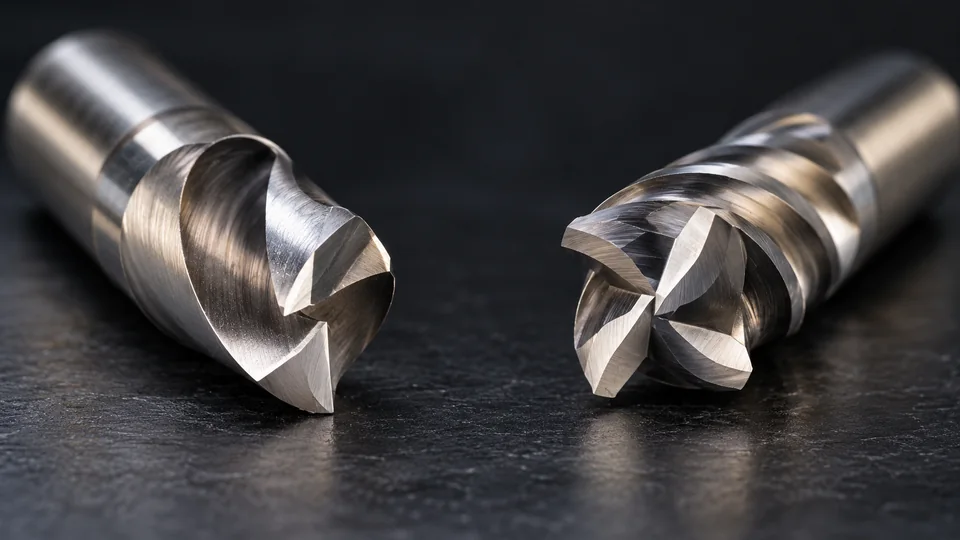
A two-flute end mill has two cutting edges and relatively large flute valleys for chip evacuation. A four-flute end mill has four cutting edges packed around the same circumference, leaving less chip space between adjacent edges. That basic geometry drives the main trade-off: two flutes generally provide more room for bulky chips, while four flutes provide more cutting-edge engagements per revolution.
Neither configuration is universally better. The practical choice depends on the workpiece material, whether the cutter is slotting or side milling, required chip clearance, tool diameter, cutting geometry, and machine rigidity. Flute count also affects feed calculations, but it does not independently determine finish quality, strength, or material compatibility.
If aluminum slotting is your main job, our guide to end mills for aluminum brings together cutters with different flute geometries and sizes.
2 Flute vs 4 Flute End Mill at a Glance
| Characteristic | 2-Flute End Mill | 4-Flute End Mill |
|---|---|---|
| Cutting edges | Two | Four |
| Typical flute space | Larger | Smaller |
| Chip evacuation | More room for large or stringy chips | Better suited to chips that clear through smaller flute valleys |
| Edge engagements per revolution | Fewer | More |
| Common application tendency | Nonferrous materials, plastics, slotting, and chip-clearance-sensitive cuts | Steels, cast iron, peripheral milling, and applications benefiting from more cutting edges |
| Potential limitation | Fewer teeth share the cutting work | Chip packing can occur if flute space is insufficient |
| Feed-rate implication | Lower calculated feed at the same RPM and feed per tooth | Higher calculated feed at the same RPM and feed per tooth |
These are tendencies rather than fixed rules. A purpose-built four-flute aluminum cutter may handle aluminum effectively, while an unsuitable two-flute cutter can still recut chips or load with material.
How Flute Count Changes Cutting Behavior
Chip Space and Evacuation
The flutes perform two related functions. Their leading edges cut the material, and their valleys provide a path for chips to leave the cutting zone. Placing fewer flutes around a cutter usually allows each valley to occupy more cross-sectional area.
Large flute valleys are valuable in materials that produce long, thick, or adhesive chips. Aluminum and many plastics can create chips that occupy considerable space. If those chips cannot escape, they may be recut, packed into the flutes, or welded to the cutting edge. Possible results include rising cutting forces, poor surface quality, heat accumulation, and tool breakage.
Four flutes divide the available circumference into more cutting edges and valleys. Each individual valley is generally smaller, though its actual capacity depends on the cutter’s core diameter, helix, rake geometry, and flute form. Short or easily broken chips may pass through these smaller spaces without difficulty.
Feed per Tooth and Programmed Feed Rate
Flute count is part of the standard milling feed relationship:
Feed rate = spindle speed × number of flutes × feed per tooth
At the same spindle speed and target feed per tooth, a four-flute cutter has twice as many cutting-edge engagements per revolution as a two-flute cutter. Its calculated table feed would therefore be twice as high. This relationship does not mean a four-flute tool can always run twice as fast. The permissible feed per tooth may change with the tool design, workpiece, radial engagement, axial depth, holder, and machine.
Replacing a two-flute tool with a four-flute tool while leaving the programmed feed unchanged cuts the feed per tooth in half, assuming spindle speed remains unchanged. An excessively small chip thickness can cause rubbing rather than efficient shearing. Feed should be recalculated from reliable tool-manufacturer guidance rather than copied from a cutter with a different flute count.
Core Size, Rigidity, and Deflection
Four-flute end mills often have room for a larger central core because less cross-sectional area is devoted to each flute valley. A larger core can improve bending stiffness and resistance to deflection. This can be useful with hard materials, long toolpaths, or cuts where dimensional control matters.
That comparison cannot be inferred from flute count alone. Manufacturers alter flute depth, web thickness, rake angle, and variable-helix geometry for specific applications. A four-flute cutter is not automatically stronger than every two-flute cutter of the same nominal diameter.
Tool projection also has a major effect. Extending an end mill farther from the holder increases leverage and makes deflection more likely. Using the shortest practical projection can matter more than changing between two and four flutes.
Surface Finish
More cutting edges can reduce the distance between successive tooth marks at a suitable feed, which may support a smoother finish. Four-flute tools are therefore frequently used for finishing and peripheral milling.
More flutes do not guarantee a better surface. Runout, vibration, built-up edge, chip recutting, tool deflection, edge condition, and incorrect feed can outweigh the flute-count advantage. A sharp two-flute tool with effective chip evacuation may leave a cleaner surface than a four-flute tool that packs with chips.
Material Suitability
Aluminum and Other Nonferrous Metals
Two-flute end mills are commonly associated with aluminum because their open flute geometry provides room for relatively large chips. Cutters intended for aluminum also tend to use sharp edges, positive rake geometry, and polished flutes. Those design features help limit material adhesion and chip buildup.
A generic two-flute end mill is not automatically an aluminum end mill. Edge preparation, helix angle, flute polish, substrate, and coating can alter its suitability. Four-flute and higher-flute aluminum cutters also exist. They may use specialized flute shapes or unequal spacing to preserve chip clearance while providing more cutting edges.
Steel and Cast Iron
Four-flute end mills are widely used in steel because the material often permits smaller flute valleys than aluminum requires. The extra cutting edges can support productive peripheral milling, and the cutter may have a substantial core for rigidity.
Steel covers many alloys, heat treatments, and hardness conditions. A flute count that works for an unhardened low-carbon steel is not automatically suitable for hardened tool steel. Cutter substrate, edge preparation, coating, engagement, and manufacturer application guidance remain significant.
Cast iron often produces short, fragmented chips, so the reduced flute volume of a four-flute tool may be less restrictive. Its abrasive character and dust-like debris introduce separate concerns involving wear, machine protection, and exposure control.
For steel work, compare steel-milling end mills after checking the cutter’s workpiece-hardness range.
Plastics
Many plastics benefit from the chip space and sharp geometry available in two-flute cutters. Heat management is especially important because rubbing or chip recutting can soften or melt some polymers. Material behavior varies substantially among acrylic, acetal, polycarbonate, reinforced plastics, and thermoplastics.
Flute count alone does not identify a plastic-cutting tool. Upcut, downcut, single-flute, and polished-flute geometries may be selected according to chip evacuation, edge quality, workholding, and the specific polymer.
How the Milling Operation Affects the Choice
Full-Width Slotting
Slotting encloses much of the cutter and leaves fewer paths for chips to escape. The end mill is engaged across its full diameter, so chip capacity becomes a central concern. A two-flute cutter often has an advantage where chips are bulky or difficult to evacuate.
A four-flute cutter can still slot successfully if its geometry suits the material and the cutting conditions allow chips to clear. Deep slots deserve extra caution because chips travel farther before leaving the cut. Coolant, air delivery, or another approved chip-control method may be required according to the machine, material, and tool manufacturer’s instructions.
Peripheral and Low-Radial-Engagement Milling
Side milling exposes more of the cutter to open space, which can make chip evacuation easier than in a full-width slot. Under these conditions, four flutes may provide useful edge engagement without overwhelming the flute valleys.
Low radial engagement can also change effective chip thickness. Parameters should account for engagement rather than relying solely on a nominal chip-load value.
Finishing Passes
A four-flute end mill is often practical for a light finishing pass because chip volume is relatively low and more edges contact the work over each spindle revolution. Still, the cutting edges must be sharp and the setup must control runout and vibration.
Keeping the same tool for roughing and finishing can avoid tool-change error, but a dedicated finishing cutter may provide more predictable geometry and edge condition. The preferred approach depends on tolerance, surface requirements, and process control.
Small Diameters and Long Reach
Small-diameter end mills have limited cross-sectional area. Increasing flute count can strengthen the core in some designs, yet the smaller flute valleys become easier to clog. Long-reach tools add a deflection and vibration problem regardless of flute count.
For these cutters, manufacturer-specific data becomes particularly important. Small geometric changes can have a large effect on edge strength and chip flow.
Our guide to micro and small-diameter carbide end mills separates the tiny cutting diameter from the shank size needed by the holder.
What Flute Count Does Not Tell You
Two end mills with the same diameter and flute count can behave very differently. A complete comparison should also examine:
- Tool construction: Solid carbide, HSS, and other tool materials have different stiffness, toughness, and wear characteristics. Flute count does not identify the tool material.
- End geometry: Square, ball nose, corner-radius, and roughing end mills serve different cutting tasks.
- Center-cutting capability: Neither two nor four flutes automatically establishes whether an end mill can plunge at its center. The actual end-face geometry must be checked.
- Helix angle: Helix geometry affects cutting action, axial force, chip movement, and edge support.
- Rake and edge preparation: Sharp positive edges may suit free-cutting materials, while stronger edge preparations may be used for demanding materials.
- Coating and flute finish: Coating compatibility and flute polish can affect wear, friction, and material adhesion.
- Cutting length and reach: A longer cutting section or greater projection can reduce rigidity.
- Variable geometry: Unequal flute spacing or variable helix can help manage vibration, but these features are separate from flute count.
- Shank and holder compatibility: Cutting diameter does not establish shank diameter. The shank must match an approved collet or holder.
A Practical Selection Method
- Identify the workpiece precisely. Distinguish aluminum alloy from steel, cast iron, or plastic. Broad material labels are insufficient for demanding applications.
- Define the operation. Full-width slotting, pocketing, side milling, and finishing impose different chip-clearance and rigidity requirements.
- Estimate the chip-evacuation demand. Favor more open flute space where the material forms bulky, adhesive, or stringy chips, especially inside enclosed cuts.
- Check the complete cutter geometry. Confirm the end style, center-cutting capability, helix, rake, cutting length, coating, and stated material range.
- Assess the setup. Machine rigidity, toolholder condition, runout, projection, workholding, and chip-control equipment affect the result.
- Use flute count in the feed calculation. Recalculate feed per tooth whenever the flute count or spindle speed changes.
- Start from documented application data. Use guidance for the specific tool and workpiece rather than treating a two-flute or four-flute label as a complete parameter recommendation.
Common Misunderstandings
“Four Flutes Remove Material Faster”
Four edges create more cutting engagements, but material-removal capability can be limited by chip packing, spindle power, machine rigidity, tool deflection, or the permitted feed per tooth. A two-flute tool may perform more reliably in a chip-heavy slot despite having fewer edges.
“Two Flutes Are Always for Aluminum”
Two-flute cutters are common in aluminum, yet geometry and surface treatment remain decisive. Some are intended for plastics or general-purpose milling, while specialized three-flute, four-flute, and higher-flute cutters can also machine aluminum.
“Four Flutes Always Produce a Better Finish”
Finish depends on the complete cutting system. Poor evacuation, runout, chatter, or a built-up edge can make additional flutes counterproductive.
“The Same Feed Works After Changing Flute Count”
Keeping feed rate and spindle speed constant changes feed per tooth whenever flute count changes. That can move the cutter away from its intended chip thickness and cause rubbing or excessive edge loading.
Quick Decision Guide
A two-flute end mill is often the more practical starting point for full-width slots, bulky chips, aluminum, and many plastics, provided the tool’s complete geometry supports that material.
A four-flute end mill is often suitable for steel, cast iron, peripheral milling, and finishing passes where chip volume is manageable and additional edge engagements are useful.
For an actual machining setup, select from the tool manufacturer’s stated application range and verify the shank, holder, machine limits, and cutting conditions. Stop the machine before inspecting or clearing chips, follow the equipment manual, and never reach into the cutting area while the spindle can move. The best flute count is the one that balances chip space, edge count, cutter rigidity, and the demands of the specific cut.
