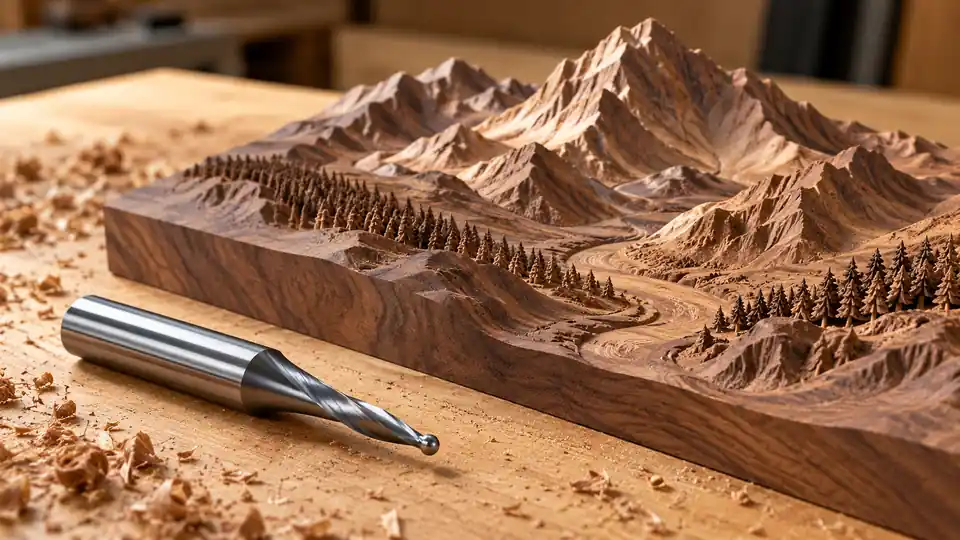
A 3D carving job can look wonderfully smooth on the screen and still emerge from the machine with ridges, fuzzy edges, or details that seem to melt together. The cutter profile has a lot to do with that result. Ball nose and tapered ball nose bits are built for curved reliefs, sculpted surfaces, lettering, and fine finishing passes, but their tip diameter, shank size, flute count, and overall reach determine where each one makes sense.
A common buying mistake is treating every ball nose bit as interchangeable. A tiny tip can reveal delicate facial features or miniature lettering, while a larger diameter covers broad contours with fewer passes. Shank size matters just as much. A 1/8-inch shank is aimed at compatible compact routers and engraving machines, while a 1/4-inch shank requires the matching collet. Material claims also vary, so a bit listed for wood, MDF, acrylic, aluminum, or other stock should be matched carefully to the actual project and machine.
For most CNC woodcarvers, the SpeTool three-piece tapered ball nose set is the strongest overall starting point because it combines several fine radii with a two-flute solid carbide design and broad documented material coverage. Buyers focused on ultra-fine relief work, a large 1/4-inch cutter, a compact 1/8-inch collet, or a broad assortment will find better-fitting alternatives below.
Quick Answer
- Best Overall: SpeTool 3Pcs Carbide Ball Nose Router Bit Set for three fine tapered ball nose radii and a two-flute solid carbide design.
- Best Fine-Detail Set: IDC Woodcraft 3D Carving Taper Ball Nose Set for its separate fine-detail and ultra-fine-detail cutters.
- Best for 1/8-Inch Collets: SpeTool 5Pcs Tapered Ball Nose Set for its documented 1/8-inch shank and five-piece format.
- Best Broad Assortment: LUNYEE 40pcs CNC End Mill Set for its mix of flat nose and ball nose cutters, coatings, and included ER11 and ER16 collets.
Best CNC Router Bits for 3D Carving Comparison Table
| Product | Best For | Bit Type | Shank Size | Tip or Cutting Diameter | Documented Materials |
|---|---|---|---|---|---|
| SpeTool 3Pcs Carbide Ball Nose Router Bit Set | Overall 3D carving flexibility | Three tapered ball nose bits | Not clearly stated in listing | 1/64, 1/32, and 1/16-inch radii | Wood, MDF, acrylic, aluminum, and more |
| LUNYEE 4Pcs Ball Nose Set | Large size range with 1/4-inch shank | Four tapered spiral ball nose bits | 1/4 inch | 1/32, 1/16, 1/8, and 1/4 inch diameters | Wood, MDF, acrylic, aluminum, and more |
| LUNYEE 40pcs CNC End Mill Set | Mixed CNC carving and engraving work | Flat nose and ball nose end mills | 1/8 inch, with ER11 and ER16 collets | 0.8 to 3.0 mm in listed set | Wood, plastics, aluminum, and circuit boards |
| IDC Woodcraft 3D Carving Set | Fine and ultra-fine wood reliefs | Two tapered ball nose bits | 1/4 inch | 0.015 and 0.045-inch tip radii | Wood, aluminum, and other listed materials |
| SpeTool 5Pcs Tapered Ball Nose Set | Compact CNC routers and 1/8-inch collets | Tapered ball nose bits | 1/8 inch | 0.5 mm diameter, 0.25 mm radius | Wood, MDF, acrylic, aluminum, and more |
| EANOSIC Extra-Long Ball Nose Bit | Long-reach 3D contours | Spiral ball nose bit | 1/4 inch | 1/4-inch cutting diameter | Wood, aluminum alloys, and listed metals |
| XYunEnZ 1/2-Inch Ball Nose Set | Large-diameter machining | Four-flute ball nose bits | 1/2 inch | 1/2-inch cutting diameter | Material coverage not fully specified |
| Two-Piece Ball Nose Set | Two common 1/4-inch-shank sizes | Two solid carbide ball nose bits | 1/4 inch | 1/8 and 1/4 inch diameters | Wood, MDF, plastics, and solid surface |
| CNC Router Bits Spiral Tapered Ball Nose | Single-bit relief carving and lettering | Tapered ball nose bit | 1/4 inch | R0.4 tip radius | Composites, plastics, foam, PVC, and sign board |
The detailed picks below focus on tip geometry, shank fit, size range, documented materials, and the trade-offs that appear once a carving moves from a broad contour to tiny surface detail.
1. SpeTool 3Pcs Carbide Ball Nose Router Bit Set — Best Overall

A three-piece set with 1/64, 1/32, and 1/16-inch ball radii gives a carver room to change scale as a project develops. A broad relief may start with the larger radius, then move to the smaller cutters for eyes, lettering, feather lines, or other details that would disappear under a wider tip. The tapered shape also provides clearance around sloped 3D surfaces, while the two-flute spiral geometry is documented for carving and engraving work.
The listing identifies these as solid carbide bits with a 15 mm flute length and 1-inch overall length. It also lists hard and soft wood, plywood, oak, MDF, acrylic, aluminum, alloy copper, and other applications. The shank dimension is not clearly stated in the supplied specifications, so buyers should verify collet fit before ordering. That small gap matters more than the broad material list if the machine accepts only one shank size.
Pros
- Includes three documented ball radii: 1/64, 1/32, and 1/16 inch.
- Uses a two-flute spiral ball nose design.
- Identified as solid carbide.
- Lists wood, plywood, MDF, acrylic, aluminum, and alloy copper applications.
- Provides a 15 mm flute length and 1-inch overall length.
Cons
- The supplied product information does not clearly state the shank diameter.
- The fine radii are specialized for detail work and may be slower for broad roughing passes.
This set suits a CNC woodcarver who wants several fine finishing sizes in one purchase and can confirm the machine connection first. Buyers needing a clearly documented 1/4-inch shank or a larger cutter for expansive contours should look at the LUNYEE four-piece set or one of the larger ball nose options instead.
To buy this product, click here.
2. LUNYEE 4Pcs Ball Nose Set — Best 1/4-Inch-Shank Range

The LUNYEE set takes a different route from a micro-detail-only kit. Its four tapered spiral bits cover 1/32, 1/16, 1/8, and 1/4-inch cutting diameters, giving the buyer a noticeable spread from delicate work to larger curved surfaces. That range can be handy when one relief combines a wide background with narrow grooves, since changing cutters is easier than forcing one tiny bit to handle every section.
Every bit is listed with a 1/4-inch shank and a 3-inch overall length. The NACO-Blue coating is identified in the product information, along with suitability for wood, MDF, acrylic, aluminum, alloy copper, and related applications. The extra length may help reach deeper profiles, but it also makes accurate collet setup and machine compatibility especially important. This is a documented 1/4-inch option, not a fit for a 1/8-inch collet without the correct equipment.
Pros
- Includes four listed cutting diameters from 1/32 to 1/4 inch.
- Uses a documented 1/4-inch shank.
- Provides a 3-inch overall length.
- Uses a stated NACO-Blue coating.
- Lists wood, plywood, MDF, acrylic, aluminum, and alloy copper applications.
Cons
- The 1/4-inch shank excludes machines limited to 1/8-inch collets.
- The longer overall length requires careful attention to machine clearance and setup.
This set fits a buyer who wants one 1/4-inch-shank collection for mixed-size 3D work and has a machine that can accommodate the listed length. Someone focused purely on miniature relief detail may prefer the IDC or SpeTool fine-radius sets, while a compact desktop CNC owner should first verify collet size.
To buy this product, click here.
3. LUNYEE 40pcs CNC End Mill Set — Best Broad Assortment

This LUNYEE kit is broader than a dedicated ball nose collection. It includes flat nose and ball nose end mills, two coating groups, and ER11 and ER16 collets. The listed 3.175 mm shank and 38 mm overall length place the set in compact CNC and engraving territory, while the cutting diameters in one group range from 0.8 to 3.0 mm. That mix is useful for a small machine where one afternoon may involve lettering, slotting, fine carving, and a little PCB routing.
The product information identifies applications across wood, plastics, aluminum, circuit boards, acrylic, and precision small-part work. It also specifically names LUNYEE 3018-series machines, desktop CNC routers, engraving machines, and other CNC equipment. Buyers should remember that a 40-piece assortment includes tools beyond 3D carving, so it makes more sense for a mixed-workshop user than for someone who wants only tapered ball nose finishing cutters.
Pros
- Includes both flat nose and ball nose end mills.
- Provides ER11 and ER16 collets in the listed package.
- Lists 0.8 to 3.0 mm cutting diameters for part of the set.
- Uses Nano Blue and titanium-coated tool groups.
- Documents applications for wood, plastics, aluminum, circuit boards, and acrylic.
Cons
- It is a mixed end mill assortment rather than a dedicated 3D ball nose set.
- The listed 3.175 mm shank requires compatible collets or machine hardware.
Choose this kit when the CNC machine handles several small operations and the convenience of a broad assortment matters more than having a few larger carving diameters. A dedicated woodcarver who already owns general-purpose end mills may get more useful coverage from a focused tapered ball nose set.
To buy this product, click here.
4. IDC Woodcraft 3D Carving Taper Ball Nose Set — Best Fine-Detail Pair
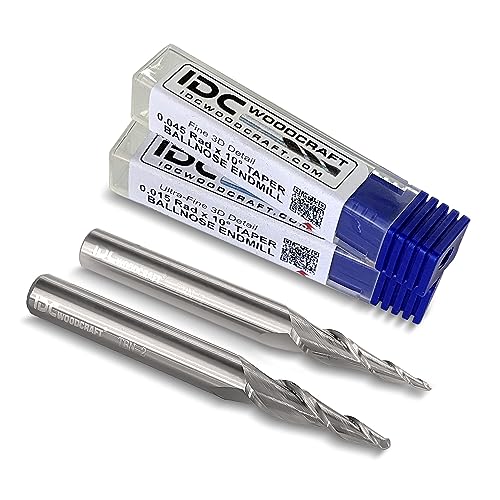
The IDC Woodcraft pair is aimed squarely at detailed 3D carving rather than broad assortment shopping. One bit has a listed 0.015-inch tip radius for ultra-fine detail, while the other uses a 0.045-inch radius for larger detailed surfaces. That pairing creates a practical progression: the smaller cutter can work into tiny features, and the larger one can cover more of a sculpted area without relying on a single ultra-fine tip.
Both bits use a 1/4-inch shank, two flutes, and a 10-degree-per-side taper according to the listing. The product information identifies micro-grain tungsten carbide and provides suggested carving settings, but those settings should be checked against the machine and material rather than copied blindly. The listing also names wood and aluminum applications. Its focused two-bit format is tidy, although buyers wanting several intermediate sizes will need another set.
Pros
- Pairs a 0.015-inch radius with a 0.045-inch radius.
- Uses a documented 1/4-inch shank.
- Both bits use a two-flute, 10-degree-per-side tapered design.
- Identifies micro-grain tungsten carbide construction.
- Provides application information for detailed 3D carving in wood and aluminum.
Cons
- Only two cutters are included, with no intermediate size listed.
- The 1/4-inch shank is unsuitable for machines restricted to 1/8-inch collets.
This pair makes sense for a carver who already knows that fine and ultra-fine relief work is the priority. It is less convenient for someone building a broad starter assortment, but its clearly separated tip radii make the choice between delicate features and larger detailed areas easier.
To buy this product, click here.
5. SpeTool 5Pcs Tapered Ball Nose Set — Best for 1/8-Inch Collets

A 1/8-inch shank changes the shopping equation. Many compact engraving machines and smaller CNC routers use that collet size, and the SpeTool set states that it can be used with routers equipped with a 1/8-inch collet. The five-piece package uses tapered ball nose cutters with a listed 0.5 mm tip diameter and 0.25 mm radius, along with a two-flute spiral design. For miniature wood carvings, that compact format keeps the set aligned with small-machine use.
The listing also specifies a 5.12-degree single-side angle, 15 mm cutting length, 1.5-inch overall length, TiAlN coating, and a stated 55HRC figure. It identifies wood, MDF, acrylic, aluminum, alloy copper, and other materials. Since the documented tip size is small, the set is aimed at detailed work rather than sweeping broad contours. The extra pieces may be useful for keeping a matching cutter available, but the listing does not identify several different tip diameters.
Pros
- Uses a documented 1/8-inch shank for compatible collets.
- Includes five tapered ball nose bits.
- Lists a 0.5 mm tip diameter and 0.25 mm radius.
- Uses a two-flute spiral design with TiAlN coating.
- Lists a 15 mm cutting length and 1.5-inch overall length.
Cons
- The listed 0.5 mm diameter is specialized for fine work rather than broad surface coverage.
- The set does not document multiple tip diameters in the supplied information.
This is the natural fit for a compact CNC owner whose collet size is already known and whose projects lean toward small reliefs, lettering, and fine wood detail. A 1/4-inch machine owner should skip it rather than rely on an adapter, while broad carving projects call for a larger ball nose diameter.
To buy this product, click here.
6. EANOSIC Extra-Long Ball Nose Bit — Best Long-Reach Option

The EANOSIC cutter is a single-bit solution with a 1/4-inch shank, 1/4-inch cutting diameter, 1-1/8-inch cutting length, and 3-inch overall length. That combination gives it a very different role from the tiny tapered bits above. A carver working across a larger curved form may appreciate the wider ball nose, while the extended body can suit jobs where a shorter tool does not provide enough reach. The product is listed for side milling, end milling, finish machining, and smooth contour carving.
The listing identifies solid carbide construction and a Blue Nano nACo coating. It names plywood, oak, MDF, hardwood, aluminum alloy, and several steel categories among the applicable materials. Those material claims are broad, so machine capability and the actual cutting plan still need separate verification. This is a practical single-cutter route for a user who wants a clearly documented 1/4-inch shank and large diameter without buying a set of fine-radius tools.
Pros
- Uses a documented 1/4-inch shank.
- Provides a 1/4-inch cutting diameter.
- Lists a 1-1/8-inch cutting length and 3-inch overall length.
- Identifies solid carbide construction.
- Lists wood, MDF, plywood, hardwood, aluminum alloy, and several steel applications.
Cons
- It is a single 1/4-inch-diameter cutter rather than a range of detail sizes.
- The extended 3-inch length requires confirmed machine clearance and suitable setup.
The EANOSIC option suits larger contours, deeper reach requirements, and buyers who prefer one substantial ball nose cutter. It is a poor substitute for a micro-detail bit, so a project filled with tiny lettering or narrow facial features will need a smaller tool as well.
To buy this product, click here.
7. XYunEnZ 1/2-Inch Ball Nose Set — Best Large-Diameter Option

The XYunEnZ set sits at the large end of this roundup, with a listed 1/2-inch cutting diameter, 1/2-inch shank, 1-1/4-inch length of cut, and 3-inch overall length. Its four-flute configuration gives the tool a different geometry from the two-flute carving bits elsewhere in the list. The product information describes a thicker core and polished flutes, but it does not provide a detailed 3D wood-carving material list, so its place here is for buyers whose machine and application genuinely call for a large ball nose cutter.
Five pieces are included, and the tools use an AlTiN coating according to the listing. The large shank and diameter mean compatibility becomes the first checkpoint, not an afterthought. A compact engraving machine or ordinary 1/4-inch router collet will not match the documented dimensions. Buyers also need to distinguish this heavy-format option from fine-detail cutters. It is aimed at broad tool geometry and substantial machine hardware, not miniature relief work.
Pros
- Provides a documented 1/2-inch cutting diameter.
- Uses a matching 1/2-inch shank.
- Includes five ball nose end mills.
- Uses a four-flute design.
- Lists a 1-1/4-inch length of cut and 3-inch overall length.
Cons
- The 1/2-inch shank and diameter exclude many compact CNC routers and handheld routers.
- The supplied information does not clearly identify a broad wood-carving material range.
This set belongs with a machine that accepts 1/2-inch tooling and a project involving larger curved surfaces. It should be skipped by buyers shopping for small CNC reliefs, fine lettering, or ordinary desktop-router compatibility, where the smaller SpeTool and LUNYEE options are more relevant.
To buy this product, click here.
8. Two-Piece Ball Nose Set — Best Two-Size Starter Pair

This two-piece set keeps the choice simple: one bit has a 1/8-inch cutting diameter and 2-inch overall length, while the other has a 1/4-inch cutting diameter and 2-1/2-inch overall length. Both use a 1/4-inch shank and are identified as solid carbide with Nano Blue coating. That pairing gives a buyer one smaller option for delicate work and one larger option for broader areas without filling a drawer with nearly identical sizes.
The documented applications include wood, plywood, MDF, other wood composites, plastics, and solid surface. The listing also mentions lettering, sign making, grooves, slots, mortises, dados, and 3D carving. It names CNC routers, X-Carve, Makita, Bosch, and plunge routers with 1/4-inch collets, although each machine still needs to be checked against its own requirements. This set lacks the tiny radii found in the more specialized carving kits, but its two sizes are easier to understand for general workshop use.
Pros
- Includes both 1/8-inch and 1/4-inch cutting diameters.
- Uses a documented 1/4-inch shank.
- Identifies solid carbide construction.
- Uses Nano Blue coating.
- Lists applications across wood, MDF, plastics, solid surface, lettering, and 3D carving.
Cons
- The two-piece format does not include the very small radii used for miniature detail.
- The larger cutter has a different 2-1/2-inch overall length that must be checked for machine clearance.
This pair suits a beginner or general-purpose sign maker who wants two useful ball nose sizes and a documented 1/4-inch connection. A dedicated sculptural carver seeking ultra-fine features will get more range from a tapered multi-size set, while a 1/8-inch-collet machine needs a different shank format.
To buy this product, click here.
9. CNC Router Bits Spiral Tapered Ball Nose — Best Single-Bit Relief Option

This single tapered ball nose bit is built around a 1/4-inch shank, a 6.2-degree tapered angle, an R0.4 ball tip, and a 3-inch overall length. Those details place it between the tiny micro-radius tools and the large 1/4-inch-diameter cutter. The listing highlights relief carving, lettering, sign making, and detailed profiles, so it may appeal to a buyer who already knows the preferred geometry and wants one focused cutter rather than a multi-piece assortment.
The product information identifies carbide construction and an nACo-blue coating. It also lists compatibility with CNC routers and plunge routers using a 1/4-inch collet, along with composites, fiberglass, polyethylene foam, phenolics, plastics, polyurethane foam, PVC, sign board, and tooling board. That material list leans beyond ordinary wood carving, making this a useful alternative for sign-making and model-board work. The 3-inch overall length remains a key fit check before purchase.
Pros
- Uses a documented 1/4-inch shank.
- Provides a listed 6.2-degree tapered angle.
- Uses an R0.4 ball tip.
- Lists a 3-inch overall length.
- Identifies applications for plastics, foam, PVC, sign board, composites, and fiberglass.
Cons
- Only one cutter is included, with no alternate size in the listed package.
- The 3-inch overall length requires a machine and work area that can accommodate it.
This bit fits a buyer working on reliefs, lettering, sign board, and non-wood stock who wants a single documented 1/4-inch-shank profile. It is less suitable for someone still experimenting with several tip sizes, where the four-piece LUNYEE set offers a broader starting range.
To buy this product, click here.
Buying Guide
Match the Shank to the Collet
Shank size is the first filter, before tip shape or coating. The roundup includes documented 1/8-inch options, 1/4-inch options, and a 1/2-inch set. A compact engraving machine may accept the smaller format, while a larger router or CNC machine may use 1/4-inch tooling. The XYunEnZ set lists a 1/2-inch shank, which places it in a very different compatibility category. Check the machine or router documentation rather than assuming an adapter makes every bit suitable.
Choose Tip Size for the Carving Scale
A fine tip can reach small recessed details, but it covers less surface with each pass. The SpeTool and IDC products focus on small radii, while the EANOSIC and two-piece set provide larger ball nose diameters. For a broad relief background, a larger cutter may be the more practical starting point. For eyes, narrow grooves, or miniature lettering, a small tapered ball nose is more appropriate.
Understand Tapered Ball Nose Geometry
The tapered body narrows toward the ball tip and is intended to provide clearance around 3D profiles. That makes tapered bits especially relevant to relief carving and sculpted surfaces. A straight comparison based only on diameter misses the point. Look at the stated radius, taper angle, cutting length, and overall length together, because each affects the kind of profile the bit can reach.
Compare Two-Flute and Four-Flute Designs Carefully
Most of the carving-focused products here use two-flute geometry, while the XYunEnZ set lists four flutes. Flute count changes the relationship between cutting edges and the spaces between them. The product listing alone does not establish that one configuration will produce a better finish in every material. Treat flute count as a geometry difference, then match it to the documented application and the machine’s requirements.
Read Material Claims Literally
Several listings identify wood, MDF, plywood, acrylic, aluminum, or other materials, but those claims are product-specific and should not be expanded into universal compatibility. A bit listed for wood and acrylic should not automatically be treated as suitable for every plastic or metal. The LUNYEE 40-piece set lists circuit-board work, while the single tapered bit lists foam, PVC, sign board, and tooling board. Those distinctions can guide the shortlist.
Check Overall Length and Cutting Length
A 3-inch overall length may help reach a deeper profile, yet it also affects clearance and setup. Shorter bits can make more sense for compact machines or shallow work. The SpeTool three-piece set lists a 1-inch overall length, while several other products list 3 inches. Neither dimension is automatically better. The useful choice is the one that reaches the intended surface without creating a compatibility problem.
For the geometry behind those size fields, use the reference to CNC carving profiles and tool-library dimensions before entering the cutter in CAM.
Best CNC Router Bits for 3D Carving FAQ
What type of router bit is used for 3D carving?
Ball nose and tapered ball nose bits are the main profiles represented in this roundup. Their rounded tips are intended for curved surfaces, reliefs, contours, and fine finishing details. A tapered design can provide clearance around sloped 3D features, while the tip radius determines how much small detail the cutter can address.
Is a smaller ball nose bit always better for detail?
A smaller tip radius is generally the more relevant geometry for narrow details, but it is not automatically the best cutter for an entire project. Small cutters cover less area and may be inefficient for broad surfaces. A common approach is to use a larger ball nose for wider forms and a finer bit for the final detail, provided both fit the machine and suit the material.
Can a 1/4-inch-shank bit fit a 1/8-inch collet?
No. The documented shank size must match the collet or toolholder system. The SpeTool five-piece set is listed for 1/8-inch collets, while several other products use 1/4-inch shanks. The XYunEnZ set lists a 1/2-inch shank and belongs to a still different compatibility group. Verify the machine specification before buying.
Are these bits suitable for aluminum?
Several listings specifically identify aluminum or aluminum alloy among their supported materials, including the SpeTool, LUNYEE, IDC, and EANOSIC products. That documentation should not be treated as a guarantee for every machine or cutting condition. The product, toolholder, machine, and material must all be appropriate for the operation, and unsupported operating parameters should not be guessed.
What is the benefit of a tapered ball nose bit?
The tapered form narrows toward the rounded tip and is intended to provide clearance while routing 3D profiles. This geometry appears across several carving-focused products in the roundup. It can be useful for reliefs and sculpted surfaces, but the actual choice still depends on tip radius, cutting length, shank size, and the shape of the model.
Should a beginner buy a set or a single bit?
A set offers several sizes or profiles for testing different areas of a project. The SpeTool three-piece and LUNYEE four-piece sets provide several ball nose sizes, while the IDC pair separates fine and ultra-fine detail. A single bit can make more sense when the project already specifies one profile, such as the single tapered option for sign board and relief work.
Do coatings make one carving bit automatically better?
No universal conclusion follows from the coating name alone. The listings identify coatings such as NACO-Blue, nACo-blue, TiAlN, and AlTiN on particular products, but the supplied information does not establish a measured ranking between them. Treat coating as one specification among several, alongside geometry, material suitability, shank fit, and dimensions.
Final Verdict
The SpeTool three-piece set is the strongest overall match for shoppers seeking fine CNC 3D carving flexibility. Its documented 1/64, 1/32, and 1/16-inch radii create a useful progression for moving from small surface features to slightly broader detail, and its two-flute solid carbide tapered ball nose design is listed for a broad group of materials. The main checkpoint is shank compatibility, which is not clearly established in the supplied specifications.
For a clearly documented 1/4-inch shank and a wider size range, the LUNYEE four-piece set is the more direct alternative. The IDC pair is better focused on fine and ultra-fine detail, while the SpeTool five-piece set belongs with compatible 1/8-inch collets. Buyers working on large contours should examine the EANOSIC or XYunEnZ options, and those handling mixed compact-CNC tasks may prefer the LUNYEE 40-piece assortment. Match the cutter to the machine, material, tip scale, and available clearance before placing the order.
