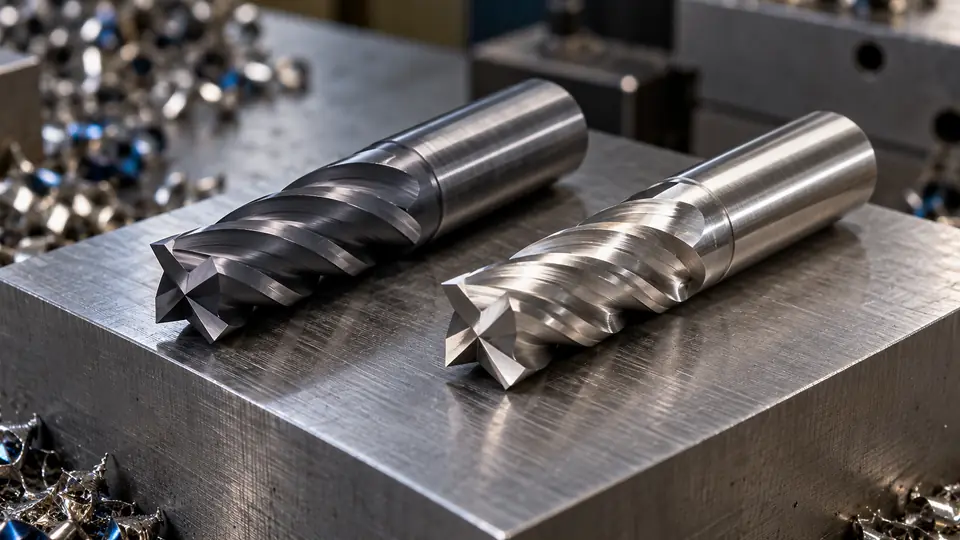
Carbide end mills are generally harder, more wear resistant, and capable of maintaining a cutting edge under higher-speed, higher-temperature conditions than high-speed steel (HSS) end mills. HSS is tougher and more tolerant of impact, vibration, runout, and tool flex. Carbide often suits rigid CNC equipment and production machining, while HSS can be a practical choice for less rigid machines, interrupted manual work, and applications where tool cost or breakage risk carries greater weight.
Neither material is universally superior. The better end mill depends on the machine, holder, workpiece, tool diameter, operation, and required production rate.
Once the machine is suitable for carbide, our guide to carbide end mills for a rigid milling setup brings the diameter, flute geometry, and material choices together.
Carbide vs HSS End Mills at a Glance
| Characteristic | Carbide End Mill | HSS End Mill |
|---|---|---|
| Typical material | Cemented carbide, commonly tungsten carbide particles held in a metallic binder | Alloy tool steel formulated to retain hardness at elevated cutting temperatures |
| Hardness | Higher | Lower than cemented carbide |
| Toughness | Lower, with greater sensitivity to chipping and fracture | Higher, with better tolerance for shock and flex |
| Wear resistance | Generally higher | Generally lower under comparable cutting conditions |
| Rigidity | Higher stiffness helps control tool deflection | More elastic and able to flex farther before breaking |
| Heat resistance in cutting | Retains cutting capability at higher cutting temperatures | Retains hardness better than ordinary carbon tool steel, but below carbide under demanding conditions |
| Machine requirements | Performs best with a rigid machine, secure workholding, accurate spindle, and suitable holder | More forgiving of modest rigidity, runout, and vibration |
| Typical initial cost | Higher | Lower |
| Common failure pattern | Edge chipping or sudden fracture | Progressive wear, edge rounding, deformation, or breakage after substantial flex |
| Frequent use case | CNC production, abrasive materials, high material-removal demand, and finish work requiring low deflection | Manual milling, light-duty work, older equipment, low-volume jobs, and conditions with elevated shock risk |
What the Two Tool Materials Actually Are
Solid Carbide End Mills
Most end mills described simply as carbide are solid cemented-carbide tools. Their cutting portion and shank are made from a composite material containing hard carbide particles, commonly tungsten carbide, bonded with a metallic binder. Composition, carbide grain size, binder content, manufacturing process, geometry, and coating all influence performance.
“Solid carbide” describes the tool substrate and construction. It does not mean the end mill consists of pure tungsten carbide, and it does not mean every carbide grade has identical hardness or fracture resistance.
Solid carbide end mills should also be distinguished from indexable milling cutters. An indexable cutter carries replaceable carbide inserts in a separate cutter body. It behaves differently from a small-diameter solid carbide end mill and has separate holder, geometry, and application requirements.
High-Speed Steel End Mills
HSS is an alloy tool steel containing elements that improve hardness, wear resistance, and the ability to retain hardness as cutting temperature rises. Different HSS grades have different compositions and properties.
Cobalt HSS is still high-speed steel. Cobalt is an alloying element within the steel rather than a cemented-carbide cutting material. A cobalt HSS end mill should not be classified as a carbide end mill.
Why Carbide Can Run Under More Demanding Conditions
Carbide combines high hardness, strong abrasion resistance, and greater stiffness than HSS. These properties help the cutting edge resist wear and help the tool resist deflection. They are particularly useful during production machining, where stable cutting conditions allow the machine to take advantage of the material.
Higher stiffness can improve dimensional control and surface finish, especially with small tools or operations that generate meaningful side load. Reduced deflection, however, does not make carbide tolerant of every setup problem. A sufficiently large load, vibration event, or impact can cause a brittle fracture rather than visible bending.
Carbide also retains useful hardness at cutting temperatures beyond those normally suited to HSS. This supports higher cutting speeds where the tool manufacturer, workpiece, coating, machine, and operation permit them. A universal speed advantage cannot be stated because cutting diameter, flute count, engagement, and workpiece grade change the operating range.
Why HSS Remains Useful
HSS has greater toughness and can absorb more deformation before fracture. That characteristic can be valuable on manual mills, older machines, or setups where vibration cannot be eliminated completely. It may survive a brief overload or moment of chatter that chips a carbide edge.
HSS can also support keen cutting geometries for relatively light cuts. Sharp HSS tools are useful in applications where cutting forces must remain modest, provided edge wear and cutting temperature stay controlled.
Initial cost is another practical distinction. An HSS end mill usually costs less than a comparable solid carbide tool. For a one-off job, occasional manual use, or a setup with a substantial chance of accidental tool damage, lower replacement cost may outweigh carbide’s potential productivity and wear advantages.
Machine Rigidity Changes the Comparison
A carbide end mill benefits from a stable cutting system. That system includes the spindle, bearings, toolholder, tool projection, workholding, machine structure, and workpiece. Weakness at any connection can produce chatter or uneven tooth loading.
Runout is particularly harmful to small carbide end mills. If the tool rotates off center, one flute may remove a larger chip than the others. The overloaded edge can chip, followed by rapid failure of the remaining cutting edges. Clean holder surfaces, a sound collet or holder, and minimal practical projection help reduce this risk.
HSS does not correct a poor setup, but its toughness gives it a wider margin under some unstable conditions. This is why replacing HSS with carbide without reviewing the entire setup may fail to produce the expected improvement.
Workpiece and Operation Considerations
Abrasive Materials and Extended Production
Carbide’s wear resistance is useful in abrasive workpiece materials and long production runs. A longer-lasting edge can reduce dimensional drift and the frequency of tool changes. Actual tool life still depends on the carbide grade, coating, edge preparation, chip evacuation, and cutting conditions.
Soft or Gummy Materials
Tool material alone does not determine performance in aluminum, copper alloys, plastics, or other materials prone to chip welding or poor evacuation. Flute count, rake geometry, polished flute surfaces, coating choice, lubrication, and chip space may matter as much as the substrate.
A purpose-specific HSS cutter can outperform an unsuitable carbide cutter. Likewise, an appropriate carbide geometry can provide excellent results. Selecting by the word “carbide” or “HSS” without examining geometry leaves out much of the application.
Roughing, Finishing, and Slotting
Full-width slotting places different demands on an end mill than peripheral finishing. Slotting restricts chip evacuation and engages a large portion of the tool. Finishing generally uses lighter radial engagement and may place greater emphasis on deflection and edge quality.
Carbide’s stiffness often benefits finishing and dimensional control. HSS toughness can help where shock loading or setup instability is difficult to avoid. Roughing end mills with serrated cutting edges, square end mills, ball nose tools, and corner-radius tools should be compared within their intended operation rather than treated as interchangeable shapes.
For larger stock-removal passes, compare carbide roughing end mills separately from finishing tools.
Small Tools and Long Reach
Small diameters and long tool projection increase sensitivity to runout and deflection. Carbide’s stiffness is valuable, but its lower fracture tolerance leaves little room for excessive chip load, recutting chips, or spindle error. HSS can flex more, though that flexibility may cause dimensional error, taper, chatter, or rubbing.
For either material, use the shortest practical projection and a holder that properly matches the shank diameter. Cutting diameter, shank diameter, flute length, overall length, and usable reach are separate specifications.
Coatings Do Not Change the Substrate Identity
Both carbide and HSS end mills may carry cutting-tool coatings. A coating can influence friction, wear, heat management, chip adhesion, and workpiece compatibility, but it does not turn HSS into carbide.
Coating selection must match the workpiece and cutting environment. A coating suited to steel machining may be a poor choice for an aluminum alloy prone to material adhesion. Uncoated and polished tools can also be appropriate for specific applications. The manufacturer’s application data should be checked for the exact substrate, coating, geometry, and workpiece combination.
Tool Cost Versus Machining Cost
Purchase price provides an incomplete comparison. A higher-priced carbide end mill may cost less per finished part if it supports shorter cycles, holds size longer, or requires fewer tool changes. That advantage depends on using equipment and cutting conditions capable of producing those gains.
HSS may be more economical where machine speed, spindle power, rigidity, or job quantity prevents carbide from delivering a meaningful productivity benefit. It can also limit the financial loss from accidental damage during setup or infrequent manual work.
Regrinding is possible with both materials, subject to tool condition and access to suitable grinding equipment. Regrinding changes cutting dimensions and may affect edge geometry or remove the original coating. A reground tool must be measured and applied according to its actual restored dimensions, not its original nominal size.
How to Select Between Carbide and HSS
- Evaluate machine condition and rigidity. Check spindle condition, holder accuracy, workholding, and the ability to minimize tool projection. Carbide offers its greatest benefit in a stable system.
- Identify the exact workpiece material. General labels such as “steel” or “aluminum” do not provide enough detail for cutting data. Alloy, condition, hardness, and abrasiveness influence the selection.
- Define the operation. Slotting, profiling, pocketing, roughing, and finishing impose different loads and chip-evacuation requirements.
- Examine the complete geometry. Flute count, helix, rake, edge preparation, corner form, cutting length, and chip space can outweigh a simple substrate comparison.
- Account for production volume. Carbide’s higher initial cost is easier to justify where its wear resistance and productivity can be used repeatedly.
- Review breakage risk. HSS may provide a more forgiving option for uncertain manual setups, interrupted contact, or machines with persistent vibration.
- Use manufacturer cutting data. Base spindle speed, feed per tooth, engagement, and coolant or lubrication strategy on the exact tool and workpiece. Avoid transferring settings between HSS and carbide without recalculation.
If you are building a small cutter inventory, compare carbide end mill sets that match the materials you actually machine.
Typical Selection Patterns
- Rigid CNC machine and repeat production: Solid carbide is frequently favored for wear resistance, stiffness, and higher permissible cutting conditions.
- Manual mill with modest rigidity: HSS may tolerate operator variation and vibration more effectively.
- Abrasive workpiece: Carbide often provides stronger wear resistance, assuming a compatible grade and geometry are available.
- One-off job with elevated crash risk: HSS can reduce replacement cost and provide greater toughness.
- Long-reach finishing: Carbide stiffness may help control deflection, but reach, diameter, engagement, and runout require close control.
- Unstable or interrupted loading: HSS may resist chipping better, though correcting the unstable setup remains preferable.
Common Misunderstandings
Carbide Always Lasts Longer
Carbide usually has greater wear resistance, but a chipped or broken tool has little useful life. Poor clamping, excessive runout, chatter, recut chips, unsuitable geometry, or incorrect cutting conditions can cause carbide to fail earlier than HSS.
HSS Is Only for Slow or Outdated Equipment
HSS remains useful where toughness, sharp geometry, lower tool cost, or tolerance for flex matters. Its lower practical cutting-speed range does not make it obsolete.
Carbide Can Compensate for a Weak Setup
Greater tool stiffness cannot correct loose workholding, a damaged holder, worn spindle bearings, or excessive projection. Carbide may expose those problems through edge chipping or sudden breakage.
The Same Parameters Work for Both Materials
Replacing an HSS end mill with a carbide tool does not justify keeping or arbitrarily increasing every setting. Cutting speed, feed per tooth, axial engagement, radial engagement, flute count, and cooling strategy must be evaluated together using reliable data for the selected tool.
Breakage and Safety Considerations
Carbide can fracture into sharp, fast-moving fragments. HSS can also break and throw chips or tool pieces. Use the machine’s guards and enclosures, wear appropriate eye protection, clamp the work securely, and keep hands away from rotating tooling.
Inspect the cutting edges and shank before use. Do not run an end mill with visible cracks, severe chipping, or a damaged shank. Confirm that the toolholder accepts the actual shank diameter and that the planned spindle speed remains within the limits of the machine, holder, and tool documentation.
Practical Decision
Choose carbide where the machine and setup are rigid enough to use its hardness, stiffness, wear resistance, and elevated-temperature capability. Choose HSS where toughness, forgiveness, lower initial cost, or tolerance for less stable conditions has greater value.
The comparison should then move beyond substrate material. A suitable end mill must also have the correct diameter, flute count, cutting length, end geometry, coating, holder interface, and application-specific cutting data. A properly selected HSS tool can be preferable to an unsuitable carbide tool, while solid carbide is often the stronger production choice under controlled machining conditions.
