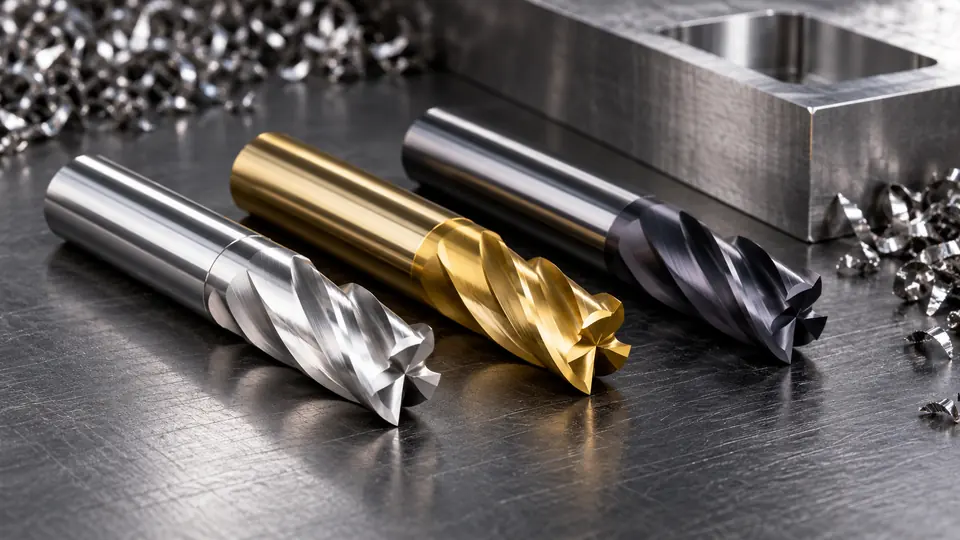
Carbide end mill coatings are thin surface layers that modify friction, wear behavior, heat resistance, and chemical interaction at the cutting edge. They do not change an unsuitable end mill into the correct tool for an application. The carbide grade, flute geometry, edge preparation, tool diameter, machining operation, workpiece material, and cutting conditions still govern performance.
Common options include TiN, TiCN, TiAlN, AlTiN, AlCrN, ZrN, and DLC. Uncoated carbide and diamond-coated carbide also have important roles. No coating is universally preferable. Aluminum alloys, hardened steels, graphite, plastics, and titanium alloys place very different demands on a cutting edge.
Our selection of end mills matched to hardened-steel work puts the permitted workpiece range ahead of the coating label.
What an End Mill Coating Actually Does
A solid carbide end mill is commonly made from cemented carbide, which consists of hard carbide particles held in a metallic binder. A coating is a separate layer applied over that substrate. A titanium-colored surface does not prove that the underlying tool is solid carbide, and a carbide coating is not the same construction as a solid carbide cutting tool.
Depending on its composition, a coating may provide several useful characteristics:
- Abrasion resistance: The coating helps protect the cutting edge and flute surfaces from gradual wear.
- Oxidation resistance: Some coatings remain more stable as cutting-zone temperatures rise.
- Reduced friction or adhesion: Low-friction surfaces can limit built-up edge and improve chip flow in compatible materials.
- A thermal barrier: Certain coatings help reduce heat transfer into the carbide substrate.
- Chemical protection: A compatible coating can reduce unfavorable interaction between the tool and workpiece.
These properties vary among coating formulations. Deposition method, layer structure, surface finish, coating adhesion, and edge preparation also affect results. Two tools sold under the same broad coating abbreviation may use different compositions or multilayer systems.
Comparison of Common Carbide End Mill Coatings
| Coating | General Characteristics | Typical Application Areas | Relevant Limitations |
|---|---|---|---|
| TiN | General-purpose wear-resistant coating with a recognizable gold color | Moderate cutting conditions in steels and some general machining applications | Usually offers less high-temperature protection than newer aluminum-rich coatings |
| TiCN | Good abrasion resistance and lower friction than basic TiN in many applications | Steels, cast irons, and wear-intensive operations under suitable conditions | Less suited to very high cutting-zone temperatures than many Al-rich coatings |
| TiAlN | Heat-resistant aluminum-containing titanium nitride system | Steels, stainless steels, and other ferrous materials where substantial heat develops | Generally a poor default choice for aluminum because aluminum in the workpiece can adhere to an aluminum-containing coating |
| AlTiN | Aluminum-rich titanium nitride family commonly used for hot, wear-intensive cutting | Alloy steels, hardened steels within the tool maker’s stated range, and some dry or limited-coolant operations | Exact composition varies, and the name alone does not establish workpiece compatibility |
| AlCrN | Good oxidation and thermal wear resistance | Steels, stainless steels, cast irons, and other applications involving high cutting heat | Suitability depends on the specific formulation and cutting conditions |
| ZrN | Relatively low-friction coating often used to reduce adhesion | Aluminum, copper alloys, brass, and selected nonferrous materials | Cannot compensate for poor flute polishing, inadequate chip space, or incorrect lubrication |
| DLC | Very low-friction carbon-based coating family | Aluminum, copper, plastics, and other applications where adhesion is a concern | Temperature capability depends strongly on the DLC formulation and is generally lower than that of hot-cutting nitride systems |
| Diamond | Exceptional resistance to abrasive wear in compatible nonferrous materials | Graphite, fiber-reinforced composites, high-silicon aluminum, and other abrasive nonferrous workpieces | Generally unsuitable for cutting ferrous alloys because diamond can react with iron at elevated cutting temperatures |
| Uncoated carbide | Exposes the carbide surface and permits a very sharp, polished cutting edge | Aluminum and other nonferrous materials, especially where sharp geometry and smooth flutes are priorities | Lacks the added wear and thermal protection supplied by a compatible coating |
The application descriptions in this table are broad categories rather than universal prescriptions. A coating supplier may formulate a particular TiAlN, AlTiN, AlCrN, or DLC system for a narrower material range. The end mill manufacturer’s workpiece recommendations provide more useful guidance than coating color or abbreviation alone.
How the Major Coating Families Differ
TiN
Titanium nitride is one of the most familiar cutting-tool coatings. It provides a useful combination of wear resistance and reduced friction under moderate conditions. Its gold appearance can also make wear areas easier to see, although color is not a reliable method for identifying an unknown coating.
TiN remains relevant for general machining, but higher-temperature steel milling frequently favors newer aluminum-containing nitride systems. TiN should be evaluated as part of the complete tool specification rather than treated as a universal baseline upgrade.
TiCN
Titanium carbonitride generally emphasizes abrasion resistance. It can perform well where flank wear and abrasive contact are prominent, particularly in compatible steels and cast irons. Its thermal stability is usually less favorable than that of coatings formulated specifically for high-temperature milling.
TiCN may therefore suit moderate-temperature wear better than operations that keep the cutting edge exposed to intense heat. Coolant strategy, engagement, and operation type can shift that balance.
TiAlN and AlTiN
TiAlN and AlTiN are aluminum-containing titanium nitride coating families associated with heat resistance in ferrous-material machining. Under hot cutting conditions, aluminum in the coating contributes to formation of a protective aluminum-rich oxide layer at the surface. This helps explain their use in steel milling, where much of the generated heat can leave with the chip.
The names should not be interpreted as exact chemical formulas. AlTiN commonly indicates a greater aluminum proportion than TiAlN, but naming practices and compositions vary among suppliers. Multilayer architecture, element ratios, deposition process, and post-treatment can all differ.
These coatings are generally avoided as the default for aluminum milling. Chemical affinity between aluminum in the workpiece and an aluminum-containing coating can promote adhesion and built-up edge. A polished uncoated tool, ZrN-coated tool, or suitable DLC-coated tool may be more appropriate, subject to the alloy and operation.
AlCrN
Aluminum chromium nitride is used where oxidation resistance and hot wear are significant concerns. Applications often include steels, stainless steels, and cast irons. Some formulations are selected for interrupted milling or demanding thermal conditions, but coating identity cannot predict resistance to mechanical chipping by itself.
An AlCrN coating still requires a carbide grade and edge preparation capable of supporting it. A very hard surface on an edge that is too fragile for the cut can fail through chipping before gradual coating wear becomes the main limitation.
ZrN
Zirconium nitride is commonly associated with nonferrous machining. Its surface characteristics can help limit material adhesion in aluminum and copper alloys. It is often paired with sharp cutting edges and polished flutes that support free chip movement.
ZrN does not eliminate built-up edge under every condition. Excessive rubbing, recutting chips, poor evacuation, unsuitable cutting geometry, and inadequate lubrication can still cause aluminum to weld onto the tool.
DLC
DLC refers to a family of diamond-like carbon coatings rather than one fixed composition. These coatings are valued for low friction and resistance to adhesion. Common application areas include aluminum, copper alloys, plastics, and other nonferrous materials.
High heat can limit some DLC systems. Tool manufacturers may specify different material and temperature ranges for their proprietary versions, so a generic DLC label supplies incomplete selection information.
Diamond Coatings
Diamond-coated carbide end mills are distinct from DLC-coated tools and from polycrystalline diamond cutters. Chemical vapor deposition is commonly used to place a diamond layer on a compatible carbide substrate. This surface is highly resistant to abrasion, making it useful for graphite, composites, and high-silicon aluminum.
Diamond coatings are generally excluded from ferrous machining. At elevated cutting temperatures, interaction with iron can accelerate degradation of the diamond cutting surface. Coating thickness and edge shape also make diamond-coated tools a specialized choice rather than a general substitute for sharply ground uncoated carbide.
Matching a Coating to the Workpiece
Aluminum and Other Adhesive Nonferrous Metals
Aluminum tends to adhere to cutting edges, particularly when chips rub or become trapped in the flutes. Low-friction surfaces, polished flutes, ample chip space, and sharp geometry are therefore central selection factors. Suitable options often include:
- Polished, uncoated carbide
- ZrN-coated carbide
- Compatible DLC-coated carbide
- Diamond-coated carbide for abrasive aluminum alloys or specialized production applications
The aluminum alloy matters. A wrought alloy that machines freely presents a different wear problem from an abrasive casting with substantial silicon content. Coating selection should follow the actual alloy and operation.
Carbon and Alloy Steels
Steel milling often generates enough heat and abrasive wear to favor TiAlN, AlTiN, or AlCrN systems. TiN and TiCN can remain useful under less severe conditions. The preferred coating depends on workpiece hardness, engagement, cutting speed, coolant use, edge preparation, and whether the operation is roughing or finishing.
A coating marketed for hardened steel does not define a universal hardness limit. The manufacturer’s stated workpiece range for that specific end mill should govern selection.
Stainless Steel
Stainless steels can combine adhesion, work hardening, and substantial cutting heat. TiAlN, AlTiN, and AlCrN families are common candidates, but coating choice is only one part of the setup. Positive cutting geometry, controlled tool engagement, secure workholding, and effective chip removal remain significant.
Rubbing is especially undesirable because it can increase heat and contribute to work hardening at the cut. A heat-resistant coating cannot correct an inadequate feed strategy or unstable toolpath.
When the workpiece is stainless steel, compare end mills for stainless steel with the alloy and cutting geometry in view.
Cast Iron
Cast iron grades vary in graphite structure, hardness, abrasiveness, and interrupted-cut behavior. TiCN, AlTiN, and AlCrN may be used depending on the grade and operation. Dry machining is common in some cast-iron applications, but machine, tool, dust-control, and manufacturer requirements must guide the process.
Titanium and Heat-Resistant Alloys
Titanium alloys and nickel-based heat-resistant alloys retain heat near the cutting edge and can react strongly with tool surfaces. Specialized coatings, carbide grades, geometries, and coolant strategies are often required. A broad label such as AlTiN does not confirm that an end mill is suitable for these materials. The complete manufacturer application data is particularly important here.
For titanium-alloy parts, compare end mills intended for titanium machining before narrowing the coating choice.
Graphite and Composites
Graphite and fiber-reinforced composites can be highly abrasive. Diamond-coated carbide is frequently selected to resist this form of wear. Tool geometry must still match the material because composites can introduce delamination, fiber pullout, splintering, and dust-control concerns that a coating alone cannot solve.
Coating Selection Depends on the Entire End Mill
Carbide end mill coatings should be evaluated alongside the following specifications:
- Carbide substrate: Carbide grain structure and binder characteristics affect toughness, wear resistance, and the support beneath the coating.
- Edge preparation: A honed edge can support a coating under heavy loading, while a very sharp edge may be preferred for low cutting forces and adhesive materials.
- Flute count: Flute quantity influences chip space and the number of cutting edges engaged per revolution.
- Helix and rake geometry: These affect cutting force, chip formation, edge strength, and evacuation.
- End geometry: Square, ball nose, corner-radius, and roughing end mills contact the workpiece differently.
- Tool projection: Excessive projection reduces rigidity and can cause vibration or breakage regardless of coating.
- Operation: Slotting, side milling, pocketing, finishing, and high-engagement toolpaths expose the coating to different mechanical and thermal loads.
- Coolant or lubrication strategy: Lubrication, flood coolant, mist, air blast, and dry cutting interact differently with workpiece and coating systems.
A coating may reduce one wear mechanism while leaving another untouched. For example, a heat-resistant coating can slow thermal wear, but it cannot prevent breakage caused by severe runout, a loose holder, an unstable setup, or chip packing.
When the part needs a curved surface, compare ball-nose carbide end mills for curved features after matching the radius and workpiece material.
A Practical Selection Process
- Identify the exact workpiece material. Use the alloy or grade where available. “Steel” and “aluminum” are too broad for precise tool selection.
- Define the operation. Full-width slotting creates different heat and chip-evacuation demands from light peripheral finishing.
- Choose suitable geometry first. Confirm flute count, flute form, reach, end profile, and edge preparation before comparing coatings.
- Identify the dominant wear risk. Look for adhesion, abrasion, high cutting heat, oxidation, or edge chipping.
- Compare coating families that address that risk. Favor low-adhesion surfaces for aluminum and heat-resistant coatings for suitable ferrous applications.
- Check the manufacturer’s material range. Proprietary coating names and formulations vary, so the tool maker’s application chart is more dependable than color or abbreviation.
- Confirm machine and holder suitability. Runout, rigidity, spindle condition, clamping, and tool projection can control results more strongly than coating choice.
- Use the tool maker’s cutting data as the starting reference. Cutting parameters must correspond to the specific tool, diameter, material, engagement, machine, and coolant strategy.
What Coating Wear Can Reveal
Wear patterns can help narrow the cause of poor performance, although they rarely confirm a diagnosis by themselves.
- Material welded to the edge: This may indicate adhesive interaction, poor chip evacuation, inadequate lubrication, excessive rubbing, or unsuitable surface chemistry.
- Uniform flank wear: Gradual abrasive wear may indicate that the coating has reached its useful limit under the current conditions.
- Localized chipping: Runout, vibration, interrupted engagement, excessive load, weak edge support, or carbide-grade mismatch may be involved.
- Coating flaking: Possible causes include poor adhesion, edge overload, substrate deformation, impact, or damage from prior use.
- Thermal cracking: Repeated heating and cooling can contribute to crack formation, especially where coolant reaches an intermittently engaged hot edge inconsistently.
- Heavy wear at one flute: Tool runout, holder contamination, spindle condition, or uneven flute geometry may be concentrating the cutting load.
Changing the coating without correcting the underlying mechanical or process problem can reproduce the same failure.
Regrinding and Recoating
Regrinding removes worn carbide and usually removes coating from the reground surfaces. This changes cutting-edge geometry and may reduce the tool diameter. A reground tool should therefore be inspected and measured before it returns to a CNC program.
Recoating can restore a surface layer, but it does not restore carbide already removed during sharpening. The regrind geometry, edge preparation, remaining dimensions, substrate condition, and compatibility with the recoating process all matter. Small or heavily damaged end mills may have limited practical reconditioning value.
Frequently Asked Questions
Can coating color identify an end mill coating?
No. Certain coatings have characteristic colors, but appearance can vary with composition, layer thickness, surface treatment, lighting, and wear. Different coating systems may also look similar. Use the manufacturer’s tool identification and technical data.
Are coated carbide end mills always better than uncoated ones?
No. Uncoated carbide can provide a very sharp edge and highly polished flute surface, both of which are valuable for many aluminum and nonferrous applications. A compatible coating can add wear, thermal, or adhesion resistance, but an incompatible coating can promote material buildup or add unnecessary edge rounding.
What is the difference between TiAlN and AlTiN?
Both names describe aluminum-containing titanium nitride coating families. AlTiN often denotes a higher aluminum proportion, while TiAlN often denotes a titanium-rich balance. Supplier naming is not fully uniform, and the abbreviation does not reveal the exact composition, layer structure, or application range.
Can a steel-cutting coating be used on aluminum?
Physical cutting may still occur, but many aluminum-containing coatings used for hot steel machining are poor default selections for aluminum workpieces because adhesion can develop at the edge. A polished uncoated, ZrN, DLC, or application-specific diamond-coated tool is often a more suitable starting category.
Does a coating prevent carbide end mills from breaking?
No. Coatings mainly influence surface wear, friction, heat, and chemical interaction. Breakage can result from runout, chatter, chip packing, excessive engagement, inadequate rigidity, improper clamping, collisions, or unsuitable geometry. Carbide remains vulnerable to fracture under unfavorable loading.
The most reliable coating choice starts with the workpiece alloy and cutting operation, then accounts for geometry, carbide substrate, heat, adhesion, abrasion, coolant strategy, and machine rigidity. Coating abbreviations narrow the options, but the complete end mill specification and the manufacturer’s application guidance determine whether a tool fits the job.
