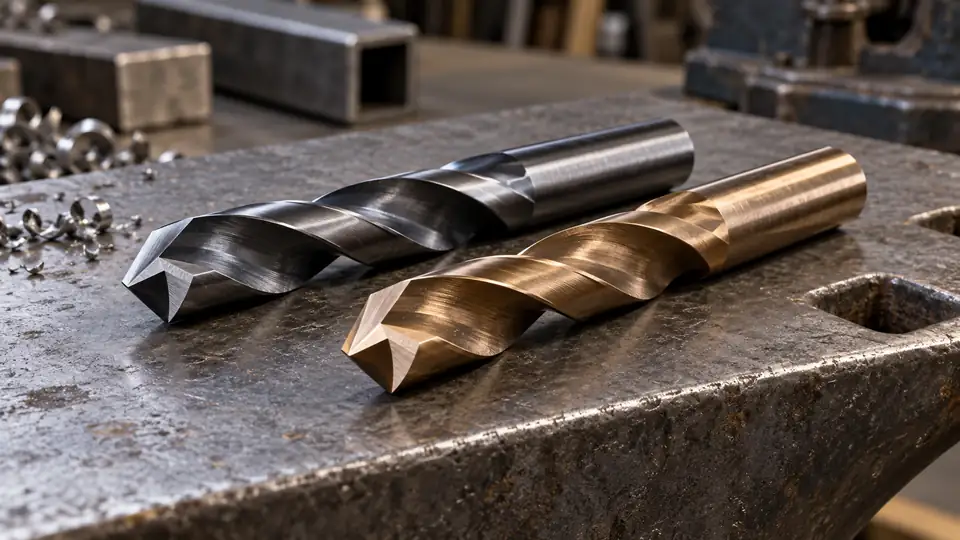
Carbide drill bits are harder, more wear resistant, and capable of maintaining a cutting edge under demanding production conditions, but they are relatively brittle and require a rigid, accurately aligned setup. Cobalt drill bits are cobalt-alloyed high-speed steel (HSS). They tolerate flex, vibration, interrupted cutting, and imperfect alignment better than carbide, which often makes them more practical for drill presses, portable drills, repair work, and lower-volume metal drilling.
Neither material is the universal choice for hard metal. Workpiece grade and hardness, hole depth, drill diameter, machine rigidity, coolant delivery, and drill geometry can change the preferred option. A carbide vs cobalt drill bits comparison therefore needs to account for the complete drilling system rather than tool hardness alone.
If the workpiece is hardened steel and the setup is rigid, start with our guide to carbide drills for hardened steel.
The Material Difference
The word cobalt can cause confusion because cobalt appears in both material systems, but in different roles.
A solid carbide drill is usually made from cemented carbide. This material consists of hard carbide particles, commonly tungsten carbide, held together by a metallic binder. Cobalt is frequently used as that binder. The finished material behaves as cemented carbide rather than cobalt HSS.
A cobalt drill is made from high-speed steel alloyed with cobalt. The cobalt is part of the steel alloy. The drill is neither pure cobalt nor tungsten carbide. Cobalt HSS retains useful hardness at elevated cutting temperatures while preserving much of the toughness associated with high-speed steel.
Material names also need to be separated from tool construction. A metalworking solid carbide drill is different from a carbide-tipped masonry bit. The latter normally has a steel body with a brazed carbide cutting tip and uses geometry intended for masonry or concrete. It is not a substitute for a precision solid carbide drill intended for metal.
Carbide vs Cobalt Drill Bits at a Glance
| Characteristic | Carbide Drill | Cobalt HSS Drill |
|---|---|---|
| Material | Cemented carbide, commonly tungsten carbide with a metallic binder | High-speed steel alloyed with cobalt |
| Hardness and wear resistance | Generally higher | Lower than carbide, but higher heat resistance than many conventional HSS grades |
| Toughness | Lower, with greater sensitivity to shock and bending | Higher, with better tolerance for flex and interrupted cutting |
| Machine requirements | Benefits from a rigid spindle, secure workholding, low runout, and accurate alignment | More forgiving of less rigid equipment and manual feeding |
| Typical use | Controlled production drilling, abrasive materials, and applications that can use carbide effectively | General metal drilling, maintenance, fabrication, and portable drilling |
| Breakage behavior | May chip or snap under deflection, chatter, or misalignment | More likely to tolerate limited bending before failure |
| Purchase cost | Usually higher for comparable drill size and design | Usually lower |
| Sharpening | Requires suitable grinding equipment and precise geometry control | Generally easier to resharpen with appropriate equipment |
Hardness, Toughness, and Wear
Why Carbide Lasts in Abrasive Cutting
Cemented carbide combines high hardness with strong resistance to abrasive wear. Those properties help a carbide cutting edge retain its geometry while drilling abrasive alloys, cast materials, composites, and other workpieces that can wear HSS rapidly.
Carbide also maintains useful cutting capability at temperatures that would soften many tool steels. This supports productive cutting conditions on suitable machinery. It does not mean heat can be ignored. Excessive heat, poor coolant delivery, chip packing, and unsuitable tool geometry can still damage the cutting edges or workpiece.
Why Cobalt HSS Survives Less Stable Setups
Toughness describes resistance to fracture and shock rather than resistance to wear. Cobalt HSS is less hard than cemented carbide, but it can absorb more deflection before chipping or snapping. That property is valuable where the drill may encounter spindle runout, inconsistent hand pressure, vibration, an interrupted surface, or slight misalignment.
Adding cobalt to HSS improves its ability to retain hardness as cutting temperature rises. The resulting drill remains a steel tool, so it generally preserves a better balance of toughness and heat resistance than solid carbide does for unstable drilling conditions.
Machine Rigidity Can Decide the Better Material
A carbide drill performs best when the machine keeps the cutting edges accurately aligned with the hole. The spindle, toolholder, workholding, and workpiece must resist movement under cutting load. Excessive runout can overload one cutting edge, while vibration and lateral movement can chip the point or fracture the drill.
CNC machining centers and rigid production machines can often provide the controlled conditions carbide needs. Secure fixturing, accurate holders, suitable coolant delivery, and stable feed are especially important for small-diameter carbide drills.
Cobalt HSS is often the more forgiving option on a conventional drill press or portable drill. Its toughness provides a larger margin for manual feed variation and modest alignment errors. This does not make careless setup acceptable. The workpiece still needs secure clamping, and the drill must be straight, sharp, and compatible with the chuck.
Once the setup is suitable for carbide, compare solid carbide drill options by diameter and usable depth.
Can Carbide Be Used in a Hand Drill?
Some carbide-containing tools are intended for portable equipment, especially purpose-built masonry, tile, or specialty drills. A precision solid carbide metalworking drill is a different case. Hand movement can apply side loading that brittle solid carbide does not tolerate well. Unless the tool manufacturer specifically approves portable use, a rigid machine is the more appropriate platform.
Workpiece Material and Hole Requirements
The label “hard metal” is too broad to select a drill. Two materials with similar measured hardness may create different chips, generate different cutting temperatures, or react differently with the cutting edge.
General Steel and Stainless Steel
Cobalt HSS drills are widely used for steels and many stainless steels, especially in fabrication and maintenance settings. A sharp point, suitable geometry, steady feed, and effective cutting fluid are important because rubbing can increase heat and promote work hardening in some stainless alloys.
Carbide drills can also machine steel and stainless steel effectively under controlled conditions. Their wear resistance can be valuable in repeated-hole production. Tool grade, coating, point geometry, and coolant strategy must match the specific alloy and operation.
Hardened and High-Strength Materials
Carbide is frequently considered for hardened or highly wear-resistant workpieces because its cutting edges are harder than those of cobalt HSS. That observation alone does not establish suitability. The workpiece hardness, surface condition, entry geometry, hole depth, drill design, and machine stability still matter.
A general-purpose carbide drill may fail where a specialized drill geometry is required. Cobalt HSS can also be unsuitable once the workpiece condition exceeds the capability of that specific drill. Manufacturer application data should govern such cases.
Cast Iron and Abrasive Materials
Carbide’s wear resistance can make it effective for cast iron and other abrasive materials in production environments. Cast surfaces, voids, and interrupted entry can create impact loading, however. The carbide grade and edge preparation must provide an appropriate balance between wear resistance and fracture resistance.
Thin Sheet and Interrupted Surfaces
Thin sheet can grab a conventional twist drill near breakthrough, and interrupted surfaces repeatedly load and unload the cutting edges. Tough cobalt HSS may tolerate these conditions better than a brittle solid carbide drill. Correct workholding and application-specific geometry remain necessary. For thin sheet, a step drill or another sheet-metal geometry may be more suitable than either conventional option.
Geometry and Coating Matter Alongside the Substrate
Tool material is one part of drill performance. Two drills made from the same substrate can behave differently because of their geometry and surface treatment.
- Point geometry: Point angle, web design, chisel-edge treatment, and edge preparation influence centering, thrust force, and cutting-edge strength.
- Flute geometry: Flute form affects chip formation and evacuation. Deep holes place greater demands on chip removal.
- Length: A short drill is usually more rigid than a long drill of the same diameter. Extra reach increases sensitivity to deflection.
- Coolant delivery: Some carbide drills use internal coolant passages to carry coolant toward the point and help move chips out of the hole.
- Coating: A coating can alter friction, wear behavior, and heat management, but it does not change cobalt HSS into carbide.
- Edge preparation: A stronger edge may resist chipping, while a sharper geometry may reduce cutting force. The appropriate balance depends on the workpiece and operation.
A gold, bronze, gray, or dark-colored surface does not reliably identify the substrate. Product specifications should state whether the drill is solid carbide, carbide tipped, conventional HSS, or cobalt HSS.
Cost, Tool Life, and Resharpening
Carbide drills usually have a higher initial cost than cobalt HSS drills of comparable size. Their wear resistance can offset that cost in repeat production where the setup supports long, consistent tool life. A broken carbide drill can erase that advantage quickly, particularly if the failure damages the workpiece or leaves a fragment in the hole.
Cobalt HSS is often economical for small batches, field repair, mixed materials, and jobs where setup conditions vary. It may need sharpening or replacement sooner in abrasive service, but its lower cost and greater toughness can make it the more practical tool.
Resharpening either type requires restoration of the original point geometry and cutting-edge symmetry. Carbide needs grinding media and equipment suitable for carbide. Coated drills may also require recoating if the original surface performance is to be restored. A poorly ground drill can cut oversize, wander, generate excess heat, or load one lip more heavily than the other.
How to Select Between Carbide and Cobalt
- Identify the exact workpiece material. Use the alloy, heat-treatment condition, and surface condition rather than a broad label such as “hard steel.”
- Evaluate machine stability. Check spindle condition, holder accuracy, workholding, and the likelihood of vibration or lateral movement.
- Define the hole. Diameter, depth, tolerance, surface finish, entry surface, and breakthrough condition all affect drill selection.
- Assess production volume. Carbide’s wear resistance has greater value in repeat operations. Cobalt HSS can be more economical for occasional holes and changing tasks.
- Match the drill geometry to the operation. Substrate alone cannot compensate for an unsuitable point, flute design, or length.
- Use tool-specific cutting data. Speed, feed, pecking strategy, and coolant requirements should come from the drill manufacturer for the stated workpiece and setup.
Favor solid carbide where the machine is rigid, runout is controlled, the work is securely held, and wear resistance or repeatability has clear value. Favor cobalt HSS where toughness, flexibility, lower initial cost, or tolerance for variable setup conditions matters more.
If several diameters are needed, choose among solid carbide drill bit sets that fit the same machine and material.
Failure Modes to Watch For
Chipped or Snapped Carbide
Carbide breakage can result from excessive runout, chatter, side loading, chip packing, unstable workholding, unsuitable entry conditions, or incorrect cutting parameters. Replacing the drill without correcting the setup may lead to another failure.
Rapidly Dulling Cobalt HSS
Fast wear may indicate an abrasive workpiece, excessive heat, rubbing instead of cutting, poor chip evacuation, or a drill geometry unsuited to the material. Blue or discolored chips and drill surfaces can signal substantial heat, but color alone does not diagnose the cause.
Oversize or Wandering Holes
Possible causes include unequal cutting lips, excessive runout, inadequate spotting, workpiece movement, or a flexible drill. Material choice may influence the result, but changing from cobalt to carbide will not correct a damaged holder or poorly ground point.
Safe Use and Setup
Drilling can produce sharp chips, hot surfaces, rotating entanglement hazards, and broken tool fragments. Clamp the workpiece rather than holding it by hand, use the machine’s guards, and follow the drill and machine manufacturers’ instructions. Eye protection appropriate to the operation is necessary, and loose clothing, gloves near rotating spindles, jewelry, and unsecured hair can create entanglement hazards.
Inspect the drill for cracks, chipped edges, damaged shanks, or visible bending before use. Confirm that the shank and holder are compatible and that the tool is clamped correctly. Stop the machine before measuring, clearing chips, or touching the tool. Chips should be removed with an appropriate brush or tool after rotation has stopped, rather than by hand.
Frequently Asked Questions
Are Cobalt Drill Bits Made From Pure Cobalt?
No. They are high-speed steel drills containing cobalt as an alloying element. The amount and alloy designation vary by drill material. They remain steel cutting tools.
Can Carbide Drill Bits Contain Cobalt?
Yes. Many cemented carbide materials use cobalt as a binder for hard carbide particles. That construction is fundamentally different from cobalt-alloyed HSS.
Which Drill Is Better for Stainless Steel?
Cobalt HSS is a practical choice for many stainless-steel jobs on drill presses and portable equipment. Carbide can be effective in rigid production setups with a drill geometry intended for the specific stainless alloy. Neither label alone guarantees suitability.
Which Type Is Better for a Drill Press?
Cobalt HSS generally provides more tolerance for runout, vibration, and manually controlled feed. Solid carbide may be appropriate on a sufficiently rigid, accurate drill press if the tool manufacturer supports the application and the setup limits side loading.
Does a Coating Make a Cobalt Drill Equivalent to Carbide?
No. A coating changes the drill’s surface properties, while the underlying substrate still determines much of its toughness, stiffness, and fracture behavior. Coated cobalt HSS remains cobalt HSS, and coated carbide remains carbide.
The Practical Distinction
Carbide supplies greater hardness and wear resistance, while cobalt HSS supplies greater toughness and tolerance for unstable conditions. Carbide is often suited to rigid, controlled, repeated drilling. Cobalt HSS is frequently better matched to general fabrication, maintenance, portable equipment, and variable setups.
The final selection should account for the workpiece, hole specification, drill construction, geometry, coating, holder, machine condition, and manufacturer’s application guidance. Selecting by the words “carbide” or “cobalt” alone leaves out the factors most likely to determine whether the drill cuts reliably or fails early.
