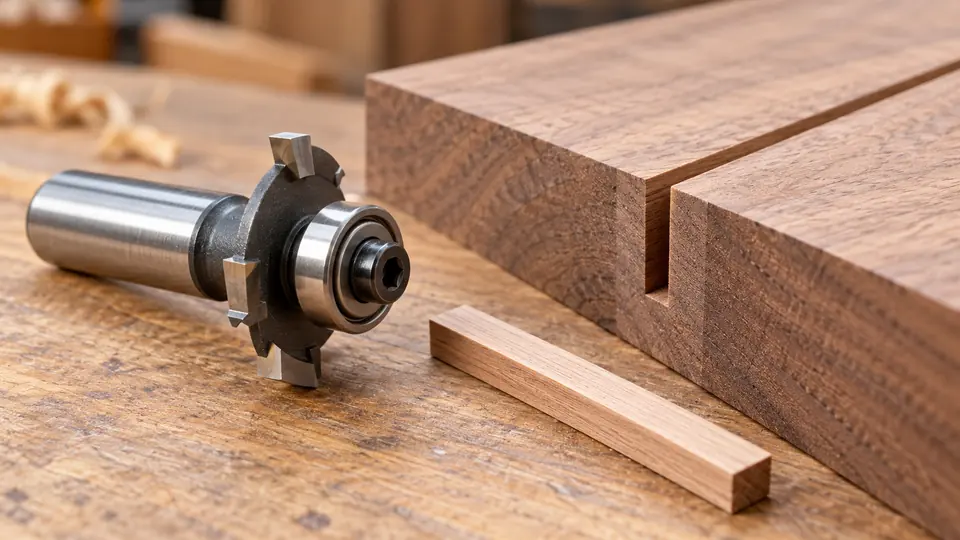
A slot cutting router bit has a fairly specific job, yet the right choice can change dramatically with the joint, panel thickness, and router collet in front of you. A 1/16-inch slot for a thin panel calls for a different cutter than a 5/32-inch groove, while a T-slot cutter belongs to an entirely separate project category. Bearing placement, cutting depth, carbide height, and shank size deserve attention before the bit ever touches wood.
The common mistake is buying by the phrase “slot cutter” alone. Some bits are intended for narrow joinery grooves, some use bearings to guide a cut along an edge, and others create a T-shaped channel for hardware. A 1/4-inch shank also cannot be treated as interchangeable with a 1/2-inch shank, and the Meihejia listing specifically limits its thin blade to softer materials, particleboard, MDF, and plywood rather than high-hardness wood.
Among these options, the WSOOX set is the most adaptable starting point because it combines two slotting profiles with three bearing sizes and specified cutting-depth changes. Buyers who need one exact groove size may prefer a single YONICO cutter, while T-track projects point clearly toward the Whiteside model. The comparison below sorts those differences quickly.
Quick Answer
- Best Overall: WSOOX Top Bearing Slot Cutting Router Bits Set for two bit profiles and three bearing sizes.
- Best for Multiple Slot Widths: Meihejia 1/4 Inch Shank Slot Cutter Set with six specified cutting thicknesses.
- Best for T-Slots: Whiteside Router Bits 3075 T-Slot Cutter for workbench hardware, shelving, and slatwall projects.
- Best for a Narrow Slot: YONICO 1/16-Inch Slotting Cutter for a 1/16-inch-thick by 1/2-inch-deep slot.
- Best Top-Bearing 5/32-Inch Slot Option: YONICO 14913q Top Bearing Slot Cutter Router Bit for a 5/32-inch-high by 1/2-inch-deep slot with a 1/4-inch shank.
Best Slot Cutting Router Bits Comparison Table
| Product | Best For | Bit Type | Shank Size | Cutting Dimensions | Notable Feature |
|---|---|---|---|---|---|
| WSOOX Top Bearing Set | General slotting and biscuit work | Top-bearing slot and biscuit bits | 1/4 inch | 1/4 to 3/8 inch depth, 5/32 or 1/4 inch height | Three bearing sizes |
| Meihejia Six-Size Set | Several narrow groove widths | Slot cutter set | 1/4 inch | 5/64 to 1/4 inch thickness | Six cutting sizes |
| YONICO Top Bearing Slot Cutter | Fixed 1/4-inch joinery slots | Top-bearing slot cutter | 1/4 inch | 1/4 inch high by 1/4 inch deep | 1-1/4-inch overall diameter |
| Freud 63-100 | Deeper slots with a 1/4-inch collet | Three-wing slotting set | 1/4 inch | 9/16-inch depth | Arbor, bearing, and Silver ICE coating |
| Whiteside 3075 T-Slot Cutter | T-track and workbench channels | T-slot cutter | 1/2 inch | 3/8-inch depth, 1/4-inch length | 1-3/16-inch large diameter |
| YONICO 1/16-Inch Cutter | Thin panel joinery | Slotting cutter assembly | 1/4 inch | 1/16 inch thick by 1/2 inch deep | Includes bearing and arbor |
| YONICO 5/32-Inch Cutter | Thicker panel joinery | Slotting cutter assembly | 1/4 inch | 5/32 inch thick by 9/16 inch deep | Includes bearing and arbor |
| Freud 63-162 | Deeper slots with a 1/2-inch collet | Three-wing slotting set | 1/2 inch | 9/16-inch depth | 1/4-inch carbide height |
| YONICO 14913q | Top-guided 5/32-inch slots | Top-bearing slot cutter | 1/4 inch | 5/32 inch height × 1/2 inch depth | 1-1/2-inch overall diameter |
Choose the slot width and depth for the joint, then match the bearing arrangement and shank to the router setup.
1. WSOOX Top Bearing Slot Cutting Router Bits Set – Best Overall

The WSOOX set is the broadest package here for a woodworker who moves between biscuit-style cuts, edge slotting, rabbets, and dado work. It includes one 4 mm, or 5/32-inch, biscuit router bit and one 1/4-inch-height slot router bit, both using a 1/4-inch shank. That combination gives the set a wider role than a single fixed-dimension cutter, especially on a project where a narrow groove and a biscuit-style cut appear on the same workpiece.
The three included bearings are the main attraction. Changing the bearing changes the listed cutting depth among 1/4, 5/16, and 3/8 inch, while the bearing hardware uses a 1/4-inch interior diameter. The supplied Allen wrench, clamps, and screws make the adjustment practical, but the listing specifically says to check that the bearing fixing parts are secure. That small setup step matters because a loose bearing assembly can affect the cut path.
Pros
- Includes both a biscuit bit and a 1/4-inch-height slot bit.
- Offers three listed cutting depths through bearing changes.
- Uses a specified 1/4-inch shank.
- Includes three bearings, clamps, screws, and an Allen wrench.
- Listed for decking installation, slotting, biscuiting, surfacing, rabbeting, and dado work.
Cons
- The set requires careful bearing hardware checks before use.
- Its 1/4-inch shank does not match routers or collets intended for 1/2-inch shanks.
This is the practical pick for someone who wants a small assortment rather than one exact groove. A buyer working exclusively with a 1/16-inch or 5/32-inch slot may get a cleaner match from a dedicated YONICO assembly, while a T-track project needs a true T-slot cutter. For mixed joinery tasks on a 1/4-inch-collet router, the WSOOX set gives the most adjustment in one package.
To buy this product, click here.
2. Meihejia 1/4 Inch Shank Slot Cutter Router Bit Set – Best for Multiple Slot Widths

The Meihejia set is aimed at the familiar woodworking moment when a panel, spline, or joining strip does not quite match the last one. It provides six cutting thicknesses, from 5/64 inch through 1/4 inch, with a listed maximum cutting depth of 1/2 inch. That spread makes it useful for buyers who want several narrow groove sizes without collecting separate single-purpose assemblies.
The material guidance is unusually important here. The listing identifies C3 micro-grain tungsten carbide blades, alloy steel bodies, and a heat-resistant Teflon coating, while also stating that the thin blade is unsuitable for high-hardness wood. It is intended for softwood, particleboard, MDF, and plywood, and it can be used with handheld or table-mounted routers. It cannot be used in an electric drill or drill machine, so the router requirement is firm rather than incidental.
Pros
- Provides six specified cutting thicknesses.
- Cuts to a listed maximum depth of 1/2 inch.
- Uses a 1/4-inch shank for compatible router collets.
- Lists softwood, particleboard, MDF, and plywood as suitable materials.
- Uses C3 micro-grain tungsten carbide blades and a Teflon coating.
Cons
- The listing says the thin blade is unsuitable for high-hardness wood.
- It cannot be used in an electric drill or drill machine.
Choose this set when variety in groove thickness matters more than bearing-guided edge work. It is especially relevant for cabinetry panels and sheet goods, where 5/64-inch, 1/8-inch, or 3/16-inch slots may serve different joining needs. Buyers seeking a single deep slot with a bearing should look toward the Freud or YONICO assemblies instead.
To buy this product, click here.
3. YONICO Top Bearing Slot Cutter Router Bit – Best Fixed-Dimension Option
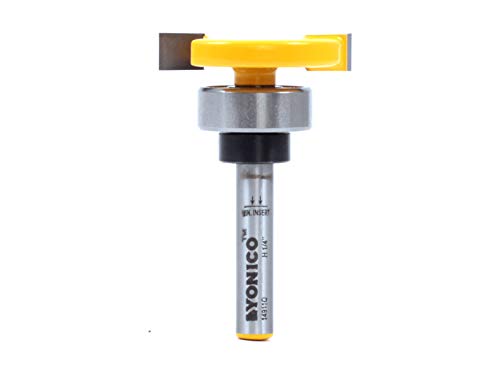
A fixed-size bit can be preferable when the joint has already been designed and there is no reason to juggle interchangeable cutters. This YONICO model routes a listed 1/4-inch by 1/4-inch slot, uses a 1/4-inch shank, and has a 1-1/4-inch overall diameter. The top-bearing format is suited to guiding the bit along an edge for repeatable joinery and general groove work.
The compact specification makes the intended use easy to understand. There is no six-size assortment to sort through and no separate bearing-depth system to configure. The listing identifies premium C3 micro-grain tungsten carbide blades and compatibility with both table-mounted and handheld routers. That leaves the important practical check to the buyer: confirm that the fixed 1/4-inch slot matches the panel or joining component before cutting.
Pros
- Produces a specified 1/4-inch-high by 1/4-inch-deep slot.
- Uses a top-bearing guiding arrangement.
- Has a 1-1/4-inch overall diameter.
- Uses a specified 1/4-inch shank.
- Is listed for handheld and table-mounted routers.
Cons
- Provides one fixed slot size rather than several cutting widths.
- Match the workpiece material and feed settings to the cutter manufacturer’s instructions.
This bit suits a buyer who values a straightforward setup for repeated 1/4-inch joinery slots. It is less suitable for a workshop that regularly changes groove thicknesses, where the Meihejia set or WSOOX package offers more adjustment. Measure the mating part first, because the fixed geometry leaves little room for a sizing correction.
To buy this product, click here.
4. Freud 63-100 9/16-Inch Depth Slotting Cutter Set – Best Deep Slot Set for a 1/4-Inch Collet

The Freud 63-100 takes a different route from the small fixed slot cutters. Its specified cut depth is 9/16 inch, with a 2-inch overall diameter and 2-3/8-inch overall length. The set includes three wing slotting cutters, an arbor, and a bearing, giving the buyer a deeper assembly intended for substantial edge-slotting work rather than a shallow decorative groove.
Its 1/4-inch shank keeps this version relevant to routers equipped with a matching collet, while the 1/16-inch carbide height describes a narrower cutting portion than the 1/4-inch-height Freud 63-162. The Silver ICE coating is another construction feature to consider alongside the cutting dimensions. The hand-held and table-mounted router designation still requires a careful check of the router, collet, and operating instructions.
Pros
- Provides a listed 9/16-inch cutting depth.
- Includes three wing cutters, an arbor, and a bearing.
- Uses a 1/4-inch shank.
- Has a specified 2-inch overall diameter.
- Includes a listed Silver ICE coating.
Cons
- The 1/4-inch shank excludes routers set up only for 1/2-inch shanks.
- The 1/16-inch carbide height is narrower than the 1/4-inch height on the Freud 63-162.
This Freud set fits woodworkers who need a deeper slot while staying with a 1/4-inch router collet. It is a more specialized purchase than the WSOOX set, and the larger 2-inch diameter should be treated as a meaningful dimensional requirement. If your router accepts a 1/2-inch shank and the project needs a taller cut, the 63-162 is the closer match.
To buy this product, click here.
5. Whiteside Router Bits 3075 T-Slot Cutter – Best for T-Track Projects

The Whiteside 3075 should be separated from ordinary slot cutters because it creates a T-shaped channel. That profile is useful for custom shelving, slatwall displays, and workbench T-track systems, where the lower portion of the cut provides room for a matching head or hardware. A standard straight slot bit cannot substitute for this geometry.
The dimensions tell the compatibility story clearly. This carbide-tipped cutter has a 1-3/16-inch large diameter, a 3/8-inch small diameter, a 1/4-inch length, and a 3/8-inch depth. Its 1/2-inch shank requires a compatible 1/2-inch collet, and its listed 2-3/8-inch overall length should be checked against the available router setup. The stated material range includes natural woods, composite woods, and hard plastics.
Pros
- Creates a specified T-slot profile.
- Uses a 1/2-inch shank.
- Lists a 1-3/16-inch large diameter and 3/8-inch small diameter.
- Has a listed 3/8-inch cutting depth.
- Is identified for natural woods, composite woods, and hard plastics.
Cons
- It requires a router collet that accepts a 1/2-inch shank.
- Its T-shaped profile is unsuitable when a simple straight slot is required.
This is the clear choice for a T-track bench or hardware channel, provided the router accepts the shank and the dimensions match the planned hardware. A buyer making biscuit joints or narrow panel grooves should skip this specialized shape and choose a conventional slotting assembly instead.
To buy this product, click here.
6. YONICO 1/16-Inch Slotting Cutter 12901q – Best for Narrow Slots

Thin panels and narrow joining strips call for a bit that matches their thickness rather than one that leaves a loose, oversized groove. This YONICO assembly is specified for a 1/16-inch-thick by 1/2-inch-deep slot. It arrives with a 1/4-inch shank and arbor, bearing, washers, and nut, so the basic assembly is specified rather than left for the buyer to piece together.
The narrow 1/16-inch dimension is the defining feature, while the 1/2-inch depth gives the cutter reach for a deeper joint. The listing identifies C3 micro-grain tungsten carbide blades and silver induction brazing. Choose this cutter when the joinery plan calls for its exact slot thickness and depth, and use it with compatible materials and a matching router setup.
Pros
- Cuts a specified 1/16-inch-thick slot.
- Provides a listed 1/2-inch cutting depth.
- Includes a 1/4-inch shank and arbor.
- Includes a bearing, washers, and nut.
- Uses C3 micro-grain tungsten carbide blades with silver induction brazing.
Cons
- The 1/16-inch slot width is specialized and unsuitable for thicker joining parts.
- Check the cutter manufacturer’s material guidance for the planned joint.
Use this cutter for a thin, clearly defined slot where a wider bit would compromise the fit. It is more precise in purpose than the Meihejia assortment, but less flexible if the project involves several groove widths. Check the mating material thickness and router shank compatibility before selecting it.
To buy this product, click here.
7. YONICO 5/32-Inch Slotting Cutter 12104q – Best for Thicker Panel Joinery

This YONICO assembly occupies the thicker-slot end of the dedicated single-bit options. It cuts a listed 5/32-inch-thick by 9/16-inch-deep slot, which makes it a better dimensional match for a thicker panel or joining component than the 1/16-inch YONICO model. The supplied 1/4-inch shank and bearing assembly keep the format familiar for compatible routers.
The included arbor, washers, and nut reduce uncertainty during setup, while the C3 micro-grain tungsten carbide blade and silver induction brazing are specified construction features. The 9/16-inch depth is also deeper than the 1/2-inch depth of the narrower YONICO model. Buyers should still treat the two as separate tools rather than interchangeable sizes, because a 5/32-inch slot will not provide the same fit as a 1/16-inch groove.
Pros
- Cuts a specified 5/32-inch-thick slot.
- Provides a listed 9/16-inch cutting depth.
- Uses a 1/4-inch shank and arbor.
- Includes a bearing, washers, and nut.
- Uses C3 micro-grain tungsten carbide and silver induction brazing.
Cons
- Its 5/32-inch slot is unsuitable for thinner joining parts.
- It offers one fixed cutting thickness rather than an adjustable set.
This model makes sense for a project built around a 5/32-inch groove and a compatible 1/4-inch router collet. For uncertain or changing dimensions, the WSOOX or Meihejia sets offer more flexibility. For a deep slot with a 1/2-inch shank, the Freud 63-162 is the more appropriate comparison.
To buy this product, click here.
8. Freud 63-162 9/16-Inch Depth Slotting Cutter Set – Best for a 1/2-Inch Collet

The Freud 63-162 shares the 9/16-inch listed cutting depth of the 63-100, but its 1/2-inch shank changes the machine requirement and its 1/4-inch carbide height changes the cutting profile. Those differences make it the larger-shank choice for a matching router and cut. It is intended for a router with a matching 1/2-inch collet and is listed for both handheld and table-mounted routers.
The set includes three wing slotting cutters, an arbor, and a bearing. Its 2-inch overall diameter and 2-3/8-inch overall length match the dimensions listed for the 63-100, while the larger shank and taller carbide height separate the two choices. Silver ICE coating is also listed. Buyers should compare the router collet first, then verify that the planned slot and available clearance suit the assembly.
Pros
- Provides a listed 9/16-inch cutting depth.
- Uses a 1/2-inch shank for compatible collets.
- Has a specified 1/4-inch carbide height.
- Includes three wing cutters, an arbor, and a bearing.
- Lists a 2-inch overall diameter and Silver ICE coating.
Cons
- It cannot be used in a router setup limited to 1/4-inch shanks.
- The 2-inch diameter and 2-3/8-inch overall length require a compatible setup and clearance.
Select this Freud when the router already accepts a 1/2-inch shank and the project benefits from the listed 1/4-inch carbide height. The 63-100 is the closer fit for a 1/4-inch collet, while the YONICO single cutters are better for one narrowly defined slot size. The central decision here is machine compatibility, not the brand name alone.
To buy this product, click here.
9. YONICO 14913q Top Bearing Slot Cutter Router Bit – Best Top-Bearing 5/32-Inch Slot Option

The YONICO 14913q fills a specific gap for buyers needing a top-bearing cutter that produces a 5/32-inch-high by 1/2-inch-deep slot. Its 1/4-inch shank keeps it relevant to routers with a matching collet, while the 1-1/2-inch overall diameter gives another useful clearance measurement for the planned setup. It is a precise single-bit choice when the joint dimensions are already known.
C3 micro-grain tungsten carbide blades and silver induction brazing are the main construction features. The bit is intended for slots and grooves in joinery and can be used in compatible handheld or table-mounted routers. The upper bearing makes the guide arrangement part of the choice. A buyer should compare both the bearing position and the cut dimensions with the workpiece rather than assuming every 5/32-inch cutter will follow the same setup.
Pros
- Cuts a clearly specified 5/32-inch-high by 1/2-inch-deep slot.
- Top-bearing guide arrangement.
- C3 micro-grain tungsten carbide blades.
- Silver induction brazing joins the cutting edges.
- Suitable for compatible handheld and table-mounted routers.
Cons
- Fixed cutting dimensions must match the panel or joining component.
- The 1/4-inch shank and 1-1/2-inch body need suitable collet and clearance.
Choose the 14913q for a top-guided slot with these exact dimensions. It differs from the YONICO 12104q assembly, which cuts to a 9/16-inch depth, and from the existing 14911q top-bearing option, which has a 1/4-inch cutting height and 1/4-inch depth. That makes the 14913q a distinct dimensional choice, not a second listing for either of those models.
To buy this product, click here.
Buying Guide
Match the Slot Profile to the Joint
A straight slot cutter, a top-bearing slot cutter, and a T-slot cutter solve different problems. A biscuit or edge-joinery project may suit the WSOOX, YONICO, or Freud assemblies. A workbench channel for T-track hardware needs the Whiteside 3075 profile, because its large and small diameters create the T-shaped cavity.
Check the Shank Before the Bit Arrives
Shank size is one of the easiest details to overlook. The WSOOX, Meihejia, YONICO, and Freud 63-100 models use 1/4-inch shanks. The Whiteside 3075 and Freud 63-162 use 1/2-inch shanks. A bit must match the router collet and the machine instructions. Similar cutting dimensions do not make different shank sizes interchangeable.
Choose the Correct Cutting Thickness
Dedicated cutters are useful when the joint dimension is already known. The YONICO 1/16-inch model is aimed at a narrow slot, while the YONICO 5/32-inch model is intended for a thicker one. The Meihejia set covers six sizes from 5/64 inch to 1/4 inch, making it the more flexible route for projects with changing panel thicknesses.
Understand Bearing Adjustments
Bearings guide certain cutters along an edge and can affect the resulting cut position or depth. The WSOOX set includes three bearing sizes and lists three possible cutting depths. Its components should be checked carefully before use. A fixed top-bearing model such as the YONICO 1/4-inch cutter offers a simpler setup when its dimensions already match the joint.
Separate Material Guidance from General Carbide Claims
Carbide construction does not automatically mean that every bit suits every wood species or material. The Meihejia listing specifically identifies softwood, particleboard, MDF, and plywood, while warning against high-hardness wood. The Whiteside listing identifies natural woods, composite woods, and hard plastics. Other products in this group have narrower or less detailed material information, so avoid stretching their listings into universal compatibility claims.
Account for Overall Diameter and Length
The larger Freud assemblies have a listed 2-inch overall diameter and 2-3/8-inch overall length. The Whiteside cutter has a 1-3/16-inch large diameter and a 2-3/8-inch overall length. Those dimensions affect available clearance and setup space. Compare them with the router, workpiece, and planned cut before focusing on the slot width alone.
See the joinery guide for slot-cutter reach and joint dimensions, with arbor hardware and the remaining material checked as part of the assembly.
Best Slot Cutting Router Bits FAQ
What Is the Best Slot Cutting Router Bit for General Woodworking?
The WSOOX set is the broadest general-purpose option in this group because it includes a biscuit bit, a slot bit, and three bearing sizes. It suits buyers who expect to handle more than one slotting task and whose router accepts a 1/4-inch shank.
What Is the Difference Between a Slot Cutter and a T-Slot Cutter?
A standard slot cutter creates a conventional groove or channel. A T-slot cutter creates a wider lower cavity beneath a narrower opening, allowing compatible T-track hardware to sit inside the workpiece. The Whiteside 3075 is the T-slot option listed here.
Can a 1/4-Inch Shank Bit Be Used in a 1/2-Inch Collet?
Do not assume that it can. The shank must match the router collet and the manufacturer’s instructions. The products listed here are supplied in either 1/4-inch or 1/2-inch shank formats, so choose the version that matches the machine rather than relying on appearance.
Which Bit Makes a 1/16-Inch Slot?
The YONICO 12901q is listed for a 1/16-inch-thick by 1/2-inch-deep slot. That dimension is specialized, so compare it with the actual thickness of the joining part before cutting.
Which Slot Cutter Offers Several Groove Sizes?
The Meihejia set lists six cutting thicknesses, ranging from 5/64 inch to 1/4 inch. The WSOOX set also provides adjustment through three bearing sizes, but its specified depth choices differ from the Meihejia thickness range.
Are These Router Bits Suitable for an Electric Drill?
The Meihejia listing specifically says it is for handheld and table-mounted routers and cannot be used in an electric drill or drill machine. Router bits should be used only with equipment and collets identified as compatible by the manufacturer.
Should I Choose the Freud 63-100 or Freud 63-162?
Both are listed with a 9/16-inch cutting depth, a 2-inch overall diameter, and a 2-3/8-inch overall length. The 63-100 uses a 1/4-inch shank and 1/16-inch carbide height, while the 63-162 uses a 1/2-inch shank and 1/4-inch carbide height. Router collet compatibility is the first dividing line.
Final Verdict
The WSOOX Top Bearing Slot Cutting Router Bits Set is the strongest overall fit because it covers several common operations with two bit profiles and three bearing sizes. Its 1/4-inch shank suits compatible routers, and its specified bearing changes provide more adjustment than a single fixed cutter. Buyers should still secure and check the bearing hardware before use, since the set depends on those components for its changing depth options.
For a lower-complexity purchase, the YONICO top-bearing cutter makes sense when a 1/4-inch by 1/4-inch slot is exactly what the joint requires. The Meihejia set is better for several narrow groove widths, while the Whiteside 3075 is the specialist choice for T-track channels. The Freud 63-100 and 63-162 divide primarily by shank size and carbide height, and the YONICO assemblies offer different slot widths and depths. Choose the 14913q when a top-bearing setup needs a 5/32-inch-high by 1/2-inch-deep slot. Match the bit profile, dimensions, and collet before buying, because those details determine whether the cutter belongs in the project at all.
