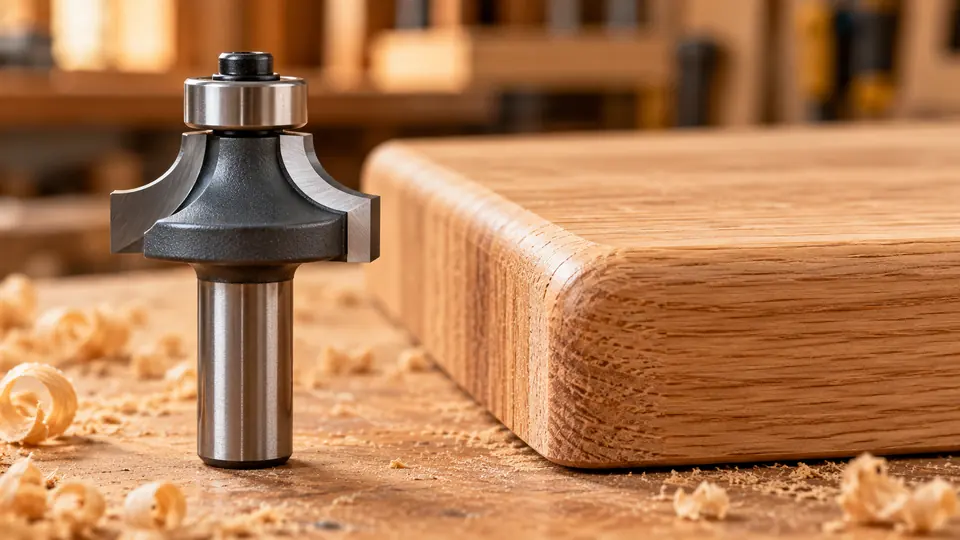
A roundover bit can turn a harsh, square board edge into something that feels finished in seconds, but the profile has to match the job. A 1/16-inch radius barely softens an edge, while a 1/2-inch radius creates a bold, furniture-style curve. Add bearing size, cutting diameter, shank compatibility, and material support to the mix, and a bit that looks right in a product photo may be completely wrong for a cabinet door or CNC detail.
The most common mistake is buying a set by piece count alone. A four-piece kit may cover the familiar 1/8, 3/16, 1/4, and 5/16-inch radii, while a single specialty bit may be the better tool for a small molding, a large table edge, or a decorative groove. The right choice depends on whether you need a compact edge treatment, several profiles for furniture work, a large 1/2-inch roundover, or a point-cutting design for CNC lettering. Among these options, the Whiteside 2000C is the strongest overall fit for buyers who want a clearly documented, carbide-tipped 1/8-inch roundover with a 1/4-inch shank.
Shank size comes first, followed by radius and the bit’s intended use. A 1/4-inch shank must match a compatible collet, and the stock should be thick enough for the selected profile. Bearing-guided sets are convenient for following an existing edge, while edge-forming bits without a documented bearing may suit controlled table-router work better. The products below cover those different priorities, from economical multi-radius sets to specialized Whiteside, Freud, YONICO, and BINSTAK options.
Quick Answer
- Best Overall: Whiteside 2000C for its documented 1/8-inch radius, 3/4-inch diameter, carbide-tipped construction, and 1/4-inch shank.
- Best Multi-Size Set: 6-Piece Roundover Router Bit Set for covering six radii from 1/8 to 1/2 inch.
- Best Large Profile: Freud 34-116 for its documented 1/2-inch radius and four-cutter design.
- Best for CNC Detail: BINSTAK Point Cutting Roundover Bit for decorative grooves, lettering, and signmaking.
Best Roundover Router Bits Comparison Table
| Product | Best For | Radius | Shank | Construction |
|---|---|---|---|---|
| Whiteside 2000C | Fine edge softening | 1/8 inch | 1/4 inch | Carbide-tipped |
| 6-Piece Roundover Set | Broad profile selection | 1/8 to 1/2 inch | 1/4 inch | YG6 carbide blades |
| Whiteside 2001 | Quarter-inch furniture edges | 1/4 inch | 1/4 inch | Carbide-tipped |
| Freud 34-116 | Large edge profiles | 1/2 inch | 1/4 inch | Ground carbide, four cutters |
| TOTOWOOD Four-Piece Set | General woodworking | 1/8 to 5/16 inch | 1/4 inch | C2 carbide inserts |
| HILTEX Four-Piece Set | Organized cabinet work | 1/8 to 5/16 inch | 1/4 inch | YG8 carbide edges |
| Whiteside 2000A | Subtle edge treatment | 1/16 inch | 1/4 inch | Carbide-tipped |
| BINSTAK Point Cutting Bit | Decorative CNC work | 1/4 inch | 1/4 inch | Carbide-tipped, two flutes |
| YONICO 13162q | Single-bit quarter-inch profiles | 1/4 inch | 1/4 inch | C3 micro-grain carbide |
The detailed reviews below match each bit or set to a particular edge profile, machine setup, and woodworking task.
1. Best Overall: Whiteside 2000C Roundover Router Bit

The Whiteside 2000C is a focused tool for jobs where a small, clean radius is the whole point. Its 1/8-inch radius and 3/4-inch large diameter create a restrained curve that works well for softening exposed board edges without making the profile look heavily molded. The published 1/2-inch cutting length gives the buyer a useful dimension to compare against the thickness of the workpiece, while the 1/4-inch shank fits routers using a matching 1/4-inch collet.
This is a carbide-tipped bit rather than a multi-size kit, so it makes the most sense for a woodworker who already knows the desired profile. The steel body and carbide cutting edges are specified separately, which helps explain the tool’s intended construction. A small radius is handy on drawer parts, shelves, trim, and furniture components where a square corner needs a gentler touch. It will not replace a 1/4-inch or 1/2-inch bit, but that narrow focus is precisely why it is easy to select for repeat work.
Pros
- Documented 1/8-inch roundover radius.
- Uses a 1/4-inch shank for compatible router collets.
- Has a published 3/4-inch large diameter.
- Includes a stated 1/2-inch cutting length.
- Uses carbide-tipped cutting edges on a steel body.
Cons
- Only provides one radius, so it cannot replace a multi-bit set.
- The 1/8-inch profile may be too subtle for large table edges or bold furniture profiles.
This bit suits buyers who want a defined small radius and prefer a single, clearly specified tool over a drawer full of unused profiles. A set is more practical for exploratory work, while the Whiteside 2000C is easier to justify when 1/8 inch is the profile repeatedly required.
To buy this product, click here.
2. Best Multi-Size Set: 6-Piece Roundover Router Bit Set

For a workshop where the next project could involve a shelf edge, a small box, or a broad tabletop curve, this six-piece set offers the widest documented radius range in the group. It includes 1/8, 3/16, 1/4, 5/16, 3/8, and 1/2-inch radii. That progression lets a buyer move from a barely softened corner to a substantial half-inch roundover without ordering separate bits one at a time.
Every bit uses a 1/4-inch shank, and the listing identifies YG6 tungsten carbide blades with a hardened 1045 steel body. The supported materials include hardwood, softwood, MDF, chipboard, plywood, acrylic, and other wood composites, while steel, iron, and sand are specifically excluded. The set is identified for CNC, portable, and table-mounted routers. That broad equipment description is useful, but the shank still has to be inserted correctly and matched to the machine’s collet.
Pros
- Includes six documented radii from 1/8 to 1/2 inch.
- Uses a consistent 1/4-inch shank across the set.
- Lists YG6 tungsten carbide blades.
- Identifies a hardened 1045 steel body.
- Supports several wood and composite materials, including MDF and plywood.
Cons
- The listing excludes steel, iron, and sand, limiting it to suitable wood and composite work.
- A six-piece set takes more storage space than a single profile bit.
This is the practical pick for a buyer still building a router-bit collection or handling projects with changing edge requirements. If one exact radius is needed for production work, a dedicated Whiteside or YONICO bit may be simpler, but this set offers the most useful spread of profiles in one purchase.
To buy this product, click here.
3. Best for Quarter-Inch Edges: Whiteside 2001 Roundover Router Bit

The Whiteside 2001 targets the familiar 1/4-inch roundover used on furniture parts, cabinet components, shelves, and table edges. Its 1-inch large diameter and 1/2-inch cutting length provide clear sizing information for checking the bit against the stock before making a cut. That matters because a quarter-inch radius needs enough material around the edge to form the complete curve cleanly.
Like the smaller Whiteside 2000C, this model has a 1/4-inch shank, a steel body, and carbide-tipped cutting edges. The single-profile design keeps the choice straightforward. Instead of sorting through a set, the user can reach for the bit marked for a quarter-inch curve. A 1/4-inch collet is required, and the router setup must accommodate the bit’s 1-inch diameter and intended cutting length.
Pros
- Provides a documented 1/4-inch radius.
- Has a published 1-inch large diameter.
- Lists a 1/2-inch cutting length.
- Uses a 1/4-inch shank for matching collets.
- Combines a steel body with carbide-tipped edges.
Cons
- It offers only one profile rather than several radius choices.
- The published information does not identify a bearing guide for edge following.
Choose this model for repeat quarter-inch edge work where a dedicated bit is preferable to a general-purpose set. Buyers who need a bearing-guided kit or several smaller and larger profiles should look elsewhere, while furniture makers with a steady 1/4-inch requirement get a more direct fit here.
To buy this product, click here.
4. Best Large Profile: Freud 34-116 Roundover Bit

The Freud 34-116 is the standout for a pronounced 1/2-inch radius. Its 1-1/2-inch overall diameter and 3/4-inch carbide height describe a substantially larger tool than the small edge-softening bits in this roundup. The result is a profile aimed at broad edges, moldings, doors, drawers, and decorative woodworking where a tiny eased corner would disappear.
The listing identifies four cutters, a 1/2-inch bearing diameter, a 1/4-inch shank, and use on CNC, handheld, and table-mounted routers. It also names a Quadra-Cut design, Perma-SHIELD coating, titanium-ground carbide, and an anti-kickback design. Those are documented construction and design details, not a guarantee of finish or tool life on every machine. The large diameter makes compatibility and setup especially important, so the router and workpiece must be appropriate for the bit.
Pros
- Provides a clearly stated 1/2-inch radius.
- Uses a 1-1/2-inch overall diameter.
- Lists four cutters and a 3/4-inch carbide height.
- Includes a 1/2-inch bearing diameter.
- Is identified for CNC, handheld, and table-mounted routers.
Cons
- The large 1-1/2-inch diameter makes it unsuitable for small edge details.
- A 1/2-inch radius requires sufficiently thick stock to form the full profile.
This is the right direction for a substantial roundover, especially on broad furniture edges and decorative work. It is excessive for a shelf that only needs a slight touch, where the Whiteside 2000A or 2000C will be easier to match to the job.
To buy this product, click here.
5. Best General-Purpose Set: TOTOWOOD Four-Piece Roundover Router Bit Set

The TOTOWOOD set covers four common profiles: 1/8, 3/16, 1/4, and 5/16 inch. That range is well suited to everyday furniture and cabinet work, where the edge usually needs a modest curve rather than the dramatic shape produced by a 1/2-inch bit. The set uses 1/4-inch shanks and bearing guides, giving buyers a straightforward way to compare it with other bearing-guided options.
The product information identifies C2 carbide inserts and lists solid wood, hardwood, softwood, MDF, particle board, plywood, and acrylic among the supported materials. It also names CNC, handheld, trimming, and table-mounted router equipment. Those material and machine references make the set flexible on paper, although a user should still match the router collet and follow the machine and bit instructions. The four-radius format is convenient for a project drawer, especially where profile changes are occasional.
Pros
- Includes four useful radii from 1/8 to 5/16 inch.
- Uses 1/4-inch shanks.
- Includes bearing guides for edge work.
- Lists C2 carbide inserts.
- Identifies support for wood, MDF, plywood, particle board, and acrylic.
Cons
- The set stops at a 5/16-inch radius and does not include 3/8 or 1/2 inch.
- The supplied information does not provide individual cutting diameters or cutting lengths for each bit.
This set fits a general woodworking drawer better than a specialized production setup. It is a useful match for buyers who want several familiar profiles and documented bearing guidance, while the six-piece set is more appropriate for projects that demand a wider radius range.
To buy this product, click here.
6. Best Organized Set: HILTEX Four-Piece Roundover Router Bit Set

HILTEX takes the familiar four-profile format and adds unusually clear dimensional information for each bit. The set includes 1/8, 3/16, 1/4, and 5/16-inch radii, with listed diameters and cutting heights for each size. That helps a buyer compare the physical scale of the tools before opening the box. Each bit uses a 1/4-inch shank and a top bearing, so the set is aimed at common edge-forming work on furniture, cabinets, tables, and similar parts.
The listing identifies YG8 carbide cutting edges on a hardened number 45 carbon steel body. It also names high-density urethane, laminate, MDF, veneered plywood, softwood, and hardwood as supported materials. Individual labeled storage cases are a small but genuinely useful detail. When several nearly similar bits are loose in a drawer, a labeled case saves time and prevents the 1/8-inch and 3/16-inch profiles from becoming a guessing game.
Pros
- Includes four radii from 1/8 to 5/16 inch.
- Provides individual diameter and cutting-height information.
- Uses top bearings and 1/4-inch shanks.
- Lists YG8 carbide edges on a hardened carbon steel body.
- Includes labeled storage cases for the individual bits.
Cons
- The set does not include the larger 3/8 or 1/2-inch profiles.
- The documented operating limit of up to 16,000 RPM may not suit every router setup or project preference.
HILTEX is a sensible pick for a buyer who values profile identification and organized storage as much as radius coverage. It is especially convenient for cabinet and furniture work, while the standalone Whiteside bits make more sense when one exact radius is used repeatedly.
To buy this product, click here.
7. Best Subtle Edge: Whiteside 2000A Roundover Bit

The Whiteside 2000A is for the small adjustment that changes how an edge feels without drawing attention to the router work. Its 1/16-inch radius is the smallest in this group, and its 5/8-inch large diameter keeps the tool physically smaller than the large-profile Freud. That makes the bit relevant to thin parts, delicate trim, and edges where a quarter-inch curve would remove too much material.
The product is listed with a 1/2-inch cutting length, 1/4-inch shank, steel body, and carbide-tipped edge. It is a single-profile bit, so it lacks the flexibility of a set, but that can be an advantage for repeatable work. A buyer who has already settled on a nearly square edge treatment does not need to sort through six radii. The important check is whether the 1/16-inch curve is visible enough for the intended design.
Pros
- Provides a documented 1/16-inch radius.
- Uses a 5/8-inch large diameter.
- Lists a 1/2-inch cutting length.
- Uses a 1/4-inch shank.
- Combines a steel body with carbide-tipped cutting edges.
Cons
- The very small radius will not create a pronounced furniture-style roundover.
- It is a single bit rather than a set with larger profile options.
This is the specialist choice for subtle edge relief. It fits buyers working with small details or thin stock, while anyone trying to soften a broad tabletop edge should move up to a larger radius such as the Whiteside 2001 or Freud 34-116.
To buy this product, click here.
8. Best for CNC Detail: BINSTAK Point Cutting Roundover Router Bit

The BINSTAK differs from ordinary edge-rounding bits because its point-cutting form is aimed at decorative detail. The listing identifies a 1/4-inch radius, 1/2-inch cutting diameter, 1/4-inch shank, and two flutes. It also describes a thin tip for rounded V-grooves, cabinet doors, moldings, columns, lettering, fluting, and signmaking. Those applications make it a more specialized tool than the general-purpose sets above.
The product is identified for CNC, table-mounted, and handheld routers, but the buyer should still confirm that the chosen setup accepts a 1/4-inch shank and suits the bit’s geometry. Its use case is especially attractive for someone cutting decorative grooves or lettering where an ordinary bearing-guided roundover would not create the same shape. The supplied information identifies carbide and high-strength steel construction, but it does not provide a broad list of supported workpiece materials beyond its woodworking applications.
Pros
- Uses a documented point-cutting roundover profile.
- Provides a 1/4-inch radius and 1/2-inch cutting diameter.
- Lists a two-flute configuration.
- Is identified for lettering, signmaking, fluting, and decorative grooves.
- Supports CNC, table-mounted, and handheld router use according to the listing.
Cons
- Its decorative point-cutting geometry is less suitable for ordinary edge rounding than a bearing-guided set.
- The supplied information does not establish the same broad material coverage listed for several woodworking sets.
This bit belongs in a CNC or signmaking collection where grooves and decorative profiles matter. For a basic cabinet edge, the TOTOWOOD or HILTEX sets are easier to match to the task, but the BINSTAK has a more specific role that those conventional roundover bits do not address.
To buy this product, click here.
9. Best Single-Bit Value Option: YONICO 13162q Roundover Edge Forming Bit
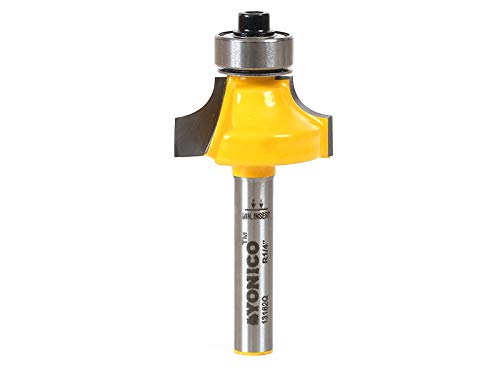
The YONICO 13162q offers a direct route to a 1/4-inch roundover without buying a set. Its published 1/4-inch radius and 1/4-inch cutting depth describe the profile in practical terms, while the 1/4-inch shank keeps it compatible with routers using the matching collet. This is the kind of bit that fits a buyer who has one recurring edge profile and wants a compact, single-tool solution.
The listing identifies premium C3 micro-grain tungsten carbide blades and silver induction brazing. It also names handheld and table-mounted routers as supported equipment and describes edge forming and small molding work as intended uses. The product data does not list a bearing, so it should not be treated as a bearing-guided substitute for the TOTOWOOD or HILTEX sets. That difference matters if the job involves following an existing curved edge.
Pros
- Provides a documented 1/4-inch radius.
- Lists a 1/4-inch cutting depth.
- Uses a 1/4-inch shank.
- Identifies C3 micro-grain tungsten carbide blades.
- Is listed for handheld and table-mounted routers.
Cons
- The product is a single 1/4-inch profile rather than a multi-radius set.
- The supplied information does not identify a bearing guide.
The YONICO 13162q is a good fit for repeat quarter-inch edge forming and small molding work. Pick it over a set when storage simplicity and one known profile matter; choose a bearing-guided collection when the project requires several radii or edge following.
To buy this product, click here.
Buying Guide
Match the Radius to the Edge
The radius determines how much material the bit removes from the corner. A 1/16-inch or 1/8-inch bit leaves the edge looking nearly square, which suits shelves, trim, and small components. A 1/4-inch radius creates a more visible furniture profile, while a 1/2-inch bit such as the Freud 34-116 needs considerably more stock to form its full curve.
Look at the thickness and final shape of the workpiece before choosing. If the board is too thin for the selected profile, the bit cannot create the complete roundover without cutting into the face or leaving an incomplete transition.
Check the Shank and Collet
Every product in this roundup uses a 1/4-inch shank. That does not mean every router can accept every bit automatically. The router must have a compatible 1/4-inch collet, and the shank should be inserted according to the tool and router instructions. A loose or mismatched setup is a compatibility problem, not a profile problem.
The bit’s diameter matters too. A 1-1/2-inch Freud bit occupies more space than a small 5/8-inch subtle-edge bit, so the machine, workpiece, and intended operation need to accommodate the selected tool.
Choose a Set or a Single Bit
A set is useful when projects change often. The six-piece option covers six radii, while the TOTOWOOD and HILTEX sets cover four common furniture profiles. A single bit is more efficient when the same radius appears on every drawer, shelf, or table component.
Piece count should never be the only deciding factor. Review the actual radii. A four-piece set stopping at 5/16 inch may be exactly right for cabinet work, but it will not replace a dedicated 3/8 or 1/2-inch bit.
Understand Bearing-Guided Designs
A bearing guide can follow an existing workpiece edge and help keep the profile aligned. TOTOWOOD and HILTEX explicitly identify bearing-guided designs, while the supplied information for the Whiteside, YONICO, and BINSTAK single bits does not establish a bearing. That difference affects how the bit is used.
A bearing-guided bit does not remove the need to set the cutting depth correctly. It also does not make every edge, curve, or material automatically suitable. Treat the bearing as one part of the setup rather than a guarantee of a particular finish.
Review the Construction
The products use different documented carbide descriptions. Whiteside models are identified as carbide-tipped, the six-piece set lists YG6 tungsten carbide blades, HILTEX lists YG8 carbide edges, and the YONICO 13162q lists C3 micro-grain tungsten carbide blades. These descriptions should be kept separate rather than treated as interchangeable grades.
TOTOWOOD identifies C2 carbide inserts, while Freud lists ground carbide with titanium and a Perma-SHIELD coating. Those are product-specific details, but the supplied information does not provide comparative cutting tests or tool-life measurements. Use the construction information to understand what is documented, not as proof that one bit will always outlast another.
Confirm the Workpiece and Machine
Several products list hardwood, softwood, MDF, plywood, particle board, acrylic, laminate, or other wood composites. The six-piece set specifically excludes steel and iron, and these are woodworking router bits rather than general metalworking cutters. Always match the material stated for the product to the material on the bench.
Machine compatibility also varies in practical importance. Some listings identify handheld, table-mounted, and CNC routers, while others provide a narrower equipment description. A CNC listing does not remove the need to verify the 1/4-inch shank, bit diameter, and machine instructions before use.
The guide to roundover radius and related edge profiles helps connect the bit’s stated geometry with the edge you want on the finished part.
Best Roundover Router Bits FAQ
What radius is best for a general furniture edge?
A 1/4-inch radius is a common middle-ground profile for furniture edges, cabinet components, and table parts. It is more visible than a 1/16 or 1/8-inch easing cut but less substantial than a 1/2-inch roundover. Stock thickness still matters, so compare the radius with the workpiece before cutting.
Are these roundover bits compatible with every router?
No. The listed products use 1/4-inch shanks, so the router must accept a matching 1/4-inch collet. The listing may identify handheld, table-mounted, or CNC use, but the buyer remains responsible for checking the machine’s compatibility with the bit diameter and setup.
Should I buy a roundover set or one bit?
Buy a set if projects use several profiles or you are still learning which radius fits your work. Choose one bit if the same radius appears repeatedly. The Whiteside 2000C, Whiteside 2001, Whiteside 2000A, and YONICO 13162q each target one specific profile, while the six-piece set covers the broadest range.
What is the difference between a 1/16-inch and 1/8-inch roundover?
A 1/16-inch radius creates a very slight softening of the edge. A 1/8-inch radius is still subtle but more visible and tactile. The choice depends on the desired appearance, the thickness of the part, and how much material should be removed from the corner.
Do bearing-guided roundover bits need a fence?
The bearing is intended to follow an existing edge, but the correct setup depends on the router and workpiece. A fence may be relevant in some table-router operations, while a bearing-guided edge-following cut may use the workpiece edge as the guide. Follow the instructions for the router and bit rather than assuming one setup applies to every operation.
Can these router bits cut metal?
The supplied product information identifies these products for wood, MDF, plywood, acrylic, laminate, and related composites. The six-piece set specifically says to avoid steel and iron. Do not treat a woodworking roundover bit as a metalworking cutter without product information that clearly supports that use.
Is a 1/2-inch roundover suitable for thin boards?
Usually, the board must be thick enough to provide the full material needed for a 1/2-inch curve. A large profile can remove too much from a thin edge or create an incomplete shape. The Freud 34-116 is better matched to substantial edges, while the Whiteside 2000A or 2000C suits more restrained edge treatment.
Which roundover bit is best for CNC signmaking?
The BINSTAK point-cutting roundover bit is the most specialized option here for lettering, signmaking, fluting, and rounded V-grooves. Its documented point-cutting design and two-flute configuration distinguish it from ordinary bearing-guided edge bits. Confirm the CNC’s collet and operating requirements before use.
Final Verdict
The Whiteside 2000C is the strongest overall recommendation because its purpose is easy to define: a carbide-tipped 1/8-inch roundover with a 3/4-inch diameter, 1/2-inch cutting length, and 1/4-inch shank. It is a focused choice for buyers who want a restrained edge treatment and clear published dimensions. For broader project coverage, the six-piece set is the better pick because it spans six radii, while the HILTEX and TOTOWOOD sets offer practical four-profile selections for common woodworking tasks.
Buy the Freud 34-116 when the project calls for a substantial 1/2-inch profile, the Whiteside 2000A for barely softened edges, or the BINSTAK for decorative CNC grooves and signmaking. The Whiteside 2001 and YONICO 13162q both suit dedicated 1/4-inch work, but their documented configurations differ, so check the bearing requirement before choosing. Match the radius to the stock, confirm the 1/4-inch collet, and select a product whose stated material and machine applications fit the job.
