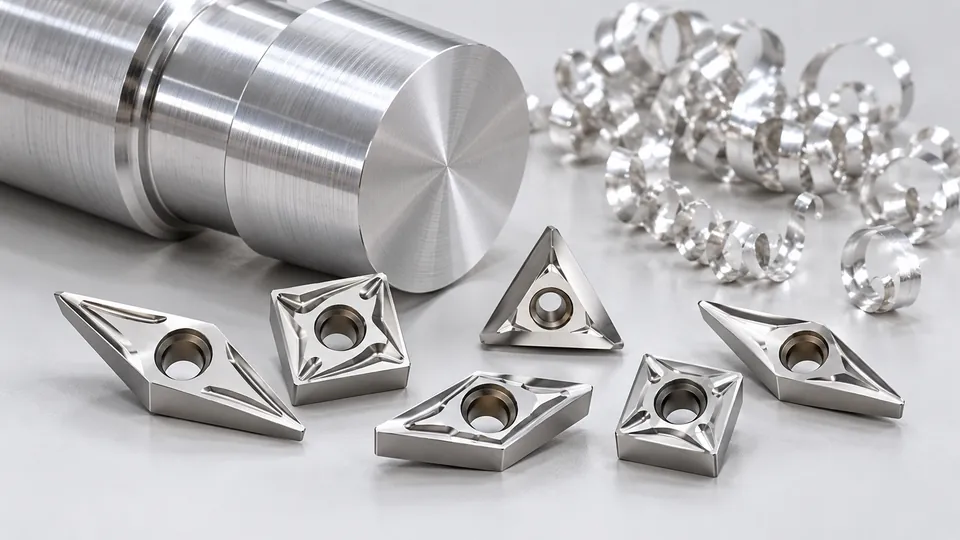
Aluminum can turn a routine insert change into a frustrating afternoon. A dull edge may leave a smeared surface, a poor chip groove can pack the cut, and an insert that fits the pocket visually may still belong to an entirely different designation. That is why buyers searching for the best carbide inserts for aluminum usually need more than a sharp-looking cutter. They need the correct insert family, nose radius, cutting operation, and workpiece application.
The products below cover aluminum-focused turning and milling inserts, with documented options for finishing, medium machining, face milling, boring, and related non-ferrous work. The most useful details are the designation, insert dimensions, radius, chip-control features, and stated material range. Holder compatibility still needs to be checked against the exact insert code before ordering. For the broadest aluminum-focused fit in this group, the GBJ APKT1604PDFR is the leading milling recommendation, while the CDBP CCGT32.50 is especially appealing for aluminum turning and finishing.
Different buyers will value different traits. A CNC lathe operator may need a CCGT, DCGT, or CNMG insert that matches an existing holder, while a machining-center user may need an APKT or SEKT milling insert. Radius choice matters too. A smaller radius can suit fine finishing, while a larger radius changes the cutting profile and may require a more substantial setup. The comparison below separates those options before the detailed reviews.
Quick Answer
- Best Overall: GBJ APKT1604PDFR Aluminum Carbide Inserts for aluminum-focused milling and a documented R0.2 radius.
- Best for Turning Finish Work: CDBP CCGT32.50 / CCGT09T302-LH Inserts with an LH chipbreaker and R0.2 radius.
- Best Smaller Turning Insert: CDBP CCGT21.51 / CCGT060204 Inserts for buyers who need the smaller listed CCGT dimensions.
- Best for Milling Versatility: OSCARBIDE APKT11T308 Inserts for documented face-mill and end-mill applications.
Best Carbide Inserts for Aluminum Comparison Table
| Product | Best For | Insert Designation | Radius | Operation | Material Application |
|---|---|---|---|---|---|
| GBJ APKT1604PDFR | Aluminum milling and finishing | APKT1604PDFR | R0.2 | Milling | Aluminum, including high-silicon aluminum |
| CDBP CCGT32.50 | Turning finish work | CCGT09T302-LH | R0.2 | Turning, boring, facing | Aluminum, copper, magnesium |
| CDBP CCGT32.51 | Finishing and medium machining | CCGT09T304 | Not stated in title | Turning and related work | Aluminum, copper, brass, bronze |
| FomaSP SEKT1204AFFN-LH2 | Aluminum milling | SEKT1204AFFN-LH2 | R0.8 | Milling | Aluminum, magnesium, copper, brass |
| FomaSP CNMG432 | General turning applications | CNMG120408 | R0.8 | Turning | Aluminum, magnesium, copper, brass |
| CDBP CCGT21.51 | Compact turning setups | CCGT060204 | Not stated in title | Turning and related work | Aluminum, copper, brass, bronze |
| FomaSP APKT160408FR | General aluminum milling | APKT160408FR | R0.8 | Milling | Aluminum, magnesium, copper, brass |
| Feyzor DCGT070204-AL | CNC lathe finishing | DCGT21.51 | R0.4 | Turning | Aluminum and soft non-ferrous metals |
| OSCARBIDE APKT11T308 | Face milling and side milling | APKT11T308 | 1/32 inch | Face and end milling | Aluminum and alloys |
The detailed reviews focus on the differences that matter at the machine, especially designation, radius, operation, and the limits of the published compatibility information.
1. GBJ APKT1604PDFR Aluminum Carbide Inserts R0.2 — Best Overall

The GBJ APKT1604PDFR is the clearest all-around match for an aluminum milling search because the listing identifies the APKT1604PDFR model, an R0.2 radius, and aluminum alloy processing as its intended use. The listing also calls out high-silicon aluminum, which gives this insert a more specific application profile than a generic replacement cutter. For a machinist looking at a box of inserts and wanting an aluminum-oriented starting point, that combination is useful and easy to identify.
Its stated package contains 10 boxed inserts, and the product description highlights a treated cutting edge and chip removal for finishing work. Those claims describe the intended design direction, rather than independent test results, so the holder, pocket, and cutting conditions still matter. The small R0.2 radius is particularly relevant to buyers focused on finishing rather than a larger-radius roughing profile. Check the complete APKT pocket designation on the milling cutter before purchase, since an insert designation must match the holder geometry exactly.
Pros
- Documented APKT1604PDFR insert designation.
- R0.2 radius is clearly identified for finishing-oriented work.
- Listing specifically identifies aluminum alloy processing.
- High-silicon aluminum is included in the stated processing range.
- Supplied as a 10-piece boxed set.
Cons
- The listing does not establish compatibility with every APKT holder or cutter body.
- Published cutting speeds, feeds, and depth limits are not provided.
This is the strongest first pick for a milling setup that already accepts APKT1604 inserts and needs an aluminum-focused R0.2 option. A turning operator should skip it in favor of a CCGT, CNMG, or DCGT insert, and a buyer needing a larger finishing radius should look at the FomaSP APKT160408FR instead. The central trade-off is simple: its aluminum-specific positioning is attractive, but exact pocket matching remains the buyer’s responsibility.
To buy this product, click here.
2. CDBP CCGT32.50 / CCGT09T302-LH Aluminum Inserts — Best for Turning Finish Work

For aluminum turning, this CDBP insert has a focused specification set. The CCGT09T302-LH designation is paired with a 0.2 mm radius, a 9.525 mm insert circle, 3.97 mm thickness, and a 4.4 mm hole diameter. Those dimensions give the buyer several points to compare against an existing holder instead of relying on the broad phrase “carbide insert.” The LH chipbreaker is listed for finish machining of aluminum, copper, and other non-ferrous metals.
The listing also identifies a polished surface and a submicron-fine-grain material, along with a stated application range that includes external turning, boring, end-face turning, chamfering, and some milling uses. The broad wording should not override the insert code or holder requirement, but it does make this a flexible non-ferrous candidate on paper. A machinist dealing with stringy aluminum chips will likely pay closest attention to the chipbreaker description, while a buyer working in a different orientation should verify whether LH geometry suits the setup.
Pros
- CCGT09T302-LH designation is clearly supplied.
- R0.2 radius is listed for a fine-cutting profile.
- LH chipbreaker is identified for aluminum finish machining.
- Dimensions include 9.525 mm insert circle, 3.97 mm thickness, and 4.4 mm hole diameter.
- Stated material range includes aluminum, copper, and magnesium.
Cons
- LH orientation may not match every turning holder or cutting direction.
- The listing does not provide a complete holder cross-reference.
Choose this model for an aluminum turning setup that already accepts the listed CCGT geometry and benefits from a small radius. Buyers needing a medium-machining insert with a different designation should look at the CCGT09T304 option, while compact setups may fit the smaller CCGT060204 better. Its useful advantage is the clearly stated aluminum finish-work focus, with holder orientation as the key checkpoint.
To buy this product, click here.
3. CDBP CCGT32.51 / CCGT09T304 Aluminum Inserts — Best for Finishing and Medium Machining

The CDBP CCGT32.51 uses the CCGT09T304 designation and is positioned for finishing and medium machining. Its 7-degree relief angle, wave-shaped chip groove, and mirror-polished finish are all documented features. Together, they give this insert a distinct identity from the smaller CCGT21.51 reviewed later, even though both belong to the CCGT family. The larger listed dimensions should be matched carefully to the holder rather than treated as interchangeable with every CCGT insert.
This model is also listed for aluminum, copper, brass, and bronze, which makes it useful for a shop that moves between several non-ferrous workpieces. The large rake angle and chip-groove description point toward chip-flow management, but the published information does not establish a measured surface finish or cutting-force advantage. A buyer machining aluminum one day and brass the next may appreciate the broader stated material range, while a dedicated fine-finishing setup may prefer the R0.2 CCGT09T302-LH.
Pros
- CCGT09T304 designation is clearly identified.
- Documented 7-degree relief angle.
- Wave-shaped chip groove is specified for finishing and medium machining.
- Mirror-polished surface is listed as a built-up-edge reduction feature.
- Stated material range includes aluminum, copper, brass, and bronze.
Cons
- The published listing does not state a nose radius in the product details supplied here.
- Exact holder compatibility must be confirmed from the CCGT09T304 designation.
This insert suits buyers who want a CCGT09T304 option for aluminum finishing and medium machining, especially where the broader non-ferrous material range is useful. It is less attractive for someone who needs a clearly stated small nose radius or the smaller CCGT060204 footprint. The decision comes down to matching the larger insert geometry and choosing the documented chip-groove profile over a more narrowly finishing-focused model.
To buy this product, click here.
4. FomaSP SEKT1204AFFN-LH2 Aluminum Milling Inserts — Best Larger-Radius Milling Option

The FomaSP SEKT1204AFFN-LH2 is a milling insert with a noticeably different size and radius profile from the APKT options in this list. The published dimensions are 12.7 mm insert circle, 4.76 mm thickness, 5.5 mm hole diameter, 16 mm length, and R0.8. That information is valuable for a buyer standing at the machine with an existing SEKT cutter, since the mounting pattern and dimensions are the first gate before any discussion of aluminum performance.
The listing identifies aluminum, magnesium, copper, brass, plastic, and wood as supported materials, with an application range from finishing to roughing. It also describes an uncoated, polished surface intended to reduce debris accumulation. Those statements make this a broad milling insert rather than a narrowly defined aluminum finisher. The larger R0.8 radius may appeal to users whose cutter and workpiece setup call for that geometry, while someone chasing a finer small-radius profile should compare the GBJ R0.2 insert.
Pros
- SEKT1204AFFN-LH2 designation is clearly supplied.
- R0.8 radius is documented.
- Dimensions include 12.7 mm insert circle and 4.76 mm thickness.
- Listed for aluminum, magnesium, copper, and brass.
- Suitable applications are described as finishing through roughing.
Cons
- Its SEKT geometry is not a substitute for APKT or other milling insert families.
- The listing does not provide a complete cutter-body compatibility chart.
This is the sensible choice for a compatible SEKT milling cutter that calls for a larger R0.8 insert and a wider non-ferrous application range. It should be skipped by buyers whose machine uses APKT pockets or who specifically need a small-radius finishing insert. The important trade-off is broader stated use against a larger physical format and a holder requirement that cannot be guessed from appearance.
To buy this product, click here.
5. FomaSP CNMG432 / CNMG120408 Aluminum Turning Inserts — Best CNMG Option

The FomaSP CNMG432 is the turning-focused heavyweight in this selection. Its supplied information identifies the CNMG120408 designation, a 12.7 mm insert circle, 4.76 mm thickness, 5.16 mm hole diameter, and R0.8 radius. Those figures are more useful than a generic claim about carbide because they allow a buyer to compare the insert directly with the dimensions required by an existing CNMG holder.
The listing places this uncoated, polished insert across aluminum, magnesium, copper, brass, plastic, and wood, with finishing to roughing applications. That broad range may suit a general-purpose turning drawer, but the product should still be chosen for a holder and operation that specifically accept CNMG120408. The R0.8 radius gives it a different role from the smaller-radius CCGT options, and buyers should account for that geometry before expecting the same finishing behavior.
Pros
- CNMG120408 designation is clearly stated.
- R0.8 nose radius is documented.
- Published dimensions include 12.7 mm insert circle and 4.76 mm thickness.
- Listed for aluminum, magnesium, copper, and brass.
- Application range covers finishing through roughing.
Cons
- CNMG geometry requires a matching CNMG holder and is not interchangeable with CCGT inserts.
- The product information does not specify a dedicated aluminum chipbreaker.
Consider this insert if a lathe already uses CNMG120408 tooling and a larger-radius, broad-application replacement makes sense. A buyer focused on dedicated aluminum finishing may prefer the CCGT09T302-LH or DCGT21.51 options, while an APKT milling setup has no use for this turning insert. Its appeal is the familiar CNMG format and broad stated material range, with holder matching as the non-negotiable detail.
To buy this product, click here.
6. CDBP CCGT21.51 / CCGT060204 Aluminum Inserts — Best Compact CCGT Option
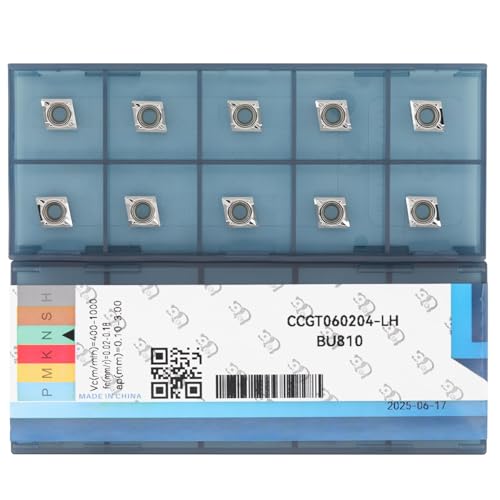
The CDBP CCGT21.51 is the smaller CCGT format in this roundup, identified as CCGT060204. Its sharp cutting edge, 7-degree relief angle, wave-shaped chip groove, and mirror-polished surface are all stated in the product information. The smaller designation separates it from the CCGT09T302 and CCGT09T304 products, so it belongs in a different holder conversation even though the general aluminum application overlaps.
This insert is listed for aluminum, copper, brass, and bronze, and the description covers finishing and medium machining. That makes it attractive for a setup where the CCGT060204 size is already established and a compact non-ferrous insert is required. It is easy to make a costly mistake by comparing only the family name, so check the complete holder specification, screw arrangement, and pocket dimensions before ordering.
Pros
- CCGT060204 designation is clearly supplied.
- Documented 7-degree relief angle.
- Wave-shaped chip groove is listed for process stability.
- Mirror-polished surface is identified as a built-up-edge control feature.
- Stated for aluminum, copper, brass, and bronze.
Cons
- The smaller CCGT060204 format is not interchangeable with larger CCGT09T302 or CCGT09T304 inserts.
- The supplied details do not state a nose radius in the product title or feature list.
This is a practical match for a compact turning or related setup that specifically calls for CCGT060204. It is a poor substitute for a larger CCGT insert simply because both carry the CCGT name. Buyers wanting a clearly identified R0.2 finishing radius should move up to the CCGT09T302-LH, while buyers with a smaller holder should keep this model in view.
To buy this product, click here.
7. FomaSP APKT160408FR Aluminum Milling Inserts — Best R0.8 APKT Option

The FomaSP APKT160408FR gives APKT users a larger-radius alternative to the GBJ APKT1604PDFR. The listing identifies a 9.8 mm insert circle, 4.76 mm thickness, 16.88 mm length, 4.4 mm hole diameter, and R0.8 radius. That larger radius is the defining distinction here. It changes the choice from a small-radius aluminum finishing insert toward a broader APKT replacement for a compatible milling cutter.
Its stated applications include aluminum, magnesium, copper, brass, plastic, and wood, with finishing through roughing listed. The polished, uncoated surface is described as reducing debris accumulation. Those features may appeal to a shop that machines more than one non-ferrous material, but the buyer should avoid treating this as a universal APKT replacement. The complete APKT160408FR designation and dimensions must agree with the cutter body before the box reaches the machine.
Pros
- APKT160408FR designation is clearly identified.
- R0.8 radius is documented for a larger-radius profile.
- Published dimensions include 9.8 mm insert circle and 4.76 mm thickness.
- Listed for aluminum, magnesium, copper, and brass.
- Application range includes finishing and roughing.
Cons
- Its R0.8 radius differs substantially from the GBJ R0.2 APKT option.
- The listing does not establish compatibility with every APKT milling cutter.
This product fits buyers who have an APKT160408FR-compatible cutter and want a larger-radius insert for aluminum and related materials. It is less suitable for a setup specified for APKT1604PDFR or a fine finishing job where the smaller radius is the priority. The main choice is between radius and application range, not brand wording or package appearance.
To buy this product, click here.
8. Feyzor DCGT070204-AL Aluminum CNC Lathe Inserts — Best DCGT Finishing Option
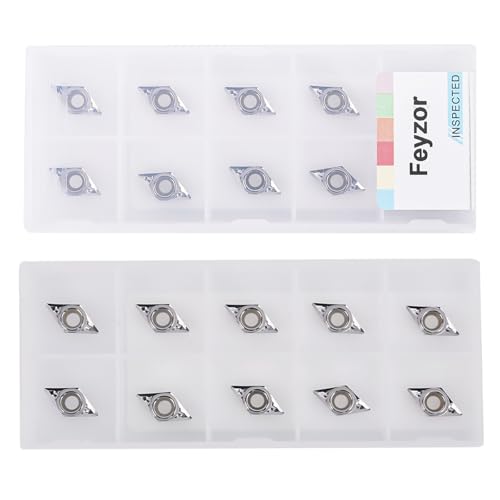
The Feyzor DCGT070204-AL brings a different turning geometry to the comparison. The listing identifies DCGT21.51 geometry, a 9.53 mm insert circle, 3.97 mm thickness, 4.4 mm hole diameter, and R0.4 radius. It also states compatibility with SDACR/L holders. That holder reference is especially useful because it gives the buyer a concrete starting point for checking fit, though the exact holder and orientation should still be confirmed.
The product is positioned for aluminum and soft non-ferrous metals, with an LH chipbreaker and a mirror-polished surface described for chip control and reduced adhesion. The listing includes additional claims about cutting-force reduction, vibration reduction, accuracy, and tool life. Those figures are product-listing claims rather than independently established results, so they should not replace normal setup verification. Still, the documented R0.4 radius and DCGT identity make this a meaningful choice for CNC lathe finishing work.
Pros
- DCGT21.51 geometry is clearly identified.
- R0.4 radius is documented.
- Published dimensions include 9.53 mm insert circle and 3.97 mm thickness.
- Listing names SDACR/L holder compatibility.
- Intended for aluminum and soft non-ferrous metals with an LH chipbreaker.
Cons
- Holder compatibility is stated for SDACR/L types, not every CNC lathe holder.
- Several performance figures in the listing are not independently verified by the supplied information.
This model deserves attention from CNC lathe users who need DCGT21.51 geometry, an R0.4 radius, and a stated SDACR/L holder fit. A buyer with a CCGT or CNMG pocket should choose the matching insert family instead. Its central advantage is the combination of a clear DCGT identity and aluminum-focused application, while the product-listing performance claims should be treated with appropriate caution.
To buy this product, click here.
9. OSCARBIDE APKT11T308 Aluminum Milling Inserts — Best for Face and Side Milling

The OSCARBIDE APKT11T308 is aimed at milling rather than lathe turning, with the listing specifying indexable face-mill and end-mill use. Its stated dimensions are a 0.256-inch insert circle, 0.142-inch thickness, 0.110-inch hole, and 1/32-inch radius. Those inch-based measurements make this insert distinct from the APKT1604 and APKT160408 products, and they give the buyer a practical checklist for an existing cutter body.
The product is described for square milling and side milling, with finishing and roughing applications listed. Aluminum cutting is included, although the title also references alloy and stainless steel. That broader wording does not mean the insert fits every cutter or performs identically across materials. A machinist should match the complete APKT11T308 designation to the face mill or end mill before treating this as a replacement. The 10-piece package is convenient for routine insert changes, provided the geometry is correct.
Pros
- APKT11T308 designation is clearly supplied.
- Documented inch dimensions include a 0.256-inch insert circle and 0.142-inch thickness.
- Listed for indexable face-mill and end-mill applications.
- Supports stated square-milling and side-milling uses.
- Suitable for finishing and roughing according to the listing.
Cons
- Its inch-based APKT11T308 dimensions are different from the APKT1604 family.
- The supplied information does not identify a specific compatible cutter model.
This insert suits a buyer who already owns a compatible APKT11T308 milling cutter and wants an aluminum-capable option for face or side milling. It should not be ordered as a substitute for APKT1604 inserts without checking the pocket and screw dimensions. The useful distinction is its documented milling scope and inch-format geometry, while exact cutter compatibility remains the deciding factor.
To buy this product, click here.
Buying Guide
Start With the Operation
Turning and milling inserts are different purchasing categories, even when both are advertised for aluminum. APKT and SEKT products in this selection are associated with milling cutters, while CCGT, CNMG, and DCGT products are associated with turning or CNC lathe work. A lathe operator searching for an APKT insert is looking at the wrong family, just as a machining-center user should not assume a CNMG insert belongs in a milling cutter. Identify the machine operation first, then compare the insert designation.
Match the Complete Designation
Insert families contain several sizes and geometries that can look remarkably similar in a product photo. CCGT09T302, CCGT09T304, and CCGT060204 are different designations, and the APKT1604, APKT160408, and APKT11T308 products also carry different dimensions. Match the full code, not a partial family name. The holder pocket, screw hole, thickness, and insert circle all matter.
Our explanation of insert codes, grades, and holder fit separates the size designation from the material-specific grade.
Choose the Radius for the Job
Nose radius is one of the clearest differences in this roundup. The GBJ APKT1604PDFR and CDBP CCGT09T302-LH list R0.2, the Feyzor DCGT option lists R0.4, and several FomaSP products list R0.8. A smaller radius can be attractive for fine-detail or finishing-oriented work, while a larger radius represents a different cutting profile and must suit the cutter, workpiece, and setup. Do not choose by radius alone, but do not ignore it either.
Read Aluminum Claims Carefully
Several listings specifically name aluminum, while others list a wider range of non-ferrous materials such as copper, magnesium, brass, or bronze. That documented range helps identify the intended application, but it is not a measured guarantee of surface finish, tool life, or cutting speed. Product descriptions that mention polished surfaces or chipbreakers can explain the design intent, yet the actual result still depends on the holder, machine, workpiece, and operating conditions.
Check Holder Compatibility Before Quantity
A 10-piece box is poor value if the insert cannot seat correctly. Confirm the insert designation, dimensions, orientation, and cutter or holder requirements before comparing package convenience. This is especially important with LH chipbreakers, CNMG versus CCGT families, and APKT products that use different dimensional formats. The Feyzor listing names SDACR/L holder compatibility, but other products provide less complete holder information, so those buyers need to verify the match manually.
Uncoated, Polished, and Grade Information
Many products here are described as uncoated with polished or treated surfaces. The listings also identify submicron-fine-grain material for several models and name a grade or chipbreaker in selected descriptions. Treat each statement as specific to that product listing. Do not assume that an uncoated insert from one family has the same material grade or cutting behavior as an uncoated insert from another family, and do not transfer specifications between brands or designations.
Do Not Shop by Price Alone
These products are generally sold in 10-piece packages, but package count does not resolve the technical question. A lower-cost box of the wrong designation cannot replace a correctly matched insert. Start with the machine, holder, insert code, radius, and aluminum application. Once those requirements are satisfied, package quantity and general material range become useful tie-breakers.
Best Carbide Inserts for Aluminum FAQ
What Type of Insert Is Best for Aluminum Turning?
The answer depends on the existing holder and the work being done. The CDBP CCGT09T302-LH is explicitly positioned for aluminum finish machining and lists an R0.2 radius, while the Feyzor DCGT21.51 option is aimed at aluminum and soft non-ferrous metals with an R0.4 radius. A CNMG120408 insert may suit a holder that requires CNMG geometry, but it should not be treated as interchangeable with either CCGT or DCGT.
Are APKT Inserts Used for Aluminum Milling?
Yes, the APKT products in this roundup are listed for milling applications involving aluminum. The GBJ APKT1604PDFR is the most aluminum-specific option here, while the FomaSP APKT160408FR provides an R0.8 alternative. The OSCARBIDE APKT11T308 is listed for indexable face mills and end mills, with square and side milling applications. Each designation must match the cutter body.
What Does the R0.2 or R0.8 Radius Mean?
The radius describes the rounded portion at the insert corner. R0.2 is a smaller radius than R0.8, so the two inserts have different cutting profiles. The smaller-radius products in this list are associated with finishing-oriented descriptions, while the R0.8 FomaSP options provide a larger-radius alternative. Radius alone does not determine suitability, since holder geometry and the intended cut remain critical.
Can CCGT09T302 and CCGT09T304 Inserts Be Swapped?
Do not assume they can. The listings identify CCGT09T302-LH and CCGT09T304 as different insert designations, with different stated applications and chipbreaker descriptions. Even when the overall shape appears similar, the complete designation, radius, orientation, and holder requirements need to match. Check the holder documentation before substituting one for the other.
Are These Inserts Suitable for Every Aluminum Alloy?
No product in this roundup should be treated as universally suitable for every aluminum alloy or every machine setup. The GBJ listing specifically mentions aluminum alloys and high-silicon aluminum, while other products list aluminum alongside copper, brass, magnesium, or bronze. Those statements establish intended material applications, not universal cutting parameters or guaranteed results across every alloy.
Do These Inserts Include the Toolholder?
The supplied product information describes replacement inserts and package quantities, not complete toolholders. A box of APKT, CCGT, CNMG, DCGT, or SEKT inserts will not automatically include a matching cutter body or lathe holder. Confirm the holder separately, including orientation and pocket dimensions where relevant.
Is a Polished Insert Automatically Better for Aluminum?
A polished surface is a documented feature on several products and is described as helping reduce material buildup or debris accumulation. That can be relevant to aluminum machining, but polish does not make two different insert families interchangeable. The designation, radius, chipbreaker, holder, and intended operation still carry more purchasing weight than the word “polished” alone.
Final Verdict
The GBJ APKT1604PDFR is the strongest overall recommendation because its aluminum-focused application, high-silicon aluminum reference, APKT1604PDFR designation, and R0.2 radius align clearly with milling and finishing needs. It gives the buyer a specific model to match against an existing cutter rather than a vague general-purpose insert. For aluminum turning, the CDBP CCGT09T302-LH is the better specialist pick because its listing identifies an LH chipbreaker, R0.2 radius, and finish-machining use.
The remaining choices serve distinct setups. FomaSP provides larger-radius APKT, SEKT, and CNMG alternatives, CDBP covers a separate compact CCGT format, Feyzor supplies a DCGT option with stated SDACR/L holder compatibility, and OSCARBIDE addresses APKT11T308 face and side milling. Match the full insert code and dimensions to the holder before ordering, then choose radius and chipbreaker according to the operation rather than assuming every aluminum-labeled insert behaves the same way.
