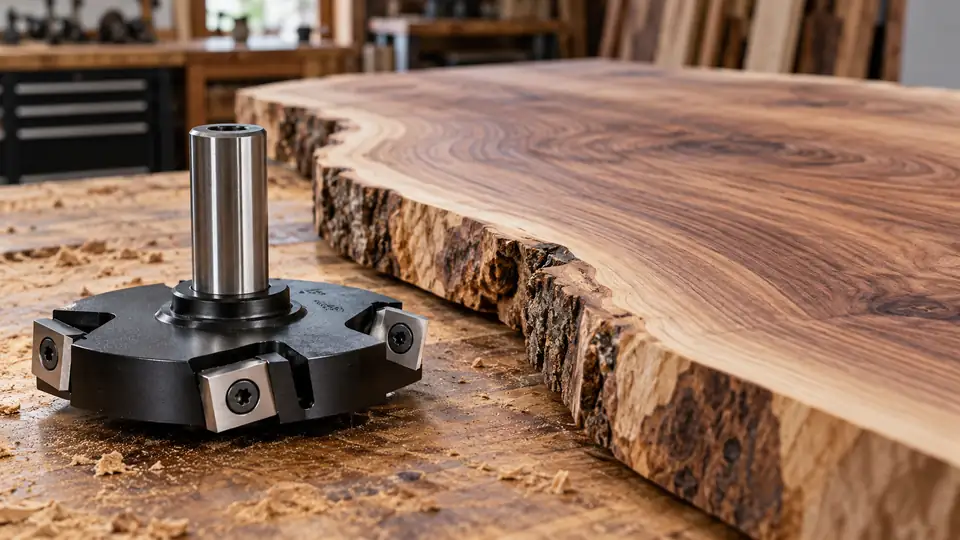
A slab-flattening router bit has a very different job from a profile bit. It has to sweep across a broad surface, remove high spots without making the router sled stumble, and leave a manageable pattern for the finishing passes that follow. Buyers often focus on cutting diameter alone, then overlook shank size, insert layout, router compatibility, and the difference between replaceable carbide inserts and carbide-tipped edges. Those details decide whether a bit feels like a useful surfacing tool or an awkward cutter taking up space in a drawer.
The main trade-off is straightforward. A 2-inch or 3-inch cutter covers more ground per pass, while a smaller 1-inch to 1-1/2-inch bit may suit lighter equipment or tighter sled setups. A 1/2-inch shank generally requires a matching collet, while 1/4-inch options open the door to more compact routers, although several listings specifically exclude trim and palm routers. Material support matters too. The products here are identified for wood, MDF, plywood, spoilboards, and related sheet materials, while some also list acrylic, epoxy, or plastics.
The BINSTAK six-wing insert bit with a 1/2-inch shank and 2-inch cutting diameter is the strongest overall fit in this group because it combines a broad surfacing path with replaceable four-sided inserts and documented use on CNC machines, router sleds, and other routers. A large 3-inch Akylin cutter, compact 1/4-inch options, and simpler carbide-tipped bits provide useful alternatives for different machines and project sizes.
Quick Answer
- Best Overall: BINSTAK Six-Wing 2-Inch Insert Bit for its 1/2-inch shank, six-wing layout, and replaceable four-sided inserts.
- Best for Large Slabs: Akylin 3-Inch Six-Wing Bit for its wide cutting diameter and eight supplied inserts.
- Best for 1/4-Inch Collets: POWERTEC 2-Inch 1/4-Inch Shank Bit for broad coverage with a documented 1/2-inch cutting depth.
- Best Budget-Oriented Pick: Mikniri 1-1/2-Inch Four-Wing Bit for a compact 1/4-inch shank and straightforward slab-flattening format.
Best Router Bits for Slab Flattening Comparison Table
| Product | Best For | Shank | Cutting Diameter | Cutting Design | Documented Applications |
|---|---|---|---|---|---|
| BINSTAK Six-Wing 2-Inch | Overall slab and spoilboard work | 1/2 inch | 2 inches | Six replaceable inserts | Wood, MDF, plywood, acrylic |
| SICWOOD Six-Wing 2-Inch | Careful router-sled setups | 1/2 inch | 2 inches | Six replaceable inserts | Wood, epoxy, MDF, plastics |
| Akylin 3-Inch | Large surfaces and wide passes | 1/2 inch | 3 inches | Six-wing insert design | Wood and spoilboards |
| Slab Flattening Insert Bit | 1/4-inch collets and mixed routing | 1/4 inch | Listing conflict: 1-1/4 to 1-3/8 inches | Four inserts | Hardwood, plywood, MDF |
| BINSTAK Four-Wing 1-1/2-Inch | General 1/4-inch surfacing | 1/4 inch | 1-1/2 inches | Carbide-tipped, four-wing | Wood, MDF, plywood, acrylic |
| BINSTAK Four-Wing 2-Inch | Simple 1/2-inch surfacing | 1/2 inch | 2 inches | Carbide-tipped, four-wing | Wood, MDF, plywood, acrylic |
| BINSTAK 2+2 Insert Bit | 1/4-inch shank with insert maintenance | 1/4 inch | 1-3/8 inches | Four replaceable inserts | Wood, MDF, plywood, acrylic |
| POWERTEC 2-Inch 1/4-Inch Shank | Full-size routers and router sleds | 1/4 inch | 2 inches | Tungsten carbide-tipped edges | Wood and spoilboards |
| Mikniri Four-Wing 1-1/2-Inch | Budget-oriented 1/4-inch setups | 1/4 inch | 1-1/2 inches | Carbide-tipped, four-wing | Wood, MDF, plywood |
The detailed picks below separate replaceable-insert cutters from carbide-tipped designs and show which dimensions matter for each setup.
1. BINSTAK CNC Spoilboard Surfacing Router Bit, 1/2-Inch Shank, 2-Inch Cutting Diameter — Best Overall

This BINSTAK combines the dimensions many slab-flattening buyers want in one cutter: a 1/2-inch shank, a 2-inch cutting diameter, and six replaceable carbide inserts. The six-wing arrangement gives the bit more cutting edges across the face than a basic two-knife surfacing cutter, while the insert format lets the user rotate a dull edge instead of replacing the entire body. The listing identifies four usable edges on each insert, which is a practical detail for repeated spoilboard work.
The bit is listed for softwood, hardwood, MDF, plywood, particle board, laminate, and acrylic. It is also identified for CNC machines, handheld routers, and table-mounted portable routers, although the machine’s collet, power, and manufacturer limits still need to match the 1/2-inch shank and broad cutter. The steel body includes an anti-kickback design, and the supplied inserts are TiN-coated according to the listing. That gives this model a well-defined role for makers who want an indexable surfacing bit rather than a one-piece carbide-tipped cutter.
Pros
- Uses a documented 1/2-inch shank.
- Provides a 2-inch cutting diameter for broad surfacing passes.
- Uses six replaceable carbide inserts.
- Each insert has four usable edges according to the listing.
- Listed for slabs, spoilboards, MDF, plywood, wood, and acrylic.
Cons
- Requires a compatible 1/2-inch collet and a machine suitable for a broad surfacing bit.
- The listing does not establish a universal safe operating setup for every router.
This is the best match for buyers building a router sled or maintaining a larger CNC spoilboard with a 1/2-inch collet. A 1/4-inch model may fit a different machine more conveniently, while the Akylin below covers a wider path for especially large workpieces.
To buy this product, click here.
2. SICWOOD Slab Flattening Router Bit, 1/2-Inch Shank, 2-Inch Cutting Diameter — Best for Careful Router-Sled Setups

The SICWOOD takes a similar broad-surfacing route with a 2-inch cutting diameter, six wings, and a 1/2-inch shank. Its supplied information is unusually direct about setup: all six inserts should be checked for flatness and tightness before use, and the router sled rails should be stable and square. That guidance matters because a wide, multi-insert cutter depends on the inserts sitting consistently across the cutting circle.
This model uses 12-by-12-by-1.5-millimeter replaceable inserts and is listed for hardwood, softwood, MDF, plywood, chipboard, acrylic, epoxy resin, and several board materials. It is intended for router sleds and CNC equipment. The listing also gives a maximum RPM figure and asks users to begin at a lower test speed, but those instructions should be read alongside the router and bit manufacturer’s requirements rather than treated as a universal setting.
Pros
- Has a documented 1/2-inch shank and 2-inch cutting diameter.
- Uses six replaceable carbide inserts.
- Lists wood, epoxy, acrylic, MDF, and plywood among supported materials.
- Provides explicit insert-flatness and tightness guidance.
- Targets router-sled and CNC slab-flattening work.
Cons
- Requires careful insert inspection before operation.
- Needs a stable, square router-sled setup and a compatible 1/2-inch collet.
This pick suits a woodworker who is comfortable checking every insert and tuning a sled before making a pass. Buyers seeking a broader 3-inch path can look to Akylin, while the BINSTAK six-wing model is a simpler overall recommendation for mixed surfacing tasks.
To buy this product, click here.
3. Akylin CNC Slab Flattening Router Bit, 3-Inch Cutting Diameter — Best for Large Surfaces

The Akylin is the largest cutter in this selection, with a 3-inch cutting diameter and a 1/2-inch shank. That wide path is aimed at large glued-up panels, live-edge slabs, spoilboards, and bottom-cleaning work where fewer overlapping passes are useful. The cutter uses six wings and comes with eight inserts, described as a 6+2 arrangement, so the product is built around replaceable cutting edges rather than a disposable one-piece bit.
The body is identified as 42CrMo4 steel, and the inserts are listed as K10/YG6X virgin carbide. Those material descriptions belong to this exact model and should not be transferred to the other products here. The listing also identifies use with router sleds, CNC equipment, handheld routers, and desktop portable routers, plus a stated RPM figure. A 3-inch cutter still demands careful attention to machine compatibility, collet size, insert tightness, and the router manufacturer’s limits.
Pros
- Offers the widest documented cutting diameter at 3 inches.
- Uses a 1/2-inch shank.
- Includes six-wing cutting geometry with eight listed inserts.
- Lists a 42CrMo4 steel cutter body.
- Identifies K10/YG6X virgin carbide inserts.
Cons
- The 3-inch diameter may be unsuitable for smaller routers or compact sleds.
- Insert screws must be tightened firmly before operation.
Large-slab owners with a compatible 1/2-inch setup should look closely at this model. Its width is the central reason to choose it, but that same width makes machine and sled suitability more important than with the smaller 1/4-inch cutters.
To buy this product, click here.
4. Slab Flattening Insert Router Bit, 1/4-Inch Shank — Best for Mixed 1/4-Inch Routing
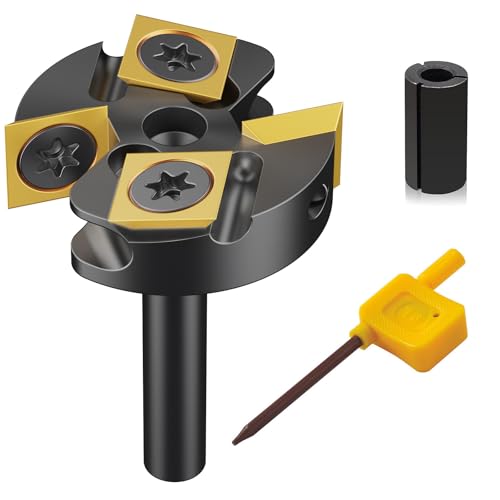
This compact insert bit is aimed at buyers who need a 1/4-inch shank and want one cutter for slab flattening, spoilboard surfacing, grooving, and edge work. The supplied information identifies four titanium-coated carbide inserts, a screwdriver, and a 1/2-inch-to-1/4-inch collet. The product title states a 1-3/8-inch cutting diameter, while one feature line identifies the cutter as 1-1/4 inches, so the exact selected dimension should be verified before purchase.
That dimensional conflict is the key issue here, yet the general format remains clear. The bit uses four inserts, is listed for hardwood, plywood, and MDF, and is described for CNC machines and router sleds. Its 1/4-inch shank may simplify matching with some routers, but the included reduction collet should never be treated as proof that every router can safely use the cutter. Check the machine’s collet requirements and the final product specification first.
Pros
- Uses a documented 1/4-inch shank.
- Includes four replaceable carbide inserts.
- Lists titanium-coated inserts.
- Includes a screwdriver and a 1/2-inch-to-1/4-inch collet.
- Supports slab flattening, spoilboard work, grooving, and edge treatment.
Cons
- The supplied information gives conflicting cutting-diameter figures.
- The listing does not establish compatibility with every compact or palm router.
This model makes sense for a buyer who values a 1/4-inch format and wants an insert-based bit for more than surface flattening. Verify the diameter before ordering. If a clear dimension is more important, the BINSTAK 2+2 model below provides a cleaner specification profile.
To buy this product, click here.
5. BINSTAK CNC Spoilboard Surfacing Router Bit, 1/4-Inch Shank, 1-1/2-Inch Diameter — Best Straightforward 1/4-Inch Option

This BINSTAK uses a 1/4-inch shank and a 1-1/2-inch cutting diameter, creating a middle ground between narrow cutters and the larger 2-inch models. The four-wing carbide-tipped design is intended for slab flattening, spoilboard resurfacing, trimming, and dado or groove work. Its listed 1/4-inch cutting length gives the buyer a clear dimensional limit to keep in mind while planning a pass.
The hardened steel body includes an anti-kickback design, and the bit has a heat-resistant Teflon coating that the listing says helps reduce resin buildup. It is identified for solid wood, MDF, laminate, particle board, plywood, and acrylic, with use on CNC machines, handheld routers, and table-mounted portable routers. The listing excludes metal, so this is a woodworking surfacing tool rather than a general-purpose cutter for every material.
Pros
- Uses a documented 1/4-inch shank.
- Provides a 1-1/2-inch cutting diameter.
- Uses four carbide-tipped wings.
- Lists wood, MDF, plywood, laminate, and acrylic applications.
- Includes an anti-kickback body design and Teflon coating.
Cons
- The 1/4-inch cutting length limits the depth of the surfacing edge.
- The listing specifically excludes metal cutting.
Choose this bit for general wood surfacing on a 1/4-inch setup where a 1-1/2-inch path is large enough for the sled. A replaceable-insert design may appeal more to frequent users, while this carbide-tipped format keeps the cutting arrangement simple.
To buy this product, click here.
6. BINSTAK CNC Spoilboard Surfacing Router Bit, 1/2-Inch Shank, 2-Inch Diameter — Best Simple 1/2-Inch Cutter

This BINSTAK provides a familiar 2-inch surfacing path with a 1/2-inch shank and four carbide-tipped wings. Its 1/2-inch cutting length distinguishes it from the smaller 1-1/2-inch, 1/4-inch model above and gives it a clear role in larger router-sled or CNC setups. The cutter is also described for trimming and slotting, although slab flattening and spoilboard work remain its central applications.
The body is identified as solid hardened steel with an anti-kickback design and a heat-resistant Teflon coating. The listing supports woods, MDF, laminate, particle board, plywood, and acrylic, while warning against metal. A 1/2-inch-to-1/4-inch reduction sleeve is included, but that accessory does not remove the need to check the router’s collet and operating requirements. The cutter is a conventional carbide-tipped choice rather than an indexable insert system.
Pros
- Uses a 1/2-inch shank and 2-inch cutting diameter.
- Provides a documented 1/2-inch cutting length.
- Uses four carbide-tipped wings.
- Lists several wood and sheet-material applications.
- Includes a 1/2-inch-to-1/4-inch reduction sleeve.
Cons
- It does not use replaceable inserts, so the complete bit is the cutting assembly.
- The listing excludes metal cutting.
This is a practical fit for someone who wants a broad, conventional surfacing bit with a 1/2-inch shank and no insert adjustment routine. Buyers who prefer edge rotation and replacement should move up to one of the indexable models.
To buy this product, click here.
7. BINSTAK CNC Spoilboard Surfacing Router Bit, 1/4-Inch Shank, 1-3/8-Inch Diameter — Best 1/4-Inch Insert Design

The BINSTAK 2+2 model is a smaller insert cutter for buyers who want the maintenance advantages of replaceable edges in a 1/4-inch format. It has a documented 1-3/8-inch cutting diameter, four inserts arranged as two plus two, and a steel body with an anti-kickback design. The four-sided inserts can be rotated with the supplied screwdriver, giving the product a different ownership pattern from the fixed carbide-tipped bits.
Its listed applications include wood slabs, spoilboards, MDF, plywood, particle board, laminate, and acrylic. The product is identified for CNC machines, handheld routers, and table-mounted portable routers. The listing also mentions a separate model for additional blades, but the exact product here includes its stated insert arrangement and should be judged on that configuration rather than another model’s specifications.
Pros
- Uses a documented 1/4-inch shank.
- Provides a 1-3/8-inch cutting diameter.
- Uses a 2+2 insert layout.
- Supplied inserts have four usable edges according to the listing.
- Supports wood, MDF, plywood, laminate, and acrylic.
Cons
- The smaller diameter covers less surface per pass than the 2-inch and 3-inch options.
- The listing refers to another model for extra blades, so replacement availability should be checked separately.
This bit suits smaller sleds and 1/4-inch routers that still benefit from an indexable cutter. It is a more specialized pick than the simple BINSTAK 1-1/2-inch model, with replaceable edges as its defining reason to choose it.
To buy this product, click here.
8. POWERTEC Slab Flattening Router Bit, 1/4-Inch Shank, 2-Inch Diameter — Best for Full-Size Routers and Sleds

The POWERTEC 73056 offers a full 2-inch cutting diameter while using a 1/4-inch shank. Its listed 1/2-inch cutting depth makes the dimensions easy to compare with the other cutters, and the tungsten carbide-tipped cutting edges give it a conventional fixed-edge construction. The bit is identified for CNC machines, router sleds, router tables, spoilboard surfacing, and live-edge planing.
Compatibility is the defining detail. POWERTEC specifically says this model is not intended for trim, compact, or palm routers, so the 1/4-inch shank should not be mistaken for universal small-router compatibility. The listing identifies an anti-kickback design and suggests shallow passes, but buyers should follow the instructions for the exact machine and bit combination. This is a broad surfacing cutter for appropriate full-size equipment.
Pros
- Provides a 2-inch cutting diameter.
- Uses a documented 1/4-inch shank.
- Lists a 1/2-inch cutting depth.
- Uses tungsten carbide-tipped cutting edges.
- Identifies CNC machines, router sleds, and router tables as intended equipment.
Cons
- It is specifically not intended for trim, compact, or palm routers.
- The fixed cutting edges are different from replaceable-insert designs.
Pick this model when a full-size router or sled accepts its 1/4-inch shank and the broad 2-inch path is useful. Skip it for compact palm-router work. The BINSTAK 1/4-inch insert models offer a different format for buyers who want replaceable edges.
To buy this product, click here.
9. Mikniri Slab Flattening Router Bit, 1/4-Inch Shank, 1-1/2-Inch Diameter — Best Budget-Oriented Option

The Mikniri keeps the format simple: a 1/4-inch shank, a 1-1/2-inch cutting diameter, four wings, and a 1/4-inch cutting length. That combination suits smaller surfacing jobs, spoilboard maintenance, and woodworking projects where a 2-inch or 3-inch cutter would add unnecessary width. It is identified for solid wood, hardwood, softwood, particle board, plywood, and MDF.
The bit uses carbon steel for the body, carbide cutting edges, an anti-kickback design, and a heat-resistant Teflon coating that the listing says helps limit resin buildup and burning. It is listed for handheld, desktop, and CNC routers. The listing does not identify replaceable inserts, so this model belongs with fixed carbide-tipped options rather than the indexable BINSTAK, SICWOOD, and Akylin cutters.
Pros
- Uses a documented 1/4-inch shank.
- Provides a 1-1/2-inch cutting diameter.
- Uses a four-wing carbide design.
- Lists wood, plywood, particle board, and MDF applications.
- Includes anti-kickback and heat-resistant coating claims in the listing.
Cons
- Its 1/4-inch cutting length is more limited than the larger surfacing options.
- The listing does not identify replaceable inserts.
This is a sensible low-cost-format pick for modest slabs, spoilboards, and wood panels where a 1-1/2-inch path fits the machine and sled. Buyers doing frequent heavy surfacing may prefer the replaceable inserts in the top-ranked BINSTAK or the wider Akylin cutter.
To buy this product, click here.
Buying Guide
Match the Shank to the Collet
Shank diameter is the first filter. The 1/2-inch models require a matching 1/2-inch collet, while the smaller products use 1/4-inch shanks. A supplied reduction sleeve or collet does not automatically make every router suitable, so check the router’s approved accessories and the bit’s stated equipment limits before mounting it.
Choose the Cutting Diameter for the Sled
A 3-inch cutter covers the broadest path, followed by the 2-inch options and the 1-1/2-inch and 1-3/8-inch models. Wider is not automatically better. A large cutter must fit the router sled’s clearance and the machine’s capabilities. Smaller bits can be easier to position on compact work, although they require more overlapping passes across a slab.
Understand Fixed Edges and Replaceable Inserts
Replaceable-insert models from BINSTAK, SICWOOD, Akylin, and the mixed-routing insert model let users rotate or replace cutting edges without replacing the complete body, based on their listings. Fixed carbide-tipped models such as the POWERTEC, Mikniri, and conventional BINSTAK bits use a different maintenance approach. Decide whether insert rotation is useful for your workload before treating one construction as universally preferable.
Check the Documented Cutting Length
Cutting diameter describes the width of the pass, while cutting length describes the vertical cutting area. Several compact models list a 1/4-inch cutting length, while the 1/2-inch BINSTAK and POWERTEC models list longer dimensions. That difference matters when choosing a bit for the actual amount of material and the geometry of the slab or spoilboard.
Review Material Support
Most of these products are aimed at wood, MDF, plywood, particle board, or spoilboard materials. Some listings add acrylic, epoxy, plastics, laminate, or other boards. Do not extend those claims to metal simply because the bit uses carbide. The Mikniri and BINSTAK 1-1/2-inch listing, for example, describe woodworking materials, while the BINSTAK four-wing 2-inch listing explicitly excludes metal.
Check Router and Sled Restrictions
The POWERTEC 1/4-inch model specifically excludes trim, compact, and palm routers, a useful warning because its shank size might otherwise look broadly compatible. SICWOOD also emphasizes squared rails and tight inserts. A router bit recommendation is incomplete without checking the machine, collet, sled clearance, and documented operating restrictions together.
See surfacing cutters within the router bit profile guide for the distinction between sweeping a flat surface and forming a shaped recess.
Best Router Bits for Slab Flattening FAQ
What Size Router Bit Is Best for Slab Flattening?
A 2-inch bit is a useful middle ground in this selection, while the 3-inch Akylin covers a wider path for large slabs. A 1-1/2-inch or 1-3/8-inch model may fit smaller sleds and projects more comfortably. The correct size depends on the router, sled clearance, shank, and surface area.
Are These Bits Suitable for a Handheld Router?
Several listings identify handheld or portable routers among their supported equipment, but that does not establish compatibility with every handheld model. The POWERTEC 1/4-inch bit is specifically not intended for trim, compact, or palm routers. Check the exact router, collet, and manufacturer instructions before use.
What Is the Difference Between a 1/4-Inch and 1/2-Inch Shank?
The difference is the shank diameter and the collet required to hold it. A 1/2-inch bit needs a 1/2-inch collet, while a 1/4-inch bit needs a 1/4-inch collet. Shank size alone does not establish which router is appropriate for a broad slab-flattening cutter.
Are Replaceable Inserts Better Than Carbide-Tipped Edges?
They serve different maintenance preferences. Replaceable inserts can be rotated or replaced according to the product listing, while carbide-tipped bits use fixed cutting edges. Insert models add an adjustment and inspection step, while fixed-edge models keep the construction simpler.
Can These Router Bits Cut Metal?
The supplied product information supports woodworking and related materials, not universal metal cutting. The BINSTAK four-wing 2-inch listing specifically says to avoid metal, and the other products should not be assumed suitable for metal without documentation. Use each bit only for the materials identified for that exact model.
What Should I Check Before Using a Six-Wing Insert Bit?
Check that every insert is seated, flat, and tight, then confirm that the shank and cutter diameter suit the router and sled. SICWOOD specifically calls attention to insert alignment, rail stability, and squareness. Follow the exact product and machine instructions rather than borrowing settings from another bit.
Is a Larger Cutting Diameter Always Better?
No. A larger diameter can cover more surface per pass, but it also changes the clearance and machine requirements. The 3-inch Akylin is aimed at large surfaces, while 1-1/2-inch and 1-3/8-inch cutters may be more manageable for smaller sleds and projects.
Final Verdict
The BINSTAK six-wing 2-inch insert bit is the strongest overall recommendation for slab flattening because its documented 1/2-inch shank, 2-inch cutting diameter, six-wing layout, and replaceable four-sided inserts align closely with the needs of repeated spoilboard and slab work. It also lists a broad range of woodworking materials and equipment types, although buyers still need to verify their router, collet, and sled setup.
For very large surfaces, the Akylin’s 3-inch diameter is the more specialized alternative. SICWOOD suits buyers who want explicit insert and sled setup guidance, while POWERTEC offers a fixed-edge 2-inch option for full-size equipment. For 1/4-inch systems, the BINSTAK 2+2, BINSTAK 1-1/2-inch, POWERTEC, and Mikniri models cover different combinations of inserts, cutting width, and straightforward carbide-tipped construction. Match the bit to the shank, machine, material, and sled clearance before choosing the widest cutter.
