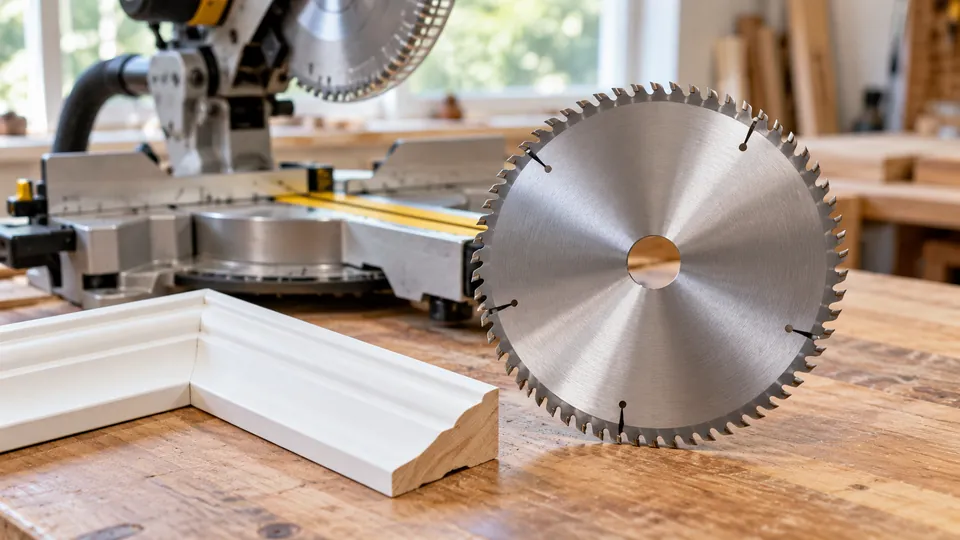
Trim work exposes every weakness in a saw blade. A slightly ragged edge can leave a bright splinter on painted casing, a fuzzy corner on crown molding, or a seam that refuses to disappear under filler. That is why buyers searching for the best miter saw blade for trim usually focus on fine-finish tooth counts, clean crosscutting, thin kerfs, and compatibility with the saw already sitting in the workshop.
Tooth count matters, but it does not answer the whole question. A 60-tooth blade may offer a useful mix of clean cuts and practical cutting speed, while an 80-, 100-, or 120-tooth blade is aimed more directly at delicate finish work. Blade diameter and arbor size are just as important. A beautifully specified 12-inch blade is useless on a 10-inch saw, and a blade that fits physically still needs to match the machine’s intended use and speed rating. Different buyers also have different priorities, from a budget-friendly replacement for occasional baseboard work to a specialized blade for polished molding cuts.
For the broadest combination of trim-focused tooth count, 10-inch compatibility, thin kerf, and clearly stated specifications, the WEN BL1080 is the strongest overall starting point. The Diablo D1280X and FOXBC 100-tooth blade are attractive alternatives for 12-inch saw owners seeking a refined finish, while the DEWALT DW7116PT makes sense for compact 7-1/4-inch setups.
Quick Answer
- Best Overall: WEN BL1080 for its 10-inch size, 80 carbide-tipped teeth, 5/8-inch arbor, and thin kerf.
- Best for Fine Crosscuts: Diablo D1280X for its 12-inch, 80-tooth Hi-ATB configuration and stated fine-finish wood application.
- Best for Polished Molding: FOXBC 12-Inch 100-Tooth Blade for its high tooth count and documented double-side-grind and axial shear-face geometry.
- Best for Compact Saws: DEWALT DW7116PT for its 7-1/4-inch format, thin kerf, and trim-focused design.
Best Miter Saw Blade for Trim Comparison Table
| Product | Best For | Blade Diameter | Arbor | Tooth Count | Documented Material |
|---|---|---|---|---|---|
| WEN BL1060 | Everyday trim work | 10 inches | 5/8 inch | 60 | Hardwoods and softwoods |
| FOXBC 100-Tooth Blade | Polished molding cuts | 12 inches | 1 inch | 100 | Wood, plywood, melamine |
| TOYAKI 12-Inch 120-Tooth | Ultra-fine 12-inch work | 12 inches | 1 inch | 120 | Wood and soft materials |
| TOYAKI 10-Inch 120-Tooth | Ultra-fine 10-inch work | 10 inches | 5/8 inch | 120 | Wood and soft materials |
| DEWALT DW7116PT | Compact trim saws | 7-1/4 inches | Not stated | 60 | Wood |
| DEWALT DWA11280 | 12-inch fine finishing | 12 inches | Not stated | 80 | Wood |
| WEN BL1080 | 10-inch fine-finish trim | 10 inches | 5/8 inch | 80 | Hardwoods and softwoods |
| Luckyway 80T 2-Pack | Replacement coverage | 12 inches | 1 inch | 80 | Wood, plastic, composites |
| Diablo D1280X | Fine crosscuts | 12 inches | 1 inch | 80 | Hardwoods and softwoods |
The reviews below focus on the tooth pattern, dimensions, supported materials, and practical trade-offs that matter at the trim saw.
1. WEN BL1080 10-Inch 80-Tooth Blade – Best Overall
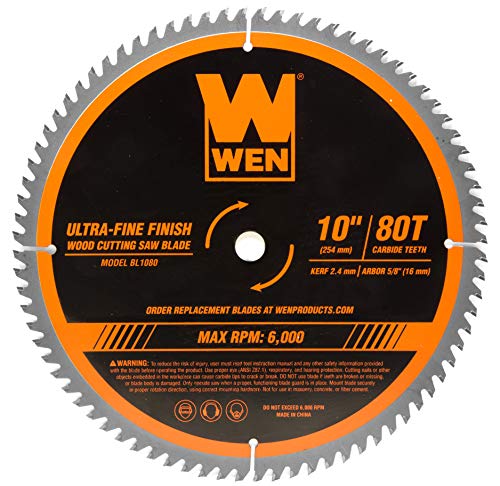
The WEN BL1080 lands in the useful middle ground for a typical 10-inch miter saw. Its 80 carbide-tipped teeth give trim buyers a finer tooth layout than a general-purpose blade, while the documented 5/8-inch arbor matches the common mounting size listed for many 10-inch miter saws, jobsite saws, and table saws. The 2.4 mm thin kerf also matters around baseboard and casing, where a narrow cut can feel more controlled and leaves less material removed.
For a homeowner cutting pine, oak, painted molding, or replacement trim, the format is easy to understand. It is rated up to 6,000 RPM, and the listing identifies it for both hard and softwoods. That broad wood focus gives it a more practical range than a blade aimed only at exceptionally delicate molding. Buyers should still verify their saw’s arbor and operating requirements before fitting it, but the combination of size, tooth count, and stated compatibility makes this the most balanced pick in the group.
Pros
- Uses 80 carbide-tipped teeth for ultra-fine wood cutting.
- Fits the documented 10-inch, 5/8-inch arbor format.
- Has a stated 2.4 mm thin kerf.
- Listed for both hardwoods and softwoods.
- Rated up to 6,000 RPM.
Cons
- It is limited to 10-inch saw applications.
- The listing does not identify a specialized molding tooth geometry beyond the 80-tooth design.
This blade suits trim installers, remodelers, and DIY users who want one 10-inch option for repeated wood crosscuts. A 12-inch saw owner, or someone chasing the most polished possible cut on delicate molding, may prefer a higher-tooth-count blade such as the FOXBC or TOYAKI options.
To buy this product, click here.
2. Diablo D1280X 12-Inch 80-Tooth Blade – Best for Fine Crosscuts
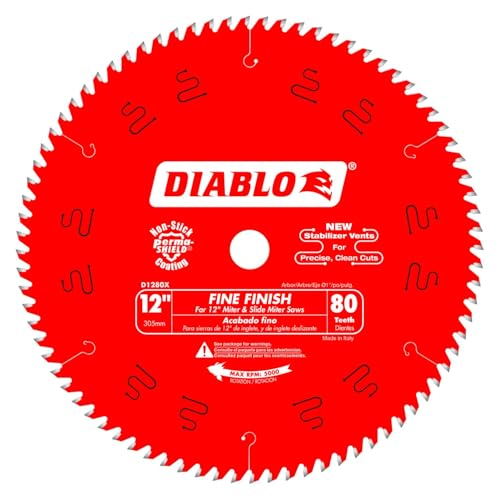
The Diablo D1280X is aimed squarely at fine-finish crosscuts in hardwoods and softwoods. Its 12-inch diameter and 1-inch arbor place it in the larger miter saw category, while the 80 Hi-ATB teeth identify a tooth geometry intended to produce clean wood cuts with reduced tear-out. For crown molding, casing, and hardwood baseboard, that combination speaks directly to the small exit-side splinters that can spoil an otherwise accurate cut.
The blade also lists TiCo Hi-Density carbide and a Perma-SHIELD coating. Those are product-specific construction details, not a promise of a particular service life, but they help explain the blade’s intended positioning. Its super-thin kerf is relevant for trim because it reduces the width of the cut and the amount of material removed. The 1-inch arbor remains the key checkpoint, especially for buyers moving between 10-inch and 12-inch saws.
Pros
- Uses 80 Hi-ATB teeth for fine-finish crosscuts.
- Has a 12-inch diameter and 1-inch arbor.
- Listed for hardwoods and softwoods.
- Specifies TiCo Hi-Density carbide.
- Includes a stated Perma-SHIELD coating and super-thin kerf design.
Cons
- It is not a fit for saws requiring a 5/8-inch arbor.
- The listing does not provide a specific maximum RPM in the supplied details.
This is a strong match for a 12-inch miter saw used on finish carpentry materials. Buyers working on a compact 7-1/4-inch saw or a 10-inch jobsite model should look elsewhere rather than trying to make the larger blade work.
To buy this product, click here.
3. FOXBC 12-Inch 100-Tooth Blade – Best for Polished Molding

With 100 teeth, the FOXBC blade is one of the most finish-focused choices here. The listing identifies it for fine molding, hardwoods, softwoods, veneered plywood, and melamine, which gives it a useful range for a trim-focused shop. Its 0.098-inch kerf and 7-degree hook angle are also clearly documented, so buyers can compare its geometry with the thicker 2.8 mm kerf listed for the Luckyway blade.
The double-side-grind tooth geometry and axial shear-face grind are the interesting details. They indicate a blade built around a shearing action and a polished finish rather than fast removal of thick stock. A homeowner installing delicate casing may appreciate that emphasis, while a user making many rough cuts could find a 100-tooth blade less suited to that pace. The 12-inch diameter and 1-inch arbor make saw compatibility the first box to check.
Pros
- Provides a high 100-tooth count for fine wood cutting.
- Uses a documented 0.098-inch kerf.
- Lists double-side-grind tooth geometry.
- Includes an axial shear-face grind design.
- Supports fine molding, hardwoods, softwoods, plywood, and melamine according to the listing.
Cons
- Requires a 12-inch saw with a 1-inch arbor.
- The high tooth count is specialized toward finish work rather than broad-purpose cutting.
Choose this blade for painted or stained molding where the cut surface deserves extra attention. The TOYAKI 120-tooth blades offer an even higher tooth count, while the WEN 10-inch options are easier matches for smaller saws.
To buy this product, click here.
4. TOYAKI 12-Inch 120-Tooth Blade – Best for Ultra-Fine 12-Inch Cuts
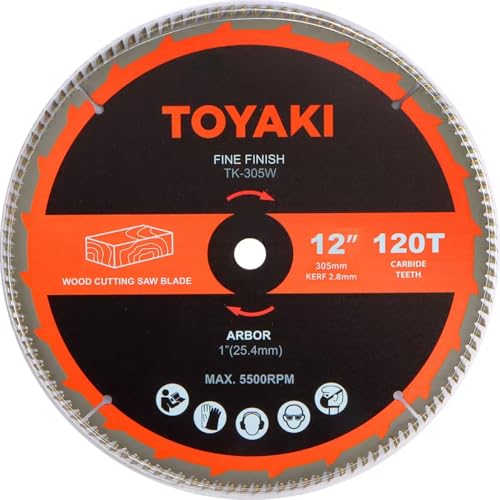
The TOYAKI 12-inch blade takes the tooth-count approach as far as any product in this roundup, with 120 teeth arranged for fine-finish work. The listing identifies it for wood and soft materials, and its 1-inch arbor is stated to fit most common table saws, circular saws, and miter saws. For a 12-inch saw used on narrow trim pieces, that fine tooth layout is the central reason to look at this model.
Its high-grade steel body and engineered tooth pattern are documented construction details. The product information also describes reduced vibration during use, though that should be treated as a listed design claim rather than an independent test result. Buyers cutting plastic as well as wood may find the broader stated material range useful, but the listing does not provide a detailed plastic compatibility chart. Confirm the exact saw requirements before installation.
Pros
- Uses 120 teeth for ultra-fine finishing work.
- Has a 12-inch diameter and 1-inch arbor.
- Listed for wood and soft materials.
- Product information identifies compatibility with common miter, table, and circular saws.
- Uses a high-grade steel body according to the listing.
Cons
- The listing provides limited detail about the exact tooth geometry.
- It is unsuitable for saws requiring a different diameter or arbor.
This blade fits a 12-inch saw owner who places a polished trim edge ahead of broad cutting versatility. If your work includes heavier stock or you want more geometry detail before buying, the FOXBC listing provides more published information about its tooth design.
To buy this product, click here.
5. TOYAKI 10-Inch 120-Tooth Blade – Best for Ultra-Fine 10-Inch Cuts
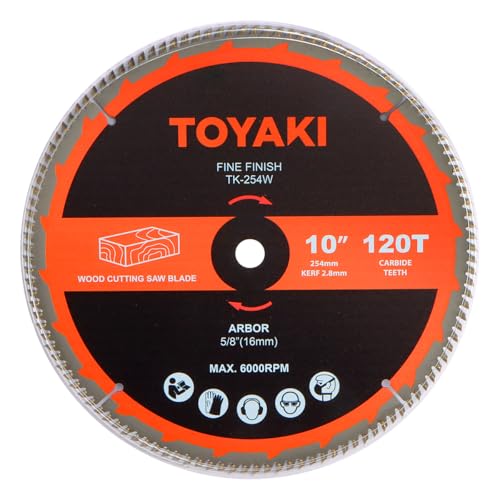
For a 10-inch miter saw owner who wants the highest tooth count available in that size group, this TOYAKI blade is a direct fit on paper. It carries 120 teeth, a 5/8-inch arbor, and a 10-inch diameter. The listing describes it for wood and soft materials, making it relevant to casing, baseboard, and other trim pieces rather than metal or masonry work.
The installation details are refreshingly clear: the standard 16 mm arbor is identified for common saw models, and the product is presented as a quick blade-change option. Its engineered tooth pattern is listed as supporting clean, accurate cuts with reduced vibration, but no independent testing is supplied. Compared with the WEN BL1080, this blade offers a higher tooth count while giving up the explicitly stated 6,000 RPM rating and broad hardwood-and-softwood wording.
Pros
- Combines a 10-inch diameter with a 5/8-inch arbor.
- Uses 120 teeth for fine-finish work.
- Listed for wood and soft materials.
- Product information identifies a standard 16 mm arbor.
- Fits the common 10-inch miter saw category described in the listing.
Cons
- The listing does not state a maximum RPM in the supplied details.
- Its material description is narrower than products that specifically list hardwoods, softwoods, plywood, or melamine.
This option is aimed at delicate 10-inch trim work where tooth count is the leading priority. The WEN BL1080 is a more balanced pick for buyers who want a documented speed rating and broader wood description.
To buy this product, click here.
6. DEWALT DW7116PT 60-Tooth Precision Trim Blade – Best for Compact Saws

The DEWALT DW7116PT is the clear choice for the smallest saw format represented here. Its 7-1/4-inch diameter and 60-tooth configuration target precision trim work on a compact miter saw. The product information calls out optimized tooth geometry, face-ground teeth, ultra-sharp carbide, thin kerf construction, and body slots intended to reduce vibration.
The ToughCoat anti-stick coating is another documented detail, with the listing stating that it reduces friction and gumming. That can matter around resinous wood or repeated trim cuts, although the supplied information does not establish a measured performance advantage. Arbor information is not included in the supplied product details, so the buyer must verify that dimension against the saw before ordering.
Pros
- Uses a compact 7-1/4-inch diameter.
- Provides 60 teeth for precision trim cutting.
- Lists face-ground teeth intended to minimize splintering.
- Includes a thin kerf design.
- Specifies body slots and a ToughCoat anti-stick coating.
Cons
- The supplied listing does not state the arbor size.
- Its 7-1/4-inch diameter limits it to smaller saw applications.
This blade deserves attention from users with compact saws who need a trim-specific format rather than a 10- or 12-inch replacement. Buyers who cannot confirm the arbor should pause before ordering, since that missing dimension is central to fit.
To buy this product, click here.
7. DEWALT DWA11280 12-Inch 80-Tooth Blade – Best for 12-Inch Fine Finishing

The DWA11280 gives 12-inch saw owners a straightforward 80-tooth fine-finish blade. Its documented specifications include ultra-sharp carbide, optimized tooth geometry, and a patented body-slot design identified as supporting low vibration. Those details make it relevant for trim work where a clean, steady cut matters more than a coarse blade’s broader stock-removal role.
The listing also presents the blade as improving finish quality and states an “up to 3X life” claim, but the supplied information does not define the comparison conditions. It is better to treat that as manufacturer marketing rather than a guaranteed result. Arbor size is not included in the supplied details, so compatibility requires extra attention before purchase, especially for saws that use different mounting standards.
Pros
- Uses an 80-tooth fine-finish configuration.
- Has a documented 12-inch diameter.
- Lists optimized tooth geometry for accuracy.
- Includes ultra-sharp carbide according to the product information.
- Specifies a body-slot design intended for low vibration.
Cons
- The supplied product details do not state the arbor size.
- The published life claim lacks test conditions in the available information.
This blade suits a 12-inch saw owner who prefers the DEWALT feature set and can verify the mounting details independently. The Diablo D1280X is easier to evaluate for arbor fit because its 1-inch arbor is clearly stated.
To buy this product, click here.
8. Luckyway 12-Inch 80-Tooth 2-Pack – Best Replacement Coverage

The Luckyway package is unusual here because it includes two 12-inch, 80-tooth blades rather than one. Each blade has a 1-inch arbor, a 2.8 mm kerf, and a 7-degree hook angle according to the listing. That format can appeal to a trim crew or homeowner who prefers to keep a spare ready instead of stopping work after a blade change becomes necessary.
The blades are listed for hardwoods, softwoods, plywood, melamine, oak, pine, plastic, composite materials, and embedded nail wood. Those material references make the package broader than a wood-only blade listing, although the product remains a cutting accessory that must be matched to the saw and application. The listing also identifies C3-grade tungsten carbide teeth and compatibility with several 12-inch saw brands, but buyers should still verify their own machine rather than rely on brand names alone.
Pros
- Includes two 12-inch blades in one package.
- Uses 80 teeth and a 1-inch arbor.
- Lists a 2.8 mm kerf and 7-degree hook angle.
- Identifies C3-grade tungsten carbide teeth.
- Lists wood, plastic, composite materials, and embedded nail wood.
Cons
- The 2.8 mm kerf is wider than the thin kerf listed for several competing options.
- It is limited to 12-inch saws with compatible mounting requirements.
This package is practical for buyers who value a spare blade and work across several listed wood-based materials. Someone seeking the narrowest kerf or a single specialized molding blade may prefer the FOXBC or Diablo alternatives.
To buy this product, click here.
9. WEN BL1060 10-Inch 60-Tooth Blade – Best Balanced 60-Tooth Option
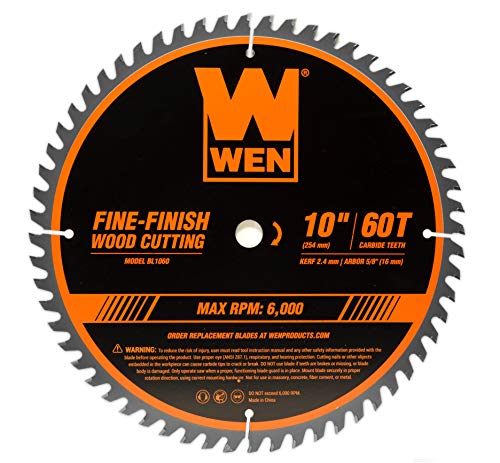
The WEN BL1060 takes a slightly less concentrated approach than the 80- and 120-tooth blades above. Its 60 carbide-tipped teeth are still specified for fine-finish wood cutting, while the 10-inch diameter, 5/8-inch arbor, and 2.4 mm kerf create a familiar fit for many standard 10-inch saws. The listing also gives a rating up to 6,000 RPM, a useful compatibility detail that is absent from several alternatives.
Its stated hard- and softwood suitability gives this blade a broad place in a trim drawer. Someone cutting baseboard one day and general dimensional wood the next may prefer that flexibility over a highly specialized 100- or 120-tooth configuration. The lower tooth count does mean buyers seeking the smoothest possible molding edge may lean toward the WEN BL1080 or a higher-tooth-count 12-inch blade.
Pros
- Uses 60 carbide-tipped teeth for fine-finish wood cutting.
- Has a 10-inch diameter and 5/8-inch arbor.
- Provides a stated 2.4 mm thin kerf.
- Listed for hard and softwoods.
- Rated up to 6,000 RPM.
Cons
- Its 60-tooth design is less finish-focused than the 80-, 100-, and 120-tooth options.
- It is restricted to compatible 10-inch saw setups.
This blade suits general trim work where a clean cut and broad wood compatibility matter more than the highest available tooth count. Choose the BL1080 for a more finish-oriented 10-inch setup, or move to a 12-inch blade if your saw supports that size.
To buy this product, click here.
Buying Guide
Match the Blade Diameter to the Saw
Start with the saw’s required blade diameter. The products here range from 7-1/4 inches to 12 inches, and those sizes are not interchangeable. A 10-inch saw needs a compatible 10-inch blade, while a compact 7-1/4-inch model points toward the DEWALT DW7116PT. Check the saw manual and existing blade before ordering.
Verify the Arbor Size
Arbor fit is just as important as diameter. Several 10-inch blades list a 5/8-inch arbor, while the 12-inch FOXBC, Diablo, TOYAKI, and Luckyway models list a 1-inch arbor. The DEWALT products in this roundup do not include arbor dimensions in the supplied details, so those measurements require extra verification.
Choose Tooth Count for the Finish You Need
More teeth generally create a more finish-oriented cutting layout, but tooth count should be read alongside the product’s intended application. The WEN 60-tooth blades provide a balanced trim format, the 80-tooth blades push further toward fine finishing, and the FOXBC 100-tooth and TOYAKI 120-tooth products target especially refined wood cuts.
Our selection guide puts miter-saw blade geometry and machine fit in context before comparing tooth count for a trim finish.
Pay Attention to Kerf
Kerf describes the width of material removed by the blade. The WEN blades list a 2.4 mm kerf, the FOXBC lists 0.098 inches, and the Luckyway blades list 2.8 mm. A thinner kerf can reduce material removal, but it does not remove the need to match the blade to the saw and follow the manufacturer’s operating requirements.
Match the Material
Trim may include pine, oak, hardwood, softwood, plywood, melamine, plastic, or composite material. Read the product’s stated material range rather than assuming a fine-tooth wood blade supports every material. The FOXBC lists molding, plywood, and melamine, while Luckyway includes plastic and composite materials in its description.
Check Speed and Machine Requirements
The WEN blades list a rating up to 6,000 RPM. Other products provide less speed information in the supplied details. Confirm the blade’s stated limits against the saw before installation, and do not treat tooth count or carbide construction as proof of universal machine compatibility.
Best Miter Saw Blade for Trim FAQ
Is a Higher Tooth Count Better for Trim?
A higher tooth count is generally associated with finer cutting work, which is why 80-, 100-, and 120-tooth blades appear frequently in trim recommendations. It is still necessary to check diameter, arbor, material support, and machine compatibility. Tooth count alone does not make a blade suitable for every saw or every cut.
What Tooth Count Is Suitable for Baseboard?
The products in this roundup include 60-, 80-, 100-, and 120-tooth options identified for wood cutting. A 60-tooth blade such as the WEN BL1060 can suit buyers who want a balanced wood-cutting option, while an 80-tooth or higher blade may appeal to someone prioritizing a more finish-focused trim cut.
Can a 12-Inch Blade Fit a 10-Inch Miter Saw?
No. Blade diameter must match the saw’s permitted size. A 12-inch blade should be used only with a compatible 12-inch saw, and a 10-inch saw should receive a compatible 10-inch blade. Never rely on tooth count to overcome a diameter mismatch.
Does Arbor Size Matter?
Yes. The arbor is the mounting opening at the center of the blade. Several products here use a 5/8-inch arbor, while several 12-inch models use a 1-inch arbor. A blade can have the correct diameter and still be unsuitable if its arbor does not match the saw’s mounting system.
Are Thin-Kerf Blades Useful for Trim?
A thin kerf removes a narrower strip of material. The WEN blades list a 2.4 mm kerf, and the FOXBC lists a 0.098-inch kerf. That information can help compare blades, but buyers should also confirm that the blade is appropriate for the saw and intended wood application.
Can These Blades Cut Plastic or Composite Trim?
Only some listings explicitly mention those materials. The TOYAKI 12-inch product is described for wood and soft materials, while the Luckyway blade lists plastic and composite materials. A wood-only description should not be treated as automatic approval for plastic or composite stock.
Should I Choose a 60-Tooth or 80-Tooth Blade?
A 60-tooth blade may offer a practical balance for general trim and broader wood work, while an 80-tooth blade places more emphasis on fine finishing. The WEN BL1060 and BL1080 make that comparison straightforward because both use a 10-inch diameter, 5/8-inch arbor, thin kerf, and stated 6,000 RPM rating.
How Can I Avoid Buying the Wrong Blade?
Write down the saw’s blade diameter, arbor size, and operating requirements before shopping. Then compare those details with the product listing, followed by tooth count, kerf, tooth geometry, and supported materials. This simple check prevents a high-tooth-count blade from becoming an expensive mismatch.
Final Verdict
The WEN BL1080 is the strongest overall match for trim buyers using a compatible 10-inch saw. Its 80 carbide-tipped teeth aim at ultra-fine wood cutting, while the 5/8-inch arbor, 2.4 mm kerf, hard- and softwood listing, and stated speed rating give shoppers several concrete specifications to verify. It is a balanced choice for casing, baseboard, and general finish carpentry where the saw size already matches.
For a 12-inch saw, the Diablo D1280X offers a clearly documented 80-tooth Hi-ATB layout for fine crosscuts, while the FOXBC 100-tooth blade leans harder toward polished molding work. The TOYAKI 120-tooth models suit buyers who prioritize tooth count, and the DEWALT DW7116PT is the specialist pick for a compact 7-1/4-inch saw. Match the blade diameter and arbor first, then choose the tooth layout and kerf that fit the trim material and finish your project demands.
