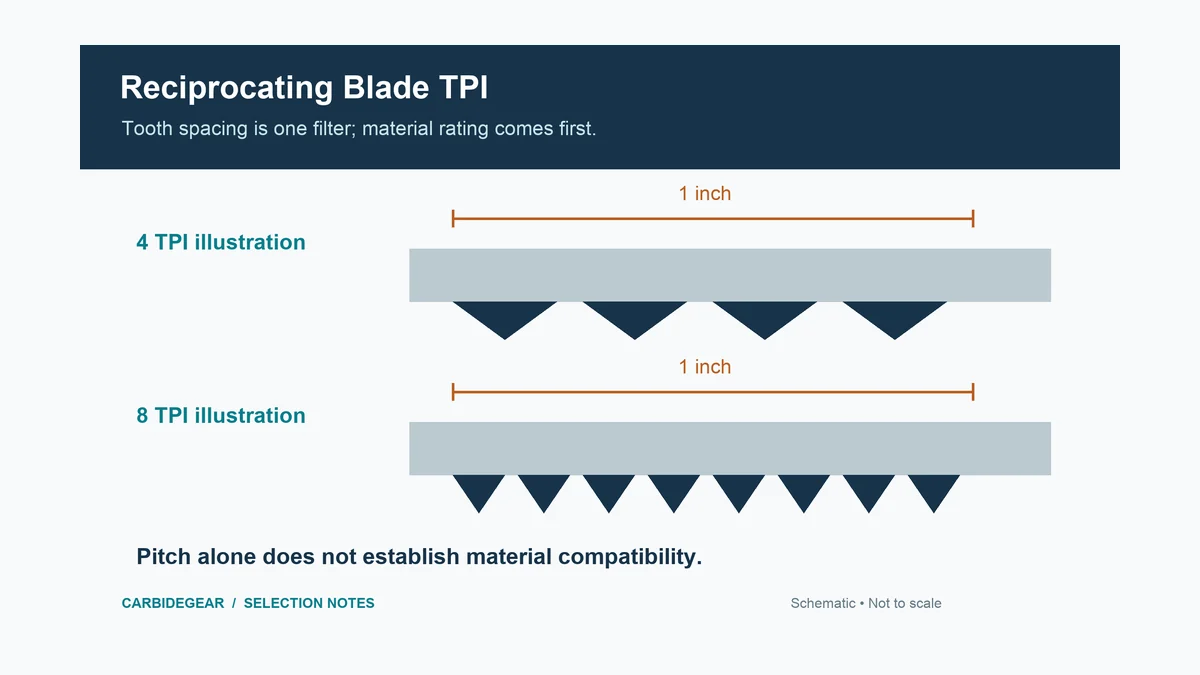
Reciprocating saw blade TPI helps match tooth spacing to the material and the thickness engaged by the teeth, but the blade also needs enough reach throughout the saw’s stroke. TPI means teeth per inch; it does not establish whether the teeth can cut nails, stainless steel, green wood, or an abrasive building material.
For mixed demolition and repair work, our carbide reciprocating saw blade guide separates the material applications and blade configurations. Start with that application match, then narrow the choice by pitch, length, and blade body.
How Reciprocating Saw Blade TPI Changes Tooth Engagement
At the same cutting engagement, a higher TPI generally places more teeth against the material. A coarser pitch spaces teeth farther apart and can provide more room between them for chips. The result depends on tooth geometry, material, feed, and saw motion as well as the number on the package.
“More teeth” is therefore not a universal upgrade. Fine teeth in a deep, chip-heavy wood cut can struggle to clear material. Teeth spaced too far apart can catch or vibrate on a thin section. The manufacturer’s material and thickness range is more useful than a bare promise of a smoother or faster cut.
A variable-pitch marking such as 6/9 TPI describes changing tooth spacing along the blade. It does not mean there are two separate blades or that one section is only for wood and another only for metal. The blade’s complete application rating still governs its use.
Material Comes Before a Numerical TPI Rule
| Workpiece | Selection priority | Common mismatch |
|---|---|---|
| Clean framing timber | Wood-cutting geometry and chip clearance | Choosing a fine metal blade only for its high TPI |
| Wood containing nails | Explicit nail-embedded-wood application | Assuming a pruning blade is a demolition blade |
| Thin metal sheet or tubing | Material grade and supported wall-thickness range | Using overall tube diameter as the metal thickness |
| Thick metal or solid bar | Rated alloy, section thickness, and tooth design | Assuming all carbide teeth share one metal rating |
| Green branches | Pruning/clean-wood application and reach | Reusing an unknown demolition blade near a retained surface |
| Light block or other abrasive material | Exact substrate rating and specialty edge | Choosing by coarse pitch alone |
Keep material thickness attached to the particular blade model. A carbide tooth can be optimized for one material range and perform poorly outside it. The carbide label does not replace the application chart.
Nail-Embedded Wood Is Its Own Category
Demolition lumber can combine soft wood, hard fasteners, coatings, and interruptions in the cut. The blade needs to be intended for that mixed engagement. A clean-wood blade may be aggressive in timber without being suitable when a tooth strikes a nail.
Compare reciprocating saw blades for wood with nails when the intended work includes embedded fasteners. Check blade length and body stiffness as well as the stated material application. A product described for nails should not be assumed to cover every bolt, hardened screw, or metal fitting hidden in a structure.
Where practical, identify and remove accessible obstructions first. Unexpected hard contact is a reason to inspect the cut, not to interpret a blade’s demolition label as permission to force it through any concealed object.
Thin Metal: Use Wall Thickness, Not Outside Diameter
A hollow tube can have a large outside dimension and a thin wall. As the blade moves through it, the number of teeth engaging metal changes. The relevant selection information includes the wall thickness, alloy, cut orientation, and the blade maker’s rated range.
The distinction matters when comparing a blade for solid steel with one for thin conduit. Both packages may say “metal,” yet tooth design and supported thickness can differ. Likewise, a stainless application should be stated for the particular blade; it cannot be inferred merely because the teeth are carbide.
There is no need to force all of these choices into a universal TPI chart. Use pitch to refine the blade selection after the material and thickness rating are correct. Follow the saw and blade guidance for stroke speed, orbital action, and any cutting lubricant.
Specialty Masonry Blades Are Not General Concrete Blades
Some reciprocating blades are designed for particular lightweight blocks, hollow clay units, fiber cement, or other abrasive materials. Those categories are not interchangeable. A blade intended for aerated block does not automatically become suitable for dense concrete, natural stone, or reinforced concrete.
Our carbide reciprocating saw blades for compatible brick and block guide is a starting point for checking the exact substrate and cutting reach. Read the selected blade’s material limitations rather than treating the article’s broad category as a rating for every kind of brick.
Specialty edges can also be grit-based rather than conventional teeth. A grit edge should not be selected by an invented TPI equivalent. Choose the cutting system approved for the material and its dust-control requirements.
Pruning Blades: Clearance and Controlled Reach
Green branches create a different cut from dry framing lumber with nails. A pruning design prioritizes cutting and clearing fresh wood. It still needs enough reach to remain beyond the branch through the stroke and enough room behind the cut to avoid striking another object.
Review carbide pruning blades for reciprocating saws for branch-cutting applications. Keep the work within the saw’s intended use and support the branch so it does not pinch the blade as the cut closes. A long blade is not a substitute for stable access or controlled work support.
Avoid using the tip against soil or stones simply because the package mentions outdoor work. Contamination changes the cutting conditions and can damage a tooth even when the blade cuts green wood well.
Length Must Cover the Full Stroke
The blade has to extend beyond the shoe and the workpiece throughout the entire stroke, as required by the saw’s instructions. The advertised overall blade length is not all usable cutting reach: the clamp, shoe position, toothless sections, and reciprocating movement affect it.
Picture a blade that just clears a board at its farthest forward position. When it retracts, its tip can enter the material and then strike the face on the next forward stroke. “It reaches at full extension” is therefore not a sufficient length check.
Choose the shortest approved blade that provides the required full-stroke clearance and access. Unneeded projection can make a flexible blade harder to guide. Also check behind the workpiece: additional blade length creates a larger zone that must remain clear.
Body Width, Thickness, and the Shoe
Two blades with the same pitch can feel different because their bodies differ. A wider or thicker body can improve support in a demanding straight cut, while a more flexible design may serve a specific access task. These properties affect control; they do not expand the list of permitted materials.
Use the shoe as the saw’s instructions specify, keeping the workpiece supported. A blade oscillating through an unsupported gap can vibrate or bend even when the teeth are appropriate. Do not diagnose every wandering cut as a TPI problem before checking the blade, clamp, shoe, and workholding.
Diagnose the Cut Before Changing Pitch
- Catching at a thin edge: confirm the blade’s supported thickness and tooth engagement; stabilize the work.
- Slow progress with packed teeth: check the material rating, chip clearance, tooth condition, and operating settings.
- Repeated tip impacts: recheck length through the full stroke and the space behind the work.
- A wandering cut: check body suitability, blade damage, shoe contact, and feed pressure.
- Early tooth loss at fasteners: confirm the exact embedded-metal application instead of choosing by carbide alone.
The useful selection sequence is material, thickness, full-stroke reach, body requirements, then the manufacturer’s operating guidance. Use reciprocating saw blade TPI within that process rather than as its only decision.
