A steel-cutting circular-saw blade must match the metal saw’s diameter, arbor, and speed. These carbide or cermet picks cover compact through 8-inch saws. Low-speed 14-inch chop-saw blades are excluded.
Compare the 9 picks below by their dimensions, application, and compatibility. Match the configuration to your equipment and the job before comparing package quantity.
Quick Answer
- Best Overall: Diablo Steel Demon Cermet II D0748CFA — 7-1/4 in.; Not listed; 48 TCG; Metal and stainless steel.
- Best for Mild Steel Circular Saws: Evolution Power Tools 185BLADEST — 7-1/4-inch diameter; 40 teeth; 20 mm arbor; 5,800 RPM maximum; mild steel.
- Best Compact Option: Echo Corner 6-1/2-Inch Cermet 40T Metal-Cutting Blade — 6-1/2 in.; 5/8 in.; 40; Ferrous and mild steel.
Best Circular Saw Blade for Steel Comparison Table
| Product | Best For | Key Specifications | Fit and Application |
|---|---|---|---|
| Diablo Steel Demon Cermet II D0748CFA | Overall | 7-1/4 in.; Not listed; 48 TCG; Metal and stainless steel | Choose the Diablo D0748CFA for a compatible 7-1/4-inch metal-cutting saw after matching the blade arbor, speed rating, and material-thickness range. |
| Diablo Steel Demon Cermet II D0842CF | for Thick Metal | 8 in.; 5/8 in.; 42 TCG; Thick metal | This blade suits buyers who need the specified 8-inch, 5/8-inch-arbor format for thicker steel work. For thinner stock or a smaller handheld saw, the 7-1/4-inch Diablo is the more direct fit. |
| Evolution Power Tools 185BLADEST | for Mild Steel Circular Saws | 7-1/4-inch diameter; 40 teeth; 20 mm arbor; 5,800 RPM maximum; mild steel | This is a sensible choice for mild-steel work when its mounting dimensions match the saw. Buyers cutting stainless or harder steel should look toward a blade whose product description explicitly supports that material instead. |
| FOXBC 7-1/4-Inch 70-Tooth Metal Blade | Higher-Tooth-Count Option | 7-1/4 in.; 5/8 in.; 70; Steel and stainless steel | This blade is for shoppers who specifically want a 70-tooth option with clearly specified mounting dimensions. A 48-tooth blade may be a more familiar comparison for general medium-metal work, while this FOXBC model offers a different tooth-count choice. |
| Echo Corner 6-1/2-Inch Cermet 40T Metal-Cutting Blade | Compact Option | 6-1/2 in.; 5/8 in.; 40; Ferrous and mild steel | This is the appropriate direction for someone whose saw requires a 6-1/2-inch blade and whose work involves the listed ferrous and mild-steel materials. Buyers with a 7-1/4-inch saw should compare arbor, guard clearance, and manufacturer requirements instead of downsizing automatically. |
| Milwaukee 48-40-4515 8-Inch 42-Tooth Cermet Blade | 8-Inch Cermet Alternative | 8-inch diameter; 42 teeth; 5/8-inch arbor; ferrous metal | Choose this Milwaukee for a compatible 8-inch metal-cutting saw after checking its rated speed against the blade label. |
| Makita A-96095 5-7/8-Inch 32-Tooth Carbide Blade | for a Matching 5-7/8-Inch Saw | 5-7/8-inch diameter; 32 TCG teeth; 5/8-inch arbor; 4,680 RPM maximum | Choose the A-96095 only for a compatible metal-cutting saw that meets its 5/8-inch arbor and speed requirements. |
| Milwaukee 48-40-4205 5-3/8-Inch 30-Tooth Blade | 5-3/8-Inch Option | 5-3/8-inch diameter; 30 teeth; metal and stainless-steel application | Choose this blade for a matching 5-3/8-inch metal-cutting saw; confirm arbor and maximum speed against the exact model before ordering. |
| Oshlun SBF-059032 5-7/8-Inch 32-Tooth Steel Blade | 20 mm-Arbor Compact Option | 5-7/8-inch diameter; 32 MTCG teeth; 20 mm arbor; 5/8-inch bushing; 4,680 RPM maximum | Choose the Oshlun when the saw matches its diameter, arbor arrangement, and maximum speed. |
1. Diablo Steel Demon Cermet II D0748CFA — Best Overall

The D0748CFA is the most balanced pick in this group for buyers seeking a 7-1/4-inch blade for medium metal. Its Cermet II teeth and 48-tooth triple-chip grind are specified for metal and stainless-steel cutting, while the Perma-Shield coating and stabilizer vents address the heat, vibration, and residue that can make steel cutting feel rough and unruly.
That combination makes sense for jobs such as steel studs, conduit, angle iron, or other medium sections where a handheld circular saw is more convenient than a chop saw. The product description also describes reduced sparks and cooler cutting compared with grinding discs.
Pros
- 7-1/4-inch format suits the specified medium-metal application.
- Uses 48 TCG teeth for metal cutting.
- Includes a Perma-Shield coating.
- Laser-cut stabilizer vents are specified for noise and vibration control.
- The product description identifies use with metal and stainless steel.
Cons
- Match the selected tool’s dimensions and mounting requirements to the job before ordering.
- Match the selected tool’s dimensions and mounting requirements to the job before ordering.
Choose the Diablo D0748CFA for a compatible 7-1/4-inch metal-cutting saw after matching the blade arbor, speed rating, and material-thickness range.
To buy this product, click here.
2. Diablo Steel Demon Cermet II D0842CF — Best for Thick Metal
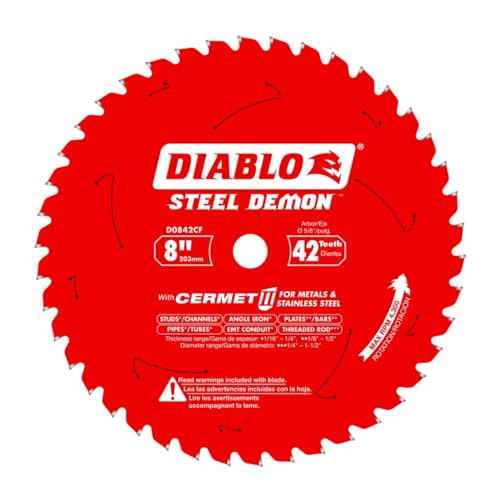
The D0842CF moves up to an 8-inch diameter and shifts the emphasis toward thick-metal work. Its 42 TCG teeth, 5/8-inch arbor, .075-inch kerf, .063-inch plate, and 0-degree hook angle are all specified, giving shoppers more mounting and geometry information than many basic metal blades provide.
Fewer teeth than the 48-tooth D0748CFA do not automatically make this blade better for every cut, but the included product identity clearly positions it for thick metal. The product description also specifies a maximum of 4300 RPM and Cermet II construction. Buyers should still match that limit and the arbor to the saw rather than treating the 8-inch size as universally compatible.
Pros
- 8-inch diameter is specified for thick-metal cutting.
- Uses a 5/8-inch arbor.
- 42 TCG teeth are specified.
- specified .075-inch kerf and .063-inch plate dimensions aid comparison.
- 0-degree hook angle is clearly listed.
Cons
- The product description provides less detail about exact steel thickness limits.
- An 8-inch blade requires clearance and speed compatibility from the saw.
This blade suits buyers who need the specified 8-inch, 5/8-inch-arbor format for thicker steel work. For thinner stock or a smaller handheld saw, the 7-1/4-inch Diablo is the more direct fit.
To buy this product, click here.
3. Evolution Power Tools 185BLADEST — Best for Mild Steel Circular Saws

The Evolution 185BLADEST is a 7-1/4-inch, 40-tooth carbide blade for mild steel. Use the tool maker’s cutting guidance for the exact material and machine.
The thin-kerf blade is intended for a compatible mild-steel circular saw. Choose it for that material rather than assuming it is a stainless-steel blade. Use only the arbor arrangement permitted by the saw and blade instructions, and match the permitted material thickness to the work.
Pros
- 7-1/4-inch diameter fits the common circular-saw size category.
- Uses 40 teeth for the specified steel-cutting application.
- Identified for mild steel and ferrous metal.
- Carbide-tipped TCT construction is specified.
- Thin-kerf design is listed.
Cons
- Limited to its intended mild-steel application.
- 20 mm arbor and rated speed must match the saw.
This is a sensible choice for mild-steel work when its mounting dimensions match the saw. Buyers cutting stainless or harder steel should look toward a blade whose product description explicitly supports that material instead.
To buy this product, click here.
4. FOXBC 7-1/4-Inch 70-Tooth Metal Blade — Best Higher-Tooth-Count Option

This FOXBC blade takes the familiar 7-1/4-inch metal-cutting format and raises the tooth count to 70. The product description gives a .075-inch kerf, 5/8-inch arbor, 5800 maximum RPM, and diamond knockout, plus specified compatibility with corded and cordless circular saws. Those details make it easier to compare with the 48-tooth blades in this roundup.
Its specified material range includes steel studs, channel, angle iron, EMT conduit, all-thread, plates, bars, and rods within the listed thickness and diameter ranges. The product also identifies ceramic carbide teeth and stabilizer vents.
Pros
- 70-tooth configuration is clearly identified.
- Uses a 5/8-inch arbor.
- 7-1/4-inch diameter suits the specified circular-saw format.
- specified .075-inch kerf and 5800 maximum RPM are available.
- Lists steel, stainless steel, conduit, angle iron, and threaded rod applications.
Cons
- The higher tooth count may not be the preferred geometry for every steel thickness.
- specified application limits still restrict the listed stock dimensions.
This blade is for shoppers who specifically want a 70-tooth option with clearly specified mounting dimensions. A 48-tooth blade may be a more familiar comparison for general medium-metal work, while this FOXBC model offers a different tooth-count choice.
To buy this product, click here.
5. Echo Corner 6-1/2-Inch Cermet 40T Metal-Cutting Blade — Best Compact Option

The compact 6-1/2-inch size makes this blade distinct from the larger 7-1/4-inch and 8-inch choices. It uses 40 cermet teeth, a 5/8-inch arbor, a .071-inch tip thickness, and a listed maximum of 6000 RPM. The product information also identifies a diamond knockout arbor for worm-drive saws, although the exact saw compatibility should still be matched against the machine manual.
Its specified workpieces include ferrous metal, mild-steel plate, sheet, tube, angle iron, and other tough metals. An ATB tooth style is described as user-friendly for handheld circular saws, while laser-cut stabilizer vents are specified to manage vibration and blade stability. This gives the blade a clear handheld orientation, but the product specifications do not define every supported steel grade or thickness.
Pros
- Compact 6-1/2-inch diameter is specified.
- Uses 40 cermet carbide teeth.
- 5/8-inch arbor and diamond knockout are specified.
- Lists plate, sheet, tube, angle iron, and mild steel.
- ATB tooth style is identified for handheld circular saw use.
Cons
- Requires a compatible 6-1/2-inch saw with a 5/8-inch arbor.
- Saw speed must not exceed the 6,000 RPM blade rating.
This is the appropriate direction for someone whose saw requires a 6-1/2-inch blade and whose work involves the listed ferrous and mild-steel materials. Buyers with a 7-1/4-inch saw should compare arbor, guard clearance, and manufacturer requirements instead of downsizing automatically.
To buy this product, click here.
6. Milwaukee 48-40-4515 8-Inch 42-Tooth Cermet Blade — Best 8-Inch Cermet Alternative
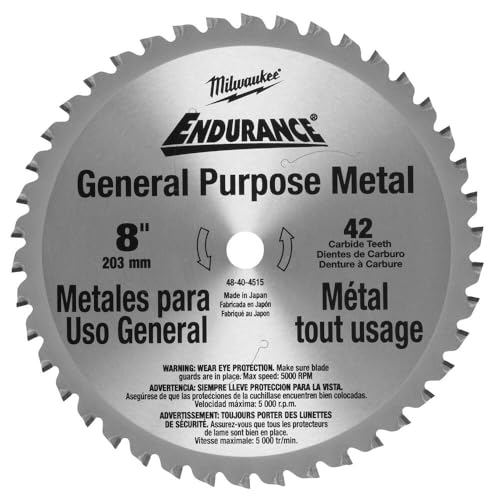
The Milwaukee 48-40-4515 uses 42 cermet teeth on an 8-inch blade with a 5/8-inch arbor. It is designed for ferrous-metal cutting, with a minimum material thickness of 3/32 inch rather than an unrestricted thin-sheet application.
This is a direct alternative for a matching 8-inch metal saw, not an upgrade for every woodworking circular saw. Match diameter, arbor, maximum blade speed, and material thickness as a group. For a smaller dedicated metal-cutting saw, one of the 5-3/8- or 5-7/8-inch blades offers a different fit.
Pros
- 8-inch metal-cutting format.
- 42 cermet teeth.
- 5/8-inch arbor.
- Ferrous-metal application.
- Defined 3/32-inch minimum material thickness.
Cons
- Does not fit smaller saw diameters.
- Saw speed must stay within the blade rating.
Choose this Milwaukee for a compatible 8-inch metal-cutting saw after checking its rated speed against the blade label.
To buy this product, click here.
7. Makita A-96095 5-7/8-Inch 32-Tooth Carbide Blade — Best for a Matching 5-7/8-Inch Saw

Makita’s A-96095 is a compact ferrous-metal blade with 32 carbide TCG teeth. Its dimensions are 5-7/8 inches in diameter with a 5/8-inch arbor, and the maximum speed is 4,680 RPM. Those details distinguish it from visually similar blades with a 20 mm bore.
The blade targets ferrous shapes such as pipe, angle, and channel on a compatible saw. Its smaller diameter is useful only when it matches the machine’s design. Confirm the actual blade model and saw spindle rather than choosing by tooth count or assuming all compact metal blades share one mounting size.
Pros
- Compact 5-7/8-inch diameter.
- 32 carbide TCG teeth.
- 5/8-inch arbor.
- 4,680 RPM maximum rating.
- Ferrous pipe, angle, and channel application.
Cons
- Not a 20 mm-arbor blade.
- Requires a saw designed for this diameter and material.
Choose the A-96095 only for a compatible metal-cutting saw that meets its 5/8-inch arbor and speed requirements.
To buy this product, click here.
8. Milwaukee 48-40-4205 5-3/8-Inch 30-Tooth Blade — Best 5-3/8-Inch Option

The Milwaukee 48-40-4205 is a 5-3/8-inch, 30-tooth blade for metal cutting, including stainless-steel applications. It fills a smaller machine-size role than the 7-1/4- and 8-inch products here, so diameter is its first selection filter.
Buy it for a saw that specifically accepts this blade format. The material application is also useful when choosing between a stainless-capable blade and a mild-steel-only alternative. Check the blade’s arbor, rated speed, and permitted material thickness against the saw and workpiece before purchase.
Pros
- 5-3/8-inch blade format.
- 30-tooth configuration.
- Metal-cutting application.
- Stainless-steel application.
- Identifiable 48-40-4205 model.
Cons
- Arbor and speed need matching to the saw.
- Small diameter limits cutting capacity.
Choose this blade for a matching 5-3/8-inch metal-cutting saw; confirm arbor and maximum speed against the exact model before ordering.
To buy this product, click here.
9. Oshlun SBF-059032 5-7/8-Inch 32-Tooth Steel Blade — Best 20 mm-Arbor Compact Option

The Oshlun SBF-059032 combines 32 MTCG carbide teeth with a 5-7/8-inch diameter. It uses a 20 mm arbor and includes a 5/8-inch bushing, giving it a different mounting arrangement from the Makita A-96095 even though the nominal diameter and tooth count are similar.
Its 4,680 RPM maximum rating makes saw-speed matching essential. Use the arbor configuration permitted by the saw and blade instructions, and keep the bushing properly seated. This is a steel-cutting blade for compatible equipment rather than a general wood blade to run at any circular-saw speed.
Pros
- 32 MTCG carbide teeth.
- 5-7/8-inch cutting diameter.
- 20 mm arbor.
- 5/8-inch bushing included.
- 4,680 RPM maximum rating.
Cons
- Bushing use must suit the saw instructions.
- Not interchangeable with a larger-diameter blade.
Choose the Oshlun when the saw matches its diameter, arbor arrangement, and maximum speed.
To buy this product, click here.
Buying Guide
Machine Fit
Check diameter, arbor, rotation, and maximum RPM. The saw’s no-load speed must not exceed the blade rating. Diameter alone does not prove fit.
Steel and Thickness
Mild steel, stainless steel, and thin sheet have different requirements. The Evolution 185BLADEST is a mild-steel choice. Follow the exact blade’s material and thickness limits.
For the complete fit check, review steel-cutting blade and machine compatibility alongside the blade’s permitted material and section thickness.
Mounting Details
Makita A-96095 has a 5/8-inch arbor. Oshlun SBF-059032 uses 20 mm with a 5/8-inch bushing. Similar diameter and tooth count do not mean identical fit; use the permitted mounting arrangement.
Frequently Asked Questions
Will these work in any wood saw?
Use a saw approved for the material and exact blade specification.
Is a 14-inch chop-saw blade included?
No. That low-speed format belongs to a different machine category.
Are more teeth always better?
Choose tooth geometry, material-thickness range, and machine fit together.
Final Verdict
Diablo Steel Demon Cermet II D0748CFA is the starting point for buyers who need its configuration. Choose the Diablo D0748CFA for a compatible 7-1/4-inch metal-cutting saw after matching the blade arbor, speed rating, and material-thickness range.
For a different requirement, compare Evolution Power Tools 185BLADEST and Oshlun SBF-059032 5-7/8-Inch 32-Tooth Steel Blade. Check diameter, arbor, rotation, and maximum RPM. The saw’s no-load speed must not exceed the blade rating. Diameter alone does not prove fit.
