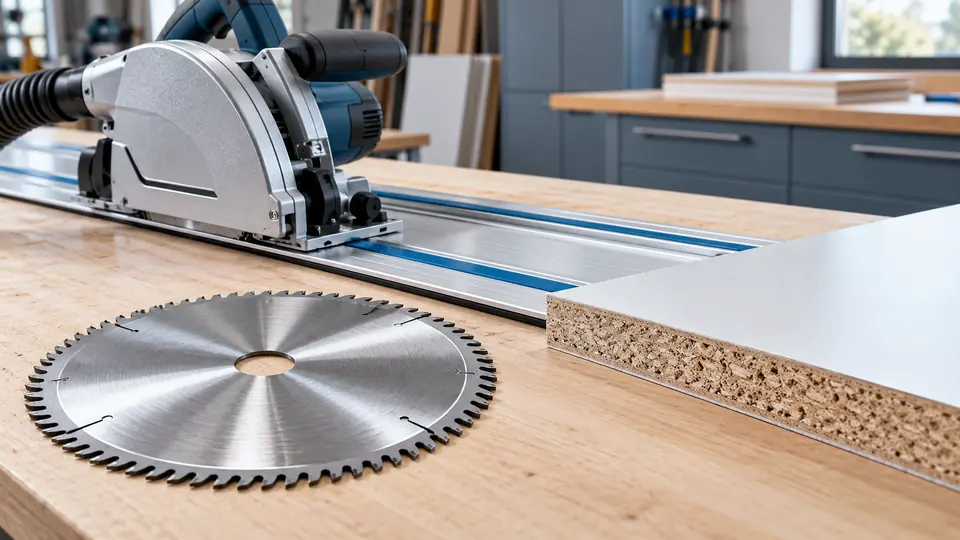
A track saw blade has to match more than the saw’s advertised diameter. The blade must also suit the arbor, tooth count, kerf, material, and the kind of edge you want after the cut. A 165 mm blade with the wrong arbor can sit unused in the drawer, while a fine-finish blade may feel painfully slow during long rip cuts. That is why buyers often compare 48-tooth, 56-tooth, and 60-tooth designs before looking at brand names.
The most common mistake is treating every 6.5-inch circular saw blade as a track saw blade. Track systems need the correct mounting dimensions, and cordless saw users may care about thin kerfs that reduce cutting resistance. Woodworkers cutting plywood, MDF, laminate, or hardwood panels also face different priorities. Tooth geometry, stabilizer slots, coatings, and compatibility can matter more than a small difference in tooth count. The Milwaukee 48 Teeth Fine Finish Track Saw Blade is the strongest overall fit here because its 165 mm format and 48-tooth fine-finish focus align closely with general track saw work.
Different buyers will reach different conclusions. A WEN blade brings a very thin 1.5 mm kerf and documented 20 mm arbor, while the Festool replacement blade is aimed at specific TS and HK saw families. Makita users have dedicated options for wood, MDF, and laminate, and the Diablo offers a broader arbor approach with a stated bushing. The useful comparison is the one that keeps your saw, workpiece, and desired finish in the same lane.
Quick Answer
- Best Overall: Milwaukee 48 Teeth Fine Finish Track Saw Blade for a documented 165 mm track saw format and fine-finish orientation.
- Best Thin-Kerf Option: WEN BL6556 6.5-Inch 56-Tooth Track Saw Blade for its 1.5 mm kerf, 20 mm arbor, and PTFE coating.
- Best for Festool Compatibility: 495377 Track Saw Blade for listed TS, TSC, ATF, AP, HK, and HKC saw compatibility.
- Best for Laminate: Diablo D0652TSL Track Circular Saw Blade for its 52-tooth TCG design and stated laminate application.
Best Track Saw Blade Comparison Table
| Product | Best For | Blade Diameter | Arbor | Tooth Count | Documented Materials |
|---|---|---|---|---|---|
| Milwaukee 48 Teeth Fine Finish Track Saw Blade | General fine-finish track saw work | 165 mm | Not specified | 48 | Not specified |
| WEN BL6556 | Thin-kerf cutting | 165 mm | 20 mm | 56 | Not specified |
| 495377 Track Saw Blade | Festool TS and HK systems | 160 mm | 20 mm | 48 | Wood, plywood, sheet goods, melamine |
| Hardwin 6-1/2-inch Track Saw Blade | Wood and laminate finishing | 165 mm | 20 mm | 56 | Hardwood, plywood, MDF, laminate, melamine, veneer |
| Makita B-57342 | Makita cordless plunge saws | 6-1/2 inches | Not specified | 56 | Wood, MDF, laminate |
| FOXBC 6-1/2-inch Track Saw Blade | DeWalt, Makita, and WEN replacements | 165 mm | 20 mm | 48 | Wood, MDF, laminate |
| Diablo D0652TSL | Laminate and composite materials | 6-1/2 inches | 20 mm and 5/8 inch with bushing | 52 | MDF, PVC, composite decking, laminate |
| Milwaukee 40 Teeth Finish Track Saw Blade | Finish cutting with a lower tooth count | 165 mm | Not specified | 40 | Not specified |
| Makita A-99998 | MDF and laminate on Makita cordless plunge saws | 6-1/2 inches | Not specified | 60 | MDF, laminate |
The detailed picks below separate broad track saw choices from blades aimed at particular machines, materials, or cutting priorities.
1. Milwaukee 48 Teeth Fine Finish Track Saw Blade, 165 mm Blade: Best Overall

The Milwaukee 48-tooth blade is the cleanest all-purpose recommendation in this group because its listing identifies it specifically as a 165 mm fine-finish track saw blade. That gives shoppers a clear starting point for panel work where a neat edge matters more than an aggressive rough cut. The 48-tooth count sits below several 56-tooth and 60-tooth choices here, which may appeal to buyers who want a middle ground between finish orientation and cutting progress.
Its product information emphasizes clean cutting and a burr-free finish, but it does not provide an arbor size or named workpiece list. That missing mounting detail matters. Before ordering, match the blade diameter and arbor against the saw manual rather than assuming every 165 mm system uses the same mounting arrangement. For a woodworker trimming cabinet panels or breaking down sheet goods, the fine-finish designation is useful, while a buyer focused on laminate or a specific cordless platform may prefer a blade with more explicit compatibility information.
Pros
- Documented 165 mm blade diameter.
- Specifically identified as a track saw blade.
- 48-tooth fine-finish configuration.
- Listing describes clean cutting and a burr-free finish.
- Milwaukee-branded option for buyers seeking a named tool platform.
Cons
- The supplied listing does not specify the arbor diameter.
- Documented workpiece materials are not listed.
This blade suits buyers who want a straightforward fine-finish track saw option and can verify the arbor independently. Skip it for a purchase where exact machine compatibility must be confirmed from the listing alone, or where a very thin kerf is the primary concern. Its strength is the clear 165 mm and 48-tooth format, not a long list of documented specialty applications.
To buy this product, click here.
2. WEN BL6556 6.5-Inch 56-Tooth Track Saw Blade: Best Thin-Kerf Option

The WEN BL6556 gives buyers unusually clear dimensional information. It uses a 165 mm diameter, a 20 mm arbor, and a 1.5 mm kerf, so the specification sheet is easier to match against a saw than listings that provide only a nominal blade size. The thin kerf is especially relevant to cordless users, since a narrower cut removes less material. That does not guarantee a particular runtime or finish, but it explains why this blade attracts buyers trying to keep cuts light and efficient.
Its 56 ATAFR carbide-tipped teeth are presented for smoother and faster cuts, and the PTFE coating is identified as a way to resist workpiece burns. The listing also states compatibility with most 6.5-inch track saws, including the WEN CT1065. Still, “most” should not replace a check of the arbor, guard clearance, and saw manual. A homeowner cutting plywood on a WEN saw gets a particularly clear fit, while a user with another platform should confirm the mounting details first.
Pros
- 165 mm diameter and 20 mm arbor are documented.
- Very thin 1.5 mm kerf.
- 56 ATAFR carbide-tipped teeth.
- PTFE coating is specified.
- Listed as compatible with the WEN CT1065 and most 6.5-inch track saws.
Cons
- The broad “most 6.5-inch track saws” compatibility statement still requires model verification.
- The supplied information does not identify a specific workpiece range.
Choose this blade when kerf width and documented mounting dimensions are high on your list, especially with a WEN track saw. A buyer cutting materials outside the listing’s stated scope, or seeking a blade with a clearly named material range, may prefer Hardwin or Diablo instead.
To buy this product, click here.
3. 495377 160 mm Track Saw Blade: Best for Festool Compatibility

This 495377 blade is aimed at a narrower machine family than the general-purpose options above. The listing names Festool TS 55, TSC 55, ATF 55 E, AP 55, HK 55, and HKC 55 saws, along with a 160 mm diameter and 20 mm arbor. That level of model detail is valuable for a buyer standing beside a Festool saw and trying to avoid a vague “universal” replacement. The 48-tooth ATB configuration is identified as fine and smooth, with applications including plywood, sheet goods, melamine, hardwood, and softwood.
The 2.2 mm kerf is wider than the WEN’s listed 1.5 mm kerf, so these two blades serve different specification priorities. The 495377 listing also identifies 5/15-degree hook angles and says it replaces model 491952, although it clearly states that the blade is not an OEM product. Buyers who need a direct replacement should compare their existing blade markings and saw model carefully. This is a practical pick for Festool-compatible work, but the 160 mm diameter means it should not be treated as a substitute for every 165 mm system.
Pros
- 160 mm diameter and 20 mm arbor are documented.
- 48-tooth ATB design is specified.
- Compatibility with several named Festool saw models is listed.
- Applications include plywood, sheet goods, melamine, hardwood, and softwood.
- 2.2 mm kerf and 5/15-degree hook angles are provided.
Cons
- It is a 160 mm blade, so it is not a direct size match for every 165 mm track saw.
- The listing states that it is not an OEM product.
This blade belongs on the shortlist of Festool owners who need the listed 160 mm and 20 mm format. Buyers with a 165 mm saw, or anyone who wants the thinnest kerf available here, should look elsewhere. Its main advantage is documented model compatibility rather than broad universal fit.
To buy this product, click here.
4. Hardwin 6-1/2-inch 56T Track Saw Blade: Best for Broad Woodworking Applications

Hardwin gives this roundup one of the clearest material-focused specifications. The listing names hardwood, plywood, MDF, laminate, melamine, and veneer panels, while also describing the blade for cross-cutting, ripping, and finishing. Its 165 mm diameter and 20 mm arbor fit the common 6.5-inch track saw format, but the listing still tells buyers to verify their saw size and arbor. That small instruction is worth taking seriously, particularly for cordless systems with platform-specific guards.
The 56-tooth carbide blade uses a stated 23-degree top rake and R-curved tips, plus a 1.8 mm thin kerf. Laser-cut expansion slots are also listed as part of the design. Those details make the blade interesting for a woodworker moving between plywood and finished panels, where tear-out and material waste are practical concerns. The supplied data does not establish comparative vibration, noise, or edge performance, so the useful conclusion is narrower: this is a well-specified candidate for the listed woodworking materials and operations.
Pros
- 165 mm diameter and 20 mm arbor are documented.
- 56 carbide-tipped teeth are specified.
- 1.8 mm thin kerf is listed.
- Material coverage includes hardwood, plywood, MDF, laminate, melamine, and veneer.
- 23-degree top rake, R-curved tips, and expansion slots are documented.
Cons
- The listing requires buyers to verify saw size and arbor compatibility.
- Comparative noise, vibration, and edge results are not independently established by the supplied information.
Hardwin is a sensible match for woodworkers who want one blade aimed at several panel and lumber materials. It may be less attractive for a Festool owner seeking named model compatibility or for a cordless user who prioritizes the narrowest kerf in the comparison.
To buy this product, click here.
5. Makita B-57342 6-1/2-inch 56T Cordless Plunge Saw Blade: Best for Makita Wood and Laminate Work

The Makita B-57342 is listed for Makita cordless 6.5-inch plunge circular saws rather than as a broadly compatible track saw blade. That distinction should guide the purchase. For a Makita owner using a plunge saw with a track system, the named platform and application fit are more useful than a generic universal claim. The blade is specified for wood, MDF, and laminate, and its 56-tooth count places it among the finer-finish options in this roundup.
Makita lists high-grade carbide tips, a fluorine coating, and laser-cut slots. The supplied product information also includes a manufacturer comparison claiming up to 140% more cuts per charge than a named standard corded plunge saw blade. That is a specific advertised comparison, not a guarantee for every saw, battery, material, or cutting pattern. Buyers should treat it as context rather than a promised result. The missing arbor and kerf information make a manual check especially important before ordering.
Pros
- Designed for Makita cordless 6.5-inch plunge circular saws.
- 56-tooth configuration is documented.
- Listed for wood, MDF, and laminate.
- Fluorine coating is specified.
- Laser-cut slots and carbide tips are listed.
Cons
- The supplied listing does not specify the arbor size.
- Kerf width is not provided.
This is the better fit for a Makita cordless plunge saw owner who regularly cuts the three listed materials. It is less suitable as a blind replacement for another brand’s track saw because the product data does not establish broad cross-platform compatibility or the arbor dimension.
To buy this product, click here.
6. FOXBC 6-1/2-inch 48T Track Saw Blade: Best Documented Replacement Fit

The FOXBC track blade is useful for shoppers comparing replacement parts by dimensions and named saws. Its listing identifies a 165 mm diameter, 20 mm arbor, 48-tooth ATB layout, 2.2 mm kerf, and 1.6 mm plate. It also names DeWalt DWS520, Makita SP6000 and SP6000J, and WEN BL655 as compatible models. That is stronger purchasing information than a simple “fits most” statement, although the buyer should still compare the saw manual and existing blade.
The documented application covers wood, MDF, and laminate, while the listing references replacement relationships to DeWalt DW5258 and Makita B-07353. Laser-cut slots are included in the feature description. The 2.2 mm kerf is the same width listed for the Festool replacement above, so neither is aimed at the narrowest cut in this group. For a user replacing a familiar 48-tooth blade on one of the named systems, the useful value is the combination of dimensions, tooth geometry, and model references.
Pros
- 165 mm diameter and 20 mm arbor are documented.
- 48-tooth ATB geometry is specified.
- 2.2 mm kerf and 1.6 mm plate are listed.
- Compatibility with named DeWalt, Makita, and WEN models is provided.
- Listed for wood, MDF, and laminate.
Cons
- The 2.2 mm kerf is wider than the WEN blade’s stated 1.5 mm kerf.
- Compatibility outside the named models is not fully established by the listing.
FOXBC makes the most sense for a buyer who wants a 48-tooth, 165 mm replacement and owns one of the listed saws. A cordless user chasing minimal material removal may prefer WEN, while someone cutting a wider range of documented panel materials may lean toward Hardwin.
To buy this product, click here.
7. Diablo D0652TSL 52-Tooth Track Circular Saw Blade: Best for Laminate and Composite Materials

Diablo’s D0652TSL is the most application-specific pick for buyers cutting laminate and related sheet materials. The listing identifies a 6.5-inch diameter, 52 teeth, TCG geometry, and suitability for MDF, PVC, and composite decking as well as laminate. TCG is a meaningful distinction from the ATB designs elsewhere in this guide, particularly for shoppers who want the product’s published geometry to match a harder or more abrasive material category.
The blade also lists a 1.8 mm kerf, stabilizer vents, a laser-cut arbor, and a Perma-SHIELD coating. Its stated arbor flexibility is unusual here: the product is listed for 20 mm and 5/8-inch arbors with an included bushing, and compatibility is named for Bosch, DeWalt, Makita, Milwaukee, and Ryobi. Buyers should verify the bushing arrangement and saw instructions rather than treating the claim as universal. This is a strong specialist option, but the product’s broad material list does not remove the need for machine compatibility checks.
Pros
- 52-tooth TCG geometry is documented.
- Listed for laminate, MDF, PVC, and composite decking.
- 1.8 mm kerf is specified.
- 20 mm and 5/8-inch arbor compatibility is listed with a bushing.
- Perma-SHIELD coating and stabilizer vents are identified.
Cons
- The included bushing and arbor arrangement still need to be matched to the saw manual.
- Its 6.5-inch format and material focus may be excessive for buyers cutting ordinary softwood only.
Diablo is the pick for a track saw user working with laminate, MDF, PVC, or composite decking and wanting TCG geometry. For ordinary plywood or a platform with a strict 20 mm mounting requirement, a simpler 48-tooth or 56-tooth blade may be easier to match.
To buy this product, click here.
8. Milwaukee 40 Teeth Finish Track Saw Blade, 165 mm Blade: Best Lower-Tooth Finish Option

The Milwaukee 40-tooth blade provides a distinct alternative to the brand’s 48-tooth version. Both are listed as 165 mm track saw blades with a finish orientation, but the lower tooth count gives this model a different place in the comparison. Tooth count alone does not prove faster cutting or a better edge, yet it is a relevant distinction for a buyer choosing between two blades from the same product line.
The listing describes a durable, high-performance blade intended to provide clean cutting and a burr-free finish. It does not identify the arbor, kerf, tooth geometry, or specific workpiece materials. That leaves the buyer with less compatibility information than the WEN, Hardwin, FOXBC, or Diablo choices. A Milwaukee owner who already knows the saw’s required mounting dimensions may still find the product appealing, while a first-time buyer should avoid ordering from diameter alone.
Pros
- Documented 165 mm diameter.
- Specifically identified as a finish track saw blade.
- 40-tooth configuration provides a distinct lower-tooth alternative.
- Listing describes clean cutting.
- Listing describes a burr-free finish.
Cons
- The supplied information does not specify the arbor diameter.
- Tooth geometry, kerf, and material applications are not listed.
This blade suits an informed Milwaukee buyer who can confirm the mounting details and wants a 40-tooth finish option. Buyers comparing blades without access to their saw specifications will get clearer purchasing information from WEN, FOXBC, or the Festool replacement.
To buy this product, click here.
9. Makita A-99998 6-1/2-inch 60T TCG Blade: Best for MDF and Laminate on Makita Saws

The Makita A-99998 is the most focused Makita option in this roundup. Its 60-tooth TCG design is listed specifically for MDF and laminate on Makita 6.5-inch cordless plunge circular saws. That makes it a targeted material choice rather than a broad wood blade. TCG also separates it from Makita’s 56-tooth B-57342, giving buyers a documented geometry distinction inside the same brand family.
The feature list includes high-grade carbide tips, laser-cut slots, and a fluorine coating intended to reduce pitch buildup. The listing presents the TCG design as engineered for longer life, but no independent test data is supplied here, so that claim should remain a manufacturer statement rather than a measured comparison. Arbor size and kerf are not provided. A Makita owner cutting laminate or MDF should verify those dimensions before purchasing, especially if the saw has a platform-specific blade requirement.
Pros
- 60-tooth configuration is documented.
- TCG tooth design is specified.
- Listed for MDF and laminate.
- Designed for Makita 6.5-inch cordless plunge circular saws.
- Fluorine coating and laser-cut slots are identified.
Cons
- The supplied listing does not specify the arbor size.
- It has a narrower documented material focus than the general wood blades.
This blade is a sensible specialist pick for Makita users cutting MDF and laminate who want the listed 60-tooth TCG configuration. It is less attractive for general plywood breakdowns or for a buyer who needs confirmed compatibility with a non-Makita track saw.
To buy this product, click here.
Buying Guide
Match the Diameter and Arbor Before the Tooth Count
A 165 mm or 6.5-inch label is only part of the fit. The arbor must match the saw, and the guard and mounting arrangement must accept the blade. WEN, Hardwin, FOXBC, and Diablo provide more arbor information than several other picks. The Milwaukee and Makita listings in this roundup leave that dimension unspecified, so check the saw documentation before buying.
Choose Tooth Count Around the Material and Finish
The products here range from 40 to 60 teeth. A higher tooth count is commonly associated with finish-focused blade designs, but the listing’s actual geometry and intended materials matter too. The Milwaukee 40-tooth and 48-tooth models are both described as finish blades, while Makita’s 60-tooth A-99998 is specifically aimed at MDF and laminate. Avoid using tooth count as the only selection rule.
Our circular-blade selection guide covers track-saw blade dimensions and kerf compatibility before tooth count and finish are compared.
Understand Kerf for Cordless Cutting
Kerf describes the width of the cut made by the blade. A thinner kerf can remove less material, which may matter to cordless users managing cutting resistance and battery use. The WEN lists a 1.5 mm kerf, Hardwin lists 1.8 mm, Diablo lists 1.8 mm, and both the Festool replacement and FOXBC list 2.2 mm. These numbers help compare the designs, but they do not establish a guaranteed runtime or cutting speed.
Use the Documented Material Range
Hardwin has the broadest named woodworking range here, including hardwood, plywood, MDF, laminate, melamine, and veneer. WEN does not provide a specific material list in the supplied data. Diablo is more specialized, with laminate, MDF, PVC, and composite decking listed. Makita’s A-99998 is aimed at MDF and laminate, while the B-57342 is listed for wood, MDF, and laminate.
Separate Track Saw Blades From Related Plunge Saw Blades
Some products in this roundup are explicitly called track saw blades, while the Makita B-57342 and A-99998 are described for Makita cordless plunge circular saws. A plunge saw may be used with a guide rail, but the listing language does not establish universal track saw compatibility. Treat those Makita models as platform-specific choices and verify the exact saw model.
Read Coating and Slot Claims Carefully
Several blades list coatings or slots. WEN specifies PTFE, Makita identifies fluorine coatings, Diablo lists Perma-SHIELD, and several products mention laser-cut slots. These are useful construction details, but they do not prove a specific edge finish, noise level, or service life against competing blades. Use them as tie-breakers after compatibility and material suitability are settled.
Best Track Saw Blade FAQ
What size blade is common for a track saw?
Many products in this comparison use a 165 mm or 6.5-inch format, including the WEN, Hardwin, FOXBC, and Milwaukee options. The Festool replacement is 160 mm. Diameter alone is insufficient, so verify the arbor and the saw manufacturer’s required blade dimensions.
Is a 6.5-inch circular saw blade automatically suitable for a track saw?
No. The blade also needs the correct arbor, mounting arrangement, guard clearance, and intended machine compatibility. Some 6.5-inch blades in the supplied data are described for circular or plunge saws rather than universal track systems.
What is the advantage of a thin kerf track saw blade?
A thin kerf removes less material with each cut. That can be useful for reducing waste and may matter to cordless users managing cutting resistance. The WEN BL6556 lists a 1.5 mm kerf, while several other options list widths from 1.8 mm to 2.2 mm.
Is a 48-tooth or 60-tooth blade better for plywood?
Neither tooth count is automatically better for every plywood cut. The blade’s stated purpose, geometry, kerf, and compatibility matter as well. The 48-tooth Milwaukee is described as a fine-finish track saw blade, while the Makita 60-tooth model is documented for MDF and laminate rather than broad plywood work.
Which track saw blade is best for laminate?
The Diablo D0652TSL is the most specifically documented laminate option in this group, with a 52-tooth TCG design and listed suitability for laminate, MDF, PVC, and composite decking. The Makita A-99998 is another focused choice for MDF and laminate on compatible Makita cordless plunge saws.
Can a Festool replacement blade fit a 165 mm track saw?
The 495377 blade is listed as 160 mm with a 20 mm arbor and named Festool compatibility. It should not be treated as a direct replacement for every 165 mm saw. Compare the exact blade diameter, arbor, and saw model before purchase.
Do carbide-tipped teeth make a blade compatible with every material?
No. Carbide-tipped construction does not establish universal material or machine suitability. The product listing still needs to identify the intended workpieces, blade dimensions, and saw compatibility. Diablo, Hardwin, and the Makita options each show why the documented application matters.
Final Verdict
The Milwaukee 48 Teeth Fine Finish Track Saw Blade is the strongest overall choice because it is explicitly identified as a 165 mm fine-finish track saw blade with 48 teeth and a clean-cutting focus. It has less published compatibility detail than WEN or FOXBC, so the arbor must be verified before purchase. For a buyer who wants the narrowest documented kerf, the WEN BL6556 is the sharper specification match. For a Festool system, the 495377 replacement provides the clearest named-model fit.
Material and machine priorities can change the best answer. Hardwin is the broadest documented woodworking option, Diablo is the specialized pick for laminate and composite materials, and the Makita blades make sense for compatible cordless plunge saws. Compare diameter, arbor, kerf, tooth geometry, and material range against the saw manual before ordering. A blade that looks right on a product page can still be the wrong choice if one mounting dimension is off.
