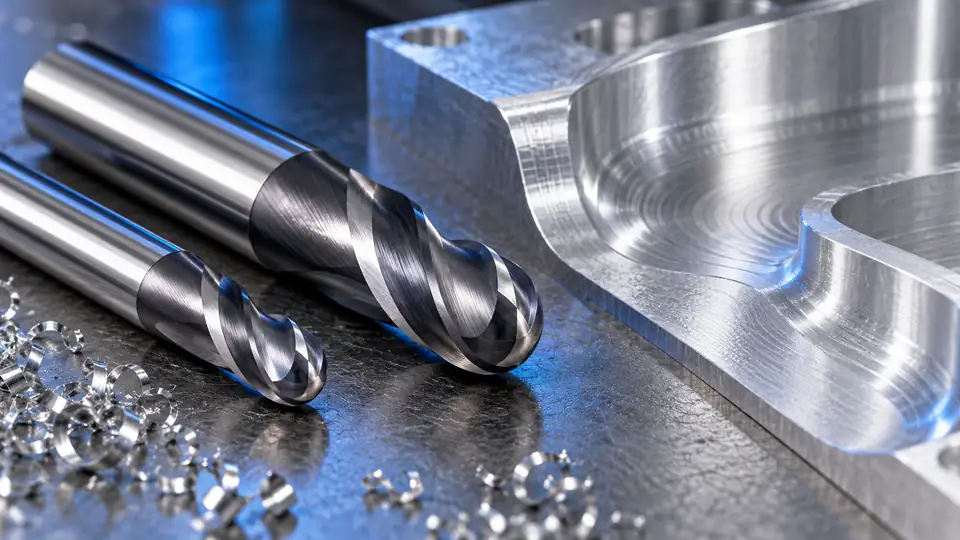
A ball nose end mill leaves a rounded cutting path that flat end mills cannot produce, making it useful for contoured surfaces, 3D machining, mold work, engraving, and finishing passes. The catch is that diameter, flute count, shank size, coating, and overall length all change how the cutter fits a job. A tiny 1/32-inch tool behaves very differently from a 1/2-inch cutter, and a 4-inch-long tool demands a different approach to rigidity and reach.
Buyers often focus on the coating or the word “carbide” and overlook the machine connection. A 1/2-inch shank will not fit a 1/4-inch collet, while a micro end mill can be a poor match for heavy stock removal. Workpiece claims matter too. Several tools here are identified for steel, hardened steel, or cast iron, while others are aimed at aluminum, wood, plastics, or engraving. The strongest overall fit is the sisona five-piece set, since it covers five diameters and documents solid tungsten carbide construction, four flutes, TiN coating, and steel applications.
Different buyers need different things from a rounded cutter. A CNC hobbyist may value a range of sizes, a mold maker may need a specific large diameter, and an engraver may care more about a very small cutting tip and a 1/8-inch shank. The recommendations below weigh those distinctions rather than treating every ball nose end mill as interchangeable.
Quick Answer
- Best Overall: sisona 5-Piece Carbide Ball Nose End Mill Set for its five documented diameters and steel-focused specification.
- Best for General-Purpose 1/8-Inch Work: BestParts 1/8-Inch Ball Nose Set with five solid carbide, AlTiN-coated cutters.
- Best for Micro Engraving: SpeTool 1/32-Inch Ball Nose Set with a 2-flute upcut profile and 1/8-inch shank.
- Best for Aluminum and Wood: WEXWE Extra Long DLC Ball Nose End Mill, which is specifically listed for aluminum, wood, plastics, PVC, and acrylic.
Best Carbide Ball Nose End Mills Comparison Table
| Product | Best For | Diameter | Flutes | Coating | Documented Materials |
|---|---|---|---|---|---|
| sisona 5-Piece Set | Size flexibility | 1/16 to 3/8 inch | 4 | TiN | Carbon, alloy, hardened steel, cast iron |
| BestParts 1/8-Inch Set | General-purpose small work | 1/8 inch | 4 | AlTiN | Steel, brass, iron, nonferrous materials |
| SpeTool Micro Set | Fine engraving | 1/32 inch | 2 | TiAlN | Carbon steel, mold steel, stainless steel, titanium alloy |
| XYunEnZ Micro Set | Small four-flute cutting | 1/16 inch | 4 | AlTiN | Not clearly specified |
| WEXWE MAH-Coated Set | Stainless and hardened steels | 1/8 inch | 2 | MAH | Stainless, hardened, alloy, high-temp materials |
| BestParts 5/16-Inch Cutter | Mid-size machining | 5/16 inch | 4 | AlTiN | Steel, brass, iron, nonferrous materials |
| BestParts 1/2-Inch Cutter | Large-diameter work | 1/2 inch | 4 | AlTiN | Steel, brass, iron, nonferrous materials |
| JIANXING Extra Long Cutter | Extended reach | 1/2 inch | 4 | AlTiN | Carbon, alloy, pre-hardened, hardened steel, cast iron |
| WEXWE DLC Extra Long Cutter | Aluminum and 3D carving | 1/2 inch | 2 | DLC | Aluminum, copper alloys, wood, plastic, PVC, acrylic |
The detailed picks below show where each diameter, flute arrangement, coating, and material listing fits best.
1. sisona 1/16 to 3/8-Inch Carbide Ball Nose End Mill Set – Best Overall

The main attraction here is range. The set includes 1/16, 1/8, 3/16, 1/4, and 3/8-inch cutting diameters, so a CNC user can move from small contour details to broader curved surfaces without buying five unrelated tools. Cutting lengths run from 3/8 to 1 inch, while overall lengths range from 1-1/2 to 2-1/2 inches. That spread gives the set a practical place in mixed-size work where one fixed cutter would feel limiting.
Every cutter is listed as solid tungsten carbide with four flutes and a TiN surface. The documented application centers on carbon steel, alloy steel, hardened steel, and cast iron. The listing also identifies compatibility with desktop and industrial CNC machines, provided the collet matches the stated shank size for each tool. That last detail deserves attention because the shank sizes vary with the cutters, so this is a range set rather than a single universal 1/8-inch-shank kit.
Pros
- Includes five documented ball nose diameters from 1/16 to 3/8 inch.
- Uses solid tungsten carbide construction.
- Provides a four-flute configuration across the set.
- Uses a stated TiN coating.
- Lists carbon steel, alloy steel, hardened steel, and cast iron as applications.
Cons
- Shank diameters vary, so the machine or collet must match each cutter.
- The set does not provide a 1/2-inch cutter for larger-radius work.
This is the most useful starting point for a buyer who wants several documented sizes for steel-focused CNC work. It is less convenient for someone committed to one shank standard or someone machining aluminum and wood, since those materials are not the emphasis of the listing. The broad diameter range is the reason to choose it over a single cutter.
To buy this product, click here.
2. BestParts 1/8-Inch Solid Carbide Ball Nose End Mill Set – Best for General-Purpose Small Work

This BestParts set takes a more focused route than the sisona assortment. It contains five identical 1/8-inch ball nose end mills, each with a 1/8-inch shank, 1/2-inch cutting length, and 1-1/2-inch overall length. That uniformity is handy for a CNC setup already built around a 1/8-inch collet. There is no guessing about which cutter fits the holder, although there is also no larger diameter for broad surface work.
The cutters use four flutes, a 30-degree helix, solid carbide construction, and an AlTiN coating according to the product information. The documented material range includes steel, brass, iron, and nonferrous materials of medium hardness. Five matching tools can make sense for repeated 1/8-inch operations, especially where having spares matters more than having several diameters in one box.
Pros
- Includes five matching 1/8-inch ball nose cutters.
- Uses 1/8-inch shanks throughout the set.
- Lists a 1/2-inch length of cut and 1-1/2-inch overall length.
- Specifies four flutes and a 30-degree helix.
- Uses solid carbide with an AlTiN coating.
Cons
- Every cutter has the same 1/8-inch diameter.
- The supplied material description is broader for medium-hard materials than for specific hardened-steel grades.
Choose this set for repeat 1/8-inch contouring where matching replacements are useful. A buyer needing tiny engraving detail or a wide selection of radii should choose a different format. Its simple size and shank combination is the appeal, especially for a small CNC machine that already accepts 1/8-inch tooling.
To buy this product, click here.
3. SpeTool 1/32-Inch Carbide Ball Nose End Mill Set – Best for Micro Engraving

A 1/32-inch cutting diameter puts this SpeTool set in a very different lane from the large steel cutters elsewhere in this roundup. The small rounded tip suits fine contour work and engraving where a 1/8-inch tool would leave too much material behind. Each bit uses a 1/8-inch shank, a 5/64-inch cutting length, and a 1-1/2-inch overall length, creating a compact cutting portion on a familiar small-machine shank.
The product is listed as a two-flute, upcut spiral ball nose tool with TiAlN coating. Its stated applications include carbon steel, mold steel, Inconel, stainless steel, titanium alloy, side milling, end milling, and finish machining. Five individually boxed cutters are included. The fine diameter is the headline feature, but buyers should recognize the trade-off: a micro cutter is selected for detail, not for removing broad amounts of stock.
Pros
- Uses a documented 1/32-inch cutting diameter for fine detail.
- Fits a stated 1/8-inch shank system.
- Uses a two-flute upcut spiral profile.
- Lists TiAlN coating.
- Applications include mold steel, stainless steel, titanium alloy, and Inconel.
Cons
- The 5/64-inch cutting length limits the reach of the cutting portion.
- The 1/32-inch diameter is specialized and unsuitable as a general large-surface cutter.
SpeTool is the focused pick for engraving, miniature contours, and small finishing details. It makes less sense for roughing or broad 3D surfaces, where the tiny diameter would require many passes. Buyers should also verify that their collet accepts the 1/8-inch shank and follow the machine and toolmaker guidance for delicate cutters.
To buy this product, click here.
4. XYunEnZ 1/16-Inch Four-Flute Carbide Ball Nose End Mill Set – Best for Small Four-Flute Work

XYunEnZ offers five cutters with a 1/16-inch cutting diameter, 1/8-inch shank, 1/4-inch cutting length, and 1-1/2-inch overall length. That combination is suited to small-scale work where a 1/8-inch cutter feels too coarse but the 1/32-inch SpeTool bits are smaller than necessary. The repeated 1/8-inch shank also keeps holder selection straightforward for machines built around that size.
The four-flute design and AlTiN coating are the central documented features. The listing describes the coating as intended to resist high-temperature oxidation and limit material adherence to the flute surface. It also identifies a thicker core as part of the four-flute design. Those details explain the product’s positioning, although the supplied information does not establish a specific workpiece material list, so buyers should avoid assuming suitability for a particular metal.
Pros
- Provides five matching 1/16-inch ball nose cutters.
- Uses a documented 1/8-inch shank diameter.
- Lists a 1/4-inch cutting length and 1-1/2-inch overall length.
- Uses four flutes.
- Includes an AlTiN coating.
Cons
- The supplied specifications do not clearly identify supported workpiece materials.
- The 1/16-inch diameter is intended for smaller details rather than broad cutting.
This set suits a buyer who needs several small four-flute tools and already knows the material and cutting conditions required for the job. It is a less certain purchase for someone who needs clearly documented steel, aluminum, or wood compatibility. Compared with the SpeTool set, it offers a larger 1/16-inch tip and four flutes instead of a 1/32-inch two-flute design.
To buy this product, click here.
5. WEXWE Tools 1/8-Inch MAH-Coated Carbide Ball Nose End Mill Set – Best for Difficult Steels

WEXWE aims this five-piece set at demanding materials, with the listing identifying stainless steel, hardened steel, high-temperature alloys, and medium alloy steels. Each cutter uses a 1/8-inch shank and a 1/8-inch ball nose diameter, so the set is specialized around one small tool size. The larger core described in the product information is relevant to buyers thinking about rigidity, though it should not be treated as a guarantee against breakage.
These are two-flute cutters with an MAH coating, and the listing states a diameter tolerance of 0 to -0.02. It also recommends high speed and low feed, but those instructions should be checked against the machine, workpiece, and toolmaker guidance rather than copied blindly into a setup. The five-axis grinding and tool inspection claims are part of the product description, while the practical decision here rests mainly on the documented size, flute count, coating, and difficult-material focus.
Pros
- Lists stainless steel, hardened steel, high-temperature alloys, and medium alloy steels.
- Uses a 1/8-inch cutting diameter and 1/8-inch shank.
- Provides five cutters in the package.
- Uses a two-flute configuration.
- Specifies MAH coating and a stated diameter tolerance.
Cons
- Offers only one cutting diameter.
- The listing’s operating recommendation requires careful matching to the machine and application.
This is the specialist choice for a buyer whose material list resembles the product description and who wants a small two-flute ball nose cutter. It is less attractive for general mixed-size work or for users who need a clearly stated aluminum or wood application. The documented difficult-steel focus separates it from the broader BestParts sets.
To buy this product, click here.
6. BestParts 5/16-Inch Four-Flute Solid Carbide Ball Nose End Mill – Best Mid-Size Option

The 5/16-inch BestParts cutter occupies useful middle ground between small detail tools and large 1/2-inch cutters. It has a 5/16-inch cutting diameter and matching 5/16-inch shank, with a 13/16-inch length of cut and 2-1/2-inch overall length. Those dimensions make it a single-size purchase for work that needs more reach and radius than a 1/8-inch tool provides, without stepping up to the largest cutter in this group.
The documented design includes four flutes, a 30-degree helix, solid carbide construction, and AlTiN coating. Its application description covers steel, brass, iron, and nonferrous materials of medium hardness. Because the cutting and shank diameters match, machine compatibility is clear only for equipment with a 5/16-inch collet or holder. A 1/4-inch or 1/2-inch collet should not be assumed to accept it.
Pros
- Uses a documented 5/16-inch cutting diameter.
- Matches the cutting diameter with a 5/16-inch shank.
- Provides a 13/16-inch length of cut and 2-1/2-inch overall length.
- Uses four flutes and a 30-degree helix.
- Lists solid carbide and AlTiN coating.
Cons
- Requires a machine or holder that accepts a 5/16-inch shank.
- Its material description is centered on medium-hard materials rather than a broad hardened-steel range.
Pick this cutter for mid-size curved work where a single substantial tool is more useful than a small set. It is a poor fit for compact machines limited to common 1/4-inch or 1/8-inch collets. Compared with the 1/2-inch BestParts model, it asks for a smaller holder and removes less material per pass by virtue of its smaller diameter.
To buy this product, click here.
7. BestParts 1/2-Inch Four-Flute Solid Carbide Ball Nose End Mill – Best Large-Diameter Option

Large curved surfaces call for a larger ball nose, and this BestParts model provides a 1/2-inch cutting diameter with a matching 1/2-inch shank. Its 1-inch length of cut and 3-inch overall length give it a substantial physical profile compared with the small engraving tools in this roundup. That can be useful for broad contour work, provided the machine has the holder and rigidity required for a 1/2-inch cutter.
The cutter uses four flutes, a 30-degree helix, solid carbide construction, and AlTiN coating. The listing identifies steel, brass, iron, and nonferrous materials of medium hardness. Those supported materials make it a general-purpose large cutter within the stated range, but the product should not be treated as a universal tool for every alloy or machine. The 1/2-inch shank is the major purchasing checkpoint.
Pros
- Provides a documented 1/2-inch cutting diameter.
- Uses a matching 1/2-inch shank.
- Lists a 1-inch length of cut and 3-inch overall length.
- Uses four flutes and a 30-degree helix.
- Combines solid carbide construction with AlTiN coating.
Cons
- Requires a 1/2-inch collet or compatible holder.
- The product is physically larger than small CNC router tooling and may not suit compact equipment.
This is the straightforward pick for larger-radius contours and a machine already equipped for 1/2-inch tooling. A buyer needing deep reach should look at the JIANXING model, while someone working in aluminum or wood should examine the WEXWE DLC cutter. The BestParts model is strongest where its stated medium-hard material range and standard 3-inch overall length fit the job.
To buy this product, click here.
8. JIANXING 1/2-Inch Extra Long Carbide Ball Nose End Mill – Best for Extended Reach

JIANXING shares the 1/2-inch cutting diameter of the BestParts large cutter, but its defining feature is the 4-inch overall length. That extra reach may help with deeper or obstructed contours where a standard-length tool cannot reach the surface. It also creates a more demanding setup, since long tooling requires careful attention to holder engagement, extension, and machine suitability.
The cutter is listed with four flutes, AlTiN coating, and HRC 55. Its supported material description includes carbon steel, alloy steel, pre-hardened steel, hardened steel, and cast iron. This is a more specifically steel-oriented listing than the BestParts 1/2-inch model. The package contains one cutter, so the appeal is the unusual length and stated hard-material range rather than a multi-tool supply.
Pros
- Provides a 1/2-inch cutting diameter.
- Uses a documented 4-inch overall length.
- Lists four flutes.
- Uses an AlTiN coating.
- Identifies carbon, alloy, pre-hardened, hardened steel, and cast iron applications.
Cons
- The extra-long format may require more careful machine and holder matching.
- Only one cutter is included.
Choose JIANXING when reach is the central problem and the machine can accommodate a 1/2-inch shank and 4-inch overall length. It is less suitable as a first general-purpose ball nose cutter for a compact CNC router. The extra length distinguishes it from the standard 3-inch BestParts tool, but it also makes compatibility and setup more consequential.
To buy this product, click here.
9. WEXWE Extra Long 1/2-Inch DLC Ball Nose End Mill – Best for Aluminum and 3D Carving

This WEXWE cutter takes the large, extended-reach format in a different direction. It has a 1/2-inch shank, 3-inch overall length, two flutes, and a DLC coating. The product information specifically lists aluminum and copper alloys alongside hardwoods, softwoods, plastic, PVC, and acrylic. That makes it the clearest choice in this roundup for a buyer working across nonferrous materials and carving stock rather than focusing on hardened steel.
The listing identifies HRC 62 ultrafine grain tungsten carbide and a ball nose tolerance within -0.01 mm. It also describes the tool for 3D carving and engraving, with a circular cutting edge intended for curved surfaces. Those details are useful for selecting the tool, but the 1/2-inch shank and 3-inch overall length still govern whether it fits the machine. It is also a single cutter, not a size assortment.
Pros
- Lists aluminum, copper alloys, wood, plastic, PVC, and acrylic applications.
- Uses a 1/2-inch shank and 3-inch overall length.
- Uses a two-flute configuration.
- Includes a documented DLC coating.
- Is identified for 3D carving and engraving.
Cons
- Its 1/2-inch shank limits use to compatible collets or holders.
- Only one tool size is included.
This is the right specialist pick for aluminum and wood carving where the documented material list fits the project. A steel-focused buyer should look at the sisona, JIANXING, or WEXWE MAH-coated options instead. The DLC coating and two-flute profile give this cutter a distinct role, while the long 3-inch format means the machine must be suitable for the tool.
To buy this product, click here.
Buying Guide
Match the Ball Diameter to the Surface
The cutting diameter affects the radius of the rounded tool tip and the scale of the work. A 1/32-inch cutter is aimed at fine engraving and miniature contours, while a 1/2-inch cutter is better suited to broad curved surfaces. Smaller tools remove less material per pass and require more care, while larger tools need a machine and holder that can accept their larger shanks.
Check the Shank Before the Cutting Diameter
A ball nose end mill only helps if it fits the collet or toolholder. The products here use shanks from 1/8 inch through 1/2 inch, and some sets change shank size as the cutter diameter changes. Never assume a 1/2-inch cutter belongs in a 1/4-inch collet. Check the machine’s stated capacity before placing an order.
Choose Flute Count With the Application in Mind
Two-flute and four-flute cutters appear throughout this roundup. Flute count changes the balance between cutting edges and space between flutes. The SpeTool and WEXWE DLC tools use two flutes, while the BestParts, sisona, XYunEnZ, and JIANXING selections use four. The product listing should guide the choice for the workpiece, machine, and intended operation rather than a simple assumption that more flutes are always better.
Read Material Claims Precisely
Material compatibility is one of the clearest differences among these products. The sisona and JIANXING listings emphasize steel and cast iron. The WEXWE MAH-coated set names stainless, hardened, alloy, and high-temperature materials. The WEXWE DLC cutter lists aluminum, copper alloys, wood, plastics, PVC, and acrylic. A coating alone does not establish suitability for a material that the listing does not mention.
Understand Coating Names
TiN, AlTiN, TiAlN, MAH, and DLC are different coating labels used across the selected tools. The product information identifies their presence, but it does not provide a controlled comparison of tool life or cutting performance. Treat the coating as one selection factor alongside geometry, dimensions, material application, and machine compatibility.
The guide to carbide end mill coating differences explains why the coating label should be matched to the workpiece.
Be Careful With Extra-Long Tools
The JIANXING cutter has a 4-inch overall length, while the WEXWE DLC tool measures 3 inches overall. Extra reach can solve an access problem, but it also makes the physical tool size central to the setup. Confirm that the spindle, holder, collet, and available clearance can accommodate the selected tool. Follow the tool and machine manufacturer’s operating instructions instead of borrowing settings from another cutter.
Best Carbide Ball Nose End Mills FAQ
What is a ball nose end mill used for?
A ball nose end mill has a rounded cutting end that can create curved paths and contoured surfaces. It is commonly selected for 3D machining, mold-style surfaces, rounded transitions, engraving, and finishing work. The appropriate diameter depends on the size of the detail and the radius required by the part.
Is a larger ball nose end mill always better?
No. A larger tool can suit broad surfaces, but it cannot reproduce the fine detail of a smaller cutter. It also requires a larger shank and compatible machine hardware. The 1/32-inch SpeTool tool and the 1/2-inch BestParts tool serve very different jobs.
What shank size do these end mills use?
The selected products use 1/8-inch, 3/16-inch, 1/4-inch, 5/16-inch, 3/8-inch, and 1/2-inch shanks, depending on the model and set. The sisona assortment includes multiple sizes, while the BestParts and WEXWE products generally use a fixed shank size. Confirm the exact product dimensions before buying.
Are these ball nose end mills suitable for hardened steel?
Some listings specifically identify hardened steel. The sisona set, JIANXING cutter, and WEXWE MAH-coated set provide the clearest hardened-steel or difficult-steel application descriptions. Other products list broader medium-hardness materials or do not clearly establish a hardened-steel application, so they should not be treated as interchangeable.
Which option is best for aluminum?
The WEXWE DLC extra-long cutter has the clearest aluminum application listing. It also names copper alloys, wood, plastic, PVC, and acrylic. The other selected products may have different intended materials, but the supplied information does not establish the same aluminum-focused positioning for them.
Should I choose two flutes or four flutes?
The answer depends on the tool’s documented application and the machining setup. Two-flute tools appear in the SpeTool, WEXWE MAH, and WEXWE DLC products, while several steel-focused tools use four flutes. Flute count changes the cutter’s geometry, but it does not independently prove that one product will perform better in every material.
Can a CNC router use every end mill in this roundup?
No. Compatibility depends on the router or CNC machine, collet, shank diameter, available clearance, and the machine’s intended tooling. Several listings mention CNC or router compatibility, but the exact collet still has to match. A 1/2-inch shank and a 1/8-inch shank are not interchangeable.
What is the biggest buying mistake with ball nose end mills?
Buying by coating or price alone is a common mistake. The diameter, shank, overall length, flute count, and documented workpiece material must fit the job together. A micro cutter selected for engraving will not replace a large tool for broad contours, and an extra-long cutter may create a machine-clearance issue.
Final Verdict
The sisona five-piece set is the strongest overall recommendation because it gives buyers five documented ball nose diameters, solid tungsten carbide construction, four flutes, TiN coating, and a clear steel-oriented application range. It covers more common size decisions than the single-diameter products, although its changing shank sizes mean the machine must support each selected cutter. For repeated 1/8-inch work, the BestParts set is a simpler alternative with five matching tools.
Specialized jobs point elsewhere. SpeTool is the focused choice for 1/32-inch engraving, JIANXING is the extended-reach option for steel work, and WEXWE’s DLC-coated cutter is the clearest match for aluminum, wood, plastics, and 3D carving. Before buying, verify the shank, cutting diameter, overall length, flute arrangement, and documented material compatibility against the actual machine and workpiece.
