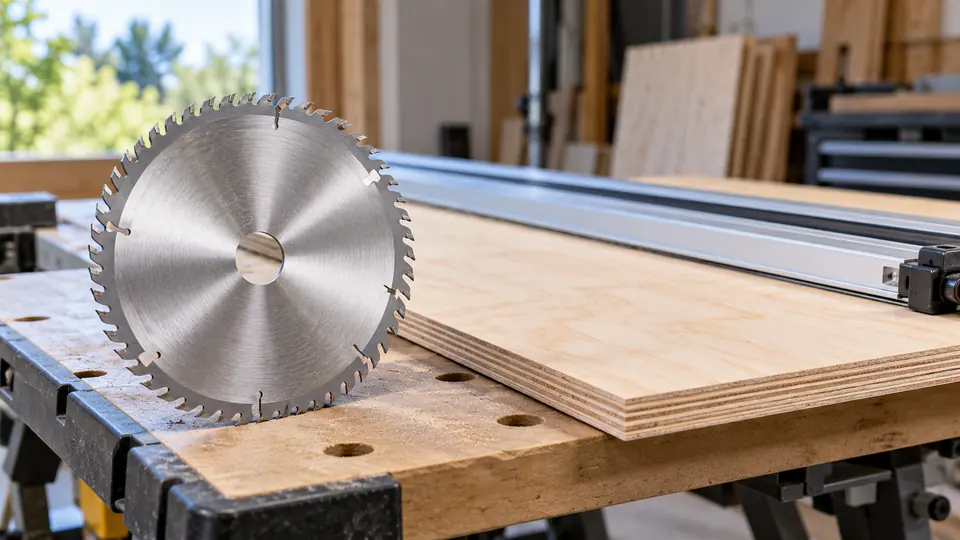
Plywood can look perfectly smooth until a circular saw blade tears the top veneer into a ragged fringe. That sudden burst of splinters usually comes from a mismatch between the blade, the saw, and the cut. Tooth count matters, but so do arbor size, blade diameter, kerf, tooth geometry, and whether the blade is intended for fine crosscuts, general wood cutting, or faster framing work.
Many buyers make the same costly mistake: they grab the highest-tooth blade without checking whether it fits the saw or whether the job calls for a fine finish blade at all. A 140-tooth blade may suit visible plywood edges, while a 24-tooth or 40-tooth blade can make more sense for rough cuts and mixed wood projects. Carbide-tipped construction, thin kerf designs, ATB teeth, expansion slots, and documented plywood compatibility all help separate useful options from generic listings.
The strongest overall fit here is the Revvstark 7-1/4-inch three-blade set because it covers framing, ripping, crosscutting, and fine finishing in one 5/8-inch arbor package. Still, a dedicated 140-tooth blade may suit delicate veneer work better, while compact saw owners need a 6-1/2-inch, 5-1/2-inch, or 4-1/2-inch option that matches their tool exactly.
Quick Answer
- Best Overall: Revvstark 7-1/4-Inch Three-Blade Set for buyers who want several documented tooth configurations for plywood and general wood cutting.
- Best Fine Finish: FOXBC 7-1/4-Inch 140-Tooth Blade for smooth plywood, veneer, paneling, and laminate cuts.
- Best Premium Pick: Diablo D0740A 7-1/4-Inch 40 ATB Blade for buyers seeking a carbide-tipped blade with a stated coating and crosscut focus.
- Best Compact Option: FOXBC 6-1/2-Inch 140-Tooth Blade for compatible compact circular saws and fine plywood work.
Best Circular Saw Blade for Plywood Comparison Table
| Product | Best For | Blade Diameter | Arbor | Tooth Count | Documented Materials |
|---|---|---|---|---|---|
| Revvstark Three-Blade Set | Mixed wood projects | 7-1/4 in. | 5/8 in. | 24T, 40T, 60T | Plywood, MDF, hardwood, laminate |
| FOXBC 140-Tooth Blade | Fine plywood and veneer cuts | 7-1/4 in. | 5/8 in. diamond | 140T | Plywood, OSB, plastic, veneer |
| Diablo D0740A | Fine crosscuts | 7-1/4 in. | 5/8 in. | 40 ATB | Hardwood, softwood, plywood |
| WORKPRO 60T Blade | General fine finishing | 7-1/4 in. | Check saw specifications | 60T | Plywood, hardwood, softwood, trim |
| IRWIN Classic 140T | Budget fine cuts | 7-1/4 in. | 5/8 in. diamond | 140T | Wood and plywood use is indicated |
| FOXBC 6-1/2-Inch 140T | Compact saws | 6-1/2 in. | 5/8 in. diamond | 140T | Plywood, OSB, plastic, veneer |
| Ryltanks 6-1/2-Inch Set | Compact saw versatility | 6-1/2 in. | 5/8 in. diamond | 24T, 40T, 60T, 140T | Plywood, OSB, melamine, wood |
| WORKPRO 6-1/2-Inch 60T | Trim and DIY projects | 6-1/2 in. | Check saw specifications | 60T | Plywood, hardwood, softwood, trim |
| Ryltanks 5-1/2-Inch Set | Small saws and varied cuts | 5-1/2 in. | 10 mm | 24T, 36T, 48T, 130T | Plywood, OSB, plastic, melamine |
The detailed reviews below focus on the blade dimensions, tooth configurations, materials, and saw compatibility that matter most for plywood.
1. Revvstark 7-1/4-Inch Three-Blade Set – Best Overall

A plywood project rarely stays in one lane. One cut may disappear inside a cabinet, another may form a visible shelf edge, and a third may pass through hardwood trim. The Revvstark set addresses those changing jobs with 24-tooth, 40-tooth, and 60-tooth blades, all sized at 7-1/4 inches with a 5/8-inch arbor. That gives buyers a documented configuration for faster framing work, general ripping and crosscutting, and finer finishing.
The set is also identified for plywood, MDF, panels, laminate, hardwood, and softwood. Its thin laser-cut kerf is intended to reduce cutting resistance and material waste, while the listing identifies thermal expansion grooves and noise-reducing perforations. The 60-tooth blade is the most relevant member for visible plywood edges, but the real attraction is the ability to switch blades rather than forcing one fine-finish blade through every rough cut. Check the saw’s arbor and rated speed before installation, especially if moving between corded and cordless equipment.
Pros
- Includes 24T, 40T, and 60T blades for different wood-cutting tasks.
- Uses a documented 7-1/4-inch diameter and 5/8-inch arbor.
- Listed for plywood, MDF, panels, laminate, hardwood, and softwood.
- Includes thin kerf construction and thermal expansion grooves.
- Offers a practical multi-blade format for mixed woodworking projects.
Cons
- The set does not provide the very high tooth count of a dedicated 140T plywood blade.
- Buyers must select the appropriate blade for each cut rather than using one universal blade.
This set suits a workshop where plywood is only part of the workload and blade changes are acceptable. Choose it over a single fine-finish blade if framing, ripping, and crosscutting appear on the same project list. For delicate veneer edges above all else, a dedicated 140-tooth option remains more focused.
To buy this product, click here.
2. FOXBC 7-1/4-Inch 140-Tooth Blade – Best for Fine Plywood Cuts
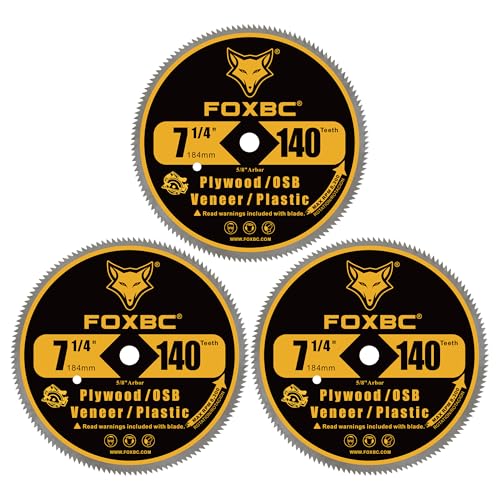
When the cut edge will remain visible, a fine-tooth blade is usually the more natural starting point. This FOXBC model uses 140 teeth on a 7-1/4-inch blade and a 5/8-inch diamond arbor. The product listing specifically targets plywood, OSB, plastic, paneling, veneer, vinyl siding, and laminate, making it one of the most application-focused options in this group.
The stated 0.086-inch kerf is relatively narrow within the supplied product information, and the blade includes expansion slots intended to address heat buildup and warping. Precision-ground teeth are identified for smooth, accurate cuts, while the three-blade package gives a DIY user replacements for repeated project work. The listing describes the construction as high-quality steel and also uses HSS wording, so buyers should treat it as a steel blade with fine teeth rather than assume solid carbide construction. That distinction matters beside carbide-tipped alternatives.
Pros
- Uses a 140-tooth configuration for fine plywood and veneer work.
- Has a documented 7-1/4-inch diameter and 5/8-inch diamond arbor.
- Listed for plywood, OSB, plastic, paneling, veneer, and laminate.
- Includes expansion slots intended to reduce heat buildup and warping.
- Comes as a three-blade package.
Cons
- The supplied listing does not identify carbide-tipped teeth.
- A 140-tooth layout is more specialized for fine cuts than fast framing work.
This blade fits buyers who put clean plywood edges ahead of broad cutting versatility and whose saw accepts a 7-1/4-inch, 5/8-inch arbor blade. It is less suitable as the only blade for a project that includes heavy ripping or rough construction cuts. For those jobs, the Revvstark set supplies more tooth-count choices.
To buy this product, click here.
3. Diablo D0740A 7-1/4-Inch 40 ATB Blade – Best Premium Pick

The Diablo D0740A takes a different route from the 140-tooth blades. Its 40 ATB teeth are intended for smooth crosscuts in hardwood, softwood, and plywood, so the design aims at a blend of finish and cutting pace rather than maximum tooth density. For a cabinet builder trimming plywood panels, that middle ground can be more useful than a blade reserved for slow, delicate finishing.
The documented construction includes TiCo high-density carbide teeth, a hardened steel body, a super-thin laser-cut kerf, Perma-Shield coating, and tri-metal shock-resistant brazing. Those details give the listing a more complete construction description than several budget alternatives. It also identifies an 8,000 RPM maximum, which should be compared with the saw’s own requirements before use. The 5/8-inch arbor and 7-1/4-inch diameter are common dimensions, but the machine still needs to accept both.
Pros
- Uses documented 40 ATB teeth for plywood and wood crosscuts.
- Has TiCo high-density carbide teeth.
- Includes a Perma-Shield non-stick coating according to the listing.
- Uses a super-thin laser-cut kerf.
- Provides a stated 7-1/4-inch diameter, 5/8-inch arbor, and 8,000 RPM maximum.
Cons
- Its 40-tooth design is less specialized for ultra-fine veneer cuts than 140-tooth options.
- It is a single blade rather than a multi-tooth-count set.
This is a sensible fit for plywood crosscuts where a carbide-tipped blade and documented coating matter more than owning several blade styles. Buyers working mainly with thin veneer may prefer a higher tooth count, while people switching between framing and finishing may get more flexibility from Revvstark.
To buy this product, click here.
4. WORKPRO 7-1/4-Inch 60T Blade – Best Budget Carbide-Tipped Option
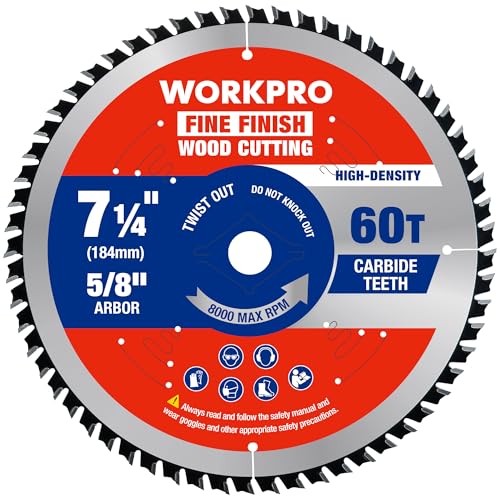
A 60-tooth blade occupies a useful middle position for DIY plywood work. It offers more finishing focus than a framing blade without committing to the dense tooth layout of a 120T or 140T design. WORKPRO identifies this model as carbide tipped, with alternating top bevel teeth and a thin kerf for plywood, hardwood, softwood, trim, and other wood materials.
The ATB geometry is relevant because the teeth meet the material at alternating bevels, a configuration commonly associated with crosscutting and reduced splintering. The supplied listing does not state the arbor size, so compatibility deserves extra attention before purchase. That missing dimension is a meaningful drawback for a circular saw blade, particularly if the buyer is replacing a blade on a compact or unusual saw. Still, the documented 7-1/4-inch size and 60T count make the intended application clear.
Pros
- Uses 60 carbide-tipped teeth for fine wood cutting.
- Employs ATB tooth geometry.
- Has a thin kerf design intended to reduce cutting resistance and material waste.
- Listed for plywood, hardwood, softwood, and trim.
- Fits the needs of buyers seeking a single fine-finish blade rather than a set.
Cons
- The supplied product information does not state the arbor size.
- It offers fewer teeth than the dedicated FOXBC and IRWIN 140T blades.
Pick this blade for ordinary plywood panels, trim, and DIY woodworking where 60 teeth provide a practical finish target. Skip it until the arbor is confirmed if the saw’s manual or existing blade does not make that dimension clear. The Revvstark 60T blade supplies a documented arbor but comes inside a three-blade set.
To buy this product, click here.
5. IRWIN Classic Series 7-1/4-Inch 140T Blade – Best Budget Fine-Cut Blade

The IRWIN Classic Series blade keeps the specification sheet straightforward: 7-1/4 inches, 140 teeth, a 5/8-inch diamond arbor, and a 0.08-inch kerf. For plywood shelves, cabinet sides, and finish carpentry panels, that high tooth count points toward a fine-cut role. The precision-ground top and face grind is also explicitly identified, giving buyers a clearer picture of the tooth arrangement than a listing that states only “fine finish.”
Its plate is described as fully hardened, with heavy-gauge high-carbon steel construction. The supplied information does not identify carbide-tipped teeth, so this blade belongs in the steel fine-cut category rather than alongside the Diablo and WORKPRO carbide-tipped options. That does not make it interchangeable with those products. It means the buyer is choosing a different construction at a budget-oriented position, with a documented arbor and kerf that simplify basic compatibility checks.
Pros
- Provides a high 140-tooth count for fine wood and plywood cuts.
- Uses a documented 7-1/4-inch blade diameter.
- Includes a 5/8-inch diamond arbor.
- Lists a 0.08-inch kerf.
- Uses precision-ground teeth and a fully hardened blade plate.
Cons
- The supplied information does not identify carbide-tipped construction.
- The high tooth count is less suited to buyers who need one blade for fast rough cutting.
This blade is a practical match for a compatible 7-1/4-inch saw used mainly for fine plywood and wood crosscuts. It makes more sense than a multi-purpose set when the job list is narrow and replacement quantity matters. Buyers who specifically want carbide teeth should move to the Diablo, WORKPRO, or Revvstark options.
To buy this product, click here.
6. FOXBC 6-1/2-Inch 140-Tooth Blade – Best Compact Fine-Finish Option

Compact circular saws need compact blades, and a 7-1/4-inch recommendation is useless if the tool is built for 6-1/2-inch accessories. This FOXBC model keeps the same fine-cut theme as the larger FOXBC blade but uses a 6-1/2-inch diameter, 140 teeth, and a 5/8-inch diamond arbor. The listing names plywood, OSB, plastic, paneling, veneer, and vinyl siding as target materials.
The stated 0.08-inch kerf is paired with expansion slots and precision-ground teeth. A three-blade package also makes sense for a compact saw that spends its time on repeated DIY cuts, where a spare can stay nearby rather than being ordered after the first blade is worn or damaged. As with the larger version, the listing describes steel construction and HSS wording rather than carbide-tipped teeth. Confirm the saw’s required diameter, arbor, and guard clearance before buying.
Pros
- Uses a 6-1/2-inch size for compatible compact circular saws.
- Provides a 140-tooth configuration for fine plywood and veneer cuts.
- Has a documented 5/8-inch diamond arbor.
- Lists plywood, OSB, plastic, paneling, and veneer applications.
- Includes a three-blade package with a stated 0.08-inch kerf.
Cons
- The listing does not identify carbide-tipped teeth.
- It is intended for 6-1/2-inch saws and cannot replace a 7-1/4-inch blade.
This is the focused pick for compact-saw owners who want a fine plywood blade and a documented 5/8-inch arbor. It is a poor match for anyone with a 7-1/4-inch tool or a need for fast framing cuts. The Ryltanks 6-1/2-inch set provides broader tooth-count coverage for buyers who want more than fine finishing.
To buy this product, click here.
7. Ryltanks 6-1/2-Inch Four-Blade Set – Best Compact Multi-Purpose Set

The Ryltanks 6-1/2-inch set gives compact-saw users a similar spread to the larger Revvstark package, with 24T, 40T, 60T, and 140T blades. The 5/8-inch arbor with diamond knockout is documented, and the set is listed for plywood, melamine, OSB, hardwood, softwood, plastic, and nail-embedded wood. That range makes it useful for a small saw that moves between construction cuts and visible plywood work.
The three lower-tooth-count blades are described with a 0.063-inch kerf, while the 140T blade is listed at 0.079 inch. The product information also identifies C3 grade high-density tungsten carbide and laser-cut stabilizer vents. Buyers should still match the blade’s maximum listed speed and mounting dimensions with their saw rather than treating compatibility as automatic. The package has more moving parts than a single-blade purchase, but it gives a compact tool far more task-specific flexibility.
Pros
- Includes four documented tooth counts: 24T, 40T, 60T, and 140T.
- Uses a 6-1/2-inch diameter and 5/8-inch diamond arbor.
- Listed for plywood, OSB, melamine, hardwood, softwood, and plastic.
- Identifies C3 grade high-density tungsten carbide construction.
- Provides separate kerf information for the three lower-tooth blades and the 140T blade.
Cons
- The set is limited to compatible 6-1/2-inch saws.
- Buyers must store and select four different blades instead of using one dedicated option.
Choose this set when a compact saw handles varied work and the arbor is confirmed as 5/8 inch. The 140T blade addresses fine plywood while the lower tooth counts cover rougher work. For a single repeatable finish cut, the FOXBC 6-1/2-inch blade is simpler.
To buy this product, click here.
8. WORKPRO 6-1/2-Inch 60T Blade – Best Compact DIY Pick

For a compact saw used on shelves, trim, and occasional plywood panels, a 60-tooth blade can be a comfortable middle ground. WORKPRO lists this 6-1/2-inch model as carbide tipped, with ATB teeth and a thin kerf. It is intended for plywood, hardwood, softwood, trim, and DIY woodworking projects, so its role is broader than a dedicated 140T panel blade.
The one-pack format keeps the purchase simple. There is no second blade style to organize and no framing blade included that might go unused in a finish-carpentry kit. The key gap is arbor information. The supplied listing says to check blade size and arbor specifications, but it does not provide the arbor dimension in the product data here. That makes the buyer’s saw manual especially important before installation.
Pros
- Uses a compact 6-1/2-inch blade diameter.
- Provides 60 carbide-tipped teeth for fine wood cutting.
- Uses ATB tooth geometry.
- Lists plywood, hardwood, softwood, and trim applications.
- Includes a thin kerf design and one-blade format.
Cons
- The supplied product information does not state the arbor size.
- Its 60T configuration is less specialized for very fine veneer work than 140T alternatives.
This model suits compact-saw owners who want a single carbide-tipped blade for general DIY finish cuts and can verify the arbor independently. Buyers cutting fragile veneer or seeking a spare-heavy package may prefer the FOXBC 140T. Those needing rough and finish settings in one purchase should look at the Ryltanks set.
To buy this product, click here.
9. Ryltanks 5-1/2-Inch Four-Blade Set – Best for Small 10 mm Arbor Saws

The smallest set in this roundup is aimed at 5-1/2-inch circular saws with a 10 mm arbor. That dimension is the central buying detail. If the saw accepts it, the package provides 24T, 36T, 48T, and 130T blades for framing, ripping and crosscutting, fine finishing, and plywood or plastic work. It gives a small saw more room to handle different jobs without stepping up to a larger blade system.
The three combination blades use a stated 0.063-inch kerf, while the 130T blade is listed at 0.079 inch. The product information identifies C3 grade high-density tungsten carbide, laser-cut stabilizer vents, and a maximum RPM of 10,000. The 130T blade is the most relevant for clean plywood edges, while the 24T, 36T, and 48T blades cover work where speed or general-purpose cutting matters more. This is a specialized package, so the 10 mm arbor must be confirmed before purchase.
Pros
- Includes 24T, 36T, 48T, and 130T blade configurations.
- Uses a documented 5-1/2-inch diameter and 10 mm arbor.
- Lists plywood, OSB, plastic, melamine, hardwood, and softwood applications.
- Identifies C3 grade high-density tungsten carbide construction.
- Provides stated kerf information and a 10,000 RPM maximum.
Cons
- The 10 mm arbor limits the set to compatible small saws.
- The 130T blade is less tooth-dense than the 140T options in this roundup.
This package is for the buyer whose saw specifically requires a 10 mm arbor and who wants more than one cutting style. It is more versatile than a single fine blade for a small workshop, but the arbor requirement leaves little room for guesswork. Owners of 5/8-inch compact saws should choose a different product from the 6-1/2-inch group.
To buy this product, click here.
Buying Guide
Match the Blade Diameter to the Saw
Start with the blade diameter printed on the saw, its manual, or the existing blade. A 7-1/4-inch blade belongs in a different equipment category from a 6-1/2-inch or 5-1/2-inch blade. Compact tools may have specific guard and cutting-depth requirements, so a smaller blade is not automatically an interchangeable substitute for a larger one.
Check the Arbor Before Looking at Tooth Count
Arbor fit comes before finish quality. The reviewed products use 5/8-inch, 5/8-inch diamond knockout, or 10 mm arbor formats, and those dimensions are not interchangeable by assumption. A beautifully specified 140-tooth blade is still the wrong purchase if its mounting hole does not match the saw.
Choose Tooth Count for the Cut
Higher tooth counts generally point toward finer cuts, while lower counts are commonly used for faster rough work. In this group, 24T and 40T blades support broader cutting roles, 60T blades sit in the middle, and 130T or 140T blades focus more heavily on fine plywood, veneer, and visible edges. A multi-blade set can make sense if the project includes several types of cuts.
The guide to handheld circular-saw fit and plywood cutting places edge quality alongside diameter, arbor, and speed compatibility.
Understand ATB and Fine-Finish Designs
ATB teeth use alternating bevels across the blade and appear on several finish-oriented products here. The Diablo, WORKPRO, and COMOWARE-style product descriptions emphasize fine crosscut or finish work, while the FOXBC and IRWIN listings use very high tooth counts. Compare the stated tooth geometry and intended application rather than assuming every high-tooth blade behaves identically.
Separate Carbide-Tipped and Steel Blades
Several products identify carbide-tipped or tungsten carbide teeth, including Revvstark, Diablo, WORKPRO, and Ryltanks. The FOXBC and IRWIN listings describe steel construction and fine-ground teeth but do not establish carbide-tipped construction in the supplied information. That difference should be visible in the purchase decision, especially for buyers who specifically want a carbide-tooth blade.
Pay Attention to Kerf and Machine Limits
Thin kerf designs can reduce the amount of material removed, but the exact kerf still varies by product. The reviewed listings provide figures such as 0.063, 0.079, 0.08, and 0.086 inch. Also check the blade’s stated maximum RPM where supplied, then compare it with the saw’s requirements. Never treat a blade listing as permission to exceed the machine’s limits.
Best Circular Saw Blade for Plywood FAQ
What Tooth Count Is Best for Plywood?
There is no single count for every plywood cut. A 60T blade can suit general finish work, while a 130T or 140T blade is more focused on fine edges, veneer, and paneling. For rough construction cuts, a 24T or 40T blade may be more appropriate. The Revvstark and Ryltanks sets make these changes easier because each includes several tooth configurations.
Is a 140T Blade Better for Plywood?
A 140T blade is more specialized for fine cuts than a lower-tooth-count blade, based on the intended applications listed for the FOXBC and IRWIN models. It may be a strong fit for visible plywood edges and veneer, but it is not automatically the best choice for ripping or fast construction work. Match the blade to the cut rather than treating tooth count as the only specification.
Do All These Blades Fit the Same Circular Saw?
No. Diameter and arbor must both match. The roundup includes 7-1/4-inch, 6-1/2-inch, and 5-1/2-inch blades, along with 5/8-inch, 5/8-inch diamond, and 10 mm arbor formats. The WORKPRO listings in the supplied data do not state the arbor size, so those dimensions need confirmation before purchase.
Are Carbide-Tipped Blades Better Than Steel Blades?
They are different constructions, and the supplied product information does not establish a universal performance winner. Carbide-tipped models in this roundup include the Revvstark, Diablo, WORKPRO, and Ryltanks blades. FOXBC and IRWIN identify steel construction and fine teeth without establishing carbide tips. Buyers should choose based on the documented construction, application, and compatibility.
What Is the Best Blade for Plywood Veneer?
A dedicated high-tooth-count blade is the most targeted option in this selection. The FOXBC 7-1/4-inch and 6-1/2-inch models list veneer among their intended materials and use 140 teeth. The IRWIN 140T blade is another fine-cut option, though its supplied description does not identify carbide-tipped teeth.
Should I Buy a Blade Set or a Single Blade?
Choose a set if the same saw will handle framing, ripping, crosscutting, and fine plywood work. Revvstark offers three 7-1/4-inch tooth counts, while Ryltanks offers four-blade packages in 6-1/2-inch and 5-1/2-inch formats. A single blade is easier to manage when the saw has one repeated job, such as cutting visible plywood panels.
Can I Use a Plywood Blade for Hardwood?
Only follow the materials identified for the exact blade. Several reviewed products list hardwood and softwood alongside plywood, including Revvstark, Diablo, WORKPRO, and Ryltanks. A listing that focuses on plywood, veneer, plastic, or paneling does not automatically establish suitability for every hardwood application.
Final Verdict
The Revvstark 7-1/4-inch set is the strongest overall recommendation because its documented 5/8-inch arbor, three tooth counts, and plywood application cover more common woodworking situations than a single-purpose blade. The 60T option addresses finer work, while the 24T and 40T blades give the set a broader role for rougher cuts, ripping, and general crosscutting.
For dedicated fine plywood and veneer work, the FOXBC 140T blades are more focused, with choices for 7-1/4-inch and 6-1/2-inch saws. The Diablo is the more fully specified carbide-tipped choice for buyers who prefer a 40 ATB crosscut blade with a stated coating and RPM limit. Compact-saw owners should begin with diameter and arbor, then choose between the FOXBC 140T, WORKPRO 60T, or Ryltanks multi-blade sets according to whether the priority is a single finish cut or several distinct cutting jobs.
