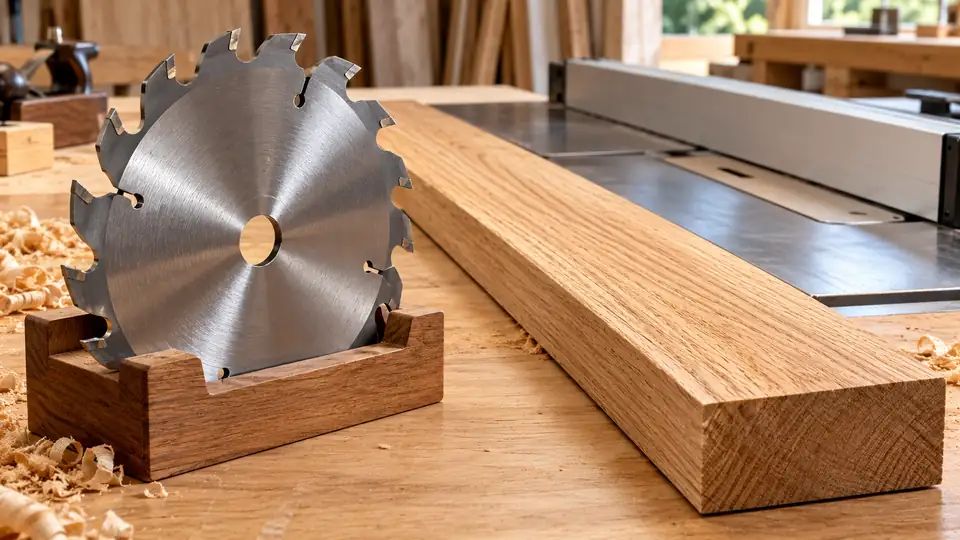
A ripping blade has a very specific job: keep a long cut moving smoothly along the grain while maintaining a stable kerf. Tooth count, tooth shape, kerf width, arbor size, and plate construction all affect that choice. A 24-tooth blade can move aggressively through stock, while a 30-tooth triple-chip grind blade may suit buyers who want a cleaner, glue-ready edge. The wrong pick can leave a rough surface, waste more material, or simply fail to fit the saw.
Many shoppers focus on tooth count alone and overlook the blade’s 5/8-inch arbor, the difference between thin and thicker kerfs, or whether the listing identifies a table-saw application. Material claims matter too. Several blades here are identified for hardwoods, softwoods, plywood, OSB, laminates, or composites, while others are more narrowly described as ripping blades. For the strongest overall blend of ripping focus, 10-inch table-saw dimensions, 30 teeth, TCG geometry, and vibration-control features, the Freud LM75R010 is the standout recommendation.
Different buyers will make different calls. A furniture builder may value a stable glue-line cut, a remodeler may prefer a lower-cost general-purpose blade, and a workshop owner may want a two-blade pack that covers ripping and fine finishing. The comparison below separates those priorities so you can check fit, tooth configuration, and intended use before opening the detailed reviews.
Quick Answer
- Best Overall: Freud LM75R010 for its 30-tooth TCG grind, thin .091-inch kerf, and documented anti-vibration construction.
- Best for Glue-Line Ripping: Freud LM74R010 for its 30-tooth triple-chip tooth design and heavy-duty blade construction.
- Best Budget-Oriented Pick: DEWALT DWA11024 for its 10-inch, 24-tooth general-purpose format and carbide teeth.
- Best Two-Blade Set: Ryltanks 40T and 60T Two-Pack for buyers who want one blade for broader cutting work and another for finer finishes.
Best Table Saw Blade for Ripping Comparison Table
| Product | Best For | Diameter | Arbor | Tooth Count | Key Ripping Feature |
|---|---|---|---|---|---|
| Freud LM75R010 | Overall ripping | 10 inches | 5/8 inch | 30 | TCG grind, .091-inch kerf |
| HARDWIN 24T | General ripping | 10 inches | 5/8 inch | 24 | .094-inch thin kerf |
| FOXBC Flat Tooth | Wood ripping | 10 inches | 5/8 inch | 24 | Flat teeth, 20-degree hook |
| DEWALT DWA11024 | Budget-oriented use | 10 inches | Not specified | 24 | General-purpose carbide design |
| CMT Orange Tools 285.624.10 | Flat-tooth ripping | 10 inches | 5/8 inch | 24 | .126-inch kerf |
| CRAFTSMAN CMAS21024 | Framing and ripping | 10 inches | Not specified | 24 | Heat-treated plate |
| Freud LU87R010 | Thin-kerf ripping | 10 inches | 5/8 inch | 24 | .094-inch kerf, flat grind |
| Ryltanks 40T and 60T Two-Pack | Mixed table-saw work | 10 inches | 5/8 inch | 40 and 60 | Ripping and fine-finish pair |
| Freud LM74R010 | Glue-ready ripping | 10 inches | Not specified | 30 | TCG grind, triple-chip teeth |
The detailed reviews now look at how each blade’s documented geometry, dimensions, and intended materials translate into practical table-saw use.
1. Freud LM75R010: Best Overall
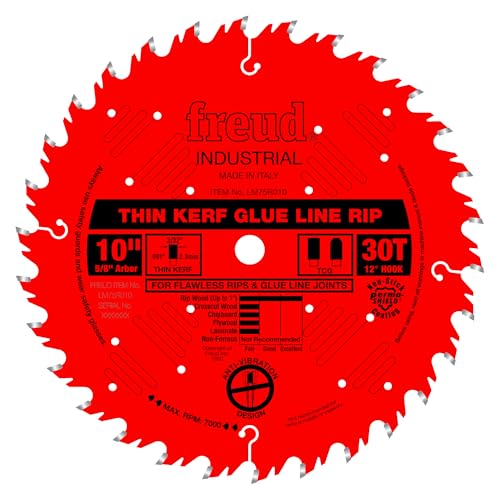
The Freud LM75R010 brings together several specifications that make sense for serious ripping work. It is a 10-inch blade with a 5/8-inch arbor, 30 teeth, a TCG grind, a 12-degree hook angle, and a documented .091-inch kerf. That relatively narrow kerf is useful for buyers who want to remove less material during repeated rip cuts, while the 30-tooth layout sits between an aggressive low-tooth ripping blade and a denser finishing blade.
Its construction details are the real attraction. Freud identifies a heavy-duty plate, laser-cut anti-vibration slots, a TiCo high-density carbide ripping blend, and a Perma-Shield non-stick coating. A woodworker sizing cabinet parts or breaking down hardwood boards will likely appreciate the emphasis on stability and reduced pitch buildup. The TCG geometry also gives this blade a different cutting personality from the flat-grind 24-tooth options below, so it suits buyers who want a ripping blade with a cleaner, more controlled specification profile.
Pros
- 10-inch diameter and documented 5/8-inch arbor.
- 30-tooth TCG grind is specifically identified.
- .091-inch kerf and .071-inch plate are published.
- Laser-cut anti-vibration slots are built into the blade.
- Perma-Shield coating is specified to resist pitch buildup and corrosion.
Cons
- The listing does not identify a maximum RPM for this model.
- Its specialized ripping construction may be more than needed for occasional rough cuts.
This is the strongest fit for a table-saw user who wants ripping-focused geometry, a documented thin kerf, and construction details aimed at stable cutting. Buyers seeking a basic framing or utility blade may prefer a simpler 24-tooth option, while those wanting the most explicitly glue-line-oriented tooth design should compare it with the Freud LM74R010.
To buy this product, click here.
2. HARDWIN 10-Inch 24T Carbide Table Saw Blade: Best Thin-Kerf General Ripper

The HARDWIN blade takes a direct, uncomplicated approach to ripping. It uses a 10-inch diameter, 5/8-inch arbor, 24 teeth, a .094-inch kerf, and a .071-inch plate. That combination is familiar territory for buyers who want a thin-kerf blade with fewer teeth for moving through hardwood, softwood, plywood, and composites. The listing also identifies tungsten carbide teeth and brazing construction, though it does not provide a detailed tooth grind.
For a small workshop, the broad material description is useful. A single blade that is identified for both solid wood and sheet goods can make sense when the saw moves between shelving, framing stock, and weekend furniture projects. The listing also states compatibility with major brands such as Makita, Milwaukee, and Skil, but the saw’s own arbor and guard requirements still need to be checked before installation. Its stated 6,800 RPM maximum is another detail to compare with the saw’s specification rather than treat as a universal operating instruction.
Pros
- 10-inch blade with a documented 5/8-inch arbor.
- 24-tooth configuration suits ripping-focused use.
- .094-inch kerf and .071-inch plate are specified.
- Listed for hardwood, softwood, plywood, and composites.
- Published maximum RPM is 6,800.
Cons
- The product information does not identify a tooth grind or hook angle.
- The broad material description does not establish a specialized glue-line finish.
The HARDWIN is a sensible fit for buyers who want a thin-kerf 24-tooth blade with broad documented material coverage. It is less informative than the Freud models on tooth geometry and vibration-control construction, so a buyer making fine furniture joints may want a more specifically described blade.
To buy this product, click here.
3. FOXBC 10-Inch Flat Tooth Ripping Blade: Best Flat-Tooth Wood Ripper

The FOXBC gives shoppers a clearly documented flat-tooth alternative. Its 10-inch blade has a 5/8-inch arbor, 24 teeth, a .094-inch kerf, a .071-inch plate, and a 20-degree hook angle. The listing identifies it for ripping hard- and softwood, with additional use across plywood, chipboard, and laminates. It also describes a supported material range from 3/4 to 2-3/4 inches thick, while acknowledging that other thicknesses may be handled.
That makes this blade interesting for a woodworker who likes to see the cutting geometry spelled out rather than hidden behind a general-purpose label. The thin plate and kerf are aimed at reducing the amount of material removed, and the 20-degree hook angle gives it an assertive ripping specification. A builder cutting dimensional lumber may value that directness, while someone focused on delicate sheet goods may prefer a blade with more teeth or a finer-cut designation.
Pros
- Flat-tooth grind is explicitly identified.
- 10-inch diameter and 5/8-inch arbor suit many compatible table saws.
- 24-tooth layout is aimed at ripping operations.
- .094-inch kerf and .071-inch plate are documented.
- Listing covers hardwood, softwood, plywood, chipboard, and laminates.
Cons
- The listing does not provide a maximum RPM.
- The relatively assertive 20-degree hook angle may not be the preference for every cutting setup.
Choose the FOXBC when flat teeth, a thin kerf, and a clearly stated 20-degree hook angle matter more than a premium vibration-control package. Its documented compatibility with several 10-inch saw brands is helpful, but the exact arbor and machine instructions should still govern installation.
To buy this product, click here.
4. DEWALT DWA11024 10-Inch 24-Tooth Saw Blade: Best Budget-Oriented Option

The DEWALT DWA11024 is the straightforward pick in this group. It is identified as a 10-inch, 24-tooth general-purpose saw blade with carbide teeth, optimized tooth geometry, and an ultra-sharp carbide cutting edge. That description does not provide the same detailed kerf, arbor, hook-angle, or grind information found on the Freud and FOXBC models, but it does make the blade’s intended position clear: a broadly useful option for routine cutting rather than a highly specialized glue-line rip blade.
This can suit a homeowner or occasional woodworker who wants a familiar brand and a 24-tooth format for general table-saw work. The phrase “up to 3X life” appears in the supplied product information, but it is a manufacturer claim rather than an independent comparison, so it should not be treated as a guaranteed result. Before ordering, verify the arbor and saw compatibility because the supplied listing does not state those dimensions.
Pros
- 10-inch diameter is identified.
- 24-tooth carbide configuration suits ripping-oriented general work.
- Optimized tooth geometry is listed.
- Ultra-sharp carbide teeth are part of the product description.
- General-purpose positioning may suit mixed workshop tasks.
Cons
- The supplied information does not specify the arbor size.
- Kerf width, plate thickness, and tooth grind are not identified.
This blade makes sense for buyers who want a simple, lower-cost general-purpose format and do not need a precisely documented glue-line geometry. A furniture maker comparing kerf and hook angle should look toward the Freud or FOXBC options, while a casual user may value the uncomplicated 24-tooth setup.
To buy this product, click here.
5. CMT Orange Tools 285.624.10: Best Documented Flat-Tooth Kerf Option

The CMT Orange Tools 285.624.10 is a focused ripping blade with a 10-inch diameter, 5/8-inch arbor, and 24 flat teeth. Its published .126-inch kerf is wider than the thin-kerf specifications on several competing blades here. That difference matters because the blade is removing a larger slice of material with each pass, which may appeal to a buyer prioritizing a clearly defined flat-tooth ripping format over minimum material waste.
The supplied information is brief, so the blade should be judged on what it actually documents. Buyers get a known tooth count, flat-tooth configuration, blade diameter, arbor, and kerf, but the listing does not establish a coating, plate thickness, hook angle, or specific material range. A woodworker comparing it with the CMT 201.024.10 will find that the two are distinct ASINs and model descriptions, yet the available data does not provide enough detail to claim a major performance gap between them.
Pros
- 10-inch diameter is specified.
- 5/8-inch arbor is documented.
- 24 flat teeth are identified.
- .126-inch kerf is clearly published.
- Ripping blade application is explicit in the product title.
Cons
- The wider .126-inch kerf may remove more material than thin-kerf alternatives.
- The supplied listing does not specify plate thickness, hook angle, or material coverage.
This CMT is best for shoppers who want a clearly labeled flat-tooth rip blade and are comfortable with a wider kerf. It is less suitable for someone trying to minimize waste or needing detailed information about vibration features and supported workpieces.
To buy this product, click here.
6. CRAFTSMAN CMAS21024 10-Inch 24T Blade: Best for Framing and Ripping

The CRAFTSMAN CMAS21024 is labeled for framing and ripping, giving it a broader job description than the dedicated glue-line blades. Its 10-inch diameter and 24-tooth carbide configuration place it in the familiar fast-ripping category, while induction-brazed carbide tips are specified for the teeth. The product also identifies a heat-treated plate, which is presented as a way to address warping, plus precision-ground teeth for accurate cuts.
This combination may appeal to someone moving between rough construction stock and ordinary shop work. A framing project often rewards a direct, durable format, while a table-saw user may appreciate the corrosion-resistant coating identified in the listing. Still, the supplied data does not provide the arbor size, kerf, hook angle, or supported materials. Those omissions are meaningful, particularly for a table saw where arbor fit and blade clearance must be confirmed before purchase.
Pros
- 10-inch diameter and 24-tooth format are documented.
- Induction-brazed carbide tips are specified.
- Heat-treated plate is identified.
- Precision-ground teeth are listed.
- Corrosion-resistant coating is part of the product description.
Cons
- The supplied information does not state the arbor size.
- Kerf, plate thickness, and hook angle are not provided.
The CRAFTSMAN suits buyers who want one 24-tooth blade described for both framing and ripping, especially where plate treatment and corrosion resistance are useful features. It is a weaker fit for precision-minded shoppers who need a known arbor and kerf before making a table-saw decision.
To buy this product, click here.
7. Freud LU87R010: Best Thin-Kerf 24-Tooth Ripper

The Freud LU87R010 is the 24-tooth counterpart to the more specialized 30-tooth Freud models. It has a 10-inch diameter, 5/8-inch arbor, flat grind, 20-degree hook angle, .094-inch kerf, and .071-inch plate. That specification set points toward fast, assertive ripping with less material removed than a wider-kerf blade. The positive hook angle is also identified as a feature for easier feeding in ripping applications.
For someone breaking down boards or preparing stock for later milling, this blade offers a clear, focused format without drifting into a fine-finish tooth count. The TiCo high-density carbide ripping blend and Perma-Shield coating add documented construction details, while the thin kerf may be attractive for repeated cuts. It lacks the LM75R010’s TCG grind and 30-tooth layout, so the choice comes down to whether faster, more aggressive 24-tooth ripping or a denser 30-tooth configuration better matches the job.
Pros
- 10-inch diameter and 5/8-inch arbor are documented.
- 24-tooth flat grind is specified.
- .094-inch kerf and .071-inch plate are published.
- 20-degree hook angle is identified for ripping.
- Perma-Shield coating is specified to reduce pitch buildup and corrosion.
Cons
- The 20-degree hook angle may be less appealing for buyers seeking a more restrained cutting geometry.
- Its 24-tooth format is less focused on glue-ready finishing than the 30-tooth TCG blades.
The LU87R010 is a strong match for buyers who want a known thin-kerf 24-tooth blade from Freud and expect ripping to be the primary task. Choose a 30-tooth TCG model instead if the cut edge and glue-line orientation matter more than an aggressive tooth layout.
To buy this product, click here.
8. Ryltanks 40T and 60T Two-Pack: Best Two-Blade Set

The Ryltanks set is different from the single-purpose ripping blades because it includes two 10-inch blades. One has 40 teeth for ripping and crosscutting, while the other has 60 teeth for fine finishing. Both use a 5/8-inch arbor, and the listing identifies a .098-inch kerf, tungsten carbide tips, and a maximum RPM of 6,000. For a workshop that regularly shifts between breaking down stock and making cleaner finishing cuts, that split can be more useful than owning two nearly identical 24-tooth blades.
The product is listed for hardwoods, softwoods, plywood, melamine, OSB, oak, pine, and nail-embedded wood. The supplied information also mentions laser-cut stabilizer vents and compatibility with many 10-inch table and miter saws, including brands such as DeWalt, Bosch, Evolution, Makita, Skil, and Metabo. The 40-tooth blade is the relevant choice for this ripping roundup, while the 60-tooth blade is a practical companion rather than a ripping specialist.
Pros
- Includes separate 40-tooth and 60-tooth blades.
- Both blades use a documented 5/8-inch arbor.
- .098-inch kerf is specified.
- Listed for hardwoods, softwoods, plywood, melamine, and OSB.
- Maximum RPM of 6,000 is published.
Cons
- The 40-tooth blade is less specialized for aggressive ripping than the 24-tooth options.
- Buyers seeking one dedicated glue-line rip blade may not need the second blade.
This set suits a mixed-use shop where one purchase needs to cover ripping, crosscutting, and finer work. It is less compelling for a buyer who spends nearly every session ripping thick stock and wants a dedicated low-tooth or TCG blade.
To buy this product, click here.
9. Freud LM74R010: Best for Glue-Line Ripping
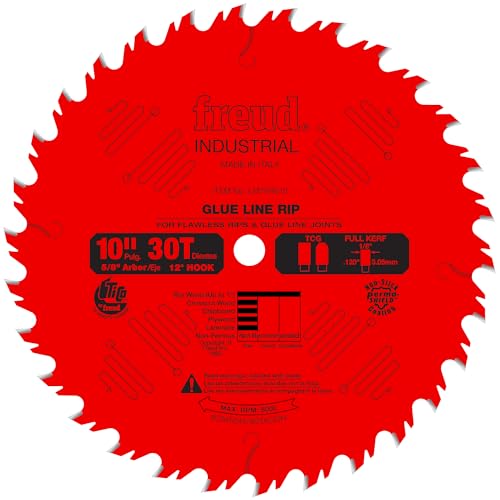
The Freud LM74R010 is the most explicitly finishing-oriented rip blade in this group. It uses a 10-inch diameter and 30 teeth with a TCG grind, and the product description calls out a triple-chip tooth design for smooth, true-cut surfaces. That geometry makes the blade especially interesting for a woodworker preparing edges for glue-up, where a clean, consistent cut can reduce the amount of follow-up jointing or sanding required.
Its heavy-duty construction includes a reinforced plate, laser-cut anti-vibration slots, a TiCo high-density carbide ripping blend, and a Perma-Shield coating. Those are documented design features, not independent performance measurements, but they give the blade a clear identity. Compared with the LM75R010, the LM74R010 has the stronger emphasis on triple-chip glue-line work, while the LM75R010 supplies more detailed published dimensions, including its .091-inch kerf and 5/8-inch arbor.
Pros
- 30-tooth TCG configuration is identified.
- Triple-chip tooth design is specified for glue-line ripping.
- Heavy-duty construction includes a reinforced plate.
- Laser-cut anti-vibration slots are listed.
- Perma-Shield coating is specified to resist pitch and corrosion.
Cons
- The supplied information does not state the arbor size.
- Kerf width and plate thickness are not provided for this model.
The LM74R010 is the better fit for a furniture builder who places glue-ready edge preparation ahead of broad utility. Buyers who need confirmed mounting dimensions should verify the arbor before ordering, while shoppers wanting the most complete dimensional specification may prefer the LM75R010.
To buy this product, click here.
Buying Guide
Match the Blade to the Saw
Start with the physical fit. A 10-inch diameter alone does not establish compatibility. Check the saw’s required arbor size, blade clearance, guard arrangement, and manufacturer instructions against the individual listing. Several blades here specify a 5/8-inch arbor, while the DEWALT DWA11024 and CRAFTSMAN CMAS21024 records supplied for this comparison do not state one. That missing dimension is a reason to verify before purchase, not a detail to guess.
Choose Tooth Count for the Cut
Lower tooth counts generally leave more space between teeth and are commonly associated with ripping-focused layouts. The 24-tooth blades in this roundup are aimed at direct ripping or general-purpose work. The 30-tooth Freud blades take a denser approach and add TCG or triple-chip geometry. The Ryltanks set shows the other end of the range, pairing a 40-tooth blade for broader work with a 60-tooth blade for fine finishing.
The selection guide explains ripping geometry within a compatible circular-blade setup, connecting chip-clearance priorities with the saw’s dimensional requirements.
Understand Kerf Width
Kerf is the width of the cut made by the blade. A thinner kerf removes less material per pass, which can matter when cutting expensive hardwood or working with a saw that benefits from lower material removal. The Freud LM75R010 lists a .091-inch kerf, while the Freud LU87R010 and several other thin-kerf options list .094 inches. The CMT 285.624.10 lists a .126-inch kerf, giving it a distinctly different material-removal profile.
Look at Tooth Geometry
Tooth count tells only part of the story. Flat teeth, TCG teeth, hook angle, and triple-chip designs create different specifications for the cut. The FOXBC identifies flat teeth and a 20-degree hook angle. The LM75R010 and LM74R010 identify TCG geometry, with the LM74R010 specifically calling out triple-chip teeth. Buyers who want a glue-line edge should study those details instead of choosing solely by the lowest tooth count.
Check the Intended Materials
Material support should come from the product description. The FOXBC listing names hardwood, softwood, plywood, chipboard, and laminates. HARDWIN lists hardwood, softwood, plywood, and composites, while the Ryltanks set includes materials such as melamine and OSB. A blade described only as a ripping blade may still suit your stock, but the available evidence is narrower, so avoid assuming broad material compatibility from the word “carbide” alone.
Separate Ripping from Finishing
A ripping blade is built around cutting along the grain, while a fine-finish blade uses a denser tooth arrangement. The Ryltanks two-pack makes that distinction visible by including 40-tooth and 60-tooth blades. A buyer who primarily breaks down boards may prefer a 24-tooth blade, while a cabinet project involving cleaner edges may justify a 30-tooth TCG blade or a dedicated glue-line model.
Best Table Saw Blade for Ripping FAQ
Is a 24-tooth blade suitable for ripping?
Yes, a 24-tooth layout is commonly associated with ripping-focused table-saw blades in this selection. The HARDWIN, FOXBC, CRAFTSMAN, and Freud LU87R010 all use 24 teeth. The exact result also depends on tooth geometry, kerf, plate construction, the material being cut, and proper compatibility with the saw.
What is the advantage of a 30-tooth ripping blade?
A 30-tooth blade can offer a denser tooth layout than a 24-tooth rip blade. In this roundup, the Freud LM75R010 and LM74R010 add TCG geometry, and the LM74R010 specifically identifies triple-chip teeth for glue-line ripping. That makes them more specialized than a basic 24-tooth general-purpose blade.
Is a thin-kerf blade better for every table saw?
No. A thin kerf removes less material, but the blade still needs to match the saw and the intended work. The Freud LM75R010 lists a .091-inch kerf, while the CMT 285.624.10 lists .126 inches. Check the saw’s instructions, blade clearance, and compatibility requirements rather than treating thin kerf as universally preferable.
What arbor size do these table-saw blades use?
Several products in this roundup specify a 5/8-inch arbor, including the Freud LM75R010, HARDWIN, FOXBC, CMT 285.624.10, Freud LU87R010, and Ryltanks set. The supplied information does not identify the arbor size for the DEWALT DWA11024, CRAFTSMAN CMAS21024, or Freud LM74R010, so those dimensions should be confirmed before purchase.
Can a ripping blade cut plywood?
Some listings specifically identify plywood as a supported material. HARDWIN, FOXBC, CMT 201.024.10, and the Ryltanks set include plywood in their supplied descriptions. That does not make every ripping blade suitable for every plywood job. Choose according to the product’s stated materials and the edge quality your project requires.
Should I choose a flat-tooth or TCG ripping blade?
That depends on the cut you want and the product’s documented application. The FOXBC and CMT 285.624.10 identify flat teeth, while the Freud LM75R010 and LM74R010 identify TCG designs. The Freud LM74R010 goes further with a stated triple-chip configuration for glue-line work, making it the more specialized choice for that purpose.
Does a higher tooth count always produce a better cut?
No. Tooth count changes the blade’s layout, but it does not provide a complete performance prediction by itself. The 40-tooth Ryltanks blade is described for ripping and crosscutting, while its 60-tooth companion is identified for fine finishing. Tooth geometry, kerf, material, and machine compatibility all belong in the decision.
Final Verdict
The Freud LM75R010 is the strongest overall recommendation because its supplied specifications address the core ripping decision with unusual clarity. It has a 10-inch diameter, 5/8-inch arbor, 30 teeth, TCG grind, .091-inch kerf, .071-inch plate, and a documented anti-vibration and non-stick coating package. That makes it a well-defined choice for buyers who want a dedicated ripping blade with a more controlled specification set than a basic 24-tooth utility blade.
The Freud LM74R010 is the better pick for glue-line work because its triple-chip tooth design is explicitly identified for that application. For a lower-cost general-purpose direction, the DEWALT DWA11024 keeps the format simple, while the Ryltanks set suits a workshop that needs both ripping and fine finishing blades. Before ordering, confirm the arbor, blade clearance, and saw instructions, then choose tooth geometry and kerf according to the stock and edge quality your projects demand.
