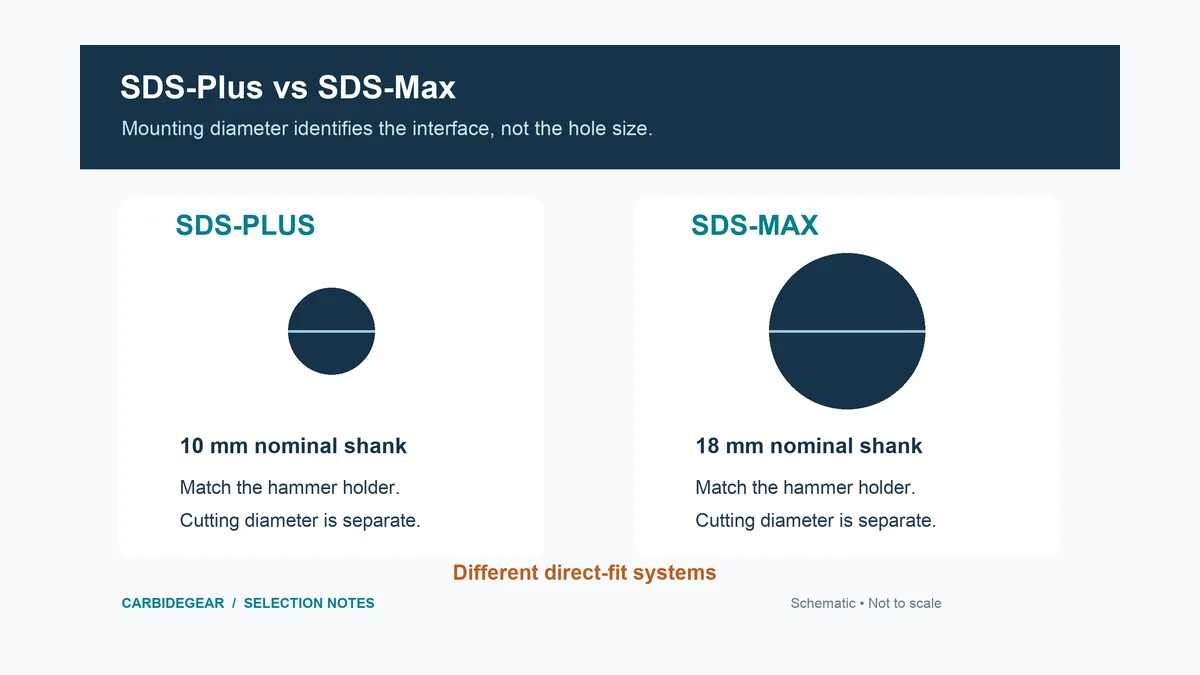
SDS-Plus vs SDS-Max drill bits differ first in the rotary-hammer connection they require. SDS-Plus uses a nominal 10 mm shank; SDS-Max uses a nominal 18 mm shank with a different locking arrangement. Match the bit to the hammer’s holder first, then choose the cutting diameter, usable drilling depth, and head design for the hole.
For a reinforced-concrete task on an SDS-Plus hammer, compare SDS-Plus carbide bits intended for reinforced concrete after confirming the required hole size and working length. A reinforcement-capable head is an application feature, not a replacement for checking the connection or the drilling plan.
SDS-Plus vs SDS-Max Drill Bits at a Glance
| Selection point | SDS-Plus | SDS-Max |
|---|---|---|
| Nominal mounting shank diameter | 10 mm | 18 mm |
| Direct fit | Matching SDS-Plus holder | Matching SDS-Max holder |
| Common equipment role | Smaller and medium-duty rotary hammers | Higher-demand drilling and chiseling equipment |
| Hole capacity | Depends on the exact hammer and bit | Depends on the exact hammer and bit |
| Cutting head | Can vary within the system | Can vary within the system |
| Interchangeability | Does not directly fit SDS-Max | Does not directly fit SDS-Plus |
The shank diameters in this table describe the connection, not the hole produced. A 10 mm SDS-Plus shank does not mean the bit drills a 10 mm hole, and an 18 mm SDS-Max shank does not limit it to an 18 mm hole.
Identify the Holder Before Comparing Cutting Heads
Read the hammer’s model information or manual and check the holder designation. Brand is not enough: a manufacturer’s range can include SDS-Plus, SDS-Max, spline, hex, and other systems. A normal three-jaw drill chuck is a different connection again.
The slots and retention features of an SDS shank allow the tool to be driven and retained in its intended holder while accommodating the hammer action. They are not intended to be gripped in an ordinary chuck as though they were a smooth round drill shank.
If the hammer is SDS-Max, use SDS-Max carbide drill bits with the required diameter and reach. Do not select the smaller system’s bit on the assumption that a similar-looking carbide head makes the shanks interchangeable.
Adapters exist for some specific combinations, but they must be approved for the machine, accessory, and operating mode. An adapter does not increase the hammer’s drilling capacity or give a smaller bit the operating limits of a larger system. Check the complete approved arrangement rather than inferring compatibility from the two connector names.
Match the Hole to the Hammer's Working Range
The maximum advertised hole diameter is not the only useful specification. A hammer may also list an optimum or recommended drilling range. Repetitive holes near a machine’s limit can be a different task from occasional holes of the same size.
Identify the hole diameter, drilling depth, number of holes, access, and substrate before deciding whether a heavier system is worthwhile. SDS-Max equipment commonly serves higher-demand work, but a larger hammer is not automatically the better tool for a small fixing or a confined overhead location.
Separate the ratings for ordinary solid drilling bits and core cutters. A machine can accept a relatively large core cutter under a different capacity rating without accepting a solid bit of that same outside diameter. Keep the intended drilling method attached to the capacity figure.
Working Length Is Different From Overall Length
Overall length includes the mounting end. Working length describes the drilling reach available for the specified accessory, subject to the actual installation and any dust-extraction equipment. Neither number should be substituted for the anchor’s specified hole depth.
For example, if a fixing calls for a particular hole depth, select a bit with enough usable reach to produce that hole while the holder and extraction arrangement remain clear. This is a dimensional check, not permission to add an arbitrary allowance to the fixing’s instructions.
On a through-hole, also consider what is behind the exit face and whether breakout could affect the finished surface or the installation. A longer bit solves reach only when the machine, guidance, and drilling method remain suitable.
Reinforced Concrete: Head Design and Authorization Are Separate
A cutting head may use a brazed carbide insert, several cutters, or a full-carbide head. The exact design and listed material application matter when reinforcement may be encountered. The words SDS-Plus and SDS-Max alone do not establish how the head behaves at steel reinforcement.
Select a bit explicitly intended for the substrate and reinforcement conditions. Then follow the work’s scanning and drilling requirements. A bit marketed for reinforced concrete does not authorize cutting structural rebar, post-tensioning tendons, or concealed services. Stop and resolve an unexpected obstruction through the relevant job procedure rather than forcing the bit onward.
The difference between a full-carbide head and a solid-carbide drill is another common source of confusion. Many masonry bits have a steel body with a carbide cutting head; a solid-carbide metalworking drill is a different tool system. The solid-carbide versus carbide-tipped drill guide explains the construction distinction.
Anchors Need the Specified Hole, Not Just a Matching Bit Label
For a mechanical or adhesive anchor, use the anchor manufacturer’s requirements for the substrate, hole diameter, drilling method, depth, and hole preparation. Two bits with the same nominal cutting diameter can differ in whether they are permitted for that installation method.
Hole cleaning is part of the installation system. Dust extraction during drilling can reduce dust at the workface, but it does not automatically replace the specified cleaning sequence. A hollow dust-extraction bit may require a compatible extractor and an explicitly approved installation procedure.
Do not use this comparison to improvise an anchor design. Its purpose is to help choose the correct connection and bit configuration for a hole whose requirements have already been established.
Rotary Hammer vs Hammer Drill
A conventional hammer drill and an SDS rotary hammer are different tool categories even when both are advertised for masonry. The connection, percussion mechanism, compatible accessories, and operating modes must match the task.
For jobs spanning more than one drill type, the carbide concrete drill bit guide provides a broader selection route. Filter by the actual shank and tool before considering a set: a package of round- or hex-shank masonry bits is not a direct substitute for an SDS package.
Common Reasons the Right-Looking Bit Is Wrong
- Right hole diameter, wrong shank: the cutting end is suitable but the bit cannot lock into the holder.
- Right system, insufficient working length: the bit mounts correctly but cannot make the required hole with the planned setup.
- Right system, wrong method: a core-cutter capacity is mistaken for a solid-drill rating.
- Right material name, wrong head: the selected variant is not rated for the substrate or reinforcement conditions.
- Right bit, incomplete installation process: the anchor’s depth, cleaning, or drilling requirements have not been followed.
Final Selection Check
Record the hammer model and holder, required hole diameter and depth, bit working length, exact head design, and listed substrate. Confirm the machine’s capacity for the chosen drilling method and any extraction equipment. For SDS-Plus vs SDS-Max drill bits, these checks resolve the choice more reliably than shank size alone.
