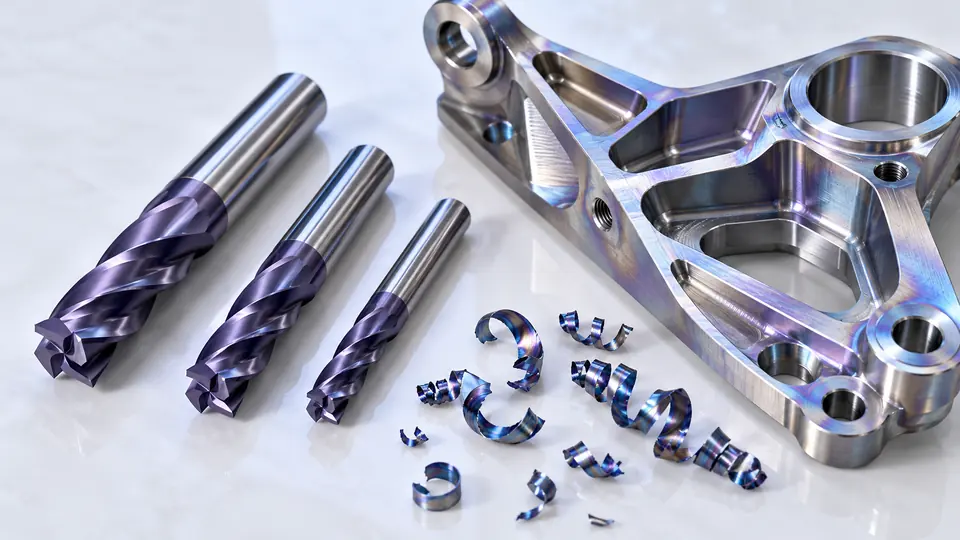
Titanium milling needs a cutter intended for the actual alloy and feature. A titanium-containing coating alone does not prove titanium-workpiece suitability. These nine picks cover square ends, corner radii, a multi-size set, and ball-nose finishing.
Compare the 9 picks below by their dimensions, application, and compatibility. Match the configuration to your equipment and the job before comparing package quantity.
Quick Answer
- Best Overall Titanium Profile Cutter: SPEED TIGER IPVR 1/4-Inch Corner-Radius End Mill — 1/4-inch diameter; 0.06-inch corner radius; 9/16-inch LOC; 4 flutes; AlTiN.
- Best 3/8-Inch Z-Carb-AP Option: SGS 36513 Z16CR 3/8-Inch Z-Carb-AP End Mill — 3/8-inch diameter and shank; 5/8-inch LOC; 2-inch overall; 4 flutes; AlTiN.
- Best Metric Square-End Option: SGS 46357 Z1M 3 mm Z-Carb-AP End Mill — 3 mm diameter; 6 mm shank; 8 mm LOC; 57 mm overall; 4 flutes; AlTiN.
Best End Mills for Titanium Comparison Table
| Product | Best For | Key Specifications | Fit and Application |
|---|---|---|---|
| SPEED TIGER IPVR 1/4-Inch Corner-Radius End Mill | Overall Titanium Profile Cutter | 1/4-inch diameter; 0.06-inch corner radius; 9/16-inch LOC; 4 flutes; AlTiN | Choose the IPVR for titanium profiling where its corner radius, cutting length, and 1/4-inch mounting size fit the part and machine. |
| Micro 100 VHMM0405 4 mm Five-Flute End Mill | Metric Corner-Radius Option | 4 mm diameter and shank; 11 mm LOC; 50 mm overall; 5 flutes; 0.3 mm radius | Choose the VHMM0405 when a 4 mm collet, 0.3 mm corner radius, and 11 mm cutting length suit the titanium feature. |
| SGS 36513 Z16CR 3/8-Inch Z-Carb-AP End Mill | 3/8-Inch Z-Carb-AP Option | 3/8-inch diameter and shank; 5/8-inch LOC; 2-inch overall; 4 flutes; AlTiN | Choose the SGS 36513 when its Z16CR corner profile and 3/8-inch size match the titanium toolpath. |
| SGS 36404 Z1 1/8-Inch Z-Carb-AP Square End Mill | Compact Square-End Option | 1/8-inch diameter and shank; 3/8-inch LOC; 1-1/2-inch overall; 4 flutes; AlTiN | Choose the SGS 36404 for small square-end titanium features using a matching 1/8-inch collet. |
| SGS 46357 Z1M 3 mm Z-Carb-AP End Mill | Metric Square-End Option | 3 mm diameter; 6 mm shank; 8 mm LOC; 57 mm overall; 4 flutes; AlTiN | Choose the SGS 46357 for a 3 mm square-end feature when the spindle has the required 6 mm collet. |
| JIANXING 1/2-Inch Extra-Long Carbide Square End Mill | Extra-Long Square-End Option | 1/2-inch cutting diameter; 4 flutes; 4-inch overall; coated carbide; TC4/TC7 | Choose the JIANXING for a genuine reach requirement with a compatible holder and well-supported titanium workpiece. |
| JIANXING 1–12 mm Nine-Piece Carbide End Mill Set | Multi-Diameter Square-End Set | 9-piece set; 1–12 mm range; 4 flutes; AP-coated carbide; TC4/TC7 titanium | Choose this set when several square-end diameters are required and the machine has the correct collets for each cutter. |
| SpeTool 1/32-Inch Ball-Nose Carbide End Mills | for Micro Contours | 1/32-inch ball diameter; 1/8-inch shank; 5/64-inch LOC; TiAlN; 5 pieces | Choose these cutters for small curved features on a rigid CNC mill using a matching 1/8-inch collet. |
| ASNOMY Ball Nose Carbide End Mill Set | for Contoured Work | 5-piece ball-nose set; R1–R4 mm radius range; 2 flutes; AlTiN | Choose the ASNOMY set for curved titanium features that call for several ball radii and compatible metric tooling. |
1. SPEED TIGER IPVR 1/4-Inch Corner-Radius End Mill — Best Overall Titanium Profile Cutter

The SPEED TIGER IPVR1T combines a 1/4-inch cutting diameter with a 0.06-inch corner radius and a 9/16-inch cutting length. Four flutes, unequal flute spacing, an unequal helix design, and an AlTiN coating give it a focused configuration for titanium-alloy milling.
The corner radius makes this a profiling choice rather than a sharp-square-corner cutter. Match the radius to the part drawing and use titanium-specific cutting parameters with stable workholding. The variable geometry is useful to consider when choosing a tool, while spindle setup and engagement still determine how the cut behaves.
Pros
- Explicit titanium-alloy application.
- Unequal flute and helix geometry.
- AlTiN-coated carbide.
- 0.06-inch corner radius.
- 9/16-inch cutting length.
Cons
- Corner radius cannot produce a sharp internal floor corner.
- 1/4-inch size must suit the part and holder.
Choose the IPVR for titanium profiling where its corner radius, cutting length, and 1/4-inch mounting size fit the part and machine.
To buy this product, click here.
2. Micro 100 VHMM0405 4 mm Five-Flute End Mill — Best Metric Corner-Radius Option

Micro 100’s VHMM0405 uses five flutes on a 4 mm carbide cutter with an 11 mm cutting length and 50 mm overall length. Its 0.3 mm corner radius and uncoated construction distinguish it from the four-flute coated options.
The tool is intended for titanium and high-temperature materials. Its metric shank needs the correct collet rather than a near-size imperial substitute. Choose it when the part benefits from a small corner radius, and establish the cutting parameters for the actual titanium grade and machine rigidity.
Pros
- Titanium and high-temperature-material application.
- Five-flute geometry.
- 4 mm cutting diameter and shank.
- 11 mm cutting length.
- 0.3 mm corner radius.
Cons
- Requires a proper 4 mm collet.
- Corner radius must suit the part geometry.
Choose the VHMM0405 when a 4 mm collet, 0.3 mm corner radius, and 11 mm cutting length suit the titanium feature.
To buy this product, click here.
3. SGS 36513 Z16CR 3/8-Inch Z-Carb-AP End Mill — Best 3/8-Inch Z-Carb-AP Option

The SGS 36513 belongs to the Z16CR Z-Carb-AP series, with four flutes and an AlTiN coating. Its 3/8-inch diameter and shank, 5/8-inch cutting length, and 2-inch overall length provide a larger cutting format than the small metric and micro options here.
The Z-Carb-AP family includes titanium-alloy machining applications. Select this model for a compatible profile rather than assuming every Z-Carb tool has the same end geometry. Check the exact corner configuration against the part drawing, then use the series guidance for the titanium grade and engagement.
Pros
- Z-Carb-AP titanium-alloy application.
- AlTiN-coated carbide.
- Four-flute configuration.
- 3/8-inch diameter and shank.
- 5/8-inch cutting length.
Cons
- Corner configuration must suit the part.
- Larger diameter needs sufficient machine rigidity.
Choose the SGS 36513 when its Z16CR corner profile and 3/8-inch size match the titanium toolpath.
To buy this product, click here.
4. SGS 36404 Z1 1/8-Inch Z-Carb-AP Square End Mill — Best Compact Square-End Option
The SGS 36404 Z1 uses a square end, four flutes, and an AlTiN coating in a compact 1/8-inch format. Its cutting length is 3/8 inch and its overall length is 1-1/2 inches, making the actual cutting geometry clear.
The Z1 Z-Carb-AP series supports titanium-alloy machining. This model is useful when a ball nose or corner-radius cutter cannot create the required flat-bottom feature. Keep overhang short and match engagement to the small diameter rather than applying the same cut used with a larger 3/8-inch tool.
Pros
- Square-end cutting profile.
- Z1 titanium-alloy application.
- Four AlTiN-coated flutes.
- 1/8-inch shank and diameter.
- 3/8-inch cutting length.
Cons
- Small diameter limits material engagement.
- Needs a precise 1/8-inch holder.
Choose the SGS 36404 for small square-end titanium features using a matching 1/8-inch collet.
To buy this product, click here.
5. SGS 46357 Z1M 3 mm Z-Carb-AP End Mill — Best Metric Square-End Option
The metric SGS 46357 Z1M combines a 3 mm cutting diameter with a 6 mm shank. It has four flutes, an AlTiN coating, an 8 mm cutting length, and a 57 mm overall length. The larger shank is an important mounting difference from a 1/8-inch tool.
The Z1M Z-Carb-AP family covers titanium-alloy work in a metric format. Use this model for a square-end feature that needs the 3 mm diameter, and check shoulder clearance around the larger shank. It is not an imperial 1/8-inch cutter, even though those cutting diameters are close.
Pros
- 3 mm square-end cutting diameter.
- 6 mm mounting shank.
- Z1M titanium-alloy application.
- Four AlTiN-coated flutes.
- 8 mm cutting length.
Cons
- Needs a 6 mm collet.
- Larger shank needs shoulder clearance.
Choose the SGS 46357 for a 3 mm square-end feature when the spindle has the required 6 mm collet.
To buy this product, click here.
6. JIANXING 1/2-Inch Extra-Long Carbide Square End Mill — Best Extra-Long Square-End Option

The JIANXING extra-long cutter uses a 1/2-inch cutting diameter and four flutes in a 4-inch overall tool. It is a coated-carbide square end mill intended for materials that include TC4 and TC7 titanium alloys.
Choose the longer body only when the part needs the additional clearance. Overall length is not the same as cutting length, so match the usable flute length and shoulder reach to the actual feature. Keep overhang as short as the part permits and use a setup rigid enough for titanium milling.
Pros
- TC4 and TC7 titanium application.
- 1/2-inch cutting diameter.
- Four-flute square-end geometry.
- 4-inch overall format.
- Coated-carbide construction.
Cons
- Longer overhang reduces rigidity.
- Confirm usable cutting length rather than treating overall length as flute length.
Choose the JIANXING for a genuine reach requirement with a compatible holder and well-supported titanium workpiece.
To buy this product, click here.
7. JIANXING 1–12 mm Nine-Piece Carbide End Mill Set — Best Multi-Diameter Square-End Set

This JIANXING set provides nine four-flute carbide square end mills across a 1–12 mm size range. The cutters use an AP coating, and TC4 and TC7 titanium alloys are among the intended workpiece materials.
The set offers diameter coverage rather than nine separate recommendations. It is useful for a project with several slot or pocket sizes, provided each shank and cutting length fits the setup. Select parameters for each actual cutter diameter; a small tool and a 12 mm tool should not share an unadjusted cutting program.
Pros
- Nine cutters in one set.
- 1–12 mm diameter coverage.
- Four-flute square-end geometry.
- Coated-carbide construction.
- TC4 and TC7 titanium application.
Cons
- Each size needs the correct collet.
- Cutting conditions must change with diameter.
Choose this set when several square-end diameters are required and the machine has the correct collets for each cutter.
To buy this product, click here.
8. SpeTool 1/32-Inch Ball-Nose Carbide End Mills — Best for Micro Contours

SpeTool pairs a 1/32-inch ball nose with two flutes, a TiAlN coating, and a 1/8-inch shank. Each cutter has a 5/64-inch cutting length and a 1-1/2-inch overall length. Five matching tools make this a focused replacement pack for repeated small-scale contour work.
The rounded end is useful for 3D surfaces and narrow curved details rather than square-bottom pockets. Titanium alloy is among its intended materials, alongside steels and other hard materials. Keep the cutting engagement appropriate to the tiny diameter and choose the toolpath for a ball end rather than treating it as a flat cutter.
Pros
- Small 1/32-inch ball-nose profile.
- Two-flute solid-carbide construction.
- TiAlN-coated cutting surface.
- 1/8-inch mounting shank.
- Five matching cutters for repeat work.
Cons
- The 5/64-inch cutting length limits depth.
- The fine tip needs precise workholding and spindle runout.
Choose these cutters for small curved features on a rigid CNC mill using a matching 1/8-inch collet.
To buy this product, click here.
9. ASNOMY Ball Nose Carbide End Mill Set — Best for Contoured Work

The ASNOMY set contains five two-flute ball-nose carbide end mills across an R1-to-R4 mm radius range. The cutters use an AlTiN coating, and titanium alloy is among their intended applications.
The size range describes ball radius, not cutting diameter: an R4 ball has an 8 mm nominal diameter. Choose each radius around the surface geometry and the required finishing toolpath. This set serves curved features rather than square-bottom pockets, and each shank and cutting length must fit the machine.
Pros
- Five ball-nose cutters.
- R1–R4 mm radius coverage.
- Two-flute carbide geometry.
- AlTiN-coated cutting surfaces.
- Titanium-alloy application.
Cons
- Radius must not be confused with diameter.
- Not a square-end pocketing set.
Choose the ASNOMY set for curved titanium features that call for several ball radii and compatible metric tooling.
To buy this product, click here.
Buying Guide
End Geometry
Choose a square end for the required flat feature, a permitted corner radius for profiling, and a ball nose for curves. SPEED TIGER IPVR and Micro 100 have different corner radii; SpeTool and ASNOMY serve ball-nose work.
Shank and Reach
SGS Z1M has a 6 mm shank around a 3 mm cutting diameter; Micro 100 uses a 4 mm shank. Match proper collets. Extra overall length is not cutting length, so check usable flutes and shoulder clearance.
Titanium Setup
Use the cutter family’s titanium guidance for the alloy, engagement, coolant, and machine rigidity. Keep overhang short and set each diameter’s cutting conditions separately.
Our explanation of coating selection for titanium alloys helps relate the surface treatment to the actual workpiece and cutting geometry.
Frequently Asked Questions
Does a titanium coating prove application?
No. Select by titanium-workpiece suitability and actual geometry.
Does R4 mean 4 mm diameter?
R4 means 4 mm radius and an 8 mm nominal ball diameter.
Are all nine the same cutting shape?
No. Square, corner-radius, and ball-nose cutters serve different features.
Final Verdict
SPEED TIGER IPVR 1/4-Inch Corner-Radius End Mill is the starting point for buyers who need its configuration. Choose the IPVR for titanium profiling where its corner radius, cutting length, and 1/4-inch mounting size fit the part and machine.
For a different requirement, compare SGS 36513 Z16CR 3/8-Inch Z-Carb-AP End Mill and ASNOMY Ball Nose Carbide End Mill Set. Choose a square end for the required flat feature, a permitted corner radius for profiling, and a ball nose for curves. SPEED TIGER IPVR and Micro 100 have different corner radii; SpeTool and ASNOMY serve ball-nose work.
