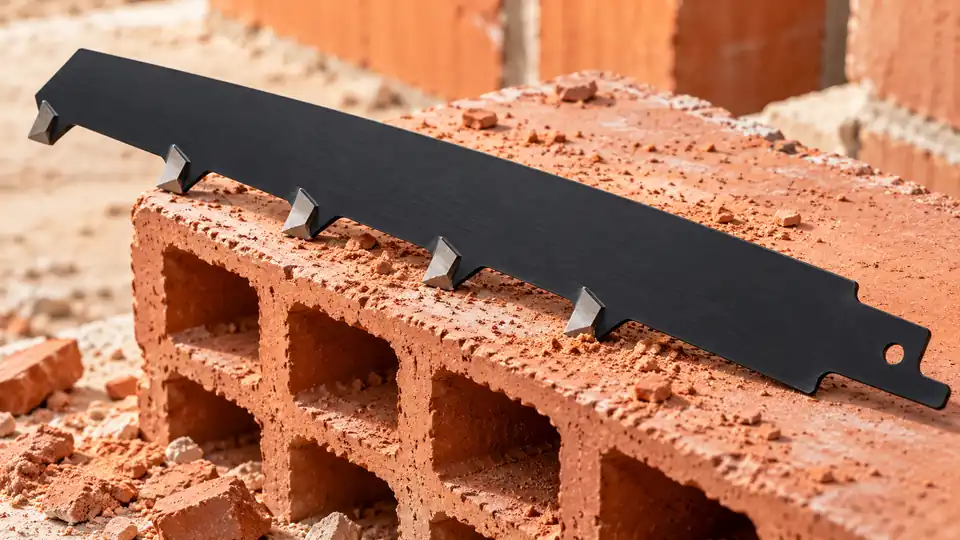
These eight carbide reciprocating-blade picks focus on light or hollow brick and aerated concrete. Choose the masonry application and usable length first, then compare single blades and replacement packs for the work ahead.
Compare the 8 picks below by their dimensions, application, and compatibility. Match the configuration to your equipment and the job before comparing package quantity.
Quick Answer
- Best Overall: PAYA TOOLS Masonry Reciprocating Saw Blade, 12-Inch, 2-Pack — 12 inches; Large masonry tooth; 2-pack; Brick, porous concrete, limestone.
- Best Shorter Blade Pack: PAYA TOOLS 3-Pack 9-Inch Masonry Reciprocating Saw Blade — 9 inches; Large masonry tooth; 3-pack; Brick, porous concrete, limestone.
- Best for Demolition-Style Work: FACHLICH Demolition Masonry Reciprocating Saw Blades — 12 inches; 2TPI large-grain teeth; 2-pack; Aerated concrete, hollow brick.
Best Carbide Reciprocating Saw Blades for Brick Comparison Table
| Product | Best For | Key Specifications | Fit and Application |
|---|---|---|---|
| PAYA TOOLS Masonry Reciprocating Saw Blade, 12-Inch, 2-Pack | Overall | 12 inches; Large masonry tooth; 2-pack; Brick, porous concrete, limestone | This is the best match for buyers who want one general-purpose masonry pair and already use a compatible 1/2-inch-shank saw. Pick a shorter blade for tighter access, or the 18-inch EZARC for deeper block reach, but the PAYA combination is the more balanced starting point for ordinary brick and porous concrete work. |
| TOLESA Carbide Reciprocating Saw Blade, 12-Inch 2TPI | Single 12-Inch 2 TPI Option | 12 inches; 2TPI large-particle serrations; 1 blade; Aerated concrete, hollow brick, brick | Choose TOLESA when a single coarse 12-inch blade matches the job and a spare is not central to your plan. Buyers preparing for a long project may prefer a two-pack, while the 2TPI format is appealing for fast rough cuts through porous brick and aerated concrete. |
| PAYA TOOLS 3-Pack 9-Inch Masonry Reciprocating Saw Blade | Shorter Blade Pack | 9 inches; Large masonry tooth; 3-pack; Brick, porous concrete, limestone | This pack is a sensible pick for repeated shorter cuts, especially around openings where control and clearance matter more than maximum reach. For cutting through a full block or reaching deep into a wall, the shorter profile may force more repositioning than a 12-inch or 18-inch blade. |
| EXFEIN 12-Inch Masonry Reciprocating Saw Blades | 253 mm Working-Length Option | 12 inches; 2TPI, slotted body; 2-pack; Porous concrete, hollow brick, drywall | EXFEIN fits buyers who measure access carefully before starting a cut and want the working dimension specified clearly. If the job demands maximum reach through a full block, the 18-inch EZARC remains the more specialized option. |
| FACHLICH Demolition Masonry Reciprocating Saw Blades | for Demolition-Style Work | 12 inches; 2TPI large-grain teeth; 2-pack; Aerated concrete, hollow brick | FACHLICH is a natural match for rough openings, block trimming, and demolition tasks involving porous masonry. A broader material list may matter more for a mixed renovation project, while this pair makes sense for buyers focused on aerated concrete and hollow brick. |
| EZARC Carbide Reciprocating Saw Blade, 12-Inch | for Mixed Masonry and Board Work | 12 inches; Carbide tooth strip; Single product description; Hollow brick, fiber cement, drywall | This blade suits renovation work where the material changes from one cut to the next. For a brick-only project, a more masonry-specific two-pack may be simpler, while buyers cutting deeper blocks should look at EZARC’s 18-inch version. |
| MUOZLOP 2TPI 12-Inch Masonry Reciprocating Saw Blades | for Light Masonry | 12 inches; 2TPI carbide teeth; 2-pack; Porous concrete, light brick, fiber cement | MUOZLOP is best for buyers cutting light brick, porous concrete, or a door opening where a two-pack and specified body thickness are useful. If the job involves ordinary dense stone or reinforced concrete, this product’s exclusions should end the search immediately. |
| EZARC Carbide Reciprocating Saw Blade, 18-Inch | for Long-Reach Cuts | 18 inches; Carbide tooth strip; 1 blade; Porous concrete, hollow brick, fiber cement | Choose this EZARC when reach is the central problem, especially for aerated blocks and deep wall cuts. Buyers doing small openings or short brick trims will likely find a 9-inch or 12-inch blade easier to position, while no length makes this a suitable substitute for a hard-rock blade. |
1. PAYA TOOLS Masonry Reciprocating Saw Blade, 12-Inch, 2-Pack — Best Overall

PAYA TOOLS takes the straightforward route here: a 12-inch masonry blade with a carbide tooth strip, a thick body, and a two-blade package. That combination fits the kind of brick-cutting job where a short blade feels cramped and a conventional bi-metal blade feels outmatched. The product description identifies brick, sand-lime brick, porous concrete, limestone, aerated concrete, and cement composite panels as supported materials, giving this option a useful spread across common masonry work.
The large tooth profile is aimed at rough, straight cuts rather than delicate finish work. Its 1/2-inch shank is also a practical detail because the product description identifies compatibility with all brands of reciprocating saw tools using that shank format. A homeowner opening a brick wall for a pipe or a contractor trimming porous blocks can appreciate having a spare blade nearby, while anyone cutting hard rock or reinforced concrete should look elsewhere before the first loud burst of vibration.
Pros
- Carbide tooth strip is identified for masonry applications.
- 12-inch length provides useful reach for brick and block cuts.
- Two-blade package supplies a spare for ongoing work.
- specified applications include brick, porous concrete, limestone, and cement composite panels.
- Fits reciprocating saws using a 1/2-inch shank.
Cons
- product description excludes stones, hard rocks, reinforced concrete, and cement blocks.
- Large masonry teeth are intended for rough straight cutting, not fine finish work.
This is the best match for buyers who want one general-purpose masonry pair and already use a compatible 1/2-inch-shank saw. Pick a shorter blade for tighter access, or the 18-inch EZARC for deeper block reach, but the PAYA combination is the more balanced starting point for ordinary brick and porous concrete work.
To buy this product, click here.
2. TOLESA Carbide Reciprocating Saw Blade, 12-Inch 2TPI — Best Single 12-Inch 2 TPI Option

TOLESA gives this single 12-inch blade a very clear identity: 2TPI large-particle carbide serrations for porous masonry. The coarse spacing is meaningful because larger gaps leave room for chips and loose masonry debris to clear the cutting area. The product description says the design improves chip removal and heat dissipation, while its wide body and thick gauge are intended to keep the blade stable during a straight cut.
This blade is a practical fit for someone who needs one replacement rather than a multi-pack. It is specified for aerated concrete, hollow brick, and brick, and the universal compatibility claim covers major reciprocating saw brands.
Pros
- 12-inch length suits deeper masonry cuts.
- specified 2TPI large-particle carbide serrations.
- Wide-body and thick-gauge construction are specified.
- Intended for aerated concrete, hollow brick, and brick.
- Works with major reciprocating saw brands according to the product description.
Cons
- Only one blade is included.
- Product guidance excludes stones, hard rocks, cement blocks, and fine branches.
Choose TOLESA when a single coarse 12-inch blade matches the job and a spare is not central to your plan. Buyers preparing for a long project may prefer a two-pack, while the 2TPI format is appealing for fast rough cuts through porous brick and aerated concrete.
To buy this product, click here.
3. PAYA TOOLS 3-Pack 9-Inch Masonry Reciprocating Saw Blade — Best Shorter Blade Pack

A 9-inch blade can be easier to manage in a crowded wall opening than a long blade that reaches beyond the work area. PAYA’s three-pack uses the same basic masonry approach as its longer option, with a carbide tooth strip, generous blade thickness, and large teeth intended for rough straight cutting. The shorter format makes sense for trimming brick around a small opening or working where long-blade flex and excess reach would be unwelcome.
The supported material list includes brick, sand-lime brick, porous concrete, limestone, aerated concrete, and cement composite panels. That is a useful spread, though the restrictions are just as relevant: the product description excludes stones, hard rocks, reinforced concrete, and cement blocks. Three blades can also be convenient for a project where abrasive masonry gradually consumes cutting edges, provided the saw accepts the specified 1/2-inch shank.
Pros
- Shorter 9-inch format suits confined cutting areas.
- Three blades provide project spares.
- Carbide tooth strip is intended for masonry.
- specified for brick, porous concrete, limestone, and cement composite panels.
- Fits reciprocating saw tools with a 1/2-inch shank.
Cons
- Shorter length offers less reach than the 12-inch and 18-inch options.
- Not intended for hard rock, reinforced concrete, or cement blocks.
This pack is a sensible pick for repeated shorter cuts, especially around openings where control and clearance matter more than maximum reach. For cutting through a full block or reaching deep into a wall, the shorter profile may force more repositioning than a 12-inch or 18-inch blade.
To buy this product, click here.
4. EXFEIN 12-Inch Masonry Reciprocating Saw Blades — Best 253 mm Working-Length Option

EXFEIN is useful for buyers who want more than a nominal blade length in the product description. The product description gives a 305 mm total length, a 253 mm working length, a 2TPI pattern, and a universal 1/2-inch (13 mm) shank. That working-length figure helps a user judge how much blade can actually reach the masonry, which is often more useful than simply seeing “12-inch” on the package.
The supported materials include porous aerated concrete, porous concrete, hollow brick, fiber cement, and drywall. This makes EXFEIN a reasonable renovation-oriented choice, although the product description specifically excludes stones, hard rocks, cement blocks, and fine branches.
Pros
- Lists both total length and working length.
- specified 2TPI tooth pattern.
- Uses a specified universal 1/2-inch, 13 mm shank.
- Slotted body is specified for dust-reduced cutting.
- Two-blade package covers porous masonry, fiber cement, and drywall applications.
Cons
- Working length is shorter than the 305 mm total length.
- Material guidance excludes hard rock and cement blocks.
EXFEIN fits buyers who measure access carefully before starting a cut and want the working dimension specified clearly. If the job demands maximum reach through a full block, the 18-inch EZARC remains the more specialized option.
To buy this product, click here.
5. FACHLICH Demolition Masonry Reciprocating Saw Blades — Best for Demolition-Style Work

FACHLICH targets the rougher end of masonry cutting with a pair of 12-inch blades, a wide body, thick construction, and 2TPI large-grain carbide teeth. That combination reads as a demolition-oriented setup for aerated concrete and hollow brick, where coarse teeth and open spacing are more relevant than a fine, clean edge. The two-pack gives a project a replacement without changing blade type halfway through the job.
The product description emphasizes chip removal, heat dissipation, and reduced dust. Those are useful design intentions in demolition work, where a cut can quickly become noisy and debris-heavy. The product is described as compatible with major reciprocating saw brands, but buyers should still verify their saw’s receptacle and follow the tool manufacturer’s instructions before fitting any masonry blade.
Pros
- Two 12-inch blades suit ongoing masonry work.
- 2TPI large-grain carbide teeth are specified.
- Wide-body, thick construction is intended for stable cuts.
- specified for aerated concrete and hollow brick.
- product description identifies compatibility with major reciprocating saw brands.
Cons
- Application information is narrower than products also listed for limestone or cement board.
- Large-grain teeth are a poor fit for buyers seeking a fine finished edge.
FACHLICH is a natural match for rough openings, block trimming, and demolition tasks involving porous masonry. A broader material list may matter more for a mixed renovation project, while this pair makes sense for buyers focused on aerated concrete and hollow brick.
To buy this product, click here.
6. EZARC Carbide Reciprocating Saw Blade, 12-Inch — Best for Mixed Masonry and Board Work

This EZARC option is aimed at buyers who may move from hollow brick to fiber cement or drywall during the same renovation. Its 12-inch format is familiar and useful for general wall work, while the wide-body, thick-gauge construction and brazed carbide teeth are specified for stable masonry cutting.
The product description identifies compatibility with major brands including DeWalt, Makita, Ridgid, Milwaukee, Ryobi, Bosch, and others. Its material guidance covers porous aerated concrete, hollow brick, fiber cement, and drywall, but excludes stones, hard rocks, cement blocks, and fine branches. That makes it a versatile porous-material blade, not a universal concrete demolition blade.
Pros
- 12-inch length suits common wall and masonry cuts.
- Wide-body, thick-gauge design is specified.
- Brazed carbide teeth are identified for masonry applications.
- Supports hollow brick, fiber cement, drywall, and aerated concrete.
- product description names compatibility with many major saw brands.
Cons
- Excluded materials include stone, hard rock, and cement blocks.
- The selected 12-inch option is one blade rather than the mixed-length bundle.
This blade suits renovation work where the material changes from one cut to the next. For a brick-only project, a more masonry-specific two-pack may be simpler, while buyers cutting deeper blocks should look at EZARC’s 18-inch version.
To buy this product, click here.
7. MUOZLOP 2TPI 12-Inch Masonry Reciprocating Saw Blades — Best for Light Masonry

MUOZLOP brings a specified 1.5 mm thickness to a 12-inch, two-pack masonry blade. That dimension gives buyers a clearer idea of the blade body than a vague “heavy duty” description, while the 2TPI carbide tooth layout is aimed at large debris and rough masonry removal. The product description identifies porous concrete, light brick, soft masonry stone, and fiber cement as suitable materials.
The product is positioned for wall cutting and door openings, which are jobs where a straight cut and manageable vibration matter. Its broad compatibility claim covers major reciprocating saw brands. The exclusions remain significant, however: stones, hard rocks, cement blocks, and fine branches are outside the specified application, so “soft masonry stone” should not be read as permission to cut hard rock.
Pros
- specified 1.5 mm body thickness helps clarify the construction.
- 2TPI carbide tooth pattern suits coarse masonry cutting.
- Two-blade package supports a longer project.
- specified for light brick, porous concrete, and fiber cement.
- product description identifies broad reciprocating saw compatibility.
Cons
- Material guidance distinguishes soft masonry stone from hard rock.
- 12-inch length may be excessive for small, shallow openings.
MUOZLOP is best for buyers cutting light brick, porous concrete, or a door opening where a two-pack and specified body thickness are useful. If the job involves ordinary dense stone or reinforced concrete, this product’s exclusions should end the search immediately.
To buy this product, click here.
8. EZARC Carbide Reciprocating Saw Blade, 18-Inch — Best for Long-Reach Cuts

The 18-inch EZARC is the specialist pick for reach. Its extra length is specified to provide enough cutting capacity to pass through an entire block in one stroke, which can reduce the need to reposition the saw during a deep cut. The blade uses a wide body, thick gauge, brazed carbide teeth, and a carbide tooth strip, with the product description focused on aerated concrete, porous concrete, hollow brick, fiber cement, and drywall.
Long reach is useful, but it is also the reason to buy this blade carefully. A compact opening may be easier with a 9-inch or 12-inch option, while a deep block cut is where this product’s defining dimension earns its place.
Pros
- 18-inch length provides the greatest reach in this roundup.
- product description states capacity to cut an entire block in one stroke.
- Wide-body, thick-gauge construction is specified.
- Brazed carbide teeth are identified for masonry use.
- Supports porous concrete, hollow brick, fiber cement, and drywall.
Cons
- Single-blade format provides no included spare.
- Long length is less convenient for confined cuts and does not expand the supported material range.
Choose this EZARC when reach is the central problem, especially for aerated blocks and deep wall cuts. Buyers doing small openings or short brick trims will likely find a 9-inch or 12-inch blade easier to position, while no length makes this a suitable substitute for a hard-rock blade.
To buy this product, click here.
Buying Guide
Actual Masonry
Light brick, hollow brick, and aerated concrete differ from dense rock and reinforced concrete. Stay within the selected blade’s material instructions.
Working Length
The blade must project beyond the work throughout the full stroke. EXFEIN has 253 mm working length in a 305 mm overall blade. The 18-inch EZARC serves a different reach requirement from a 9-inch blade.
Pack Selection
Choose the length and application before replacement quantity. A two- or three-blade pack remains one recommendation and still requires the correct saw connection.
The guide to specialty reciprocating blades and substrate limits explains why a coarse pitch or carbide label does not establish suitability for every masonry material.
Frequently Asked Questions
Are these for reinforced concrete?
Use them within their light or hollow masonry applications. Reinforced concrete needs tooling specifically intended for it.
Can blade length equal wall thickness?
Allow the required projection throughout the stroke and follow the saw and blade instructions.
Should I choose a single blade or a pack?
A single blade suits a specific short job. A replacement pack is useful for repeated work once the blade length and masonry application are right.
Final Verdict
PAYA TOOLS Masonry Reciprocating Saw Blade, 12-Inch, 2-Pack is the starting point for buyers who need its configuration. This is the best match for buyers who want one general-purpose masonry pair and already use a compatible 1/2-inch-shank saw. Pick a shorter blade for tighter access, or the 18-inch EZARC for deeper block reach, but the PAYA combination is the more balanced starting point for ordinary brick and porous concrete work.
For a different requirement, compare PAYA TOOLS 3-Pack 9-Inch Masonry Reciprocating Saw Blade and EZARC Carbide Reciprocating Saw Blade, 18-Inch. Light brick, hollow brick, and aerated concrete differ from dense rock and reinforced concrete. Stay within the selected blade’s material instructions.
