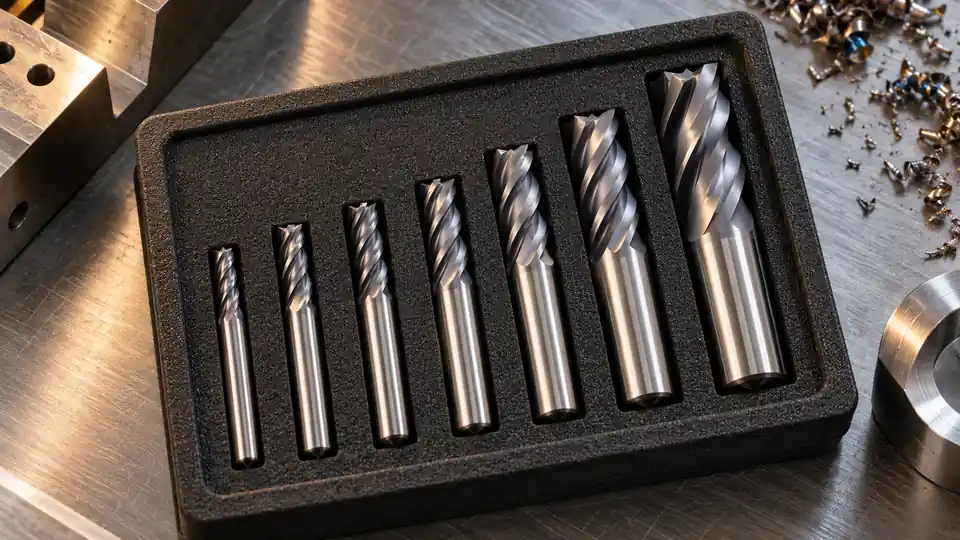
Choosing a carbide end mill set starts with the workpiece and the machine, not the number of cutters in the box. A set aimed at steel may be a poor match for aluminum, while a metric assortment can leave an inch-based CNC setup short of the size you need. Flute count, tool diameter, shank diameter, coating, and cutting geometry all shape the decision, especially where collet size and machine rigidity limit your options.
The products below cover several distinct uses. Four-flute square end mills dominate the steel and general-purpose selections, while the three-flute ZrN-coated set is specifically identified for aluminum and copper. There is also a ball nose set for curved or contoured work and an indexable shoulder mill with replaceable APKT1003 inserts. The main mistake is treating carbide, coating, or a larger set count as a guarantee of performance. Check the stated material, dimensions, and collet requirements first.
For the broadest inch-size range and a clear general-purpose specification, the 6-piece AlTiN-coated solid carbide set is the strongest overall starting point. Buyers focused on steel may prefer the sisona TISIN-coated set, while aluminum machinists have a much more specific fit in the three-flute ZrN option. Your priorities may be range, metric sizing, hardened-steel suitability, contouring, or replaceable inserts, so the rankings reflect those differences.
Quick Answer
- Best Overall: 6Pcs 1/8″ – 1/2″ 4 Flute Solid Carbide Square End Mill Set for its six inch sizes, 30-degree helix, AlTiN coating, and stated use across several medium-hard materials.
- Best for Aluminum: 6Pcs 3 Flute Solid Carbide Square End Mills Set because the listing specifically identifies aluminum and copper applications.
- Best for Steel: sisona 1/8″ to 3/8″ Solid Carbide End Mill Set with TiN coating and documented steel applications.
- Best Ball Nose Option: sisona Carbide Ball Nose End Mill Set for curved or contoured cutting work where a rounded nose is required.
Best Carbide End Mill Sets Comparison Table
| Product | Best For | Diameter Range | Flutes | Coating | Material Compatibility |
|---|---|---|---|---|---|
| sisona Solid Carbide Set | Steel-focused CNC work | 1/8″ to 3/8″ | 4 | TiN | Carbon, alloy, hardened steel, cast iron |
| Home of Quality Tools 6-Piece Set | Hard-material inch work | 1/8″ to 1/2″ | 4 | TiAlN | Listed for HRC 45 applications |
| CNC Metric 8-Piece Set | Metric CNC work | 2 mm to 12 mm | 4 | Not specified | Metal processing and CNC work |
| Home of Quality Tools 1/2-Inch Set | Repeated 1/2-inch work | 1/2″ | 4 | AlTiN | Alloy and hardened steel, cast iron |
| 6-Piece AlTiN Solid Carbide Set | General-purpose inch milling | 1/8″ to 1/2″ | 4 | AlTiN | Stainless, alloy, carbon steel, cast iron |
| Tanomate Indexable Shoulder Set | Square shoulder milling | 3/8″ to 5/8″ cutters | Insert-based | PVD inserts | Not specifically limited in listing |
| sisona Ball Nose Set | Contoured steel work | 1/16″ to 3/8″ | 4 | TiN | Carbon, alloy, hardened steel, cast iron |
| 6-Piece ZrN Aluminum Set | Aluminum and copper | 1/8″ to 1/2″ | 3 | ZrN | Aluminum and other non-ferrous materials |
| 5-Piece Wide-Range AlTiN Set | Larger inch cutters | 1/4″ to 3/4″ | 4 | AlTiN | Alloy steel and general CNC work |
The detailed reviews below separate square, ball nose, metric, indexable, and material-specific options so you can match the cutter to the job rather than the package count.
1. sisona 1/8″ to 3/8″ Solid Carbide End Mill Set – Best for Steel
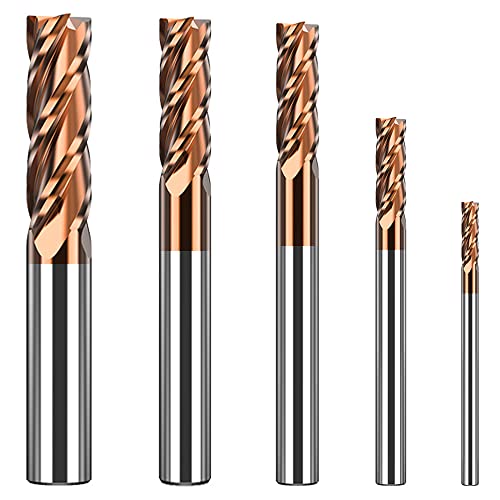
Steel is the clearest target for this sisona set. The listing identifies carbon steel, alloy steel, hardened steel, and cast iron, giving this group a more defined material brief than a generic end mill assortment. Its five diameters run from 1/8 inch through 3/8 inch, so a CNC user can move between smaller detail work and broader passes without changing to metric tooling.
Each cutter is described as solid tungsten carbide with a TiN surface and four flutes. Cutting lengths range from 3/8 inch to 1 inch, while overall lengths run from 1-1/2 inches to 2-1/2 inches. Those changing dimensions matter at the collet and workpiece because the correct cutter still needs adequate clearance. The listing also says the set works with desktop and industrial CNC machines when the collet size matches, so compatibility must be checked before purchase.
Pros
- Five documented inch diameters from 1/8 inch to 3/8 inch.
- Solid tungsten carbide construction is specified.
- TiN surface is identified on the cutters.
- Four-flute geometry suits the stated steel-focused application.
- Steel and cast iron applications are listed.
Cons
- The set stops at 3/8 inch, so it does not cover 1/2-inch or larger work.
- Correct collet sizing remains the buyer’s responsibility.
This is a sensible match for a CNC owner whose routine work centers on steel and who wants several inch sizes in one box. Buyers machining aluminum or needing metric diameters should look elsewhere, since those applications are not the focus of the listing. The range is useful, but the smaller maximum diameter limits it for broad pocketing work.
To buy this product, click here.
2. Home of Quality Tools 6-Piece Carbide Square End Mill Set – Best for HRC 45 Work

This six-piece set covers the familiar inch progression from 1/8 inch to 1/2 inch, which gives it a useful edge over sets that end at 3/8 inch. The listing identifies four flutes, micro-grain carbide, and a TiAlN coating. It also describes the cutters for hard materials and gives an HRC 45 designation, making the set relevant to buyers working within that stated hardness range.
The chamfered design is presented as an installation aid, with a rounded, smooth handle intended to make tool changes easier. That detail is modest, but it matters during a day of switching between six diameters. The product data does not provide individual cutting lengths or overall lengths, so buyers with tight fixturing or deep-reach requirements should verify those dimensions before ordering.
Pros
- Six inch sizes include the useful 1/2-inch diameter.
- Four-flute square end mill configuration is documented.
- Micro-grain carbide construction is identified.
- TiAlN coating is specified.
- The listing identifies HRC 45 applications.
Cons
- Individual cutting and overall lengths are not supplied in the product information.
- The listing does not identify a specific machine or collet system.
This set fits buyers who need a broad inch assortment and want the listing’s HRC 45 positioning. It is less suitable for a purchase where exact reach dimensions or a material-specific geometry, such as aluminum-focused flute design, is central. Compare its six sizes with the more application-specific sets before choosing.
To buy this product, click here.
3. CNC Metric 8-Piece Carbide End Mill Set – Best Metric Range

A metric machine setup needs metric cutters, and this eight-piece collection keeps the sizes straightforward: 2, 3, 4, 5, 6, 8, 10, and 12 mm. The four-flute tungsten steel carbide cutters are described for metal processing, CNC machining, and engineering use. That span gives a small CNC operator more diameter steps than most of the inch sets here, especially at the 2 mm to 6 mm end.
The listing highlights a large core diameter, a negative forefoot design, and a large chip flute design. These are presented as choices intended to balance edge strength, rigidity, and chip removal, though no cutting data or test results are supplied. The set has straight shanks, but the product information does not state a universal shank diameter or machine compatibility, so the collet and holder must be confirmed against the exact cutter.
Pros
- Eight documented metric diameters from 2 mm to 12 mm.
- Four-flute geometry is specified.
- Carbide tungsten steel construction is identified.
- Large-core design is documented in the listing.
- Intended uses include metal processing and CNC machining.
Cons
- The listing does not identify a coating.
- Exact shank dimensions and machine compatibility are not clearly supplied.
This is the natural pick for a metric CNC workflow that needs many common diameters in one set. Inch-based users will find the sizes less convenient, and buyers who require a documented coating should choose a different option. The range is the attraction here, not a specialized material claim.
To buy this product, click here.
4. Home of Quality Tools 1/2-Inch Carbide End Mill Set – Best Repeated 1/2-Inch Option
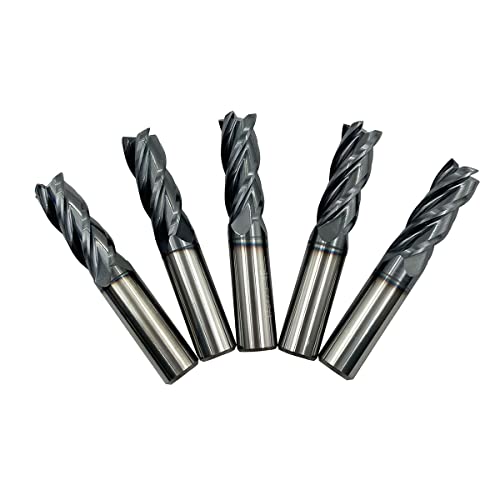
This set takes a narrower approach than a mixed-diameter assortment. It includes five 1/2-inch square end mills, all described as four-flute micro-grain carbide cutters with AlTiN coating. That format makes sense for a shop that repeatedly uses the same diameter and wants several matching cutters available rather than a drawer filled with sizes that rarely see action.
The listed application range includes carbon steel, alloy steel, pre-hardened steel up to HRC 45, hardened steel from HRC 40 to 45, and cast iron. The set is also identified for shallow slotting, profile milling, and finish machining. Those are meaningful application cues, but the product data does not provide cutting lengths, overall lengths, or machine-specific compatibility, so the 1/2-inch shank and reach should be checked carefully.
Pros
- Five matching 1/2-inch cutters are included.
- Micro-grain carbide construction is specified.
- AlTiN coating is documented.
- Four-flute geometry is identified.
- HRC 40 to 45 steel applications are listed.
Cons
- There is no diameter variety within the set.
- Length and exact shank specifications are not provided in the product data.
Choose this format for repeat 1/2-inch work where spare cutters are more useful than variety. A buyer building a first end mill collection will get more flexibility from a mixed-size set, while a production-minded user may appreciate the identical-tool format. Verify the holder before relying on the stated diameter.
To buy this product, click here.
5. 6-Piece 1/8″ to 1/2″ Solid Carbide Square End Mill Set – Best Overall

This is the most balanced set in the group for a buyer who wants a broad inch range without moving into a specialized cutter profile. It includes 1/8, 3/16, 1/4, 5/16, 3/8, and 1/2-inch diameters. Every cutter is listed as solid carbide with four flutes, a 30-degree helix, and an AlTiN coating, giving the set a well-defined geometry rather than a vague “multi-purpose” label.
Cutting lengths run from 1/2 inch to 1-1/4 inches, and overall lengths extend from 1-1/2 inches to 3 inches. Shank diameters match the stated cutting diameters in the supplied specifications. The listed applications include stainless steel, alloy steel, carbon steel, and cast iron, described as materials of medium hardness. That material range and size spread make this the easiest general recommendation, though aluminum-specific buyers should choose the three-flute set instead.
Pros
- Six sizes cover 1/8 inch through 1/2 inch.
- Solid carbide construction is clearly identified.
- Four flutes and a 30-degree helix are specified.
- AlTiN coating is documented.
- Stated applications include stainless steel, alloy steel, carbon steel, and cast iron.
Cons
- The listing describes medium-hard materials rather than a broad universal material range.
- Its four-flute geometry is less specifically targeted to aluminum than the three-flute option.
This set suits a CNC owner building a practical inch-based assortment for steel and cast iron work. It may be excessive for someone who uses only one diameter, and it is not the first pick for aluminum-focused machining. The combination of documented dimensions, coating, helix, and material range gives it the clearest all-around profile in this roundup.
To buy this product, click here.
6. Tanomate 1/2-Inch Shank Indexable Carbide End Mill Set – Best Indexable Shoulder Option
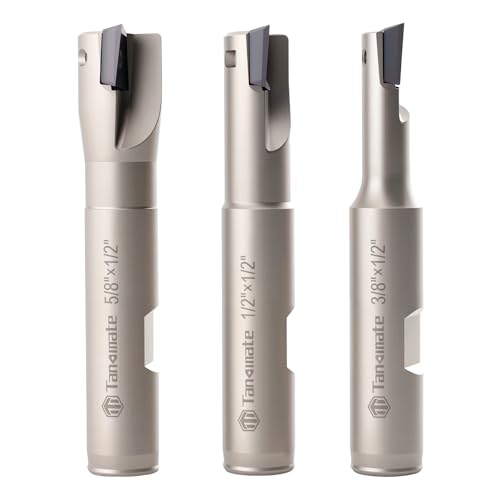
This Tanomate set is fundamentally different from the solid end mills above. It uses a 1/2-inch shank toolholder with pre-installed APKT1003 carbide inserts and offers three cutter sizes: 3/8 by 1/2 inch, 1/2 by 1/2 inch, and 5/8 by 1/2 inch. The 90-degree square shoulder description points toward shoulder milling rather than a general collection of solid square cutters.
Four PVD-coated inserts arrive installed, and the holder is nickel plated according to the listing. Replacement inserts are identified as available separately, while an aluminum protective case is included for storage and transport. Buyers must pay close attention to insert designation and holder requirements here. This is an insert-based system, so it should be selected for the documented APKT1003 format rather than treated as a universal substitute for solid carbide end mills.
Pros
- Three documented cutter sizes are included.
- Uses a 1/2-inch shank toolholder.
- Four APKT1003 carbide inserts are pre-installed.
- PVD-coated inserts are specified.
- An aluminum storage case is included.
Cons
- It is not a conventional solid carbide end mill assortment.
- Insert and holder compatibility must be checked carefully before purchase.
This option belongs on the shortlist for square shoulder milling and buyers who prefer replaceable inserts. It is a poor match for someone seeking a drawer of solid carbide cutters in small diameters. The central trade-off is clear: insert replacement can change the maintenance routine, but the system depends on the APKT1003 format and the supplied holder.
To buy this product, click here.
7. sisona Carbide Ball Nose End Mill Set – Best Ball Nose Option

A ball nose profile changes the job entirely. Instead of the flat end of a square cutter, this five-piece sisona set uses rounded noses in 1/16, 1/8, 3/16, 1/4, and 3/8-inch sizes. That makes the assortment relevant to contoured surfaces, rounded transitions, and three-dimensional toolpaths where a square end mill is the wrong shape.
The cutters are described as solid tungsten carbide, four flutes, and TiN coated. Cutting lengths range from 3/8 inch to 1 inch, with overall lengths from 1-1/2 inches to 2-1/2 inches. The listing identifies carbon steel, alloy steel, hardened steel, and cast iron, and says the bits can be used with desktop or industrial CNC machines when the collet is correctly matched. The supplied information does not establish a universal machine fit, so the shank details deserve a careful check.
Pros
- Five ball nose diameters range from 1/16 inch to 3/8 inch.
- Solid tungsten carbide construction is stated.
- Four-flute geometry is documented.
- TiN coating is specified.
- Steel and cast iron applications are listed.
Cons
- Ball nose cutters are specialized and cannot replace flat end mills for every operation.
- Correct collet sizing is required for the stated machine compatibility.
This is the right shape for a buyer working with contours rather than ordinary flat pockets and slots. A general-purpose CNC setup should pair it with square end mills instead of using it as the only set. Its small 1/16-inch cutter adds detail capability, but the narrow profile range means it is an application tool, not a universal assortment.
To buy this product, click here.
8. 6-Piece 3-Flute ZrN-Coated Solid Carbide End Mill Set – Best for Aluminum

Among these sets, this one has the most specific material brief. It is identified for aluminum, copper, and other non-ferrous materials, and it uses three flutes with a 37-degree helix. The six diameters run from 1/8 inch to 1/2 inch, giving an aluminum-focused CNC user a useful spread without switching to metric sizes.
The cutters are solid carbide and ZrN coated. Cutting lengths range from 1/2 inch to 1-1/4 inches, while overall lengths run from 1-1/2 inches to 3 inches. The listing also supplies matching shank diameters from 1/8 inch to 1/2 inch. A three-flute design offers a different balance of cutting edges and flute space than the four-flute sets, which is precisely why this product should be judged as a material-specific alternative rather than another generic assortment.
Pros
- Aluminum and copper applications are explicitly identified.
- Six sizes cover 1/8 inch through 1/2 inch.
- Three-flute geometry is documented.
- 37-degree helix is specified.
- Solid carbide and ZrN coating are both listed.
Cons
- Its material focus is narrower than the general-purpose steel sets.
- The listing does not provide operating speeds or feed rates.
Aluminum and copper users should start here before looking at four-flute steel-oriented sets. Buyers mainly cutting cast iron or hardened steel may prefer a different material specification. As with every rotating cutter, the published geometry does not replace machine-specific setup data, so operating parameters must come from the appropriate tool and machine guidance.
To buy this product, click here.
9. 5-Piece 1/4″ to 3/4″ AlTiN Carbide End Mill Set – Best for Larger Inch Cutters

This set shifts the size range upward, with 1/4, 3/8, 1/2, 5/8, and 3/4-inch cutters. That makes it distinct from the smaller assortments and useful for a buyer whose work routinely calls for broader inch diameters. The listing describes four-flute carbide end mills with AlTiN coating for side milling, end milling, CNC machining centers, engraving machines, and other high-speed machine tools.
Each cutter is packed in a separate plastic box, a practical storage detail when larger tools are being moved between a cabinet and machine. The product data identifies alloy steel as a material application, but it does not provide cutting lengths, overall lengths, helix angle, or specific holder requirements. Those omissions matter more as cutter diameter increases, so confirm the dimensions and machine fit before purchase.
Pros
- Includes larger 5/8-inch and 3/4-inch diameters.
- Four-flute geometry is identified.
- AlTiN coating is specified.
- Alloy steel application is listed.
- Each cutter has separate plastic storage.
Cons
- It does not include the smaller 1/8-inch or 3/16-inch sizes.
- Cutting length, overall length, and helix information are not supplied.
This set suits a machine setup that already handles larger cutters and needs diameters through 3/4 inch. It is less useful as a first all-purpose collection because the small sizes are absent. The separate cases are handy, but diameter and holder compatibility should drive the purchase rather than storage convenience.
To buy this product, click here.
Buying Guide
Match the End Mill to the Workpiece
Material is the first filter. The sisona steel set lists carbon, alloy, hardened steel, and cast iron, while the three-flute ZrN set specifically names aluminum, copper, and other non-ferrous materials. A general label such as carbide does not erase those distinctions. Start with the workpiece you actually machine most often, then compare geometry and coating within that group.
Choose Square or Ball Nose Geometry
Square end mills are the conventional choice among these products for flat-bottomed slots, pockets, profiles, and shoulder work. The sisona ball nose set serves a different purpose with rounded cutting ends and sizes down to 1/16 inch. A ball nose cutter should be selected for a contouring requirement, not because its rounded profile appears more versatile.
Compare Flute Count and Helix
Most of the steel-oriented products here use four flutes. The aluminum-focused set uses three flutes and a 37-degree helix, while the general-purpose AlTiN set lists a 30-degree helix. Flute count and helix affect the cutter’s geometry and chip-space balance, but the product data does not provide feed or speed recommendations. Use the documented geometry as a selection clue, not as a substitute for machine-specific cutting data.
Before choosing a set, use how flute count changes chip clearance to relate its two-, three-, or four-flute tools to the work.
Check Diameter, Shank, and Reach
A 1/2-inch cutting diameter does not by itself guarantee that a tool fits your collet or holder. The sisona set calls for the correct-sized collet, and the aluminum set lists shank diameters matching its cutting diameters. Cutting length and overall length also change across several sets. Compare those dimensions with the workpiece, fixture, and available clearance before ordering.
Understand Coating Differences
The roundup includes TiN, TiAlN, AlTiN, and ZrN coatings. These labels identify different surface treatments, but the supplied product information does not establish a universal performance ranking among them. Treat coating as one part of the specification. The material application, flute arrangement, diameter, and machine compatibility deserve equal attention.
Solid End Mills Versus Indexable Cutters
Most selections are solid carbide end mill sets. The Tanomate product instead uses a 1/2-inch shank holder and APKT1003 carbide inserts. That means insert designation and holder compatibility become central. It belongs in a different buying category from a drawer of small solid cutters, even though both products are described as carbide milling tools.
Best Carbide End Mill Sets FAQ
What size carbide end mill set should I buy?
Choose a range that matches your machine’s collets and the diameters used in your work. The 6-piece AlTiN set covers 1/8 inch through 1/2 inch, while the wide-range set runs from 1/4 inch through 3/4 inch. Metric users may prefer the 2 mm to 12 mm assortment rather than converting between measurement systems.
Are four-flute end mills suitable for every material?
No. Four-flute cutters appear throughout the steel-oriented selections, but the aluminum-specific set uses three flutes and is explicitly identified for aluminum and copper. Flute count should be considered alongside the stated material, helix, coating, and machine setup.
Which set is best for aluminum?
The 6-piece ZrN-coated set is the clearest fit because its listing specifically identifies aluminum, copper, and other non-ferrous materials. It also provides three flutes, a 37-degree helix, and sizes from 1/8 inch to 1/2 inch. The product information does not supply cutting speeds or feeds.
Can I use a ball nose end mill as a regular square end mill?
A ball nose cutter has a rounded cutting end and is intended for contoured or three-dimensional work. It is not a direct substitute for a square end mill where a flat-bottomed pocket or square shoulder is required. The sisona ball nose set should therefore supplement, rather than replace, a conventional square set.
What does HRC 45 mean in these listings?
HRC 45 is a hardness reference used in the descriptions of several Home of Quality Tools sets. The listings identify applications involving pre-hardened or hardened steels within stated ranges. Buyers should match the actual workpiece hardness to the documented application and avoid treating the label as universal permission for every hardened material.
Does a carbide end mill fit any CNC machine?
No. Collet or holder size, shank diameter, machine type, and available clearance all matter. The sisona listing specifically instructs buyers to select the correct-sized collet, and the other sets provide different diameter and shank details. Confirm the exact machine interface before purchase.
What is the difference between solid carbide and an indexable carbide end mill?
A solid carbide end mill is one cutter with an integrated cutting body. The Tanomate indexable set uses a toolholder with replaceable APKT1003 inserts. The indexable system requires matching insert and holder details, while a solid cutter is replaced as a complete tool when its cutting edges are no longer usable.
Final Verdict
The 6-piece 1/8-inch to 1/2-inch AlTiN solid carbide set is the strongest overall recommendation because its listing supplies a broad inch range, four-flute geometry, 30-degree helix, AlTiN coating, cutting lengths, overall lengths, and applications covering stainless steel, alloy steel, carbon steel, and cast iron. It gives a buyer more useful selection information than a bare size assortment while remaining focused on conventional square end milling.
Different jobs call for different picks. The sisona steel set is better aligned with a steel-focused CNC workflow, the ZrN three-flute set is the clearest aluminum and copper option, and the metric eight-piece set makes sense for metric tooling. Choose the ball nose set for contoured work, the larger AlTiN assortment for 5/8-inch and 3/4-inch cutters, or the Tanomate system when an indexable shoulder cutter fits the machine and APKT1003 insert format. Always verify the collet, shank, reach, and documented material application before cutting.
